5 Ways AI Is Actually Making Hiring Slower - And What HR Leaders Can Do About It in 2026 - AI Doom Loop
Average time-to-hire has climbed to 44 days in 2026, up from 31 days just two years ago. That's not despite AI adoption in recruiting — it's partly because of it.
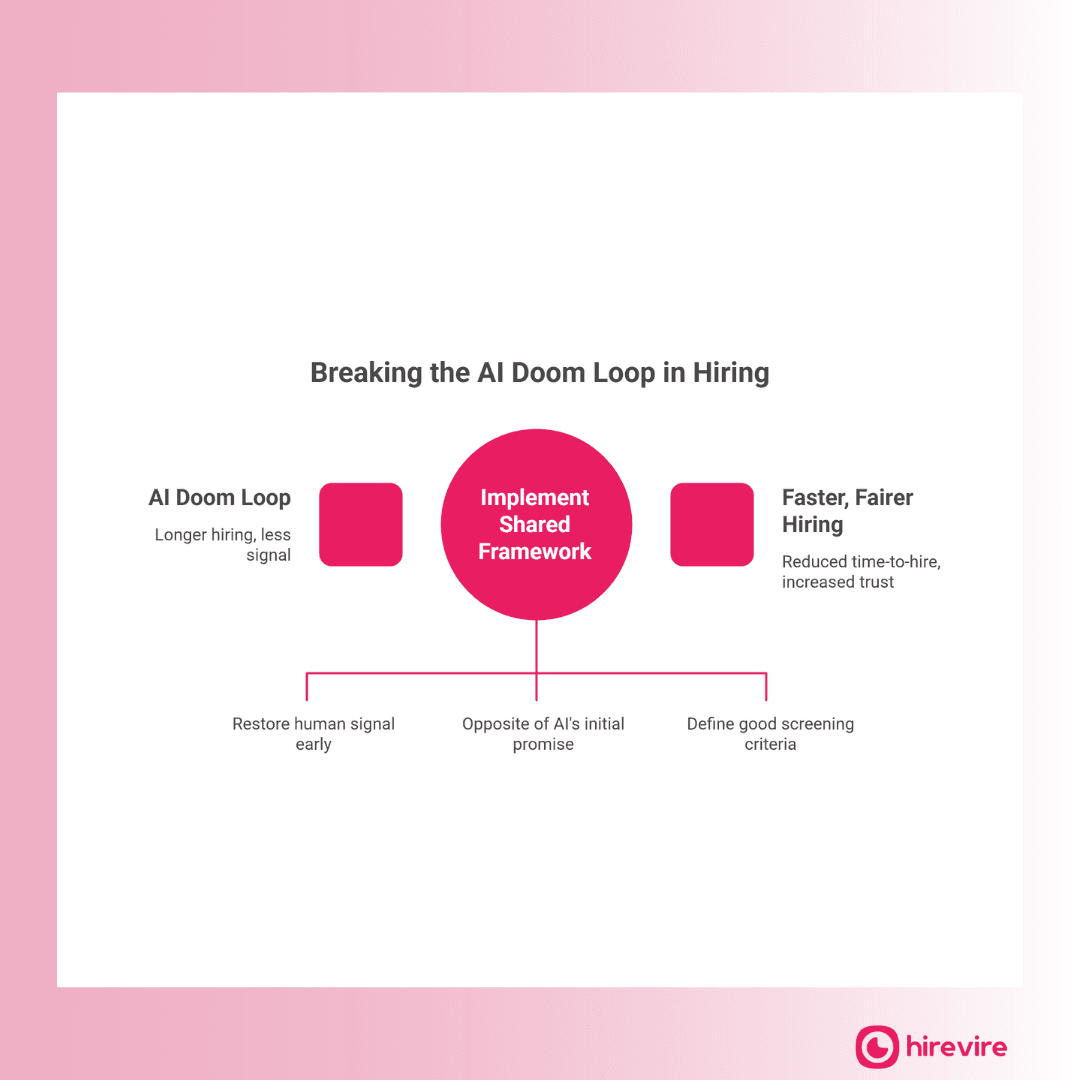
The pattern is now well-documented. Companies deployed AI to speed up screening. Candidates responded by using AI to submit more applications. Recruiters added AI filters to handle the volume. The result: more applications, more friction, longer processes, and less signal. The Greenhouse CEO named it the "AI doom loop", and the term has entered mainstream HR vocabulary because it describes something real.
This article breaks down the five specific mechanisms that are making AI-powered hiring slower, not faster — along with practical guidance for hiring teams that want results rather than technology for its own sake.
Key Takeaways:
- Time-to-hire has increased by 42% in two years, reaching 44 days, despite widespread AI adoption in recruiting
- Only 8% of job seekers consider AI screening fair, creating trust breakdowns that extend hiring cycles
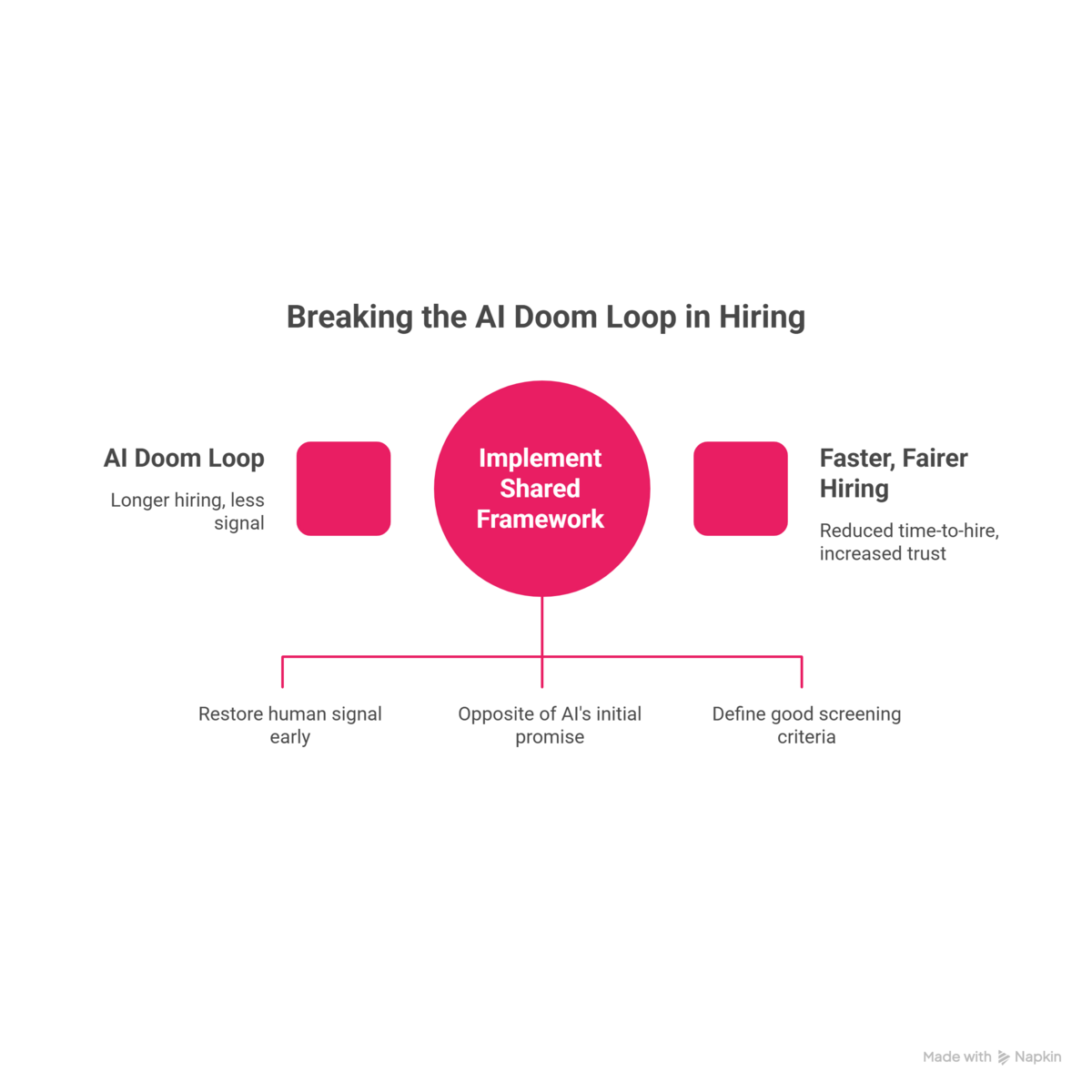
- Companies are deliberately adding friction back into applications — the opposite of what AI promised
- Async video screening tools like Hirevire restore human signal to early-stage evaluation without adding recruiter workload
Why the AI Doom Loop Matters Right Now
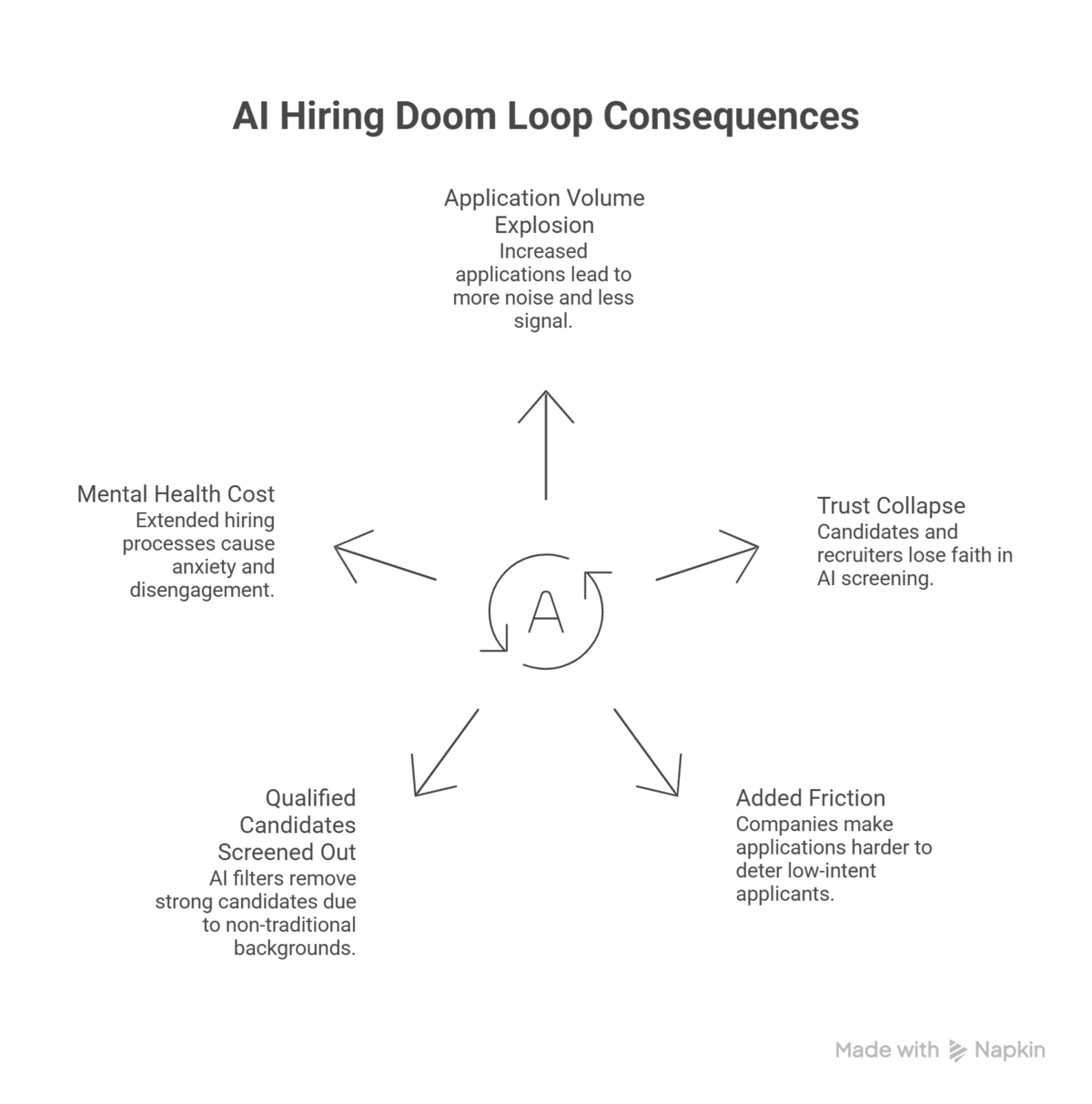
The doom loop is not a niche problem for a few companies that implemented AI poorly. It is the default outcome when AI is deployed on both sides of the hiring transaction without a shared framework for what good screening actually looks like.
CNN Business reported in December 2025 that the AI hiring experience is making companies and job seekers miserable across the board — not just at enterprise scale but at mid-market companies that adopted AI tools precisely because they lacked the resources to manage high application volumes manually.
Fortune documented that trust is at an all-time low for both sides of the market. Recruiters don't trust that AI-filtered candidates are actually the best ones. Candidates don't trust that AI filters are evaluating them fairly. And both perceptions are correct.
What makes this particularly hard to solve is that each side's behavior is rational given the other's. Candidates mass-apply because they know AI filters reject resumes algorithmically, so volume is a hedge. Companies add more AI filtering because volume is too high to review manually. The loop becomes self-reinforcing because fixing it requires one side to change behavior while the other does not — and neither side has reason to move first.
The five mechanisms below explain why the loop forms, why it persists, and what the specific cost is for hiring teams at each stage.
Way 1: The Application Volume Explosion Creates More Noise, Not Less Signal
LinkedIn now sees over 11,000 applications per minute, a 45% year-over-year increase. That volume did not exist before AI made it trivially easy for candidates to tailor and submit applications at scale.
The problem is that volume and quality are not correlated. When candidates can submit 50 applications with minimal effort, they will — regardless of fit. Hiring teams then receive applicant pools where a significant portion of submissions are low-intent or poorly matched, filtered through AI cover letters and resume optimization tools that make every application look surface-level qualified.
The practical consequence: recruiters spend more time screening a larger pool to find the same number of genuinely strong candidates they would have found in a smaller, higher-intent pool. The efficiency gain that AI screening was supposed to provide gets consumed by the volume increase AI applications enabled.
For small and mid-sized companies, this creates a specific problem. They cannot absorb the volume the way large enterprises can with dedicated sourcing teams. They end up in a situation where their AI ATS filter is working overtime on an inflated pool, producing results that still require substantial human review.
The signal-to-noise ratio has inverted. More applications means more work, not less — unless hiring teams fundamentally rethink what early-stage screening is measuring.
For recruitment agencies, the volume problem is compounded. They handle multiple client searches simultaneously, and inflated applicant pools across all of them create resource strain that no amount of incremental AI tooling resolves. The efficiency argument for AI in recruiting assumed that higher-quality filtering would reduce downstream effort. The data shows the opposite is happening.
Way 2: The Trust Collapse Extends Every Stage of the Process
Only 8% of job seekers say AI screening is fair, according to Greenhouse's AI Trust Crisis research. And 42% of candidates who have lost trust in the hiring process directly attribute that loss to AI.
When candidates do not trust the process, several things happen that slow hiring down. First, offer acceptance rates drop. Candidates who feel filtered by algorithms rather than evaluated by humans are less invested in the outcome, more likely to continue pursuing other opportunities, and more likely to decline offers or ghost late-stage interactions. Second, employer brand suffers. Word travels quickly about companies perceived to use opaque AI screening — particularly in professional communities on LinkedIn, Reddit, and industry-specific forums. Third, the pipeline to offer stage becomes longer because more candidates are needed at the top of the funnel to produce the same yield at the bottom.
The Harvard Business Review noted in January 2026 that AI has made hiring worse in its current configuration — but that the failure is a design failure, not a technology failure. The tools can help, but only when deployed in ways that preserve candidate trust rather than eroding it.
The trust deficit has a direct time cost: every stage of the process is now slower because candidate commitment is lower.
Way 3: Companies Are Adding Friction Back In — Intentionally
SHRM reported that a growing number of employers are deliberately making applications harder to complete. Longer application forms, mandatory skills tests before screening calls, additional in-person rounds — all of it introduced specifically to filter out candidates using AI to mass-apply.
This is the loop closing on itself. AI applications caused volume problems, so companies responded by adding friction designed to deter low-intent applicants. But friction does not discriminate between low-intent candidates and qualified candidates who have limited time. A demanding application process drives away strong passive candidates who have jobs and options, while doing little to stop determined applicants using AI tools sophisticated enough to complete multi-step applications.
The net effect: hiring processes that were supposed to become more efficient through automation are now longer and more demanding than they were before AI was introduced. Companies are paying the cost of a problem they are not actually solving.
For recruiting teams, the uncomfortable question is whether the friction they've added is actually filtering for genuine commitment or simply filtering for people with the most time to invest in applications — which is not necessarily the same population as the most qualified candidates.
Way 4: Qualified Candidates Are Being Screened Out by AI Recommendations
35% of companies reject candidates based on AI recommendations alone, according to Greenhouse's research. Only 26% require human oversight for every rejection at the screening stage.
This creates a specific and costly problem: the candidates most likely to succeed in roles are not always the candidates most legible to AI screening systems. Career changers, non-traditional backgrounds, and candidates from underrepresented groups are systematically disadvantaged by pattern-matching algorithms trained on historical hiring data.
The consequences extend beyond individual rejections. Companies that screen out qualified candidates at the AI stage then spend additional weeks searching for candidates who fit a narrower profile. Hiring cycles lengthen, not because good candidates aren't available, but because AI filters removed them from the pool before a human ever had a chance to evaluate them.
SHRM has documented that recruitment processes built on automation and algorithms are failing to identify the people they are supposed to find. The design assumption — that better filtering produces better candidates — is not holding up in practice.
The practical implication for hiring teams: AI filtering is a blunt instrument when used without human oversight checkpoints. Building mandatory human review into the process at specific stages is not optional for quality-conscious teams — it's what the data supports.
Growing companies in the 50-200 employee range feel this acutely. They often have one or two recruiters managing full hiring cycles, and those recruiters lack the bandwidth to manually review every AI rejection. The result is that false negatives — strong candidates incorrectly removed by AI filters — pass undetected. Those candidates either accept offers elsewhere or stop applying altogether. The cost of a single false negative, when measured against replacement hiring costs and productivity gaps, can dwarf the cost of implementing a basic human oversight protocol.
Way 5: The Mental Health Cost Is Damaging Pipelines and Employer Brand
72% of job seekers report negative mental health impacts from extended hiring processes, according to data cited by Fortune. Long, opaque, algorithm-driven processes create anxiety, uncertainty, and disengagement — particularly when candidates receive no feedback and cannot tell whether their application was reviewed by a person at all.
The employer brand consequence is direct: candidates who have poor experiences talk about them. They post on Glassdoor, mention companies by name in Reddit's r/humanresources and r/recruiting communities, and warn professional contacts away from applying. Negative employer brand doesn't just affect future candidate pipelines — it affects current employees, who are more likely to leave organizations perceived as treating candidates poorly.
The business cost compounds. Companies that damage their employer brand through opaque AI hiring face higher future recruiting costs, longer time-to-fill, and increased reliance on the same AI systems that created the problem. The loop does not just slow hiring in the short term — it makes every future hiring cycle more expensive.
For HR leaders thinking about candidate experience as a soft metric, the data suggests it should be a hard financial one. The pipeline damage from poor candidate experience has measurable cost consequences that extend well beyond the individual role being filled.
There's also a talent market dynamic at play. In competitive hiring markets — technology, healthcare, professional services — the strongest candidates have multiple options and short decision windows. A slow, opaque, algorithmically-driven process does not just discourage weak candidates. It specifically disadvantages companies competing for the best people, who can afford to disengage when a process feels dehumanizing. The companies treating candidate experience as a strategic priority are quietly building better pipelines while their competitors manage the fallout from poor employer brand.
How Hirevire Helps You Break the Doom Loop
As AI makes early-stage screening noisier and less trustworthy, hiring teams need a tool that puts human signal back into the process — without adding recruiter workload.
Hirevire addresses the doom loop directly by replacing the algorithm-vs-algorithm dynamic with something AI cannot replicate: a candidate's actual communication, personality, and thinking, captured on their own time.
Async video screening. Candidates record video, audio, or text responses to structured questions when it suits them — no scheduling required. Recruiters watch responses at their own pace, sharing links with hiring managers for collaborative evaluation. The result is a consistent, comparable screening layer that carries genuine human signal rather than resume pattern-matching.
No candidate login required. Hirevire's no-login experience removes a common friction point that causes candidate drop-off. In a market where 42% of candidates abandon slow application processes, reducing unnecessary friction on the candidate side while maintaining meaningful screening is a competitive advantage.
Multi-format response options. Candidates can respond via video, audio, or text depending on their preference. This increases completion rates and gives recruiters richer, more varied signal than a resume scan produces.
Transparent evaluation. Every screening interaction is reviewable, shareable, and auditable. There's no black-box algorithm making pass/fail calls — just structured responses that humans evaluate. For companies concerned about candidate trust and employer brand, that transparency is a meaningful differentiator.
Try Hirevire free and see how your team can add human signal at scale without adding scheduling overhead.
Action Steps: How to Break the Doom Loop
Step 1: Audit What Your AI Is Actually Filtering For
Before adding or modifying AI screening, document what signals the current system uses and what outcomes it's producing. Are rejection rates for AI-screened candidates higher or lower than human-screened ones? What percentage of AI-rejected candidates would your recruiters have advanced? If you don't know, you can't optimize.
Step 2: Add Human Checkpoints Before AI Rejections
Implement a policy requiring human review before any AI rejection reaches a candidate. Even a brief recruiter review of borderline cases catches the false negatives that make AI screening costly. This doesn't eliminate AI assistance — it adds accountability that protects quality and employer brand.
Step 3: Replace Synchronous Phone Screens with Async Video
Phone screens are the scheduling bottleneck that inflates time-to-hire most directly. Hirevire allows candidates to record structured responses at their convenience, and recruiters to evaluate those responses asynchronously. For a team doing 50+ screens per week, this shift alone can recover 10-15 hours of recruiter time.
Step 4: Communicate Process Clearly to All Applicants
One of the primary drivers of candidate trust loss is opacity. Candidates don't know if anyone saw their application, how decisions are made, or when they'll hear back. A simple automated update at each stage — even just "your application is under review" — measurably improves candidate experience without adding recruiter workload.
Step 5: Measure Quality of Hire, Not Just Speed
If the only metric your team tracks is time-to-fill, you're optimizing for speed without accountability for outcomes. Adding 90-day retention rate, hiring manager satisfaction, and performance review scores to your recruiting metrics creates a feedback loop that identifies where in the process AI assistance is helping versus hurting.
A practical starting point: compare the 90-day performance of candidates who entered through different screening channels. Candidates who completed async video screens before advancing often show stronger initial performance scores — the structured format gives hiring managers more consistent signal to evaluate. Tracking this data over two or three hiring cycles gives recruiting teams the evidence they need to make the case for process changes to leadership.
Frequently Asked Questions
What is the AI doom loop in hiring?
The AI doom loop refers to the self-reinforcing cycle where candidates use AI tools to mass-apply for jobs, companies deploy AI filters to manage the volume, and both sides end up worse off: hiring takes longer, trust erodes, and fewer qualified candidates actually make it through. The term was popularized by Greenhouse CEO Daniel Chait and is now widely used in talent acquisition discussions.
Why is time-to-hire increasing if AI is being adopted in recruiting?
AI adoption has increased application volume dramatically without a corresponding increase in application quality. More applications means more screening work, not less. Additionally, companies have added friction to counter AI-generated applications, extending processes further. The 44-day average time-to-hire reflects both increased volume and the friction responses it has triggered.
Is AI screening actually fair to candidates?
According to Greenhouse research, only 8% of job seekers consider AI screening fair. The concern is legitimate: AI systems trained on historical hiring data can perpetuate past biases, and pattern-matching algorithms often disadvantage non-traditional backgrounds. Fairness in AI screening requires human oversight, transparent evaluation criteria, and regular bias auditing.
How can small businesses compete when AI screening is designed for enterprise scale?
Small businesses should be cautious about over-investing in enterprise AI screening tools built for high-volume environments. Async video platforms like Hirevire offer structured screening at SMB-friendly pricing (starting at $39/month) that adds human signal without requiring a large recruiting team. The competitive advantage for smaller teams is the ability to move faster and communicate more personally than large companies.
What can hiring teams do to restore candidate trust?
Three changes that measurably improve candidate trust: communicate proactively at each process stage so candidates know where they stand; ensure human review happens before any rejection; and use screening tools that give candidates a chance to show who they are, not just pattern-match their resume. Async video screening does all three.
How does async video screening differ from AI screening?
AI screening filters on resume signals: keywords, education, experience. Async video screening captures a candidate's actual communication ability, thought process, and personality in response to structured questions. Recruiters evaluate those responses directly. There's no algorithm making the call — a human watches and decides. That's fundamentally different from black-box filtering, and it produces different (and often better) signal.
Will the AI doom loop get worse before it gets better?
Based on current adoption trajectories, application volume will continue increasing as AI tools become more accessible. The loop is likely to intensify unless companies actively redesign their screening processes to prioritize human signal over pattern-matching. Organizations that make that shift now will have a hiring advantage within 12-24 months as their competitors continue struggling with inflated, low-quality pipelines.
What to Watch Next
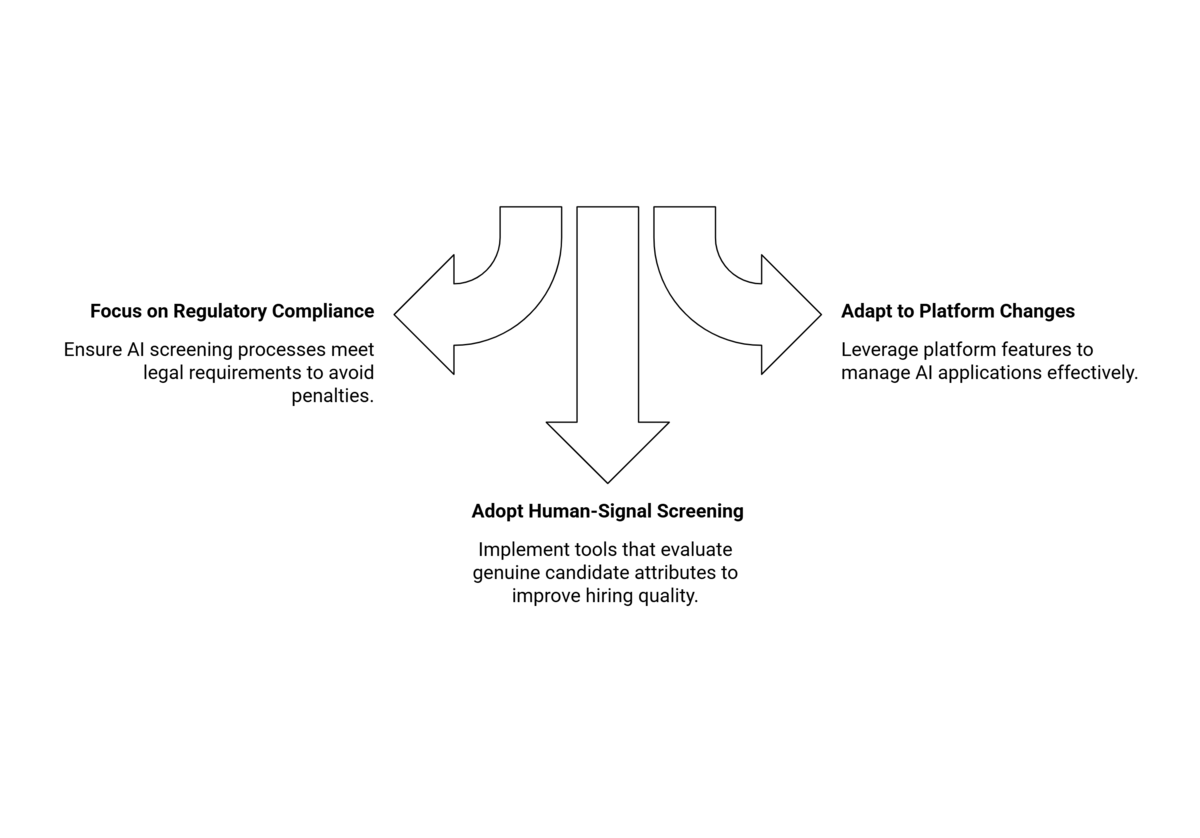
Three developments worth tracking closely:
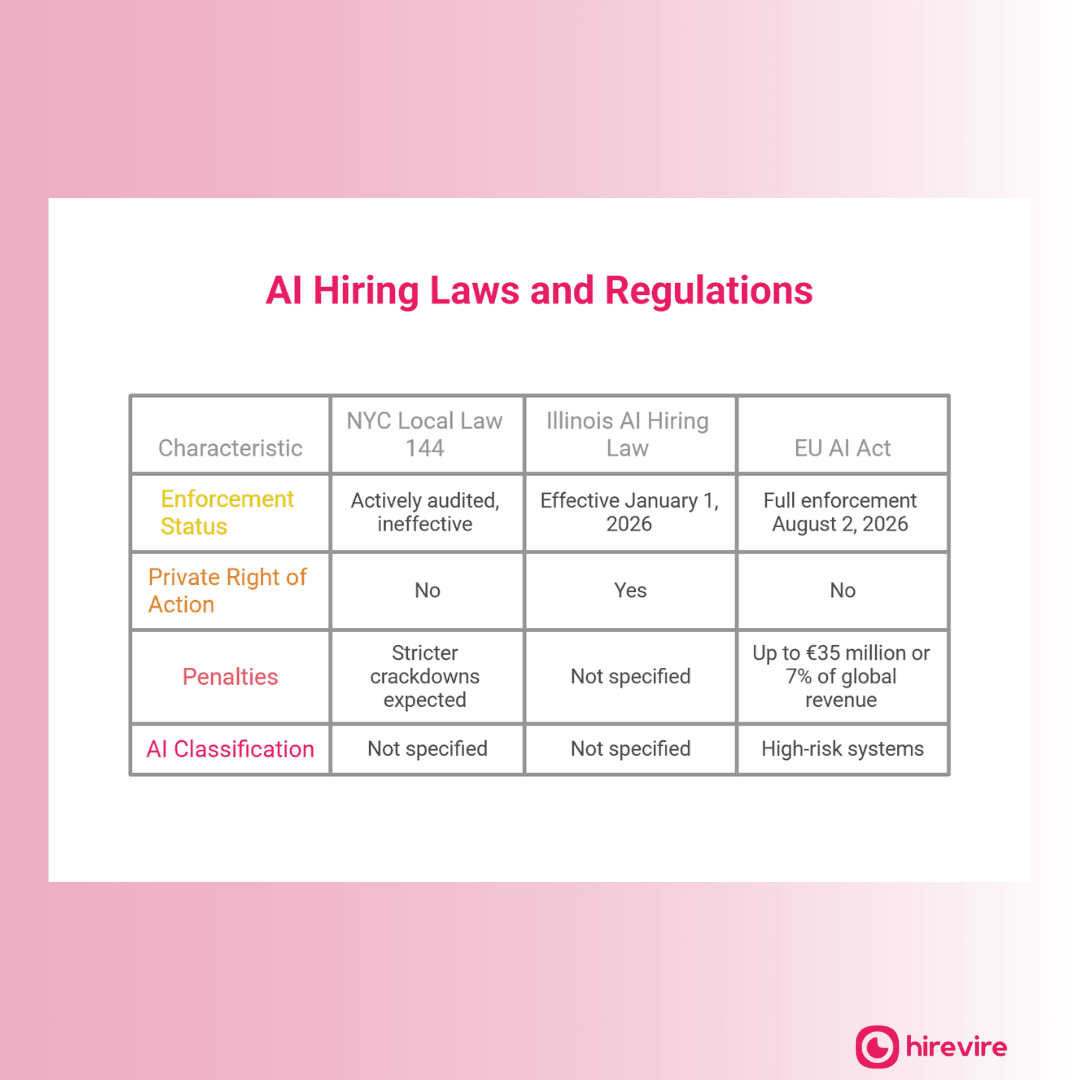
Regulatory response to AI screening. As AI hiring laws proliferate across U.S. states and the EU AI Act takes effect in August 2026, companies face mounting requirements to demonstrate transparency and human oversight in AI-assisted hiring decisions. The regulatory landscape will reshape what's legally permissible in AI screening, not just what's strategically wise.
Platform-level responses to mass AI applications. LinkedIn, Indeed, and other job boards are actively developing features to identify and de-prioritize AI-generated applications. Platform-level intervention could shift application dynamics more rapidly than individual company policy changes.
Emergence of human-signal screening as a category. The market will increasingly distinguish between AI screening (pattern-matching at volume) and human-signal screening (structured evaluation of genuine candidate attributes). Tools built for the latter — async video, structured interviews, work samples — will likely see accelerating adoption as the doom loop's costs become undeniable.
The organizations that navigate this transition most successfully will be those that used this period to build processes that scale human judgment, rather than replace it.
Conclusion
The 44-day time-to-hire isn't a technology failure — it's a design failure. AI was deployed to solve a volume problem, and it solved that problem while creating three new ones: inflated application pools, collapsed candidate trust, and processes that screen out qualified people while letting through well-optimized applications from poor-fit candidates.
Breaking the loop requires reintroducing human signal at the screening stage, not adding more automation to compensate for automation that isn't working. The companies that understand this now are the ones that will spend less time and money on hiring twelve months from now.
Hirevire gives hiring teams the human-signal layer that AI screening lacks: async video responses that show who candidates actually are, evaluated by recruiters on their own schedule. It's not more AI — it's the antidote to the doom loop.