Compliant AI Hiring in 2026: What the Ohio, NYC, and Illinois Laws Actually Require (and How to Screen Candidates)
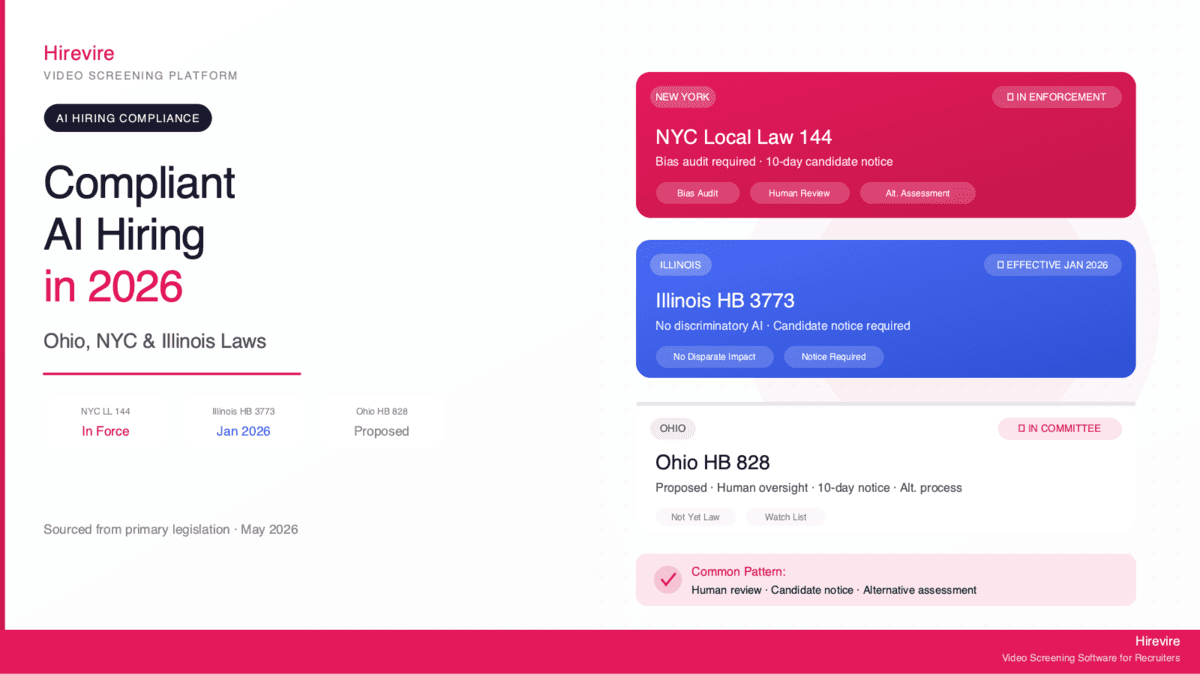
Two jurisdictions already regulate AI in hiring with real penalties, and a third is trying to. New York City has enforced Local Law 144 since July 2023. Illinois added a second AI employment statute on January 1, 2026. Ohio's House Bill 828 has been sitting in committee since May. If you use HireVue, Paradox, Harver or anything else that scores candidates, these laws apply to you now. A tool that only records answers for a human to review mostly sits outside them. The line between the two is below.
| Law | Status | Who it covers | What it demands | Penalty |
|---|---|---|---|---|
| NYC Local Law 144 | In force since July 5, 2023 | Employers evaluating candidates or employees located in NYC | Independent bias audit, published results, 10 business days' notice, an alternative process on request | Civil penalties via DCWP |
| Illinois AI Video Interview Act | In force since January 1, 2020 | Illinois employers using AI to analyze recorded video interviews | Notice, explanation, consent before recording, deletion within 30 days of a request | Enforcement through state remedies |
| Illinois HB 3773 | In force since January 1, 2026 | Illinois employers | No discriminatory outcomes from AI, no zip-code proxies, notice to employees | Illinois Human Rights Commission remedies |
| Ohio HB 828 | Proposed; in House committee since May 13, 2026 | Ohio employers, if enacted | Human review, 10 days' written notice, alternative evaluation on request | Not yet set |
Everything below comes from the statutes and the legislative records. Where a law is ambiguous, the ambiguity is flagged.
What counts as an automated employment decision tool
Every one of these laws starts from the same idea: a computational process that spits out a score, a rank, a classification or a recommendation, and that output shapes an employment decision.
NYC's definition is the one most lawyers quote. An AEDT is "any computational process, derived from machine learning, statistical modeling, data analytics, or artificial intelligence, that issues simplified output, including a score, classification, or recommendation, that is used to substantially assist or replace discretionary decision-making for employment decisions."
The operative words are "substantially assist or replace." A tool that hands a recruiter a ranked shortlist qualifies. A tool that stores video answers for a recruiter to watch does not. Ohio copied this language almost word for word. Illinois HB 3773 never defines the term; it regulates the outcome instead.
That definitional gap is the whole game when you pick and configure a tool, and it gets its own section below.
New York City Local Law 144
Enacted November 10, 2021. Effective January 1, 2023. Enforced by the Department of Consumer and Worker Protection since July 5, 2023. It applies to any employer or employment agency using an AEDT to evaluate candidates or employees who are located in New York City, wherever the employer sits.
Two duties. First, a bias audit by an independent third party before the tool is used, testing for disparate impact by race, ethnicity and sex, with the results and the audit date published on your website for at least six months. Second, notice: candidates and employees who live in NYC get at least 10 business days' warning that an AEDT will be used, what it assesses, and how to ask for an alternative process or an accommodation.
What it leaves alone: resume parsing that does not rank, scheduling software, and tools that support a human decision without producing a score.
Enforcement has been thin. The NYC Comptroller audited DCWP's work in December 2025 and found little active monitoring and few penalties relative to the number of employers that probably use AEDTs. Treat the audit as a warning. Agencies that get told they have failed to enforce tend to start enforcing.
Illinois has two laws, and they cover different tools
The AI Video Interview Act (820 ILCS 42)
Enacted August 9, 2019, effective January 1, 2020, amended January 1, 2022. It is narrow: it applies when you ask an applicant to record a video interview and use AI to analyze the recording.
If that is you, before the interview you must tell the applicant AI may analyze it, explain how the AI works and what it evaluates, and get consent. You may share the video only with people whose expertise or technology is needed to evaluate the applicant. You must delete it within 30 days of a request. Since 2022, employers who rely solely on the AI analysis to decide who gets an in-person interview also have to collect and report demographic data on who advanced and who did not.
It does not touch text scoring, test scoring or any AI tool that never looks at a video.
HB 3773, the Human Rights Act amendment
Signed August 9, 2024, effective January 1, 2026. This is the broad one. It makes it a civil rights violation to use AI in recruitment, hiring, promotion, discipline, discharge or terms of employment in a way that has the effect of discriminating on a protected basis. Intent is irrelevant. Zip codes cannot be used as a proxy for a protected class. Employers using covered AI must notify employees.
The Department of Human Rights published draft notice rules in late 2025 and was expected to finalize them before the effective date. Complaints go through the Illinois Human Rights Commission, with the usual remedies.
Ohio House Bill 828, still a bill
Introduced April 21, 2026 by Rep. Ismail Mohamed (D-Columbus) and Rep. Veronica Sims (D-Akron). Referred to the House Commerce and Labor Committee on May 13, 2026. No hearing, vote or amendment recorded as of September 22, 2026.
If it passes, employers, employment agencies and staffing firms could not use an AEDT as the sole basis for an employment decision; a person would have to check the output. Written notice at least 10 days before use. An alternative evaluation on request. The definition tracks NYC's.
You owe Ohio nothing under this bill today. It stays in this article because the structure copies NYC's; if it moves, the compliance work is already familiar.
What the three enacted laws agree on
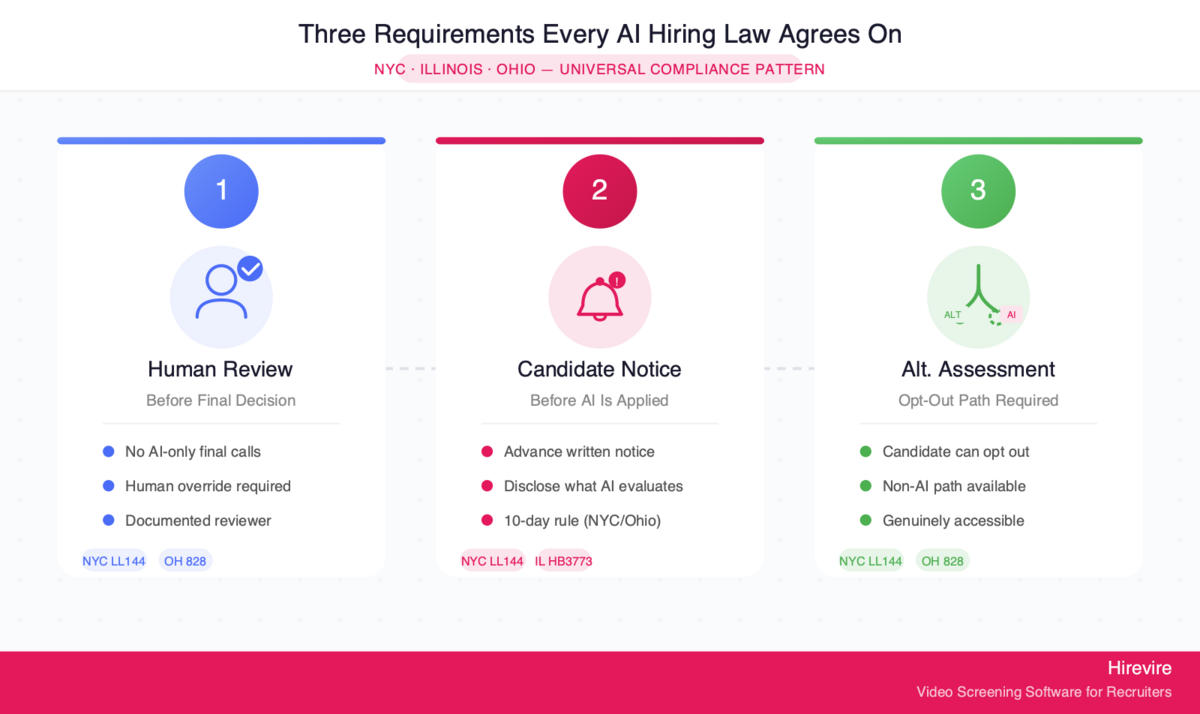
Strip away the differences in scope and mechanism and the same three requirements sit underneath.
Human review before a final decision. None of the laws ban AI in hiring. They ban letting AI make the call unsupervised. NYC targets tools that "substantially assist or replace" discretion; Illinois targets discriminatory outcomes. Both assume a reviewer who can override the machine.
Notice before the AI is applied. Ten business days in NYC, consent before recording in Illinois, timing still being fixed under HB 3773. The principle is the same everywhere: a candidate gets to know a machine is evaluating them.
An alternative for people who ask. NYC requires one. Ohio's bill requires one. The Illinois video law creates one by requiring consent, which can be refused. HB 3773 never uses the word "alternative." Liability for discriminatory outcomes pushes employers toward a path they can defend anyway.
So any AI-assisted screening program that touches these states needs a documented route around the AI.
What an alternative assessment looks like, and where Hirevire sits
The laws require an alternative and say almost nothing about its shape. The working consensus, from the legislative records and the guidance law firms have published, is that it must not use the regulated tool and must give the candidate a fair chance to show they can do the job.
Async video screening with a human reviewer meets that test. The candidate answers structured questions on video; a recruiter or hiring manager watches and judges. No algorithm scores anyone.
That is a different category from HireVue's video analysis or Harver's situational judgment scoring, where the score is the product. The line the laws draw runs through whether a computational process produces a score or recommendation that substantially assists the decision. Video by itself never crosses it.
Hirevire can sit on either side of that line, so be precise about which side a given role is on.
By default it collects video, audio, text and file answers and shows them to your reviewers. Nobody is scored. Run this way, it does not meet the AEDT definition in NYC, Illinois or the Ohio bill, and it works as the alternative assessment those laws want you to offer.
Hirevire also sells AI Scorecards, which score answers (and since August 2026, resumes) against criteria you write. Scoring is off until you switch it on for a workspace. When it is on, the Data Processing Agreement says the output is advisory and display-only: it "does not sort, filter, hide or reject candidates," and you stay responsible for human review and for telling candidates. Good design. It still leaves the employer inside the law once a score is shown to a reviewer. A score a recruiter reads before deciding can "substantially assist" that decision under LL 144, and AI reading a recorded interview is exactly what the Illinois video law regulates. If scoring is on for candidates in these states, treat the role as in scope. Give the notice, get consent in Illinois, keep the human review documented, and offer the unscored version as the alternative.
One more thing people miss. Hirevire's auto-disqualification is a rule you write against must-have criteria such as work authorization or a required licence. It involves no machine learning, so it falls outside the AEDT definitions as drafted. It does reject people automatically. Tell candidates the criteria exist and keep a way for someone to ask a human.
Compliance checklist
This checklist is informational. Employment counsel for your jurisdiction has the final word.
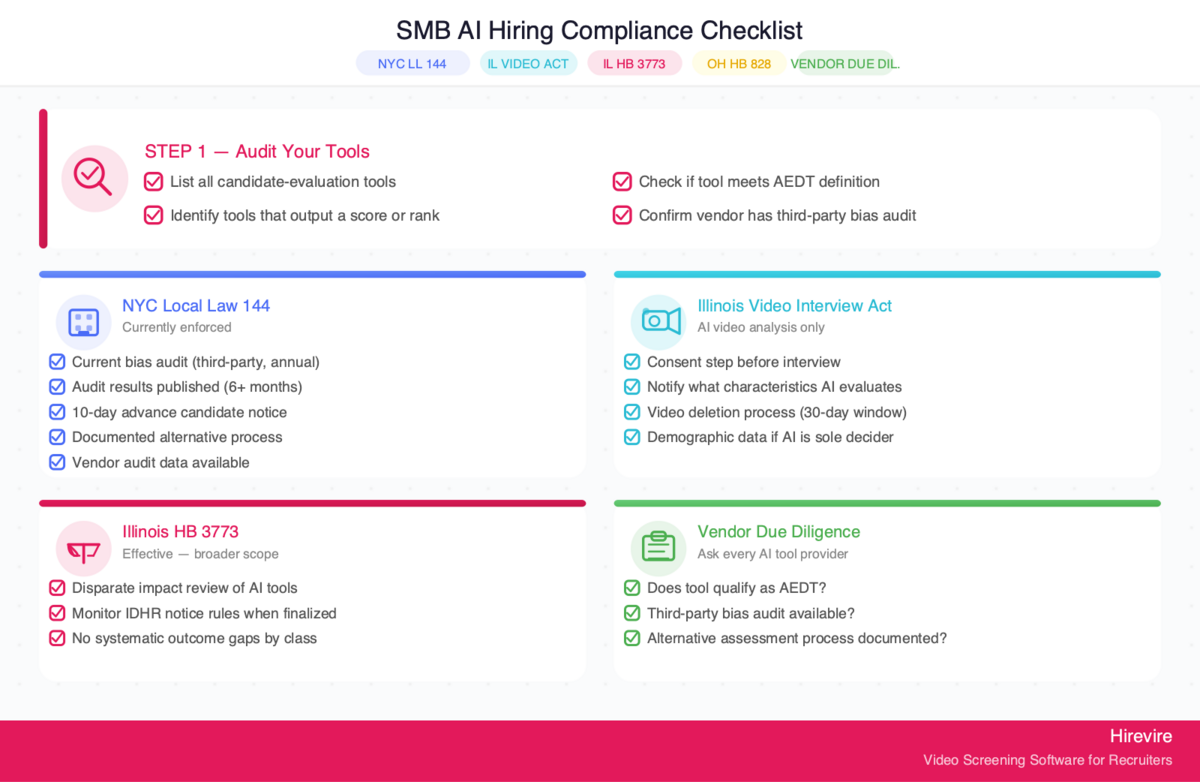
Audit your tools
- [ ] List every tool that touches candidate evaluation
- [ ] Mark the ones that produce a score, rank or recommendation, including optional scoring features that are switched on
- [ ] Check each against the NYC definition
- [ ] For each AEDT, get the vendor's third-party bias audit and results
NYC hiring (LL 144)
- [ ] Bias audit dated within the past year, with results published
- [ ] Results on your website for at least six months
- [ ] A 10-business-day notice process for every candidate the AEDT evaluates
- [ ] A documented alternative process
- [ ] Confirmation that the vendor can supply audit data or runs its own audit
Illinois hiring (Video Interview Act)
- [ ] Consent step before any AI-analyzed video interview
- [ ] Notice that explains what the AI evaluates
- [ ] A deletion request process with a 30-day window
- [ ] Demographic data collection if AI alone decides who advances
Illinois hiring (HB 3773)
- [ ] Disparate impact review of every AI used in a covered decision
- [ ] The Department of Human Rights notice rules, once final
- [ ] Evidence that outcomes do not differ by protected class
Ohio hiring (HB 828, nothing required yet)
- [ ] Watch the 136th General Assembly; the bill has not moved since May 13, 2026
- [ ] If it passes: human review, 10-day notice, alternative assessment
Questions to put to any vendor
- [ ] Does your tool meet the AEDT definition under NYC Local Law 144?
- [ ] Have you had a third-party bias audit? When? Can we see it?
- [ ] What demographic data do you give us for disparate impact review?
- [ ] What happens when a candidate asks for an alternative assessment?
- [ ] How do you handle deletion requests?
- [ ] What notice text do you provide?
- [ ] Can scoring be switched off per role, and does the score ever sort or reject on its own?
How Hirevire fits a compliant process
The laws leave room for technology that helps a person decide and regulate technology that decides on its own. That is the distinction Hirevire is built around.
With AI Scorecards off, it collects video, audio, text and file answers and puts them in front of human reviewers. No score ranks anyone and no recommendation advances or rejects anyone. Under the NYC, Illinois and Ohio definitions that is not an AEDT, so the bias audit, advance notice and alternative assessment duties do not attach.
With AI Scorecards on, the score is against criteria you wrote, and the contract makes it display-only. You can run scored roles in one state and unscored roles in another. The Timeline log on every application records who moved a candidate and when, which is the human-review evidence these laws ask for.
If you use a scored tool elsewhere in your funnel and need an alternative for candidates who opt out, a Hirevire role with scoring off is that alternative: same structured questions, reviewed by a person. Candidates do not create accounts or install anything, so completion stays high, and you can show the alternative was real.
Pricing starts at $39 a month billed annually, and AI Scorecards are included whether you use them or not. Try it free.
Frequently asked questions
Does my company need to comply with NYC Local Law 144 if we are not based in New York?
Yes, if you use an AEDT to evaluate candidates or employees located in New York City. The law follows the location of the candidate. A Dallas company that opens a role to NYC residents and screens them with AI is covered for those candidates.
What counts as an "automated employment decision tool" under these laws?
Under NYC's definition, a tool that uses machine learning, statistical modeling, data analytics or AI, produces a simplified output such as a score, classification or recommendation, and is used to substantially assist or replace discretionary decision-making in hiring. Resume parsing that does not rank, ATS platforms that store applications, and scheduling tools are generally out. Tools that rank candidates, predict fit or classify by likelihood of hire are in.
Is Ohio's proposed HB 828 a law I need to comply with now?
No. As of September 2026 it sits in the House Commerce and Labor Committee, where it was referred on May 13, 2026, with no further action. Ohio employers owe nothing under it today. If it passes, expect NYC's framework.
Does asking candidates to record a video interview trigger Illinois law?
Only if AI analyzes the recording. A recruiter watching the video and forming their own view does not trigger the Act. An AI system scoring word choice, vocal patterns or expressions does, and then you need notice and consent first. Treat an optional scoring feature such as Hirevire's AI Scorecards as covered the moment it is switched on for Illinois candidates.
Does Hirevire's AI Scorecard make it an AEDT?
Only when scoring is on; it is off by default. With scoring on, the score is advisory and display-only under Hirevire's DPA and never sorts, filters, hides or rejects anyone. A recruiter can still read it before deciding, and a score that substantially assists a decision meets NYC's definition. Treat a scored role as in scope: notice, Illinois consent, documented human review, and the unscored version as the alternative.
What is the risk of getting this wrong?
NYC's DCWP can impose civil penalties. Illinois HB 3773 complaints run through the Human Rights Commission, with back pay, reinstatement and damages on the table. The bigger exposure is disparate impact litigation under existing federal law: a paper trail of AI outputs that screened out protected-class candidates is evidence, whether or not a local AI statute applies.
Do these laws apply to promotion decisions, or only to initial hiring?
NYC LL 144 covers promotion, demotion and reassignment as well as hiring. HB 3773 covers promotion, renewal, training selection, discharge and discipline. The Illinois video law covers video interviews in the application process only.
What should I tell candidates about AI use in our hiring process?
That AI may evaluate their application, what it assesses, and how to request an alternative. NYC wants written notice 10 business days ahead. Illinois HB 3773's timing depends on the final rules. If a candidate asks a question about your AI that you cannot answer, your vendor has not given you enough.
What to watch
The Illinois Department of Human Rights notice rules under HB 3773 will settle timing and format. If you hire in Illinois, watch for the final text.
Ohio HB 828 has not moved since May. If it reaches a floor vote the lead time will be short, so anyone using scored tools in Ohio should have the NYC playbook ready.
Federally, the EEOC pulled its AI hiring technical assistance in January 2025. Title VII's disparate impact standard still applies. New federal guidance is unlikely. The states will keep filling the gap.
The short version: tools that score or classify candidates bring audits and notices with them; tools that record answers for a person to judge do not. Use AI where it saves you time without scoring people, keep any scoring you do switch on advisory and disclosed, and make sure a human makes the call. Hirevire lets you choose that role by role.
This article is informational and does not constitute legal advice. Consult employment counsel for guidance specific to your jurisdiction and tool configuration.