Knockout Questions in Hiring: How to Auto-Disqualify Without Losing Good Candidates
A knockout question is a mandatory application question with one acceptable answer. Candidates who answer otherwise are automatically disqualified before a human ever reviews their application.
Used correctly, they save hours of recruiter time every week. Used poorly, they quietly eliminate some of the best candidates in your pipeline while passing through others who learned to game the system.
The divide between "used correctly" and "used poorly" is narrower than most people think, and the consequences of getting it wrong - missed hires, legal exposure, application abandonment - are real.
This guide covers what knockout questions are, where they work reliably, where they fail quietly, the legal risk most teams overlook, and the combined screening approach that handles both cases without losing good candidates.
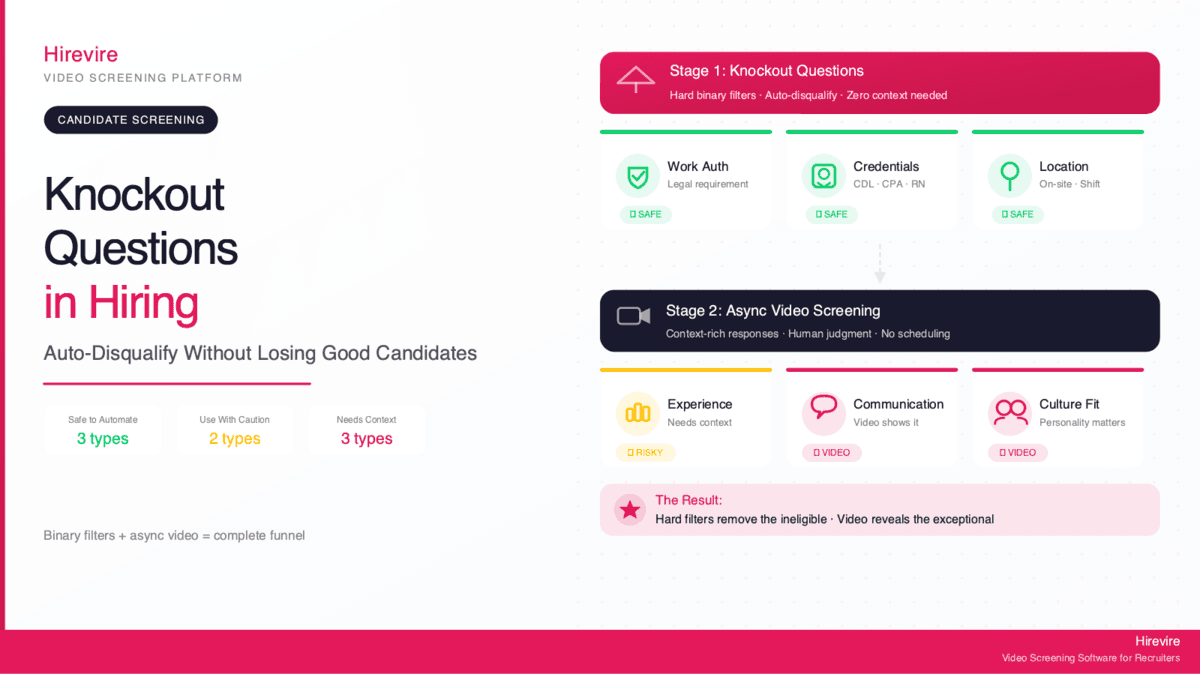
Quick Summary: Knockout questions work best for hard, binary, non-negotiable requirements: work authorization, specific licenses, logistical non-starters. They create measurable risk when applied to years of experience, salary expectations, or soft skills. The most effective funnels pair knockout questions for hard filters with async video pre-screening for everything that needs context.
What Is a Knockout Question?
A knockout question is a structured application question designed to disqualify candidates who do not meet a specific, non-negotiable requirement. The format is typically yes/no, though some applicant tracking systems support dropdown or multi-select variants.
The mechanics are straightforward: a candidate answers the question as part of their application. If their answer matches the disqualifying response, they are automatically moved to a rejected or archived status without a recruiter reviewing the rest of their materials.
Where knockout questions sit in the funnel: Knockout questions appear in the application form itself, before any human review step. They operate upstream of resume screening, upstream of phone calls, upstream of everything. A candidate can have a flawless resume and years of directly relevant experience - if they answer a knockout question wrong, none of that matters.
How they work in practice: An employer posts a role with a legal requirement for a specific license. The application form asks: "Do you hold a valid CDL Class A license?" Any applicant who answers "no" is automatically disqualified. No resume review. No phone screen. No second look.
What triggers the disqualification: Most ATS platforms handle this automatically. The employer sets the question, marks one answer as disqualifying, and the system routes non-matching applicants to a rejected pool. Some systems send an immediate rejection email; others hold candidates in a pending state until the recruiter manually processes them.
According to SHRM, the average corporate job opening receives 250 applications. For roles with clear hard requirements, knockout questions reduce the time spent reviewing applications that never had a chance of advancing. That efficiency gain is real - but only when the filter is genuinely non-negotiable.
The Key Distinction: Binary vs. Contextual
Every knockout question implicitly claims that its filter is binary: there is a right answer and a wrong answer, and the wrong answer means the candidate cannot do the job.
That claim holds for some requirements. It does not hold for most.
Work authorization is binary. You either have the legal right to work in a jurisdiction or you do not. A CDL license is binary. A security clearance is binary. Whether you have "at least 5 years of experience" is not binary - it is a rough proxy for readiness, and a proxy with significant error rates in both directions.
The difference between these two categories is where most teams go wrong with knockout questions.
Key Takeaways
| Use Case | Knockout Question? | Better Alternative |
|---|---|---|
| Work authorization | Yes | - |
| Required license/certification | Yes | - |
| Location/region eligibility | Yes | - |
| Years of experience | Risky | Async video + scorecard |
| Salary expectations | Risky | Open-ended question |
| Soft skills / culture fit | No | Async video |
| Communication ability | No | Async video |
| Problem-solving approach | No | Async video + work sample |
When Knockout Questions Work
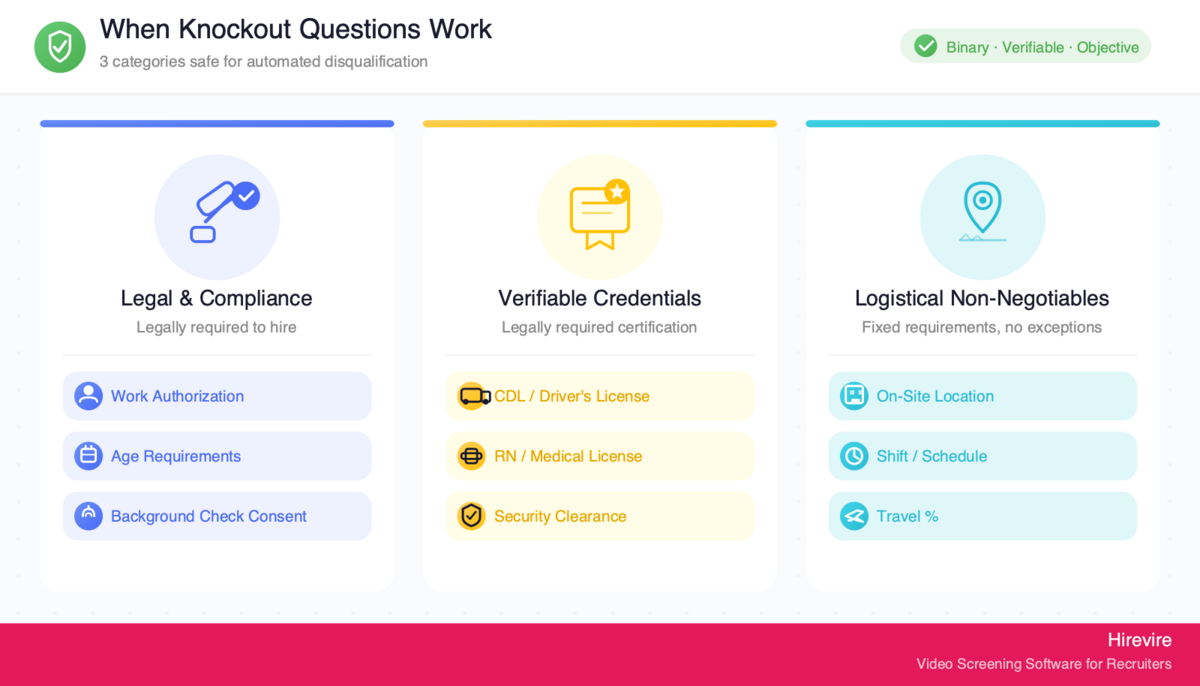
Three categories of requirements are genuinely safe for automated disqualification.
Legal and Compliance Requirements
Requirements with legal teeth are the clearest case for knockout questions. If a candidate cannot legally perform the job or legally work in your jurisdiction, no amount of other qualifications changes that.
Work authorization: "Are you authorized to work in the United States without sponsorship?" is a standard knockout question for employers who cannot or choose not to sponsor work visas. The answer is binary. A candidate who is not authorized to work cannot be hired, full stop.
Age requirements for regulated roles: Some industries have age requirements backed by law. Security roles, alcohol service, certain financial positions, and jobs involving hazardous materials may have minimum age requirements that are legally non-negotiable. These are appropriate for knockout filters.
Background check willingness: For roles that legally require clear background checks (childcare, healthcare, security clearance positions), "Are you willing to undergo a background check as a condition of employment?" is a reasonable knockout question. Note that this is different from asking about past convictions, which carries its own legal complexity.
Why these are safe to automate: Each of these requirements is objective, verifiable, and legally meaningful. No context changes the binary outcome. No amount of soft-skill excellence makes a candidate eligible if they fail a hard legal requirement.
Verifiable Credentials
Professional credentials that are required to legally perform a role - not just preferred credentials - are appropriate knockout filters.
Commercial driver's license (CDL): For driving roles that legally require CDL certification, this is a genuine binary requirement. An applicant without a valid CDL cannot legally operate the relevant vehicles.
Professional certifications: A CPA credential for roles that legally require a licensed accountant, an RN license for roles that require a registered nurse, a bar admission for roles requiring a licensed attorney. When the credential is legally required to perform the work, it is an appropriate knockout filter.
Security clearance: For roles in defense or government contracting where clearance is mandatory, this is a legitimate binary requirement. However, be specific: ask about the exact clearance level required, not clearance in general.
Language proficiency for translation roles: If the role legally requires certification or demonstrated fluency in a specific language (court interpretation, for example), this can function as a knockout filter.
Why verifiable credentials work: They are externally validated, objective, and either present or absent. There is no gray zone.
Logistical Non-Negotiables
Physical and logistical requirements that are genuinely fixed - not merely preferred - belong in this category.
Location and on-site availability: "This role requires working on-site at our [City] office five days per week. Are you able to commute to or relocate to [City]?" If the role truly cannot be performed remotely and you cannot support relocation assistance, this is a real binary filter.
Shift and schedule requirements: Overnight shift, weekend availability, 24/7 on-call - if these are genuinely non-negotiable and verified through the rest of the hiring process, they can function as knockout filters.
Travel percentage: If the role requires 60% travel and that number is real and fixed, a knockout question can filter candidates who cannot meet it.
The caveat on logistical filters: These filters only hold if the stated requirement is genuinely firm. If your "five days on-site" rule has exceptions, if candidates who express hesitation about travel percentage routinely get hired anyway, or if your start date requirements regularly flex, then the knockout question is filtering on something that is not actually non-negotiable - which creates both legal exposure and missed hires.
When Knockout Questions Backfire
This section is where knockout questions cause the most damage. The problems here are often invisible: you never see the candidates you lost, so you cannot measure the cost.
Years of Experience
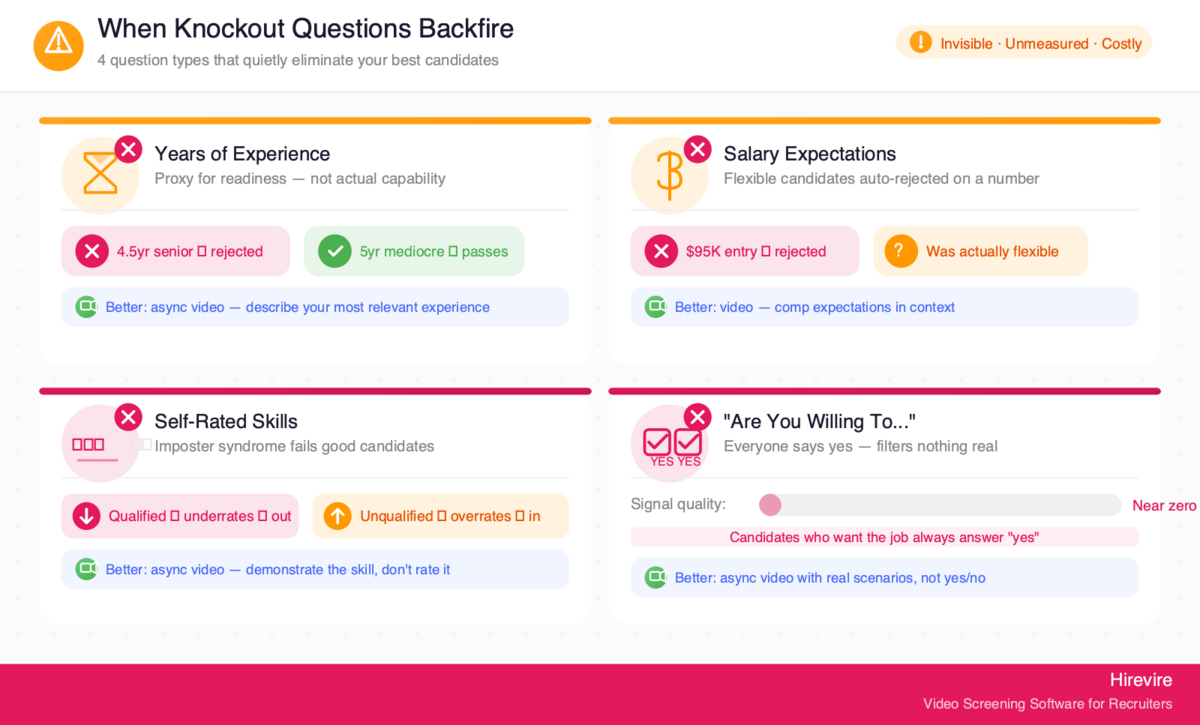
"Do you have at least 5 years of experience in [field]?" is probably the most commonly used and most commonly problematic knockout question.
The intent is to filter for readiness. The execution is blunt. A candidate with 4.5 years of senior-level work and a track record of delivering above their title gets auto-rejected. A candidate with exactly 5 years of mediocre, siloed experience moves through.
The year-count is a proxy for capability, and it is a poor one. Context matters enormously: industry, company size, role complexity, rate of growth. None of that context fits into a yes/no question.
The real cost: For roles where talent is competitive, blanket experience-year filters eliminate candidates who would have been excellent hires. The candidate does not know they were auto-rejected on a technicality; they just see a rejection. They move on to other employers who will evaluate them more carefully.
The alternative: An async video pre-screening question that asks candidates to describe their most relevant experience, what they shipped, and what challenge they solved does what the year-count was trying to do - assess readiness - but without the false binary. A recruiter watching a 90-second response gets real signal, not a number.
Salary Expectations
Filtering on salary expectations at the application stage removes candidates who are misaligned on initial entry of a number they may not have thought carefully about.
A candidate who enters $95,000 on an application for a role budgeted at $85,000 might be entirely flexible once they understand the total compensation package, growth trajectory, and benefits. They are auto-rejected before that conversation can happen.
Salary knockout questions also carry disparate impact risk: research has consistently shown that salary expectation questions can perpetuate pay gaps by encoding existing inequities into automated filters.
The alternative: Hold the compensation conversation during screening, not before. An async video question asking candidates to describe their compensation expectations in context - what they are currently earning, what they are looking for, and what matters most to them beyond base salary - surfaces the same information with far better fidelity.
Self-Rated Skills
"Rate your proficiency in [software/skill] on a scale of 1-5" as a knockout filter is problematic for a different reason: self-rating is notoriously unreliable.
Imposter syndrome causes qualified candidates to underrate genuine competence. Overconfidence causes unqualified candidates to overrate. The resulting filter eliminates some of the people you most want and passes through some of the people you least want.
"Are You Willing To..." Questions
"Are you willing to work overtime when needed?" "Are you willing to travel on short notice?" "Are you willing to take on additional responsibilities as the role grows?"
Candidates who want the job answer "yes" to all of these, regardless of reality. The question does not filter for willingness; it filters for people who understand they need to say "yes" to get through the application.
These questions produce meaningless data and give a false sense of filtering.
Reddit r/recruiting example: Users in hiring communities frequently describe receiving applications from candidates who answer "yes" to all willingness questions in the form and then decline the role or exit shortly after hire when the reality of those requirements becomes clear. The knockout question screened nothing meaningful.
The Legal Risk Most Teams Miss
Knockout questions attached to requirements that are not bona fide occupational qualifications create disparate impact exposure.
Under Title VII of the Civil Rights Act and related state employment laws, a facially neutral employment practice that disproportionately screens out members of a protected class is unlawful unless the employer can demonstrate the practice is job-related and consistent with business necessity. This is the disparate impact standard.
Questions that look neutral but create risk:
"Do you have reliable transportation?" looks like a logistical question. It functions as a socioeconomic proxy. Candidates without car ownership or in areas with limited public transit are more likely to come from lower-income backgrounds, which correlates with race and national origin. If the role can be performed via any reliable transit method - not specifically a car - this question may create disparate impact exposure.
"Are you available 24/7?" looks like a scheduling question. It functions as a caregiver proxy. Candidates with young children, elder care responsibilities, or medical conditions affecting schedule flexibility are more likely to answer "no" or to answer "yes" and then struggle with the reality of the requirement. If 24/7 availability is genuinely required, the question needs to be paired with an honest description of what that actually looks like in the role.
"Are you comfortable lifting 50 pounds?" is appropriate when the role genuinely requires it and the weight is accurate. It creates risk when the stated requirement does not reflect actual job duties or when it is inflated beyond what the role actually demands.
The rule of thumb: Every knockout question must tie to a bona fide occupational qualification - a requirement that is genuinely necessary to perform the core functions of the job. If challenged, you must be able to demonstrate that the filter is job-related and that no less discriminatory alternative would serve the same business purpose.
Note: This section describes general legal principles, not legal advice. Consult employment counsel for guidance specific to your jurisdiction, industry, and role requirements.
How to Set Up Knockout Questions (Platform-Agnostic Walkthrough)
Most ATS platforms support knockout questions with similar mechanics. The setup process generally follows four steps regardless of platform.
Step 1: Write the question as a genuine binary
The question should have exactly one acceptable answer and exactly one disqualifying answer. Test this: if someone answered the "wrong" way, is there any circumstance in which you would still advance them? If yes, it is not a genuine knockout filter.
Good binary: "Are you legally authorized to work in Australia without visa sponsorship?"
Bad binary: "Do you have experience with enterprise software implementations?"
Step 2: Set the disqualifying answer explicitly
In your ATS, mark which answer triggers disqualification. Do not leave this ambiguous. Know whether your platform sends an immediate automated rejection or holds candidates in a pending status - both approaches have tradeoffs for candidate experience.
Step 3: Configure the rejection communication
Automated rejections should be prompt, respectful, and clear enough for candidates to understand they did not meet a specific requirement - without stating which question triggered the rejection in ways that create legal risk. Work with your legal team on the language if you have specific concerns.
Step 4: Route to an appropriate pipeline stage
Disqualified candidates should move to a clearly labeled stage in your ATS - "Does Not Meet Requirements" or similar - not to a generic rejection bucket. This preserves the ability to audit patterns and review the disqualified pool if you suspect the filter is too aggressive.
How major platforms handle it:
Workable supports qualifying questions with automatic disqualification on the wrong answer. Breezy HR includes question-based pipeline stages with automatic routing. Greenhouse offers application form knockout questions with custom disqualification logic. Most platforms in this category handle the mechanics similarly; the differences are in reporting, audit trails, and candidate communication customization.
The Better Pattern: Knockout Questions + Async Video Pre-Screening
Knockout questions answer one question: "Should this person even be in our pipeline?" They are binary filters for binary requirements.
They do not answer the question that matters most at the early screening stage: "Is this person worth a live interview?" That question requires context, and context requires human judgment applied to real candidate responses.
The most effective hiring funnels combine both:
Stage 1: Knockout questions handle hard disqualifiers (binary requirements only)
Set up 1-3 knockout questions maximum, limited to genuine legal or logistical non-starters. These take 30 seconds to answer and 0 minutes of recruiter time to process. Every candidate who fails this filter genuinely could not have been hired.
Stage 2: Qualified applicants complete an async video pre-screening
The candidates who pass the knockout filter receive an invitation to a Hirevire screening - 3-5 role-specific questions answered via video, audio, or text at their convenience, typically in under 15 minutes.
The recruiter then watches the responses at 2x speed, typically 5-8 minutes per candidate, and rates using a simple scorecard. This is where the real screening happens: communication style, clarity of thinking, relevant examples, and the intangible fit signals that a resume cannot convey.
What this does to your funnel:
Hirevire customers report that async video pre-screening reduces screening hours by 85-90% compared to phone screens, without the scheduling burden that phone screens create. Where a recruiter might complete 6-8 phone screens per day, they can review 30-40 async responses in the same time.
The Hirevire specifics: Hirevire starts at $39/month billed annually. Candidates complete screenings without creating an account or downloading any software - they receive a link and record responses in their browser. Multi-format support means recruiters can ask for video responses where presence matters, audio where content matters, or text where written communication is the relevant skill. Responses are shareable with hiring managers and integrate with existing ATS workflows via webhooks and Zapier.
From a recruiter at Remote Talents (Roy Lammers, CEO): "It saves a lot of time - otherwise we would need to interview people manually. The software always works, it's really easy for our candidates to use and their support is really 10/10."
The combined funnel does what neither component can do alone: knockout questions remove candidates who cannot do the job in 30 seconds; async video identifies candidates worth meeting in under 10 minutes per person. The live interview is reserved for candidates who have already demonstrated they are worth the time.
12 Knockout Question Examples That Actually Work
These examples are structured around the three categories where knockout questions are genuinely appropriate.
Work Authorization and Legal Requirements
1. Work authorization (general)
"Are you legally authorized to work in [Country] without requiring visa sponsorship from our company?"
Why it works: Binary, verifiable, legally meaningful.
2. Work authorization (sponsorship specific)
"This role requires an active security clearance at the [Secret/TS-SCI] level. Do you currently hold this clearance?"
Why it works: Clearance cannot be rapidly obtained; the question filters on an existing, verifiable credential.
3. Background check willingness (regulated roles)
"This role requires a comprehensive background check as a condition of employment. Are you willing to undergo this check?"
Why it works: For legally mandated background check roles, this is a real non-negotiable. Note: this applies to willingness, not history.
4. Drug testing compliance (regulated industries)
"This role requires passing a pre-employment drug screening. Are you willing to comply with this requirement?"
Why it works: Appropriate for safety-sensitive industries where drug testing is legally mandated.
Professional Credentials
5. Commercial driver's license
"Do you currently hold a valid CDL Class A license?"
Why it works: Legally required to operate the equipment; binary and verifiable.
6. Professional certification (licensed roles)
"Are you currently licensed as a Registered Nurse in [State]?"
Why it works: License is legally required to practice; credentials are externally validated.
7. Legal bar admission
"Are you admitted to the bar in [State] and in good standing?"
Why it works: Required to practice law; binary and verifiable.
8. Language certification (court interpretation)
"Do you hold a state or federal court interpreter certification for [Language]?"
Why it works: Required for court interpretation roles; externally certified.
Logistical Non-Negotiables
9. On-site availability
"This role is based in our [City] office with no remote option. Are you currently located in or willing to relocate to [City] at your own expense before your start date?"
Why it works: Genuine logistical requirement; specifies the condition (at own expense) that makes it a real filter.
10. Shift requirement
"This role requires working the overnight shift, 10pm-6am, Sunday through Thursday. Are you available to work these hours consistently?"
Why it works: Specific enough to be meaningful; tests against a real requirement.
11. Travel percentage
"This role requires approximately 60% travel, including overnight stays, on short notice. Does this fit your current situation?"
Why it works: Specific percentage with conditions; general enough to capture real constraints.
12. Physical requirement (genuine)
"This warehouse role requires regularly lifting items weighing up to 50 pounds. Are you able to meet this physical requirement?"
Why it works: Tied to a specific, verifiable job function; appropriate when the requirement reflects actual duties.
Common Mistakes to Avoid
Stacking too many knockout questions
Every knockout question added to an application form reduces completion rates. Research on application abandonment consistently shows that longer forms - particularly with questions that feel like trick questions or gotchas - cause candidates to leave mid-application. Three knockout questions maximum is a defensible ceiling for most roles; one or two is better.
Using knockout questions for things that need a conversation
If you are using a knockout question to surface information that you would follow up on during a phone screen anyway, the question is doing work the screen was going to do. Remove it and let the screen happen.
Not testing your own application
Complete your own application form as a candidate would. Check whether the knockout questions are clearly worded, whether the branching logic works correctly, and whether the rejection communication is what you intended. Many knockout questions contain ambiguous phrasing that creates inconsistent outcomes.
Forgetting the rejection email
Candidates who are auto-rejected deserve a timely, respectful notification. An application that disappears into silence is a candidate experience failure that damages employer brand. Configure your ATS to send an automated acknowledgment within 24-48 hours of disqualification.
Never reviewing the disqualified pile
Treat your disqualified applicant pool as a data source. If a knockout question is consistently eliminating 90%+ of applicants, either the question is too aggressive or you are posting to the wrong candidate audience. Review the disqualified pool periodically to check whether the filter is working as intended.
Misaligning stated requirements with actual requirements
If your posted role requires "5+ years of experience" but your highest-performing hires over the past two years came from candidates with 3-4 years, your knockout filter is not filtering for what actually predicts success. Audit your knockout criteria against your actual hire quality data at least annually.
Frequently Asked Questions
What is the difference between knockout questions and screening questions?
Knockout questions result in automatic disqualification when answered a certain way. Screening questions are used to gather information that a recruiter reviews to make a decision. Both appear on application forms, but only knockout questions result in automated pipeline movement. Screening questions might ask about a candidate's current role, relevant experience, or preferred start date - useful context that a recruiter evaluates, not binary filters.
Are knockout questions legal?
Knockout questions themselves are a legal practice in most jurisdictions. The risk arises in what you ask. Questions tied to bona fide occupational qualifications - genuine, legally meaningful, verifiable requirements - are defensible. Questions that create disparate impact on protected classes without a demonstrated job-related necessity create legal exposure. Questions that touch on protected characteristics (age, national origin, disability status, family situation) - even indirectly - require careful review before use. When in doubt, consult employment counsel.
Can I auto-disqualify on a "yes" answer?
Yes. Most ATS platforms allow you to set either answer as the disqualifying response. For example, "Have you been employed by our organization within the past 12 months?" might disqualify candidates who answer "yes" if your rehire policy has a waiting period. The question type supports either direction; what matters is that the logic matches your actual requirement.
How many knockout questions should I use per role?
Fewer is better. One to three questions for most roles; zero for roles where no genuinely binary requirements exist. Each knockout question you add reduces application completion rates and increases the risk that you are filtering on something that is not actually non-negotiable. If you are tempted to use more than three, reconsider whether each one meets the "genuinely binary, legally sound, verifiable" test.
Knockout questions vs. async video screening - when do I use which?
Knockout questions handle requirements where the answer is binary and the filter has zero false positives when applied correctly. Use them for work authorization, specific required credentials, and firm logistical requirements.
Async video screening handles everything that requires context: experience, communication ability, problem-solving approach, motivation, and fit. Hirevire is structured for this use case - candidates record responses to role-specific questions, recruiters review on their own schedule. The two tools are complements, not substitutes.
Do knockout questions work with my ATS?
Most enterprise and mid-market ATS platforms support knockout questions or qualifying questions with automatic routing. Workable, Greenhouse, Lever, Breezy HR, Ashby, and SmartRecruiters all include this functionality. Hirevire integrates with ATS platforms via webhooks and Zapier, so async screening responses can flow directly into whatever system you are already using.
Should I tell candidates they were auto-rejected?
Yes, with appropriate framing. Candidates deserve timely notification. The communication should be prompt (within 24-48 hours), respectful, and indicate that their application was reviewed but they did not meet the requirements for this specific role. It should not specify which question triggered the rejection, both for legal reasons and because that information rarely helps the candidate. A clear, graceful rejection is a better employer brand outcome than silence.
Do candidates know which question disqualified them?
Not unless you tell them, and most employers do not. From the candidate's perspective, they completed an application and received a rejection. The mechanics of knockout questions are generally invisible to applicants. This is one reason why the quality of your rejection communication matters: candidates who understand they did not meet a specific requirement feel more fairly treated than candidates who receive no explanation.
Conclusion: Build the Funnel That Matches Your Actual Requirements
Knockout questions are a useful tool for a narrow set of use cases. The efficiency gain is real when applied to genuine binary requirements. The cost is real when applied to anything that requires context.
The fundamental question before adding any knockout filter: "If a candidate answers this question the wrong way, is there any scenario in which we would still want to hire them?" If yes, it is not a knockout filter. It is a screening question that belongs in a human-reviewed step.
For the 80% of early screening that requires context - experience level, communication style, motivation, problem-solving approach, cultural fit - Hirevire provides a structured alternative that captures what phone screens do at a fraction of the time cost. Candidates record responses to role-specific questions on their own schedule. Recruiters review async responses at 2x speed, share with hiring managers, and rate using consistent criteria.
The combined funnel - knockout questions for binary filters, async video for everything else - is what the brief set out to build. The result is a hiring process where no genuinely qualified candidate is lost to a crude filter, and no recruiter hour is spent on a candidate who was never going to be hired.
Your Next Steps
- Audit your current application forms and identify every question being used as a knockout filter
- Apply the test: "Is this genuinely binary, legally sound, and verifiable?" Remove any that fail
- Set up Hirevire async screening for the stage immediately after knockout filtering - role-specific questions, no candidate login required
- Run both for one hiring cycle and measure screening time, candidate quality, and false-positive rates
Last updated: May 2026. Practices and legal standards verified as of publication date. This article is informational and does not constitute legal advice.