Benefits of using AI in Recruitment to Recruit Better
Picture this: Your recruiting team spends 78% of their time on repetitive administrative tasks - reviewing resumes, scheduling interviews, sending follow-up emails - leaving just 22% for strategic candidate evaluation and relationship building. Meanwhile, top candidates ghost your slow hiring process after waiting weeks for feedback.
This scenario is not hypothetical. According to recruitment industry research, HR professionals spend the majority of their time on tasks that could be automated, while high-quality candidates are lost due to lengthy, inefficient processes. The cost of these inefficiencies is staggering - organizations lose an estimated $15,000 per hire in wasted productivity and missed talent opportunities.
The fundamental challenge facing modern recruitment is not a lack of candidates or budget - it's the impossibility of scaling human-intensive processes to meet hiring demands while maintaining quality and speed. Manual resume screening for 200 applications takes 50+ hours. Coordinating interviews across six stakeholders creates 30+ email exchanges per candidate. Following up with 100 applicants requires days of admin work.
Quick Summary: AI recruitment technology addresses these challenges by automating repetitive, high-volume tasks while freeing human recruiters to focus on strategic evaluation, relationship building, and final decision-making. However, the key to AI recruitment success lies not in replacing human judgment entirely, but in identifying which tasks benefit from automation and which require human insight. This guide explores the tangible benefits of AI in recruitment and the critical balance between technology and human expertise.
What is AI in Recruitment?
AI in recruitment refers to the application of artificial intelligence and machine learning technologies to streamline, enhance, and optimize various stages of the hiring process. Unlike traditional recruiting software that simply organizes data, AI recruitment tools analyze patterns, make predictions, learn from outcomes, and automate complex decision-making processes.
Modern AI recruitment encompasses several technologies working together: natural language processing (NLP) to understand resume content and candidate responses, machine learning algorithms to identify patterns in successful hires, predictive analytics to forecast candidate performance and fit, and conversational AI to engage candidates throughout the hiring journey.
These capabilities transform recruiting from a manual, time-intensive process into a scalable, data-driven operation that combines technological efficiency with human judgment.
Core Components of AI Recruitment
Automated Resume Screening
AI systems analyze resumes and applications at scale, extracting relevant experience, skills, and qualifications while identifying candidates who match specific criteria. Unlike keyword matching, modern AI understands context, synonyms, and related experience. For example, AI recognizes that "customer success manager" and "client relationship specialist" represent similar roles, while keyword systems might miss this connection.
Intelligent Candidate Matching
Machine learning algorithms compare candidate profiles against successful hire patterns, scoring applicants based on likelihood of success. These systems consider factors beyond what's explicitly listed on resumes - career progression patterns, skill combinations, education-experience relationships, and tenure indicators.
Automated Communication and Scheduling
AI-powered chatbots and scheduling assistants handle candidate questions, send personalized updates, coordinate interview logistics, and manage follow-ups. This automation ensures consistent, timely communication without requiring recruiter intervention for every interaction.
Assessment and Evaluation Analysis
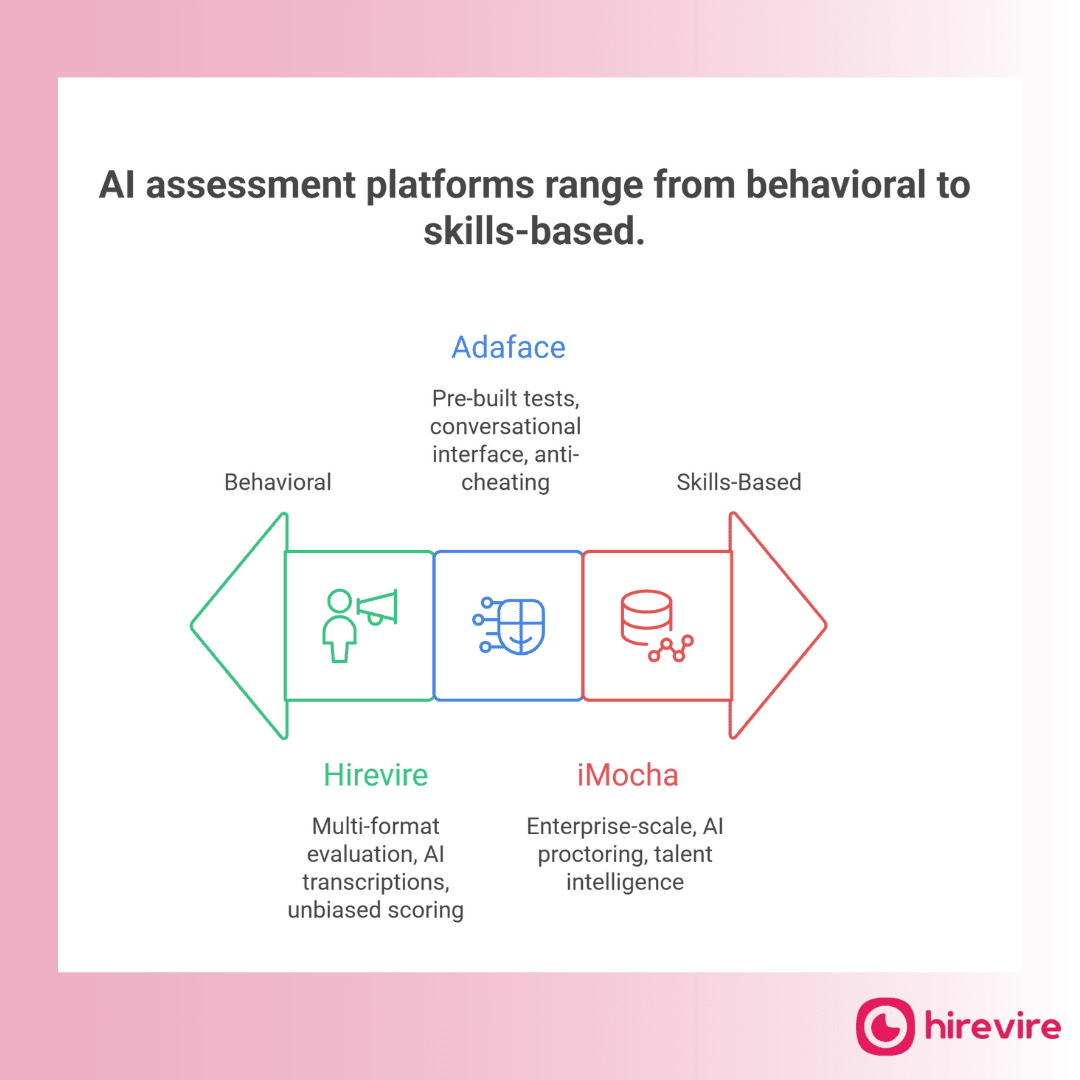
AI evaluates interview responses, skills assessments, and other evaluation data to provide objective scoring and insights. Platforms like Hirevire use AI to transcribe and analyze video, audio, and text responses in 90+ languages, evaluating communication clarity, answer completeness, and relevance to role requirements.
Traditional Recruitment vs. AI-Powered Evolution
Traditional Manual Approach:
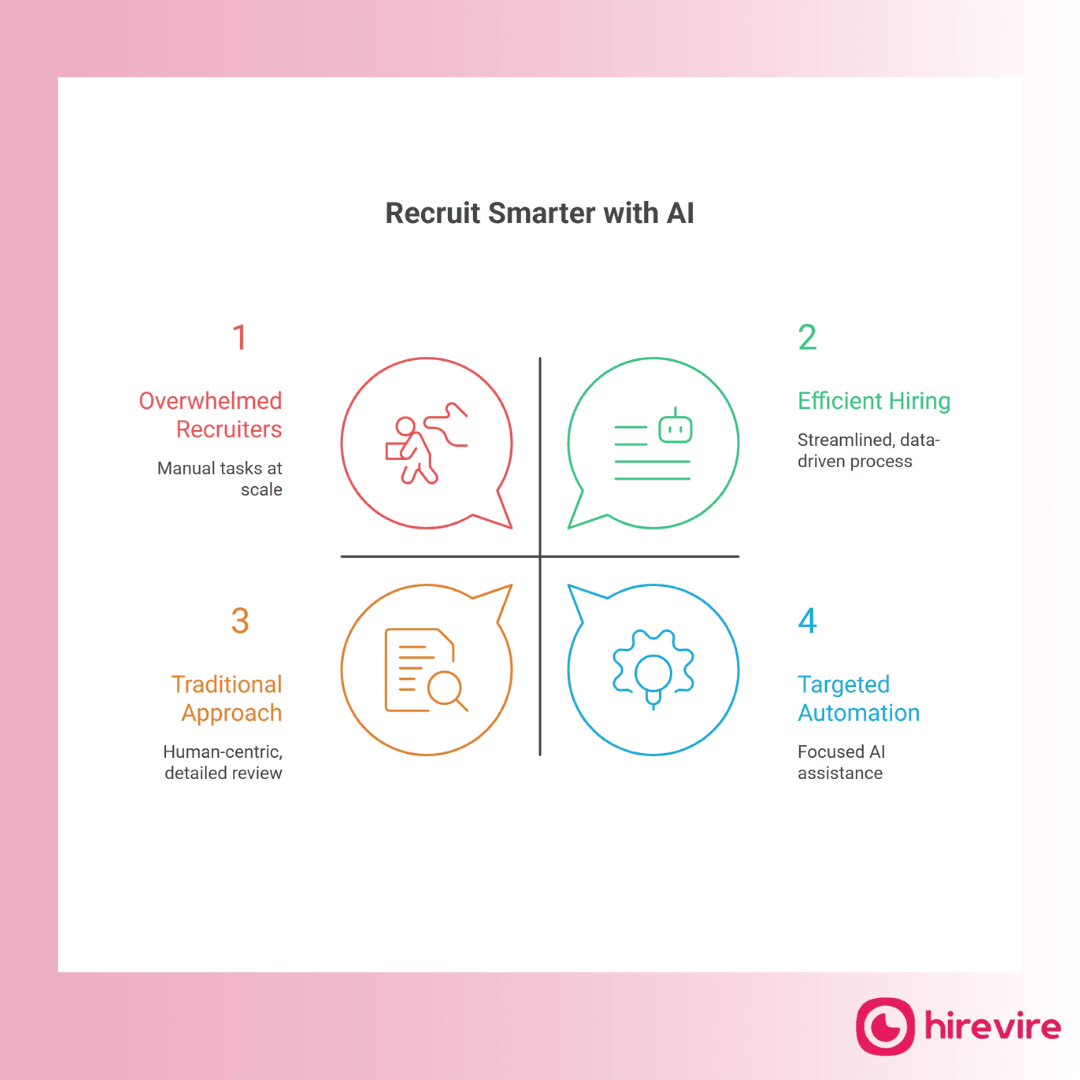
Manual recruitment relies on human recruiters performing every task: reading each resume individually, scheduling interviews through email exchanges, evaluating candidates based on notes and memory, and making decisions influenced by recency bias, interview fatigue, and subjective impressions. This approach works adequately for low-volume hiring but breaks down quickly as candidate volumes increase.
A recruiter can thoroughly review perhaps 15-20 resumes per hour. Interview scheduling for a single position with multiple stakeholders can consume 2-3 hours of coordination. Following up with 50 candidates requires half a day of admin work. These time constraints force trade-offs between thoroughness and speed.
Modern AI-Powered Evolution:
AI recruitment platforms process hundreds or thousands of applications simultaneously while maintaining consistent evaluation criteria. Interview scheduling happens automatically without email ping-pong. Candidate communication occurs in real-time through chatbots. Evaluation analysis provides data-driven insights within seconds rather than days.
The transformation is not merely about speed - it's about enabling recruiters to focus on activities where human judgment adds unique value: assessing cultural fit, evaluating soft skills through conversation, building candidate relationships, and making nuanced decisions about team dynamics and growth potential.
The Core Purpose: Eliminating Repetitive Tasks While Preserving Human Decision-Making
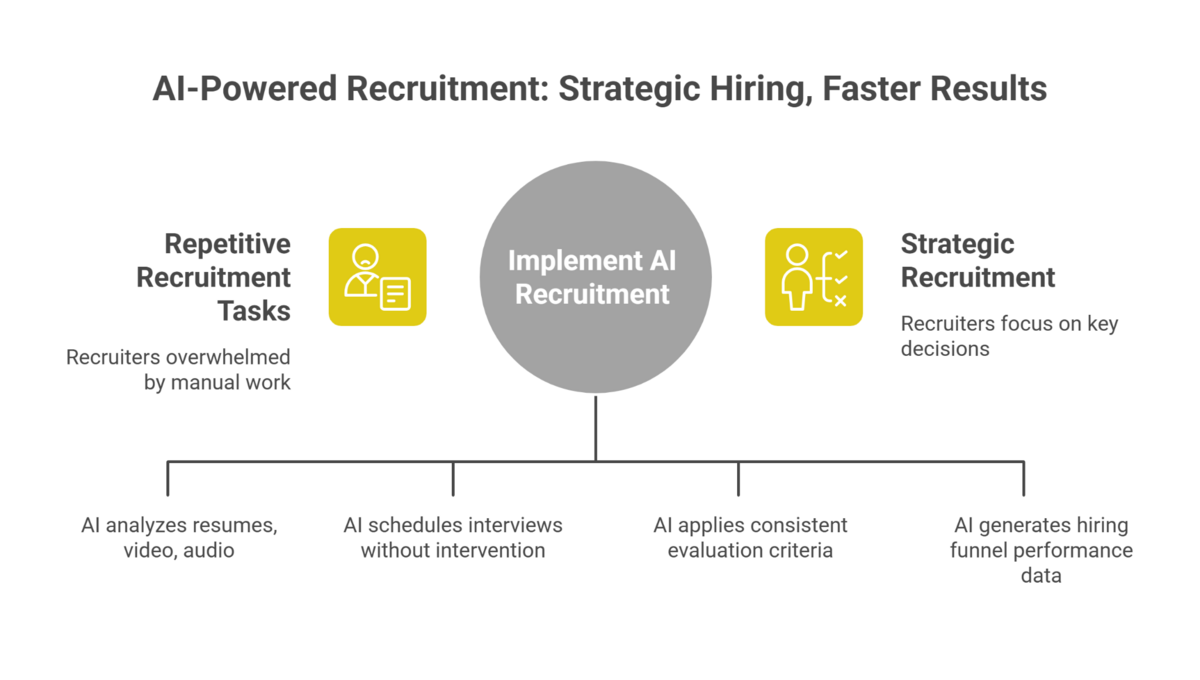
Here's a critical distinction many organizations miss: AI recruitment should eliminate repetitive, high-volume tasks that drain recruiter time and energy - not replace the human judgment essential for quality hiring decisions.
The purpose of AI in recruitment is to handle the scalable, pattern-based work that humans find tedious and time-consuming, freeing them to apply expertise where it matters most: strategic evaluation, relationship building, and final hiring decisions.
Primary Purpose: Freeing Human Recruiters for Strategic Work
AI excels at processing volume while maintaining consistency. A recruiter might lose focus after reviewing 30 resumes in a row, but AI evaluates candidate 300 with the same rigor as candidate 1. This consistency allows AI to handle initial screening, qualification checks, and administrative coordination - the tasks that consume 70-80% of recruiter time but require the least strategic thinking.
Key benefits:
- 40-60% reduction in time spent on resume screening
- 75% decrease in interview scheduling coordination
- 50% faster candidate communication and follow-up
- Elimination of manual data entry and system updates
When Hirevire automates candidate screening through AI-analyzed video, audio, and text responses, recruiters reclaim hours previously spent on initial phone screens, enabling them to invest more time in in-depth conversations with qualified candidates.
Secondary Purpose: Improving Hiring Speed Without Sacrificing Quality
Traditional recruiting faces an impossible trade-off: speed requires shortcuts (less thorough screening, fewer candidates considered), while quality requires time (comprehensive evaluation, multiple interview rounds). AI breaks this trade-off by maintaining thorough evaluation at accelerated timelines.
AI screens 500 applications in minutes rather than weeks, shortlists candidates instantly based on objective criteria, schedules interviews without human intervention, and provides evaluation insights immediately after assessments. The result is faster hiring with more thorough candidate consideration.
Enhancing Consistency and Reducing Bias
Human evaluators bring unconscious biases influenced by factors unrelated to job performance: name associations, university prestige, resume formatting, interview time of day, and comparison to previous candidates. These biases are well-documented and persistent even among well-intentioned recruiters.
AI evaluation, when properly designed, applies identical criteria to every candidate regardless of demographic factors, name associations, or presentation style. The system evaluates candidate 500 with the same standards used for candidate 1, eliminating fatigue-based variance and recency bias.
Enabling Data-Driven Hiring Decisions
AI recruitment generates data on hiring funnel performance, candidate source quality, assessment predictiveness, and time-to-hire by stage. This visibility enables continuous improvement: identifying which interview questions predict success, which candidate sources yield better hires, where bottlenecks occur in the process, and which evaluation criteria matter most.
The Critical Balance: AI for Tasks, Humans for Decisions
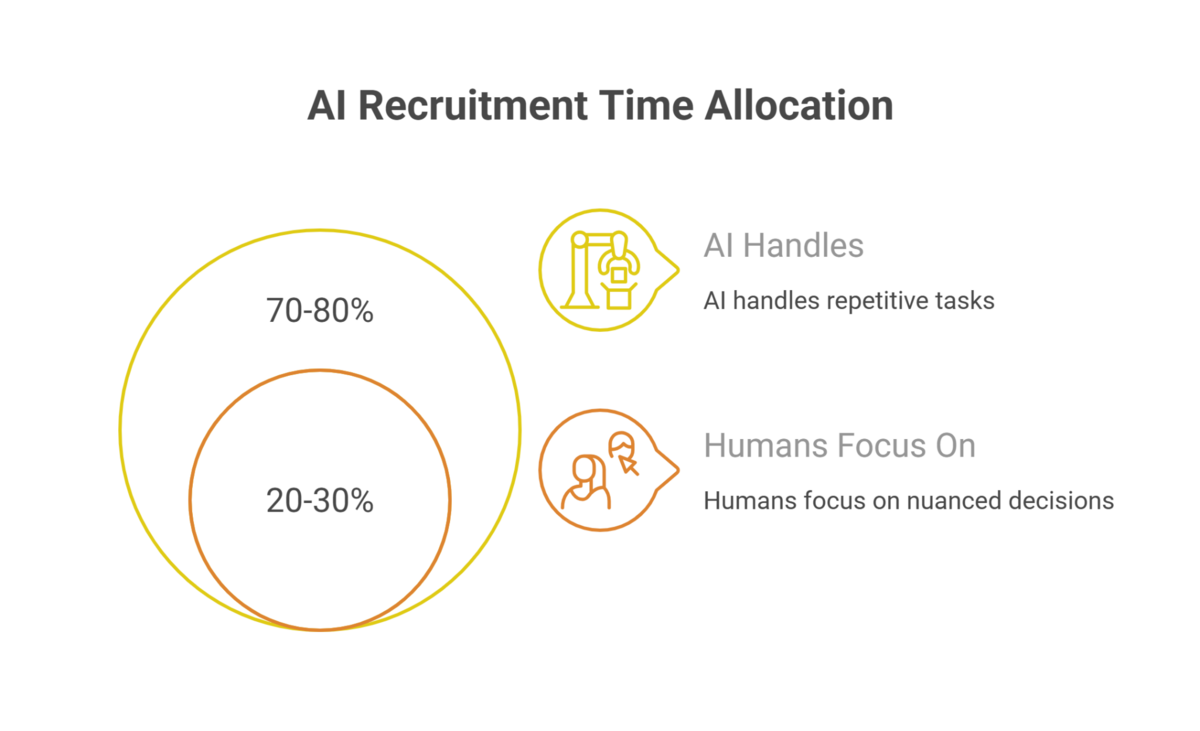
The most successful AI recruitment implementations follow a clear principle: Use AI to eliminate repetitive tasks that don't require human judgment, while preserving human decision-making for nuanced evaluation, relationship assessment, and final hiring decisions.
This balance is not merely a best practice - it's the fundamental requirement for AI recruitment success. Organizations that attempt to fully automate hiring decisions or, conversely, fail to leverage AI for repetitive work, miss the transformative potential of human-AI collaboration.
Where AI Excels: High-Volume, Pattern-Based Tasks
AI handles these tasks better than humans:
Resume Screening and Initial Qualification
Processing hundreds of applications to identify candidates meeting basic qualifications, relevant experience, and required skills. AI performs this work in minutes with perfect consistency, while human screening introduces variance and requires days or weeks.
Candidate Communication and Scheduling
Sending status updates, answering common questions, coordinating availability across multiple schedules, and sending reminders. AI chatbots and scheduling assistants handle these interactions 24/7 without human intervention.
Assessment Evaluation and Scoring
Analyzing video interview responses, skills test results, and written submissions against defined criteria. Hirevire evaluates candidate responses for communication clarity, answer completeness, and keyword relevance across video, audio, and text formats, providing objective scores within seconds.
Data Extraction and Organization
Pulling relevant information from resumes into ATS fields, updating candidate statuses, logging interview outcomes, and maintaining recruiting metrics. These administrative tasks consume hours weekly but add minimal strategic value.
Where Humans Remain Essential: Judgment, Strategy, and Relationships
Humans excel at these aspects:
Cultural Fit Assessment
Evaluating whether a candidate aligns with team values, communication styles, and organizational culture. These judgments require nuanced understanding of team dynamics, company evolution, and interpersonal chemistry that AI cannot replicate.
Situational Judgment and Context
Determining whether a candidate with unconventional experience could succeed, whether a skills gap is trainable, or whether a candidate's career trajectory indicates growth potential. These decisions require context, industry knowledge, and strategic thinking.
Relationship Building and Candidate Experience
Creating rapport with candidates, conveying company culture authentically, addressing candidate concerns, and negotiating offers. High-quality candidates evaluate companies as much as companies evaluate them - human connection differentiates great recruiting from transactional processes.
Final Hiring Decisions
Weighing multiple factors - assessment results, interview performance, team needs, budget constraints, growth trajectory - to make hiring decisions. AI provides data and recommendations; humans make decisions considering factors beyond measurable criteria.
The Optimal Division of Labor
The most effective AI recruitment strategies follow this division:
AI Handles (70-80% of recruiter time):
- Initial resume screening and qualification
- Candidate communication and updates
- Interview scheduling and coordination
- Assessment administration and scoring
- Data entry and system maintenance
Humans Focus On (20-30% of recruiter time):
- In-depth candidate interviews
- Cultural fit evaluation
- Final candidate selection
- Candidate relationship building
- Offer negotiation and closing
This allocation enables recruiters to evaluate 3x more qualified candidates while investing more time per candidate in meaningful interactions.
Key Benefits of AI in Recruitment
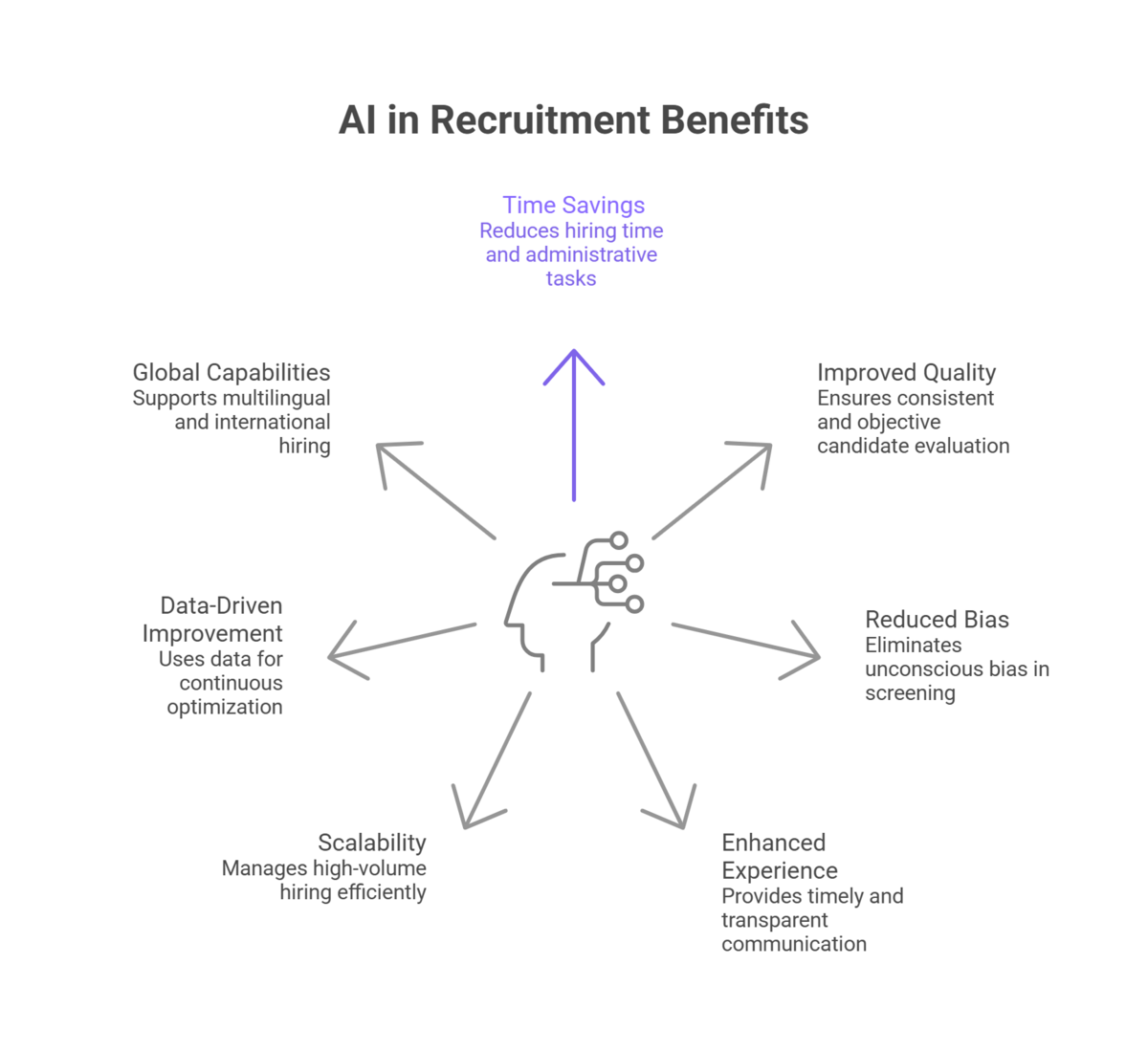
1. Dramatic Time Savings and Efficiency Gains
Quantifiable Impact:
Organizations implementing AI recruitment report 40-60% reduction in time-to-hire, 75% decrease in administrative coordination time, and 50% faster initial screening completion. These improvements translate directly to recruiter capacity - a team of three recruiters can manage hiring volumes previously requiring five to six people.
How This Works:
AI processes 500 resumes in the time a recruiter screens 15. Automated scheduling eliminates 30+ email exchanges per candidate. Chatbots answer candidate questions instantly without recruiter involvement. Assessment scoring provides immediate results rather than requiring days of manual review.
Hirevire enables this efficiency through AI-powered analysis of candidate responses in multiple formats. Instead of conducting 20 initial phone screens, recruiters review AI-analyzed video/audio responses with highlighted insights, focusing their time on top candidates.
2. Improved Candidate Quality Through Consistent Evaluation
The Challenge:
Manual screening suffers from fatigue effects, recency bias, and inconsistent standards. The 200th resume receives less attention than the 10th. Morning interviews are evaluated differently than afternoon ones. Criteria shift based on recent conversations.
AI Solution:
AI applies identical evaluation criteria to every candidate with perfect consistency. Candidate 500 receives the same thorough analysis as candidate 1. Assessment scoring uses the same standards regardless of time, day, or evaluator mood.
The result is higher-quality shortlists based on objective criteria rather than variable human factors.
3. Reduced Unconscious Bias in Initial Screening
The Problem:
Unconscious bias affects hiring decisions at every stage. Research shows identical resumes receive different scores when associated with different names, universities, or demographics. These biases persist despite awareness and training.
How AI Helps:
Properly implemented AI screening focuses on skills, experience, and qualifications without considering name, age, gender, or other demographic factors. The system evaluates what candidates have accomplished and can do, not how they're perceived based on unconscious associations.
Important Caveat: AI systems can perpetuate bias if trained on biased historical data or poorly designed criteria. Effective AI recruitment requires careful design, regular auditing, and human oversight to ensure fair evaluation.
4. Enhanced Candidate Experience Through Speed and Communication
Candidate Expectations:
Top candidates expect timely communication, transparent processes, and efficient hiring timelines. Delays signal disorganization or lack of interest. Poor communication creates negative impressions lasting beyond the hiring process.
AI-Enabled Improvements:
AI enables immediate application acknowledgment, automated status updates, instant FAQ responses through chatbots, and coordinated interview scheduling without delays. Candidates receive consistent, professional communication throughout the process.
Hirevire contributes to positive candidate experience by eliminating account creation requirements, allowing candidates to complete screenings on their schedule (rather than coordinating phone screens), and supporting multiple response formats (video, audio, text, files) based on candidate preference and comfort.
5. Scalability for High-Volume Hiring
The Volume Challenge:
Organizations conducting seasonal hiring, campus recruiting, or rapid growth hiring face impossible volume challenges. Manually screening 2,000 applications for 50 positions requires weeks. Coordinating interviews for 200 candidates creates scheduling chaos.
AI Solution:
AI scales evaluation capacity infinitely without additional recruiter headcount. Processing 2,000 applications takes minutes rather than weeks. Scheduling 200 interviews happens automatically. The marginal cost of evaluating additional candidates approaches zero.
This scalability enables organizations to consider broader candidate pools without overwhelming recruiting teams.
6. Data-Driven Continuous Improvement
Visibility and Insights:
AI recruitment generates data on candidate source effectiveness, assessment predictiveness, hiring funnel conversion rates, and time-to-hire by stage. This visibility enables evidence-based optimization rather than guesswork.
Organizations can identify which interview questions predict successful hires, which sourcing channels yield better candidates, where candidates drop off in the process, and which evaluation criteria matter most for role success.
7. Multilingual and Global Hiring Capabilities
Global Talent Challenge:
Organizations hiring internationally face language barriers, timezone coordination challenges, and difficulty evaluating candidates in non-native languages. These barriers limit access to global talent pools.
AI Solution:
AI transcription and analysis support multiple languages, enabling evaluation of candidates regardless of language. Hirevire provides AI transcriptions in 90+ languages, allowing recruiters to evaluate international candidates through automated translation while candidates respond in their preferred language.
How Hirevire Delivers AI Recruitment Benefits
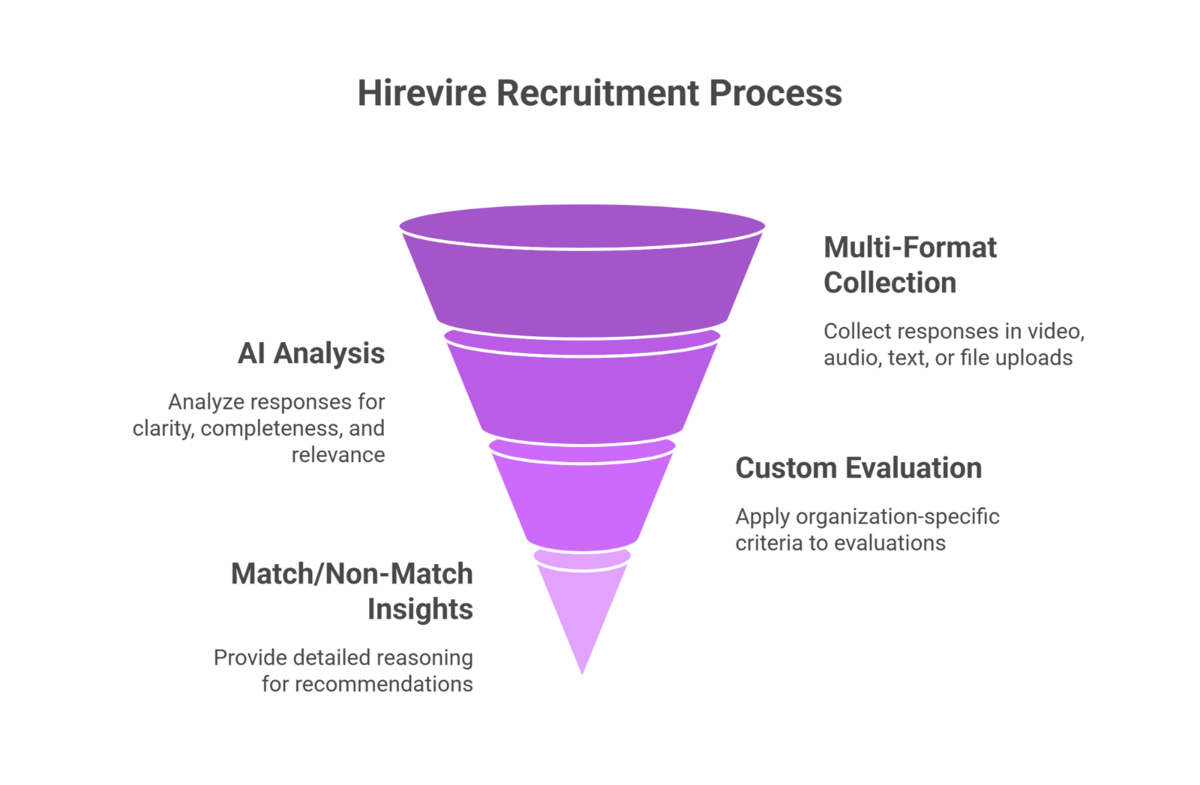
Hirevire exemplifies modern AI recruitment by automating initial candidate screening while maintaining human control over final decisions. The platform processes candidate responses across multiple formats - video, audio, text, and file uploads - using AI analysis to provide objective evaluation insights.
Automated AI-Powered Candidate Screening
Multi-Format Response Collection:
Candidates respond to screening questions through their preferred format: video for roles requiring presentation skills, audio for candidates uncomfortable on camera, text for detailed written responses, or file uploads for portfolio submissions. This flexibility accommodates diverse candidate preferences while capturing comprehensive evaluation data.
Real-Time AI Analysis:
Hirevire automatically transcribes and analyzes responses using AI that understands context beyond simple keyword matching. The system evaluates communication clarity (independent of technical audio/video quality), answer completeness (whether responses address all question components), and keyword relevance (presence of role-specific experience and skills).
90+ Language Support:
AI transcription supports 90+ languages, enabling global hiring without language barriers or expensive manual translation. Recruiters review English transcripts of candidate responses given in any supported language.
Custom Evaluation Criteria
Organizations customize evaluation focus through 200-character prompts defining what to assess. Examples include:
- "Evaluate experience with agile methodologies and cross-functional collaboration"
- "Assess leadership examples involving conflict resolution and team motivation"
- "Identify customer service skills including problem-solving and empathy"
AI analysis adapts to these custom criteria rather than applying generic scoring, ensuring evaluation aligns with specific role requirements.
Match/Non-Match Insights with Detailed Reasoning
The system provides transparent decision support: candidate scores with explanations, specific response elements supporting evaluations, and clear reasoning for match/non-match recommendations. This transparency enables recruiter override when AI recommendations don't account for context or nuance.
Recruiters receive AI insights to inform decisions rather than automated accept/reject actions. The human recruiter remains the decision-maker.
Pricing and Accessibility
| Plan | Monthly Price | Yearly Price | Features | Best For |
|---|---|---|---|---|
| Essentials | $49/month | $39/month (save $120/year) | 1 job, 1 user, 300 interviews/year | Single position hiring |
| Professional | $149/month | $99/month (save $600/year) | 5 jobs, 5 users, 1,200 interviews/year, AI Match | Regular hiring needs |
| Agency | $249/month | $199/month (save $1,200/year) | 20 jobs, 15 users, 12,000 interviews/year, white-label | High-volume teams |
Customer Reviews:
G2: 4.7/5 stars (25+ reviews) - View Reviews
"Hirevire has revolutionized our interview process. We save at least 75% time on screening, and candidates love the flexibility to record at their convenience."
—Nathan Ackerman, Partner, Global Risk Advisory
Capterra: 5/5 stars (20+ reviews) - View Reviews
Implementation Strategy: Balancing AI and Human Judgment
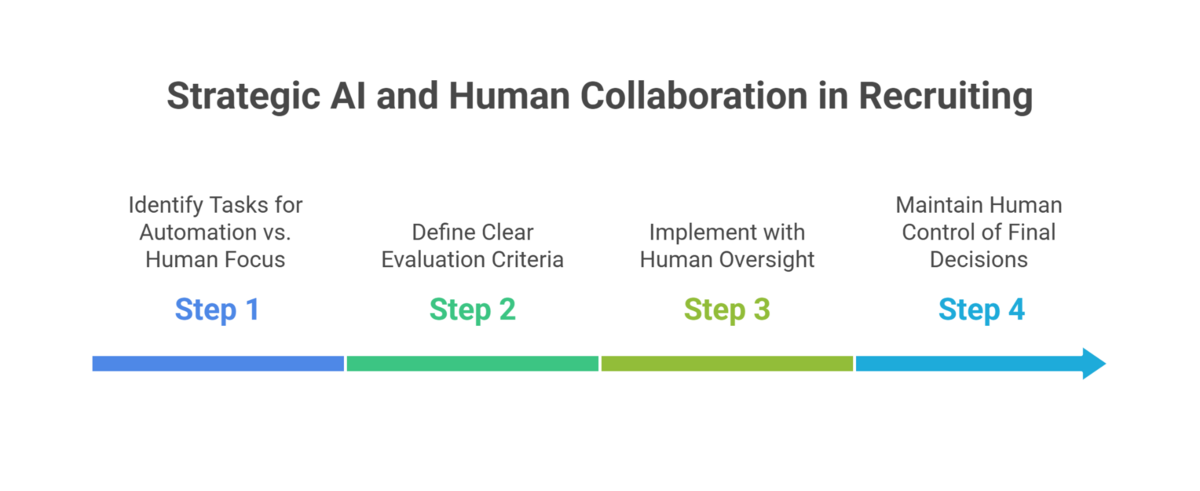
Step 1: Identify Tasks for Automation vs. Human Focus
Audit current recruiting workflows to categorize tasks:
High-Volume, Pattern-Based Tasks (AI Candidates):
- Resume screening for basic qualifications
- Initial candidate communication and FAQs
- Interview scheduling and coordination
- Assessment scoring against defined criteria
- Data entry and status updates
Strategic, Judgment-Intensive Tasks (Human Focus):
- In-depth candidate interviews
- Cultural fit evaluation
- Reference checks and background verification
- Final hiring decisions
- Candidate relationship building and closing
Step 2: Define Clear Evaluation Criteria
AI evaluation requires explicit criteria. Define required qualifications, preferred experience, skills assessments, and evaluation weights before implementing AI screening. Vague criteria produce vague AI results.
Step 3: Implement with Human Oversight
Start with AI recommendations reviewed by humans before taking action. Monitor AI evaluation quality, identify patterns in overrides, and adjust criteria based on learning. Gradually increase trust in AI recommendations as accuracy proves consistent.
Step 4: Maintain Human Control of Final Decisions
AI should inform hiring decisions, not make them. Recruiters review AI insights, interview top candidates identified through AI screening, and make final decisions considering both AI data and human judgment.
This approach delivers AI efficiency benefits while preserving human decision-making authority.
Frequently Asked Questions
What are the main benefits of using AI in recruitment?
AI recruitment delivers five core benefits: (1) dramatic time savings by automating high-volume tasks like resume screening and scheduling, (2) improved candidate quality through consistent evaluation criteria applied to all applicants, (3) reduced unconscious bias when properly implemented to focus on qualifications rather than demographics, (4) enhanced candidate experience through faster communication and streamlined processes, and (5) scalability enabling organizations to evaluate larger candidate pools without additional recruiter headcount. Organizations implementing AI recruitment typically report 40-60% reduction in time-to-hire and 50-75% decrease in administrative work.
Does AI recruitment replace human recruiters?
No. Effective AI recruitment augments rather than replaces human recruiters. AI handles repetitive, high-volume tasks that consume 70-80% of recruiter time - resume screening, scheduling, candidate communication, and initial assessment evaluation. This automation frees human recruiters to focus on activities requiring judgment and relationship skills: in-depth interviews, cultural fit assessment, candidate relationship building, and final hiring decisions. The optimal approach uses AI for scalable tasks while preserving human expertise for strategic evaluation and decision-making. Organizations should view AI as eliminating tasks, not positions.
Can AI recruitment help reduce hiring bias?
Yes, when properly designed and monitored. AI screening can reduce unconscious bias by evaluating candidates based on skills, experience, and qualifications without considering demographic factors like name, age, gender, or university prestige. However, AI systems can also perpetuate bias if trained on biased historical data or designed with flawed criteria. To ensure fair AI recruitment, organizations must carefully design evaluation criteria focusing on job-relevant factors, regularly audit AI recommendations for bias patterns, maintain human oversight of AI decisions, and avoid using AI for subjective judgments better suited to human evaluation. AI is a tool for reducing bias, not a guaranteed solution.
How does AI recruitment improve candidate experience?
AI improves candidate experience through faster response times, consistent communication, and process convenience. AI-powered chatbots answer candidate questions instantly rather than requiring days for recruiter response. Automated scheduling coordinates interviews efficiently without email ping-pong. Status updates occur automatically rather than leaving candidates wondering about their application status. Platforms like Hirevire enhance experience by eliminating account creation requirements, allowing candidates to complete screenings on their schedule, and supporting multiple response formats (video, audio, text) based on candidate preference and comfort level.
What recruitment tasks should remain human-focused?
Final hiring decisions should always involve human judgment. While AI provides data and recommendations, humans must make decisions considering cultural fit, team dynamics, growth potential, and contextual factors AI cannot fully evaluate. Additionally, in-depth candidate interviews, relationship building, offer negotiation, and reference checks benefit from human interaction and judgment. AI excels at initial screening, scheduling, and assessment scoring - tasks involving pattern recognition and volume processing. Humans excel at nuanced evaluation, strategic thinking, and relationship development. The optimal division allocates repetitive tasks to AI while preserving human focus for judgment-intensive activities.
How quickly can organizations implement AI recruitment?
Implementation speed varies by solution complexity. Simple AI tools like Hirevire for candidate screening can launch within hours - create screening questions, share links with candidates, and start collecting AI-analyzed responses immediately. Comprehensive AI platforms integrating with existing ATS systems may require weeks or months for implementation, data migration, team training, and process adjustment. Organizations should start with targeted AI applications addressing specific pain points (e.g., initial screening automation) rather than attempting complete recruitment transformation simultaneously. Iterative implementation allows learning and adjustment before expanding AI scope.
What is the ROI of AI recruitment?
AI recruitment ROI stems from three sources: time savings (recruiters spending 40-60% less time on screening and admin), cost reduction (handling higher volumes without additional headcount), and quality improvement (better hiring decisions from consistent evaluation and larger candidate consideration). A typical mid-sized organization processing 2,000 applications annually might save 800-1,200 recruiter hours through AI screening automation, avoid one to two additional recruiter hires during growth periods, and improve candidate quality leading to lower turnover costs. ROI becomes apparent within three to six months of implementation for most organizations.
Can AI recruitment work for small businesses?
Yes. Modern AI recruitment platforms like Hirevire offer accessible pricing starting at $39/month, making professional AI screening affordable for small businesses. Small companies benefit from AI recruitment by competing more effectively for talent through professional processes, handling hiring efficiently without dedicated recruiting staff, and scaling hiring operations during growth periods without proportional admin burden. The key is selecting right-sized solutions rather than enterprise platforms designed for large organizations.
How does AI handle global and multilingual hiring?
AI recruitment platforms with multilingual capabilities support global hiring through automated transcription and translation. Hirevire provides AI transcriptions in 90+ languages, enabling recruiters to evaluate international candidates through English transcripts while candidates respond in their preferred language. This capability eliminates language barriers without expensive manual translation or requiring recruiters to speak multiple languages. AI also facilitates timezone challenges through asynchronous screening - candidates complete video/audio interviews on their schedule without requiring real-time coordination across global timezones.
What data should organizations track for AI recruitment optimization?
Key metrics include candidate source quality (which channels yield best hires), assessment predictiveness (which evaluation criteria correlate with successful hires), time-to-hire by stage (identifying bottlenecks), candidate conversion rates (where drop-off occurs), AI recommendation accuracy (comparing AI shortlists to final hires), and recruiter time allocation (hours spent on various tasks). Tracking these metrics enables data-driven optimization: improving sourcing strategy, refining evaluation criteria, eliminating process bottlenecks, and adjusting AI parameters based on results. Organizations should establish baseline metrics before AI implementation to measure impact accurately.
Conclusion: The Future of AI-Human Collaboration in Recruiting
AI recruitment technology has evolved from experimental novelty to essential capability for competitive talent acquisition. Organizations embracing AI recruitment benefit from significant time savings, improved hiring consistency, reduced bias potential, enhanced candidate experience, and unprecedented scalability.
However, the fundamental principle remains clear: AI should eliminate repetitive tasks that drain recruiter capacity, not replace the human judgment essential for quality hiring decisions. The most successful AI recruitment implementations follow this division - AI handles high-volume screening, scheduling, and initial assessment while humans focus on strategic evaluation, relationship building, and final decisions.
Key Takeaways
- AI recruitment delivers measurable benefits: 40-60% time savings, improved candidate quality, and enhanced scalability
- The critical success factor is balancing AI automation with human judgment rather than attempting full automation
- Identifying which tasks benefit from AI (repetitive, pattern-based) versus which require humans (strategic, relationship-focused) determines implementation success
- Modern AI platforms like Hirevire make professional AI screening accessible at $39-199/month, democratizing capabilities previously available only to large enterprises
The Bottom Line
The question for recruitment leaders is not whether to adopt AI recruitment, but how to implement AI effectively while preserving human expertise where it matters most. Organizations that find this balance gain competitive advantage through faster hiring, better candidate quality, and more efficient recruiting operations.
For organizations seeking to implement AI-powered candidate screening with human decision-making control, Hirevire provides comprehensive capabilities through multi-format response collection (video, audio, text, files), AI analysis in 90+ languages, and transparent evaluation insights - all at accessible pricing starting at $39/month.
Your Next Steps
- Audit current recruiting workflows to identify high-volume tasks consuming recruiter time
- Define clear evaluation criteria for roles you're hiring
- Try Hirevire's free trial to experience AI-powered candidate screening while maintaining human control of hiring decisions
Ready to transform your recruitment efficiency while preserving quality?