Evaluate AI Recruiting ROI: Measure AI Recruitment Platforms for ROI [Framework + Calculator]
Every AI recruitment vendor claims the same things: faster hiring, lower costs, better candidates. The numbers in their sales decks are always impressive. "60% reduction in time-to-hire." "3x improvement in candidate quality." "ROI in under 90 days."
What those numbers rarely include: the baseline they're measured against, the company size they apply to, whether they've been independently verified, or the full cost of the platform being quoted.
According to Gartner research, organizations waste an estimated 30-40% of their HR technology budgets on tools that underdeliver on their stated ROI. The gap between vendor promises and actual outcomes is one of the most predictable problems in HR tech procurement.
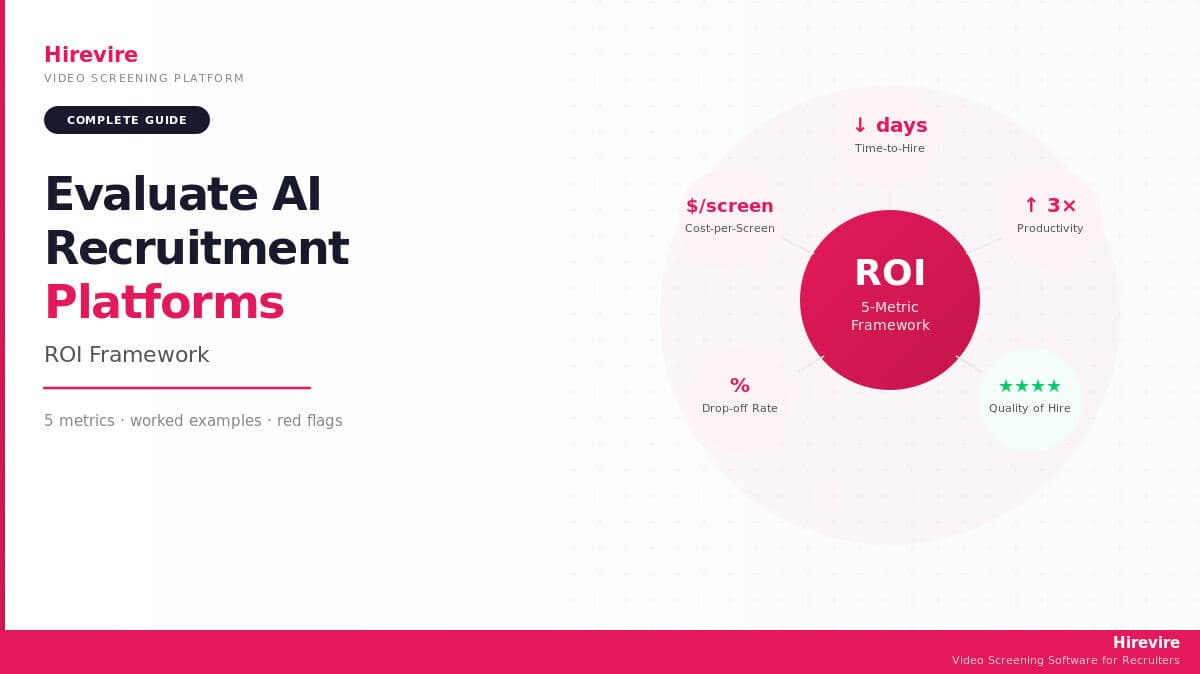
This guide gives you a five-metric framework for evaluating AI recruitment platforms on ROI - applied consistently, regardless of which vendor you're evaluating. Every metric comes with a worked example. The math at the end of this guide consistently favors platforms with transparent, fixed pricing over those with per-interview or per-hire cost structures.
Quick Summary: The five ROI metrics for evaluating AI recruitment platforms are: time-to-hire reduction, cost-per-screen, quality-of-hire impact, recruiter productivity gains, and candidate experience scores. Hirevire performs particularly well on cost-per-screen (as low as $0.20/screen vs. $1.50+ for alternatives) and recruiter productivity (85-90% pre-screen time reduction) due to its fixed monthly pricing model.
Table of Contents
- Why Most ROI Claims in HR Tech Are Misleading
- The 5-Metric ROI Framework
- Metric 1: Time-to-Hire Reduction
- Metric 2: Cost-per-Screen
- Metric 3: Quality-of-Hire Impact
- Metric 4: Recruiter Productivity Gains
- Metric 5: Candidate Experience Scores
- Downloadable ROI Calculator Template
- Red Flags When Vendors Quote ROI Numbers
- FAQ
Why Most ROI Claims in HR Tech Are Misleading
HR technology ROI claims fail in predictable ways. Understanding the patterns helps you know what questions to ask before signing a contract.
The Baseline Problem
"We reduced time-to-hire by 40%" sounds significant - until you ask what the baseline was. A company going from 90-day hiring cycles to 54 days is solving a real problem. A company going from 25 days to 15 days with the same tool is reporting a different magnitude of improvement.
Most vendor case studies don't disclose the before state in quantitative terms. The improvement is presented as a percentage, which sounds the same whether the baseline was broken or healthy.
What to ask: Request the absolute numbers, not just the percentage change. "Average time-to-hire went from X days to Y days" is verifiable. "We reduced time-to-hire by 40%" is not.
The Selection Bias Problem
Vendor case studies feature their most successful customers by definition. The customer who implemented the platform, saw no measurable improvement, and let the contract lapse after one year doesn't appear in the marketing materials.
This selection bias makes individual case studies nearly useless as evidence of typical outcomes. What matters is: what does the average customer experience look like?
What to ask: Ask for cohort data, not cherry-picked case studies. "What percentage of your customers achieve X outcome within 12 months?" is a better question than "Can you share a success story?"
The Attribution Problem
When a company improves its hiring outcomes after implementing a new platform, multiple things usually changed at the same time: the platform, the hiring process, the team structure, the market conditions. Attribution to the software is always uncertain.
Good vendors acknowledge this. Vendors whose ROI claims don't acknowledge confounders are overselling.
The Total Cost Problem
Per-seat pricing, implementation fees, onboarding costs, training time, integration work, and the opportunity cost of switching from a previous system are rarely bundled into the ROI calculation vendors present.
A platform that appears inexpensive at $X/month can be significantly more expensive in total cost of ownership when integration complexity and admin overhead are included.
The 5-Metric ROI Framework
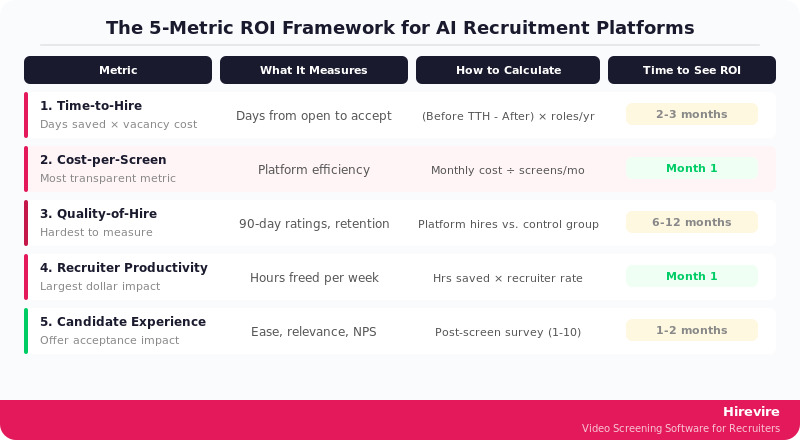
Apply these five metrics to every AI recruitment platform you evaluate. Use the same definitions across vendors to enable fair comparison.
| Metric | What It Measures | How to Calculate | Data Source |
|---|---|---|---|
| Time-to-hire reduction | Days saved from job open to offer accept | (Before avg TTH - After avg TTH) x roles/year | ATS data |
| Cost-per-screen | Platform cost per candidate evaluated | Monthly platform cost / candidate volume | Finance + ATS |
| Quality-of-hire impact | Performance of hires made via platform | Manager ratings at 90/180 days vs. control | Performance system |
| Recruiter productivity | Hours freed per recruiter per week | Manual screen time - platform screen time | Time tracking |
| Candidate experience | Candidate perception of screening process | Post-screen surveys, completion rates | Survey data |
Each metric requires both a before state (baseline) and an after state (post-implementation) to be meaningful. If you can't measure the before state, you can't calculate ROI - only report outputs.
Metric 1: Time-to-Hire Reduction
Time-to-hire is the most commonly cited ROI metric in recruiting software because it's easy to measure and has a clear financial implication: every day a role sits open has a cost.
Calculating the Value of Time-to-Hire Reduction
The standard formula:
Cost of vacancy per day = (Annual salary of role / 250 working days) x 1.5
The 1.5 multiplier accounts for lost productivity, overtime from teammates covering the gap, and downstream impacts. It's a conservative estimate; some organizations use higher multipliers for revenue-generating or leadership roles.
Example calculation:
- Role: Senior Customer Success Manager, $90,000/year
- Cost of vacancy per day: ($90,000 / 250) x 1.5 = $540/day
- Current time-to-hire: 42 days
- Post-platform time-to-hire: 28 days (14-day reduction)
- Annual saving per role: 14 days x $540 = $7,560
- Organization filling 30 such roles per year: $7,560 x 30 = $226,800/year
This calculation is often used by vendors to justify large software spend. The critical check: is the time-to-hire reduction actually attributable to the platform, and is 14 days a realistic expectation for your organization's hiring context?
Where AI Platforms Reduce Time-to-Hire
AI recruitment platforms reduce time-to-hire by addressing specific bottlenecks:
- Application intake: AI initial screening reduces time from application close to first shortlist
- Pre-screening: Async video collection eliminates scheduling overhead that adds 3-7 days to the pre-screen stage
- Reviewer coordination: Shared platforms reduce the email back-and-forth between recruiters and hiring managers
- Offer stage: Automated communication keeps candidates engaged during the offer preparation period
Hirevire specifically addresses the pre-screen bottleneck - which is typically the most calendar-intensive stage. Recruiting teams that have moved from phone screens to async video with Hirevire report 5-10 day reductions in time-to-first-shortlist on roles with 30+ applicants.
For a comparison of AI video approaches vs. traditional methods, see the AI video interviews vs traditional methods ROI comparison.
What Time-to-Hire Reduction Won't Fix
Time-to-hire improvements plateau once the platform is implemented. A recruiter who was taking 42 days before doesn't go to 14 days. They might go to 28-30 days. The remaining time is in stages the platform doesn't touch - committee scheduling, reference checks, offer negotiation.
Any vendor claiming 50%+ time-to-hire reductions as a typical outcome should be pressed on the baseline and the methodology.
Metric 2: Cost-per-Screen
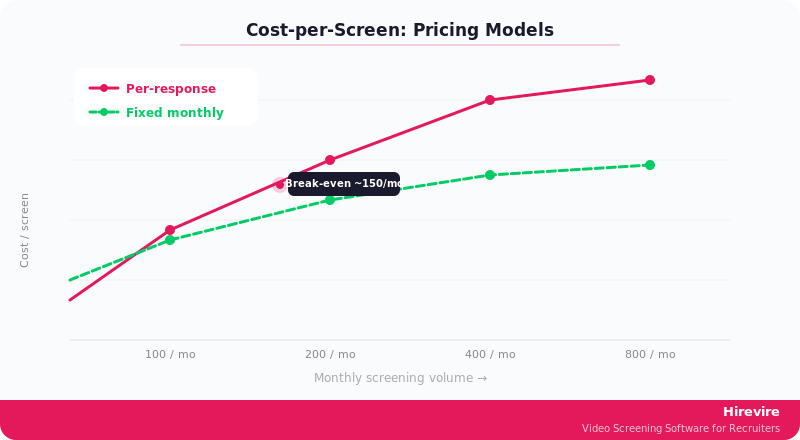
Cost-per-screen is the most useful operational efficiency metric in AI recruitment platform evaluation - and the most commonly omitted from vendor ROI presentations.
The formula is simple:
Cost-per-screen = Total monthly platform cost / Number of candidates screened per month
This metric makes pricing model differences immediately visible.
The Worked Example: Fixed vs. Per-Response Pricing
Platform A (per-response pricing):
- Plan: $299/month for up to 200 video responses
- Monthly screens: 200
- Cost-per-screen: $299 / 200 = $1.50/screen
Hirevire (fixed monthly pricing):
- Plan: Professional at $99/month (billed annually), up to 1,200 interviews/year (100/month)
- Monthly screens: 100
- Cost-per-screen: $99 / 100 = $0.99/screen
At higher volumes with the Essentials plan:
- Plan: Essentials at $39/month, up to 300 interviews/year (25/month average)
- At full utilization: $39 / 25 = $1.56/screen (but unlimited in terms of no per-interview fees within plan limits)
Agency plan at full volume:
- Plan: Agency at $199/month, up to 12,000 interviews/year (1,000/month)
- At full utilization: $199 / 1,000 = $0.20/screen
The $0.20/screen figure for high-volume hiring is the most competitive cost-per-screen available from any async video platform at scale. For a recruiting team processing 500-1,000 pre-screens per month, the cost difference versus per-interview pricing compounds significantly.
Why Fixed Pricing Wins on This Metric
Per-interview pricing creates perverse incentives: it makes recruiters reluctant to send the pre-screen link to candidates they're uncertain about, because each screen has a cost. Fixed pricing removes that hesitation - you can pre-screen everyone who clears resume review without worrying about the per-unit cost.
The result: fixed-pricing platforms produce higher completion data (more candidates screened per role), which gives recruiters more comparative information. Per-interview platforms produce smaller comparison sets because of cost anxiety.
How to Calculate This for Your Volume
Your cost-per-screen calculation:
- Determine your current monthly candidate volume (ATS data)
- Add up all platform costs for the month (subscription + per-use fees)
- Divide: total cost / candidates evaluated
Do this for every platform being evaluated. The differences are often dramatic - and this metric is fully transparent from pricing pages, unlike vendor-quoted "ROI."
Metric 3: Quality-of-Hire Impact
Quality-of-hire is the hardest ROI metric to measure but potentially the most valuable. A platform that reduces time-to-hire by 10 days but causes a 5% decline in hire quality may be net-negative.
Defining Quality-of-Hire
Quality-of-hire has no universally accepted definition. For practical purposes, use a composite of:
- 90-day performance rating: Manager assessment at 3 months, scored against a standard rubric
- Retention at 12 months: Whether the hire is still employed and performing satisfactorily
- Ramp-to-productivity: Time until the hire is operating at full expected output
- Hiring manager satisfaction: Post-hire satisfaction score from the hiring manager
For the metric to be useful in platform evaluation, you need a control group: hires made through a different process or before the platform was implemented. Without comparison, you're measuring outputs, not impact.
The AI Screening Connection
AI recruitment platforms affect quality-of-hire primarily through the pre-screening stage. Better pre-screens surface candidates whose communication style, role understanding, and motivation align with what the role requires - improving the quality of who reaches formal interviews.
Hirevire's AI screening evaluates video responses against custom criteria - keyword relevance, answer completeness, and communication clarity - producing match scores that help prioritize candidates for depth review. This structured filtering means the candidates who reach interview panels have been evaluated against consistent criteria, reducing the variance in who gets through.
Measuring Quality-of-Hire Change
Before implementing any platform, establish your baseline quality-of-hire metrics:
- Pull 90-day manager ratings for the last 50 hires
- Calculate 12-month retention rate for the same cohort
- Document average ramp-to-productivity by role type
After 6-12 months with the new platform, run the same analysis on platform-sourced hires. The comparison tells you whether the screening process change improved or degraded hire quality.
This data takes time to collect - which is why most vendor ROI presentations skip it. Hold them accountable for it anyway.
Metric 4: Recruiter Productivity Gains
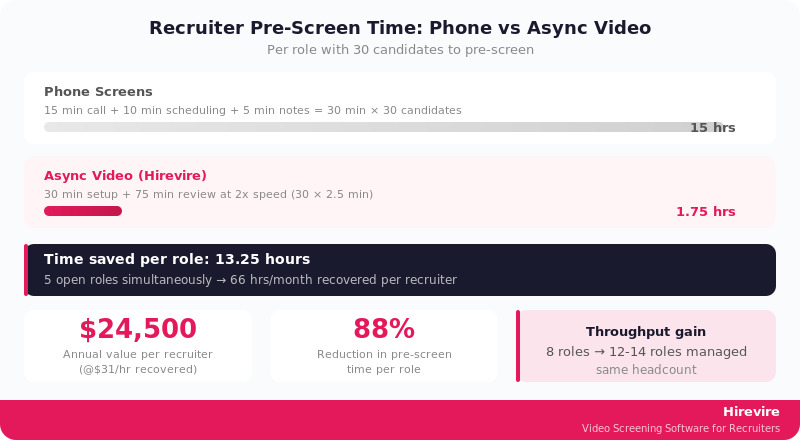
Recruiter time is a finite resource. Every hour spent on mechanical screening tasks (scheduling calls, conducting phone screens, taking notes, sending follow-up emails) is an hour not spent on sourcing, stakeholder management, offer negotiation, and candidate experience.
Quantifying Current Recruiter Time on Screening
Before evaluating any platform, measure where recruiter time currently goes. A simple time audit over two weeks:
| Task | Avg Hours/Week/Recruiter |
|---|---|
| Phone screen scheduling | X hours |
| Conducting phone screens | X hours |
| Screen notes and write-ups | X hours |
| Resume review | X hours |
| Candidate follow-up (status updates) | X hours |
| Hiring manager coordination | X hours |
The first three rows - scheduling, conducting, and documenting phone screens - are the categories AI recruitment platforms address most directly.
The Pre-Screen Time Calculation
With phone screens:
- 30 candidates to pre-screen per role
- 15 min call + 10 min scheduling + 5 min notes = 30 min per candidate
- 30 candidates x 30 min = 900 min = 15 hours per role
With async video (Hirevire):
- 30 min setup (create questions, configure link)
- 30 candidates self-schedule and record asynchronously
- Review at 2x speed: 30 candidates x 2.5 min = 75 min
- Total: ~1.75 hours per role
Time saved: 15 hours - 1.75 hours = 13.25 hours per role
For a recruiter managing 5 open roles simultaneously, that's 66 hours per month recovered from the pre-screen stage alone. At an average recruiter salary of $65,000/year ($31/hour), that's $2,046/month in recovered recruiter capacity - or approximately $24,500/year per recruiter.
The Compounding Effect
Recovered recruiter hours don't just reduce cost - they increase recruiter capacity. A recruiter who was managing 8 open roles while drowning in phone screens can effectively manage 12-14 roles when pre-screening is automated. That's 50-75% more hiring throughput from the same headcount.
For growing organizations, this throughput gain can delay the need for additional recruiter headcount - a significant indirect ROI that's often larger than the direct cost savings.
See the analysis at top HR tech softwares with best ROI in hiring for a broader view of where HR tech delivers best on productivity metrics.
Metric 5: Candidate Experience Scores
Candidate experience is the most overlooked ROI metric in AI recruitment platform evaluation. It affects multiple downstream outcomes:
- Offer acceptance rates: Candidates who have a poor experience in the process are more likely to decline offers, even when compensation is competitive
- Employer brand: Candidates who had a negative screening experience tell others - Glassdoor and Indeed reviews increasingly reference the screening process
- Pipeline quality: Strong candidates who have many options will drop from processes they perceive as disrespectful of their time
What Good Candidate Experience Looks Like
In the pre-screening context, candidate experience is shaped by:
Transparency: Is the purpose of the pre-screen clearly explained? Do candidates understand how their response will be used?
Convenience: Can candidates complete the pre-screen at a time that works for them? Is the interface easy to use on mobile?
Respect for time: Is the question set appropriately brief? Are candidates given enough time to complete it without being rushed?
Communication quality: Are candidates given clear timelines? Do they receive status updates regardless of outcome?
Measuring Candidate Experience
Post-pre-screen surveys sent 24-48 hours after completion (to all candidates, not just those who advanced) provide the most direct data. Key questions:
- How easy was the pre-screen process to complete? (1-10)
- Did you feel the questions were relevant to the role? (1-10)
- How would you rate your overall experience with our recruitment process so far? (1-10)
Async video pre-screening typically scores higher on question 1 (convenience) than phone screens because candidates complete it on their own schedule. It scores comparably or higher on question 3 when the video format is clearly explained upfront.
The Async Video Candidate Experience
Hirevire gives candidates control over their pre-screen: they choose when to record, can re-record responses if they want to improve their answer, and aren't subject to the scheduling friction of phone screens. For candidates working full-time jobs, the ability to record an evening pre-screen response rather than arranging a mid-afternoon call is a meaningful quality-of-life difference.
The AI screening layer in Hirevire doesn't interact with candidates directly - it evaluates recordings after submission - so the candidate experience is entirely managed through the human-designed question set and the communication around it.
Downloadable ROI Calculator Template
Apply the five-metric framework to your specific situation using this template. The calculator is available as a pre-filled Excel file here.
Example with Hirevire Agency Plan ($199/month, $2,388/year):
- Time-to-hire: 30 roles/year x $500/day x 7 days saved = $105,000
- Cost-per-screen: 500/month at $0.20 vs $1.50 = $650/month saving = $7,800/year
- Productivity: 2 recruiters x 40 hrs/month x $31/hr = $2,480/month = $29,760/year
Total saving: $142,560/year | Platform cost: $2,388 | Net ROI: $140,172 | ROI%: 5,871%
These are illustrative figures. Your actual numbers will vary based on hiring volume, baseline efficiency, and role salary levels.
Red Flags When Vendors Quote ROI Numbers
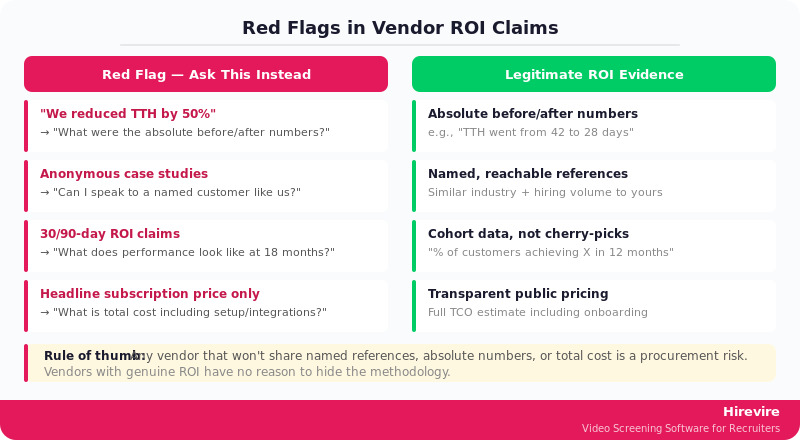
Use these checks to evaluate any ROI claim you receive from an AI recruitment vendor.
Red Flag 1: No Disclosed Baseline
"We reduced time-to-hire by 50%" without stating the starting point is meaningless. A vendor moving a client from 100-day cycles to 50 days is solving a severe problem. A vendor moving a client from 20 to 10 days is reporting the same percentage on a very different situation.
Ask for: Specific absolute numbers before and after, not just percentages.
Red Flag 2: Case Studies Without Attribution
Anonymous case studies ("a Fortune 500 company...") can't be verified. They may be fabricated, heavily cherry-picked, or based on a very different operational context than yours.
Ask for: Named customers you can speak with directly, or a referral call with a customer in a similar industry and hiring volume.
Red Flag 3: Short Measurement Windows
ROI claims measured over 30-90 days capture the honeymoon effect - teams are motivated, the new tool is novel, extra effort is being invested. The real question is what performance looks like at 12-18 months when the platform is part of routine operations.
Ask for: Data on cohorts that have been using the platform for 18+ months.
Red Flag 4: Missing Total Cost of Ownership
A $99/month subscription that requires $5,000 of integration work, 40 hours of admin setup, and ongoing IT support has a very different total cost than its headline price. Vendors with complex implementations rarely include this in their ROI math.
Ask for: An implementation timeline and cost estimate, including any integration or professional services fees.
Red Flag 5: ROI Claims Without Control Groups
"Our customers report better hire quality" is unverifiable without a comparison. Did hire quality improve because of the platform, because the economy changed, because the team up-leveled their interviewing skills simultaneously?
Ask for: Controlled comparison data - hires made through the platform vs. hires made concurrently through other channels.
Red Flag 6: Vague Productivity Claims
"Our platform saves recruiters hours every week" - how many hours, per what activity, verified by what methodology?
Ask for: Specific activity-level time savings with a clear methodology (e.g., "We measured time spent on phone screen scheduling before and after using platform data").
What Legitimate ROI Looks Like
Vendors with genuine ROI to show will provide:
- Absolute before/after numbers for key metrics
- Named customer references in similar contexts
- Transparent pricing with no hidden costs
- Honest acknowledgment of what the platform doesn't improve
- A realistic timeline for ROI realization (not "ROI in 30 days")
Hirevire publishes transparent pricing on its pricing page - Essentials at $39/month (billed annually), Professional at $99/month, Agency at $199/month - with no per-interview fees within plan limits. The cost-per-screen calculations in this guide use public pricing, not vendor-quoted estimates.
FAQ
What is a good ROI for recruitment software?
There's no universal benchmark, but a useful rule of thumb: recruitment software should generate at least 10:1 ROI in the first year of full utilization. That means a $5,000/year platform should save at least $50,000 in recruiter time, vacancy costs, or quality improvements. Platforms with fixed pricing and high-volume use cases regularly achieve 50:1 or higher when productivity savings are included.
How do I calculate cost-per-hire vs. cost-per-screen?
Cost-per-hire includes all recruiting costs (advertising, agency fees, platform costs, recruiter time) divided by hires made. Cost-per-screen is narrower - just the platform cost divided by candidates evaluated at the screening stage. Cost-per-screen is a better metric for evaluating screening-specific platforms because it isolates the platform's contribution rather than blending it with costs the platform doesn't influence.
What data do I need before I can calculate hiring ROI?
Minimum data required: current average time-to-hire by role type (from ATS), current recruiter time allocation (from time-tracking or estimation), current platform and sourcing costs (from finance), and 90-day manager ratings for recent hires (from your performance system). Organizations without this baseline data should establish it before implementing any new platform.
How long does it take to see ROI from AI recruitment platforms?
For efficiency metrics (cost-per-screen, recruiter time savings), ROI is visible within the first month of full utilization. For hiring outcome metrics (time-to-hire reduction), expect 2-3 months of data before meaningful trends emerge. For quality-of-hire impact, 6-12 months is the minimum measurement window.
Is ROI different for high-volume vs. low-volume hiring?
Significantly. Fixed-cost platforms like Hirevire have dramatically better ROI at high volume because the cost-per-screen decreases as volume increases. A team screening 1,000 candidates/month on a $199/month plan achieves $0.20/screen. A team screening 20 candidates/month on the same plan achieves $9.95/screen. ROI calculations should always be run at your actual volume.
How do I build a business case for AI recruitment tools?
Structure the business case around three numbers: (1) the annual cost of the status quo - recruiter time on pre-screening, vacancy costs from extended time-to-hire, and cost-per-screen on current tools; (2) the annual cost of the proposed platform at full utilization; (3) the net difference with a conservative 50% discount applied to account for uncertainty. A net positive at the 50% discount case is a compelling business case.
What's the difference between ROI and total cost of ownership (TCO)?
ROI measures the financial return relative to investment. TCO measures the full cost of ownership including implementation, training, ongoing maintenance, and integration work - not just the subscription fee. Both are necessary for a complete evaluation. A platform with strong ROI metrics but high TCO may be less attractive than a simpler platform with moderate ROI and near-zero TCO.
Should I trust AI recruitment platforms that don't disclose pricing?
Proceed with caution. Non-disclosed pricing typically means one of three things: pricing is highly variable by company size and negotiation; pricing is high enough that public disclosure would drive buyers away; or the sales process involves pressure tactics that work better when buyers don't know the market price. All three are reasons to require full pricing transparency before investing evaluation time.
How does async video pre-screening ROI compare to traditional phone screening ROI?
Async video pre-screening has better ROI than phone screening on every measurable dimension:
- Cost: fixed monthly vs. recruiter hourly time at $15-30/hour per call
- Scale: no scheduling constraint vs. calendar-limited throughput
- Consistency: standardized questions vs. interviewer-dependent variation
- Documentation: automatic recordings vs. manual notes
The only scenario where phone screens outperform async video on ROI is for executive roles where direct interaction is critical to candidate assessment - and even then, async video often serves as a useful first filter before the phone call.
Where can I get the ROI calculator for Hirevire?
The pre-filled ROI calculator template (Excel format) referenced in this guide is available via Hirevire's pricing page. It includes pre-populated Hirevire numbers for all three plans and blank fields for your current-state data. The output calculates net ROI and payback period for your specific hiring volume.
Conclusion: A Framework You Can Apply Today
AI recruitment ROI is measurable. The five-metric framework in this guide - time-to-hire reduction, cost-per-screen, quality-of-hire impact, recruiter productivity, and candidate experience - covers every major value driver and can be calculated with data you likely already have.
The consistent finding when applying this framework honestly: platforms with transparent, fixed pricing outperform per-interview pricing models on cost-per-screen ROI at almost every volume level. And the single highest-leverage action most recruiting teams can take is replacing phone screen marathons with async video pre-screening - recovering 10-15 hours per role per recruiter while improving evaluation consistency.
Key Takeaways
- Vendor ROI claims are nearly always cherry-picked - apply your own framework to every platform
- Cost-per-screen is the most transparent and comparable efficiency metric across platforms
- Fixed pricing (like Hirevire at $39-$199/month) produces dramatically better cost-per-screen ROI at volume than per-interview pricing
- Quality-of-hire impact takes 6-12 months to measure - don't make platform decisions solely on short-term efficiency data
- Any platform that won't give you named references, absolute before/after numbers, or transparent total cost of ownership is a risk
Your Next Steps
- Run the cost-per-screen calculation for your current tools using the formula in this guide
- Estimate your annual recruiter pre-screen hours using the time audit framework
- Get the Hirevire ROI calculator pre-filled with your volume - see the net ROI in under 5 minutes
- Apply the red-flag checklist to every vendor ROI presentation you receive
Ready to see the math on your own hiring operation?