How Hiring Software Pricing Scales When You Hire More | Recruiting Software Pricing Guide
Most hiring software looks affordable at first glance. Then your busiest quarter hits, applications double, and the invoice triples. That pattern is not a bug in how vendors price their tools - it is the intended design.
According to SHRM's talent acquisition benchmarking data, small and mid-size businesses report that recruiting costs are their fastest-growing HR budget line. A significant portion of that growth is not headcount - it is software costs that scale against hiring volume rather than company size.
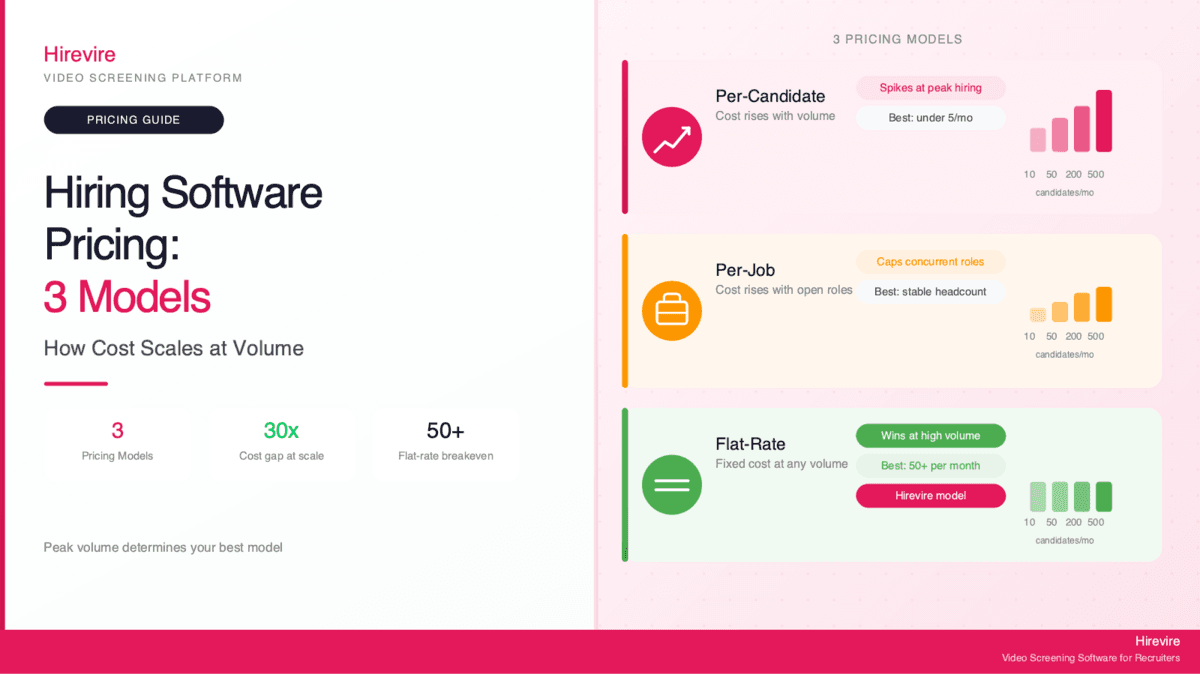
Quick Summary: Three pricing models dominate hiring software: per-candidate, per-job, and flat-rate. They look similar at low volume and diverge sharply at scale. This guide shows the math at four hiring volumes and helps you identify which model fits your actual hiring pattern. Hirevire uses flat-rate pricing, which means costs stay fixed even during peak hiring months.
TL;DR - Three Pricing Models, Very Different Cost Curves
| Model | Best at low volume | Best at high volume | Risk |
|---|---|---|---|
| Per-candidate | Yes (pay only when active) | No (costs spike at peak) | Unpredictable invoices |
| Per-job | Moderate | Moderate | Limits concurrent openings |
| Flat-rate | Less efficient | Yes (costs stay fixed) | Overpaying during slow periods |
The fundamental question is not which model is cheapest on average - it is which model is cheapest during your busiest quarter, which is exactly when you most need the tool to work.
The Three Pricing Models in Hiring Software
Before running the numbers, here is what each model actually means in practice.
Per-candidate pricing
You pay a fee for each candidate who enters the screening process. This might be a flat fee per screened applicant, a fee per completed video interview, or a credit-based system where each response consumes credits. The bill grows directly with application volume. When hiring demand spikes - seasonal roles, rapid growth, replacing multiple leavers at once - the cost spikes with it.
Vervoe charges $300 for 10 candidates scaling to $9,000 for 1,000. At first glance that looks reasonable. Spread across a slow quarter with 20 candidates, it is $600. Across a busy quarter with 300 candidates, it is $2,700 for a single quarter.
Per-job pricing
You pay based on the number of active job openings rather than the number of candidates who apply. This model is common in applicant tracking systems. It is predictable for companies that always have a fixed number of openings but becomes expensive when you need to post many roles simultaneously.
Spark Hire's video interview plan runs $249-$299/month regardless of candidate volume, but limits active job postings. Companies running seasonal hiring across multiple roles simultaneously may hit those caps at the worst possible moment.
Flat-rate pricing
You pay a fixed monthly or annual fee that does not change based on how many candidates you screen or jobs you post. Costs are predictable. The trade-off is that you pay the same amount during a slow month as a busy one.
Hirevire uses this model. The Professional plan at $99/month (billed annually) covers up to 1,200 screening sessions per year across 5 active roles. That cost does not change if you use 200 sessions in December versus 50 in February.
Pricing Comparison at Four Hiring Volumes
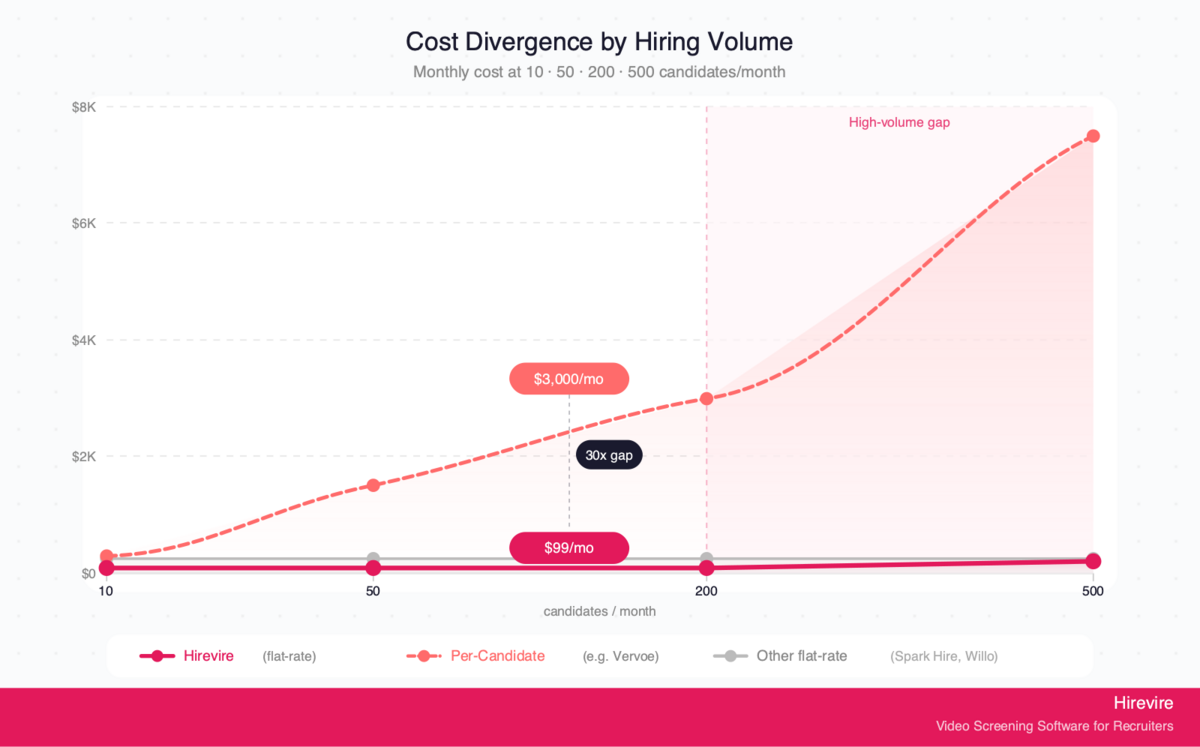
The table below estimates monthly costs for each platform at four candidate volumes: 10, 50, 200, and 500 per month. All figures are based on publicly available pricing or documented pricing structures as of 2026.
| Platform | 10 candidates/mo | 50 candidates/mo | 200 candidates/mo | 500 candidates/mo |
|---|---|---|---|---|
| Hirevire (Professional, annual) | $99 | $99 | $99 | $99-$199 |
| Spark Hire (annual) | $249 | $249 | $249 | $249 |
| Willo (Growth, annual) | $209 | $209 | $209-$307 | $307+ |
| Workable (Standard, annual) | $299 | $299 | $299 | $299+ |
| Vervoe (per-candidate) | ~$300 | ~$1,500 | ~$3,000+ | ~$7,500+ |
Hirevire Professional covers 1,200 sessions/year (~100/month). Above that, the Agency plan at $199/month covers 12,000/year.
Willo Growth covers 2 active assessments. High-volume concurrent usage may require Scale plan at $307/month.
The divergence between flat-rate and per-candidate pricing becomes significant above 50 candidates per month. At 200 candidates per month, a per-candidate tool that charges $15/screen costs $3,000/month. Hirevire's flat-rate costs $99.
Annual cost comparison at 200 candidates/month:
| Platform | Annual cost at 200 candidates/mo |
|---|---|
| Hirevire Professional | $1,188/year |
| Spark Hire | $2,988/year |
| Willo Growth/Scale | $2,508-$3,684/year |
| Workable Standard | $3,588/year |
| Vervoe (est.) | $36,000+/year |
These figures assume consistent volume. Real hiring is not consistent - which is exactly why peak-volume pricing matters more than average-volume pricing.
When Per-Candidate Pricing Actually Wins
Flat-rate pricing is not always the right answer. There is one scenario where per-candidate pricing makes genuine sense: extremely low, very sporadic hiring.
A business that makes 3-5 hires per year, with no predictable cadence, has little reason to pay a flat monthly subscription during the 10 months they are not actively hiring. Per-candidate or per-job tools let them pay only when active.
The threshold is roughly 5 candidates per month. Below that, a flat-rate plan charging $99/month may cost more annually than a per-candidate tool would at that volume. Above it - and especially above 20-30 candidates per month - flat-rate wins on cost almost universally.
When per-candidate tools make sense:
- Under 5 screened candidates per month on average
- Highly seasonal businesses with 1-2 intense hiring windows separated by months of no hiring
- Project-based organizations that hire in bursts and are dormant between projects
When Flat-Rate Unlimited Wins
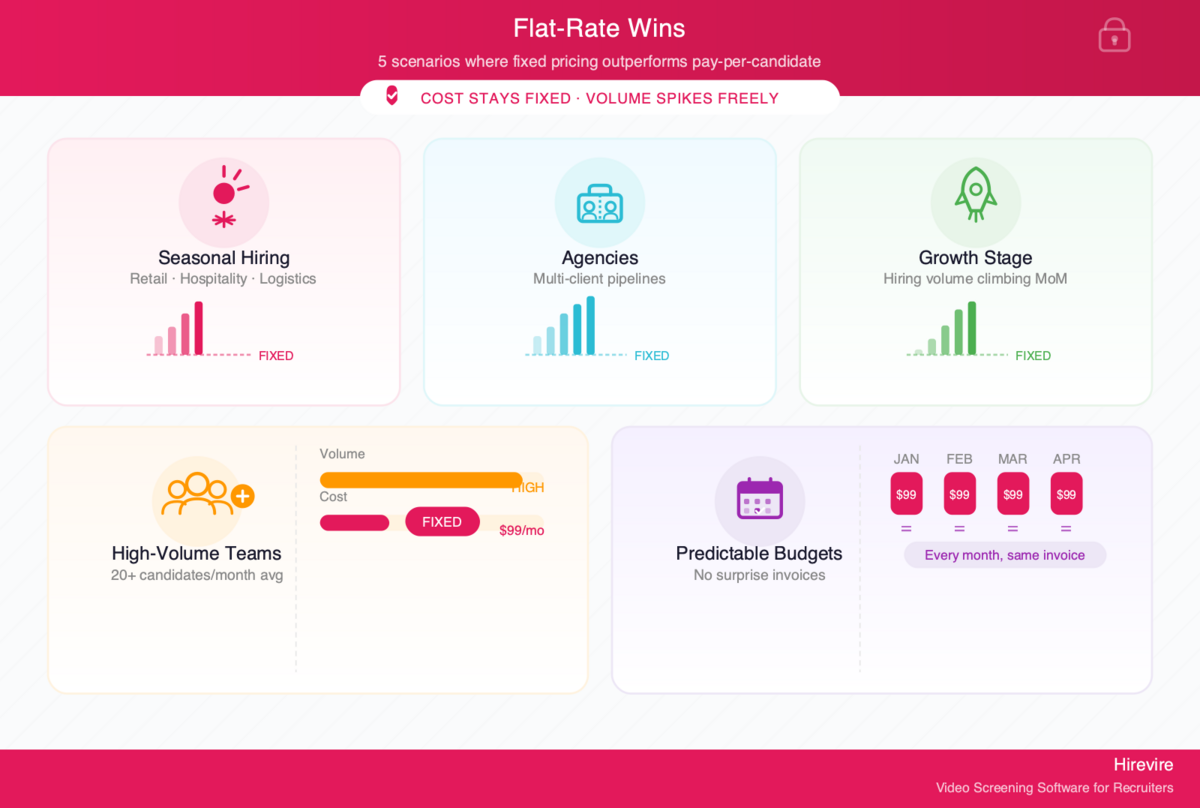
Flat-rate pricing has a compounding advantage: it does not punish success. When a job post goes viral, when a new product launch creates 50 simultaneous openings, when an employee leaves and you post three roles in the same week - the cost does not change.
Hirevire is built for teams where hiring volume is variable but the need for screening does not disappear during busy periods. Customers like agencies handling multiple client accounts, growing startups in active hiring phases, and SMBs with seasonal demand all benefit from knowing the screening bill stays fixed.
"We brought in about 25 applications so far through Hirevire, and our candidates, as well as management teams, love the system. This is a major time saver for us." melgipson, AppSumo
When flat-rate wins:
- Average screening volume above 20 candidates per month
- Seasonal hiring with significant peaks (retail, hospitality, logistics)
- Agencies managing multiple client hiring pipelines simultaneously
- Growth-stage companies where hiring volume is climbing month over month
- Any team where predictable budgeting matters more than pay-as-you-go flexibility
Hirevire pricing:
| Plan | Monthly | Annual | Sessions/year | Active roles |
|---|---|---|---|---|
| Essentials | $49/mo | $39/mo | 300 | 1 |
| Professional | $149/mo | $99/mo | 1,200 | 5 |
| Agency | $249/mo | $199/mo | 12,000 | 20 |
"It cuts down my hiring process by at least 75% and made it sooo much easier to see/feel who the candidates were before having to hop on a call with them." ElevateClients, AppSumo
One Question to Choose Your Model
All the comparison tables aside, there is a single question that determines which pricing model fits your situation:
What is your peak monthly screening volume in your busiest quarter?
Not your average. Not your slow months. Your peak.
If that number is under 5: per-candidate pricing is likely cheaper.
If that number is 10-50: flat-rate and per-candidate are close - run the math at your specific peak volume.
If that number is above 50: flat-rate almost certainly wins, sometimes by a factor of 10x or more.
The reason peak matters more than average: hiring software is most valuable - and most heavily used - during your worst bottlenecks. A tool that becomes expensive exactly when you need it most is poorly matched to your actual needs. The budgeting question is not "what does this cost on average?" It is "what does this cost when I'm drowning in applications?"
Hirevire customers consistently cite predictable billing as a key factor in choosing flat-rate over per-candidate alternatives. The monthly invoice does not change whether it was a slow month or a record-breaking one.
"Hirevire is a game-changer in streamlining the hiring process. Its automated screening software saves lots of time and provides a good view of candidates. It's user-friendly, efficient, and perfect for high-volume hiring or short-staffed HR teams." Mohammad Awais, AppSumo
Frequently Asked Questions
Pricing Models
What is the difference between per-candidate and per-job pricing?
Per-candidate pricing charges based on how many applicants go through screening - each screened person costs something. Per-job pricing charges based on how many open roles you have active at once, regardless of how many applicants apply to each. Per-candidate costs scale with application volume; per-job costs scale with the number of concurrent openings. Hirevire uses neither - its flat-rate model charges a fixed monthly fee regardless of candidates or open roles within plan limits.
Are there hiring tools that are completely free?
Some ATS platforms (Breezy HR, Zoho Recruit) offer limited free tiers. Pre-screening tools like Hirevire do not offer a free tier but provide a trial. Free tiers in hiring software almost always cap the number of active jobs, users, or monthly responses, making them unsuitable for any serious hiring volume.
Does Hirevire charge per candidate?
No. Hirevire charges a flat monthly or annual rate. Within plan limits (300/year on Essentials, 1,200/year on Professional, 12,000/year on Agency), there are no per-candidate or per-interview fees. You screen 10 candidates in a month or 100 candidates - the bill is the same.
Volume Scenarios
What happens if I hit my plan's session limit mid-month?
With Hirevire, sessions are allocated annually. If you hit the annual limit before year-end, you can upgrade to the next plan tier. The Essentials plan (300/year) works out to about 25 sessions per month. The Professional plan (1,200/year) averages 100/month. Most small business hiring teams stay well within Professional plan limits.
How does pricing work for agencies managing multiple clients?
Agencies are one of the clearest use cases for flat-rate pricing. A recruiting agency screening candidates across five different client mandates simultaneously cannot predict total candidate volume month to month - but per-candidate tools would bill them for every candidate across every client. Hirevire's Agency plan at $199/month covers 20 active roles and 12,000 sessions per year, making the per-client cost predictable regardless of how many candidates each mandate attracts.
Is hiring software pricing negotiable?
For enterprise platforms (HireVue, iCIMS, Greenhouse), pricing is almost always negotiated - list prices are starting points. For SMB-focused flat-rate tools like Hirevire, pricing is standardized and published. The tradeoff is that you know exactly what you pay before signing up, without a negotiation process that can take weeks.
Switching Costs
What does it cost to switch hiring software mid-year?
The direct cost is usually the new subscription and any setup time. The hidden costs are workflow disruption, re-configuring question sets, and the learning curve for the team. For screening-focused tools like Hirevire, setup is typically measured in hours rather than weeks - the platform is designed for fast deployment. ATS switching is more involved because historical candidate data and pipeline state need to migrate.
How do I evaluate a new hiring tool before committing?
Run a real hiring role through it, not a demo scenario. Use it on an active open position for 2-3 weeks, screen real candidates, and have at least two team members review responses. Cost comparison is easier to evaluate after you have a sense of whether the tool actually fits the workflow. Hirevire offers a trial period to test before committing to an annual plan.
Conclusion: Price Your Hiring Software Against Peak Demand, Not Average Demand
The single most common mistake in hiring software budgeting is comparing average monthly costs. Average costs are misleading because hiring is not average - it spikes, and those spikes are when the tool earns its value.
A per-candidate tool that costs $150 in a typical month may cost $3,000 in your busiest month. A flat-rate tool at $99/month costs $99 in both months.
The math is straightforward once you know your peak volume. If your busiest quarter involves more than 30-50 screened candidates per month, flat-rate pricing almost always wins on cost. If your hiring is sparse and irregular, per-candidate tools may be the better fit.
Hirevire offers flat-rate pre-screening at $39/month (billed annually on Essentials) to $199/month (Agency), with no per-candidate fees within plan limits and no candidate login required. It sits alongside your ATS rather than replacing it, handling the pre-screening stage where per-candidate costs typically add up fastest.
Key takeaways:
- Three pricing models: per-candidate scales with volume, per-job scales with openings, flat-rate stays fixed
- Flat-rate wins above roughly 20-50 screened candidates per month
- Per-candidate makes sense only for very low, very sporadic hiring
- Peak-quarter volume is the right metric for model selection, not average monthly volume
- Agencies and seasonal businesses benefit most from flat-rate predictability
Calculate your per-candidate cost at peak volume → then compare to Hirevire's flat rate
Last updated: May 2026. All pricing verified against public sources as of May 2026.