How to Use AI in Recruitment in 2026: A Practical Implementation Guide to Improve Recruitment Process
You don't need a massive budget or tech team to implement AI in recruitment. While headlines showcase Fortune 500 companies deploying complex AI systems, the reality is that small and medium organizations can leverage AI recruitment tools effectively with minimal resources and see measurable results within weeks.
According to LinkedIn's 2025 Global Talent Trends report, 76% of talent professionals say AI is transforming recruitment, but the gap between awareness and action remains significant. The primary barrier isn't technology availability or cost but rather uncertainty about where to start.
This guide provides a practical, step-by-step roadmap for implementing AI in recruitment. Unlike theoretical frameworks, this guide focuses on actionable steps you can take tomorrow, quick wins that demonstrate value immediately, and proven implementation strategies based on real-world adoption patterns.
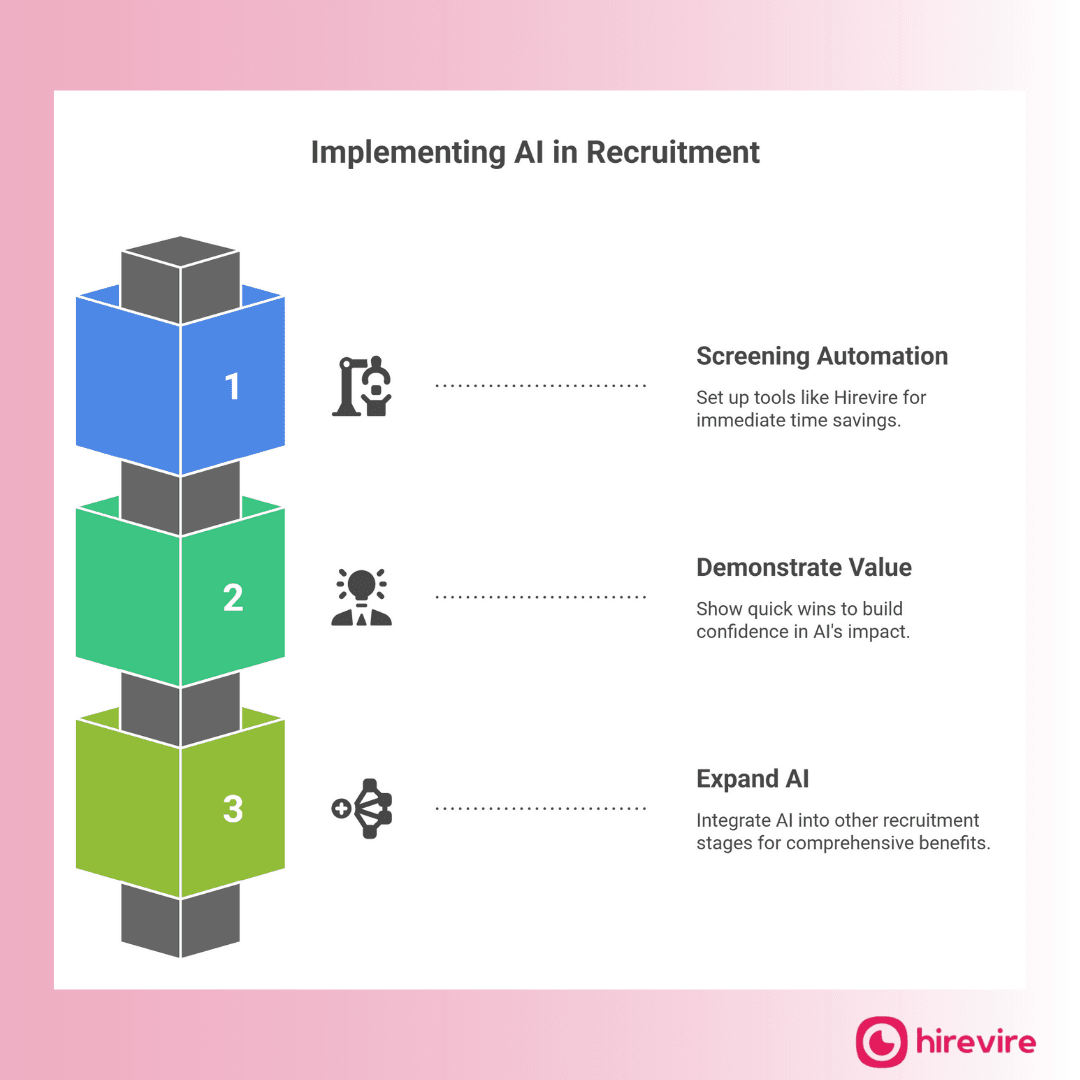
Quick Summary: The fastest path to AI recruitment implementation starts with screening automation. Tools like Hirevire can be set up in under an hour, deliver 70-80% time savings immediately, and require no technical expertise or large budget. This practical approach lets you demonstrate value quickly before expanding AI to other recruitment stages.
Understanding the Opportunity: Why AI in Recruitment Now
Before diving into implementation steps, understanding why AI in recruitment delivers compelling ROI clarifies where to focus efforts and what results to expect.
The Recruiting Bottleneck
Traditional recruitment processes create predictable bottlenecks. Initial screening represents the most time-consuming, highest-volume, and often lowest-value activity recruiters perform. Phone screens typically require 15-20 minutes per candidate plus 10-15 minutes of scheduling coordination.
For a position receiving 200 applications, comprehensive phone screening would require 50-67 hours of recruiter time. Faced with this volume constraint, organizations make compromises: screen only top candidates based on resume review, conduct superficial screens, extend time-to-fill, or increase recruiting costs.
Why Screening is the Optimal Starting Point
AI delivers value across multiple recruitment stages, but screening represents the optimal starting point:
Highest Volume, Highest Time Savings - Screening consumes more recruiter hours than any other activity. AI screening automation delivers immediate 70-80% time reduction.
Well-Structured, Objective Evaluation - Unlike cultural fit assessment requiring nuanced judgment, initial screening involves structured competency assessment ideal for AI automation.
Low Risk, High Value - AI screening maintains human decision authority. Humans review AI analysis and make final decisions, combining efficiency with oversight.
Proven, Mature Technology - AI screening platforms like Hirevire represent mature, proven technology with thousands of successful implementations.
The Economics of AI Screening
For a typical mid-market organization conducting 100 hires annually:
- Current screening cost: 20 hours per position × 100 positions × $50/hour = $100,000 annually
- AI screening cost: Hirevire Professional plan at $99/month (billed yearly) = $1,188 annually
- Time savings: 75% reduction = 1,500 hours freed annually
- Net benefit: $73,812 plus improved hiring speed
This 62x ROI explains why AI screening adoption continues accelerating.
Phase 1: Audit Your Current Recruitment Process
Successful AI implementation begins with understanding your current state. A structured process audit identifies bottlenecks, quantifies improvement opportunities, and guides strategic implementation decisions.
Map Your Current Recruitment Workflow of Your Hiring Process
Document your current recruitment process focusing on:
Time Mapping:
- How many days does each stage require on average?
- Where do delays concentrate?
- What's your total time-to-fill?
Activity Breakdown:
- How many hours per week do recruiters spend on screening?
- Which activities consume the most time relative to value delivered?
Volume Analysis:
- How many applications do typical positions receive?
- What are your application-to-phone-screen and phone-screen-to-interview ratios?
- Where do candidates drop out most frequently?
Identify Your Biggest Bottleneck in Talent Acquisition
For most organizations, screening emerges as the primary bottleneck. Calculate your current screening burden:
- Average applications per position: _____
- Phone screens conducted per position: _____
- Minutes per phone screen including scheduling: _____
- Total hours per position: _____
- Annual positions filled: _____
- Total annual screening hours: _____
This calculation quantifies the opportunity.
Document Your Current HR State Metrics
Establish baseline metrics before AI implementation:
- Average time-to-fill (days)
- Recruiter hours spent on screening (weekly/monthly)
- Cost per hire
- Candidate-to-interview conversion rate
- Offer acceptance rate
- 90-day new hire performance ratings
- Candidate satisfaction scores
Phase 2: Start with ONE High-Impact Area (Screening Recommended)
The temptation when implementing AI is to try everything at once. This scattered approach leads to overwhelming complexity, difficulty isolating what works, team resistance from too much change, and unclear ROI attribution.
Instead, focus intensely on one high-impact area, prove value, build confidence, and then expand systematically.
Why Screening Delivers Fastest ROI
Immediate Value Realization - Unlike sourcing AI requiring months to build talent pools, screening automation delivers value from day one.
Minimal Technical Complexity - Modern screening platforms require no IT involvement, no complex integrations, and no technical expertise. Setup takes under an hour.
Low Risk with Human Oversight - AI screening maintains human decision authority, combining efficiency with judgment.
Quantifiable, Demonstrable ROI - Time savings are easy to measure and demonstrate.
Foundation for Advanced Capabilities - Successful screening implementation builds organizational AI literacy and confidence.
What Screening Automation Looks Like
Traditional Process:
- Recruiter reviews resume (5-10 minutes)
- Recruiter schedules phone screen (10-15 minutes)
- Recruiter conducts phone screen (15-20 minutes)
- Total time: 30-45 minutes per candidate
AI-Powered Screening Process:
- Candidate receives Hirevire invitation automatically
- Candidate completes video screening at their convenience (10-15 minutes)
- AI generates transcription and analysis automatically
- Recruiter reviews video with AI insights (3-5 minutes)
- Total time: 3-5 minutes per candidate (83-91% time reduction)
This dramatic efficiency gain enables comprehensive evaluation of entire candidate pools.
Phase 3: Choose Your Tool with Confidence
Critical Evaluation Criteria
When evaluating AI screening platforms, assess:
1. Functionality and Flexibility - Does the platform support video, audio, text, and file responses? Hirevire uniquely supports all four formats.
2. Candidate Experience - Login requirements cause 20-25% drop-off. Hirevire's no-login approach eliminates this friction.
3. AI Capabilities - What languages are supported? Hirevire offers 90+ language transcription.
4. Integration Capabilities - Hirevire offers 5000+ app connections via Zapier, webhooks, and API.
5. Implementation Speed - Hirevire enables setup in under an hour with no IT involvement.
6. Pricing Transparency - Hirevire offers transparent pricing ($39-199/month) with unlimited candidates.
7. Compliance and Risk Management - Hirevire's human-in-the-loop design maintains human decision authority.
Recommended Platform: Hirevire for Screening
Based on comprehensive evaluation, Hirevire represents the optimal AI screening platform due to:
- Multi-format responses (video, audio, text, files)
- No candidate login required
- AI transcription in 90+ languages
- 5000+ app connections
- Setup in under 1 hour
- Affordable pricing ($39-199/month)
- Human decision authority maintained
Phase 4: Run a Focused Pilot Program
Rather than full-scale implementation, run a structured pilot program to validate effectiveness, build team confidence, and demonstrate ROI.
Two-Week Pilot Framework
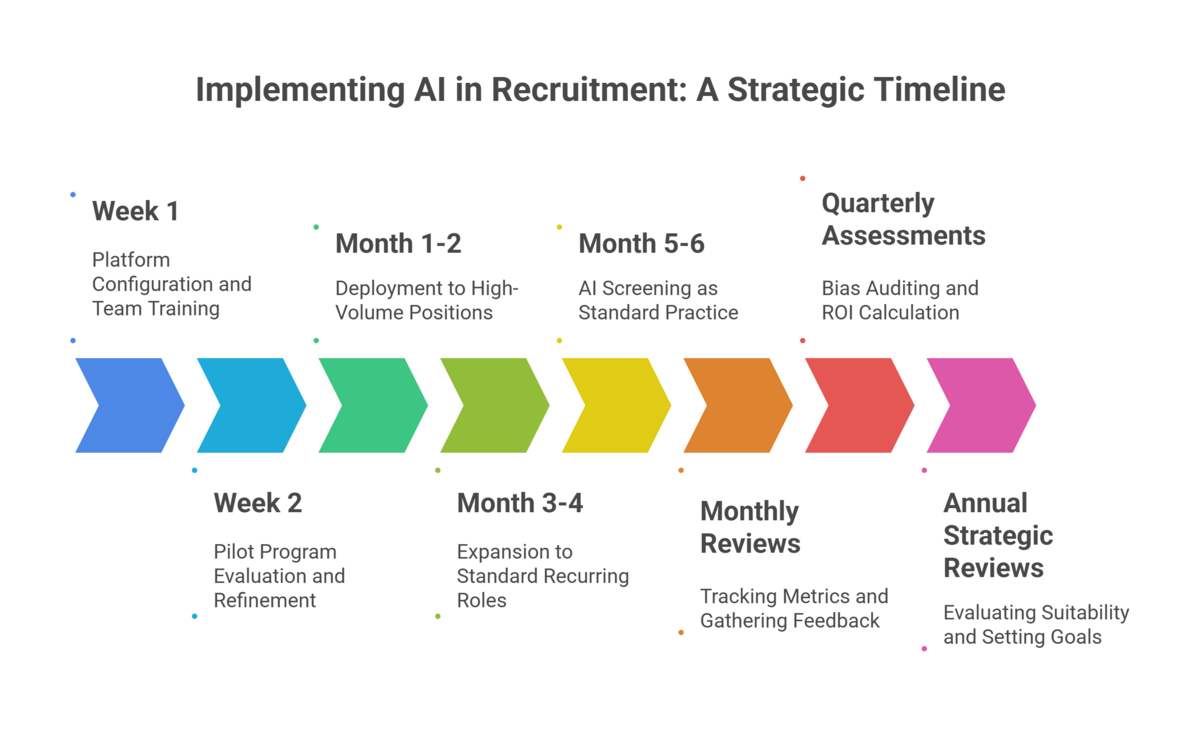
Week 1: Setup and Initial Deployment
Monday-Tuesday: Platform Configuration
- Create Hirevire account (30 minutes)
- Select 1-2 positions for pilot
- Draft screening questions (4-6 questions recommended)
- Define evaluation criteria
- Configure automated workflows
Wednesday: Team Training
- 30-minute training session
- Demonstrate candidate experience
- Walk through reviewer interface
- Address questions
Thursday-Friday: Initial Candidate Invitations
- Send Hirevire invitations to 20-30 candidates
- Monitor completion rates
- Review first batch of responses
Week 2: Evaluation and Refinement
Monday-Wednesday: Full Deployment
- Continue sending invitations
- Review incoming responses daily
- Compare AI analysis to recruiter assessment
- Document time spent reviewing
Thursday: Candidate Feedback Collection
- Survey candidates who completed screening
- Identify pain points or confusion
Friday: Pilot Assessment
- Team debrief meeting
- Review quantitative metrics
- Collect qualitative feedback
- Decide: proceed to scale or refine
Pilot Success Criteria
Define success metrics before starting:
- Candidate completion rate: 70%+ (vs. 50-60% for phone screens)
- Time savings: 75%+ reduction
- Quality alignment: 80%+ agreement between AI and human assessment
- Candidate satisfaction: 4.0+ / 5.0 average rating
- Team satisfaction: Majority prefer AI screening
Common Pilot Adjustments
Based on pilot results, organizations commonly refine:
- Question clarity - Simplify complex questions
- Evaluation criteria - Refine AI prompts for better alignment
- Workflow integration - Optimize invitation timing
- Candidate communication - Improve invitation email clarity
Phase 5: Measure Results and Scale Systematically
Measuring Success: Key Metrics to Track
Efficiency Metrics:
- Screening time per candidate
- Total screening hours per position
- Recruiter time freed per week
- Value of freed time
Speed Metrics:
- Time-to-first-screen
- Time-to-interview
- Overall time-to-fill
- Speed improvement percentage
Quality Metrics:
- Candidate-to-interview conversion rate
- Interview-to-offer conversion rate
- 90-day new hire performance ratings
- First-year retention rate
Experience Metrics:
- Candidate completion rate
- Candidate satisfaction score
- Recruiter satisfaction
- Hiring manager satisfaction
ROI Calculation:
- Monthly subscription cost
- Monthly time savings (hours × cost)
- Net monthly benefit
- ROI percentage
Typical Hirevire customers at the $99/month plan saving 100 hours monthly achieve ROI exceeding 4,000%.
Systematic Scaling Strategy
After successful pilot, scale systematically:
Month 1-2: High-Volume Positions - Deploy to all positions receiving 50+ applications
Month 3-4: Standard Recurring Roles - Expand to positions with regular hiring needs
Month 5-6: All Positions - Make AI screening standard practice
This phased approach enables continuous learning, gradual change management, and building of organizational expertise.
Continuous Optimization
Monthly Reviews:
- Track metrics dashboard
- Identify positions with lower effectiveness
- Gather feedback from team
- Refine questions and criteria
Quarterly Assessments:
- Conduct bias auditing
- Validate quality of hire
- Calculate and communicate ROI
- Identify opportunities for expansion
Annual Strategic Reviews:
- Assess platform continuing suitability
- Evaluate new features
- Consider expanding to additional stages
- Set goals for year ahead
Quick Wins: What You Can Implement Today
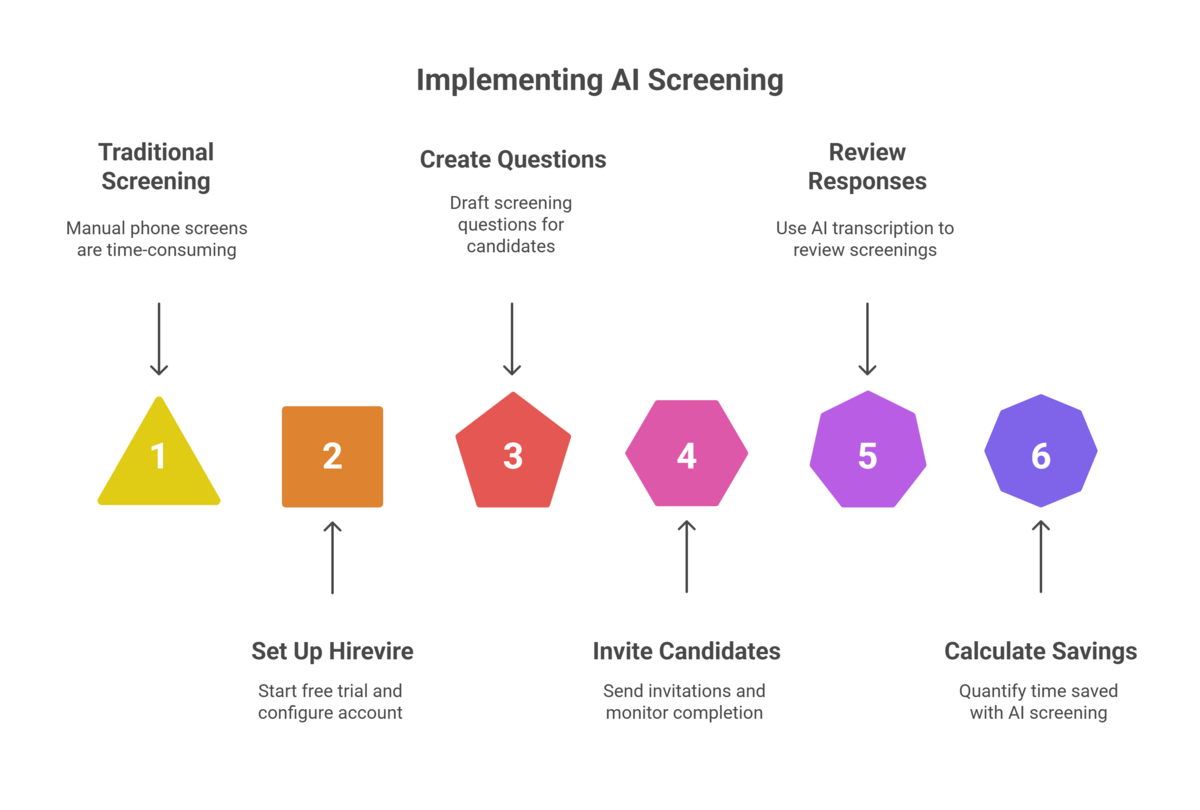
Quick Win 1: Set Up Hirevire Account (30 Minutes)
- Visit Hirevire and start free trial
- Complete account setup
- Upload company logo
- Configure email settings
Quick Win 2: Create First Screening Question Set (30 Minutes)
Draft 4-6 screening questions for your highest-volume position:
- Question 1: Background and experience verification
- Question 2: Technical or functional competency
- Question 3: Situational or behavioral
- Question 4: Culture fit or motivation
Quick Win 3: Invite 10 Candidates (15 Minutes)
Send Hirevire invitations to 10 recent applicants and monitor completion over 24-48 hours. Expected outcome: 7-8 candidates complete within 48 hours.
Quick Win 4: Review First Responses (30 Minutes)
Review completed screenings with AI transcription support. Compare time spent vs. traditional phone screens. Typical result: Review 8 candidates in 30-40 minutes vs. 2-3 hours for phone screens.
Quick Win 5: Calculate and Communicate Time Savings (15 Minutes)
Quantify pilot results:
- Traditional: 8 phone screens × 25 minutes = 200 minutes (3.3 hours)
- Hirevire: 8 video reviews × 4 minutes = 32 minutes (0.5 hours)
- Time saved: 2.8 hours (84% reduction)
Share results with stakeholders highlighting efficiency gains.
Total Time for Quick Wins: 2.5 Hours
In less than half a workday, you can go from zero to a functioning AI screening capability with quantifiable results.
Common Pitfalls and How to Avoid Them
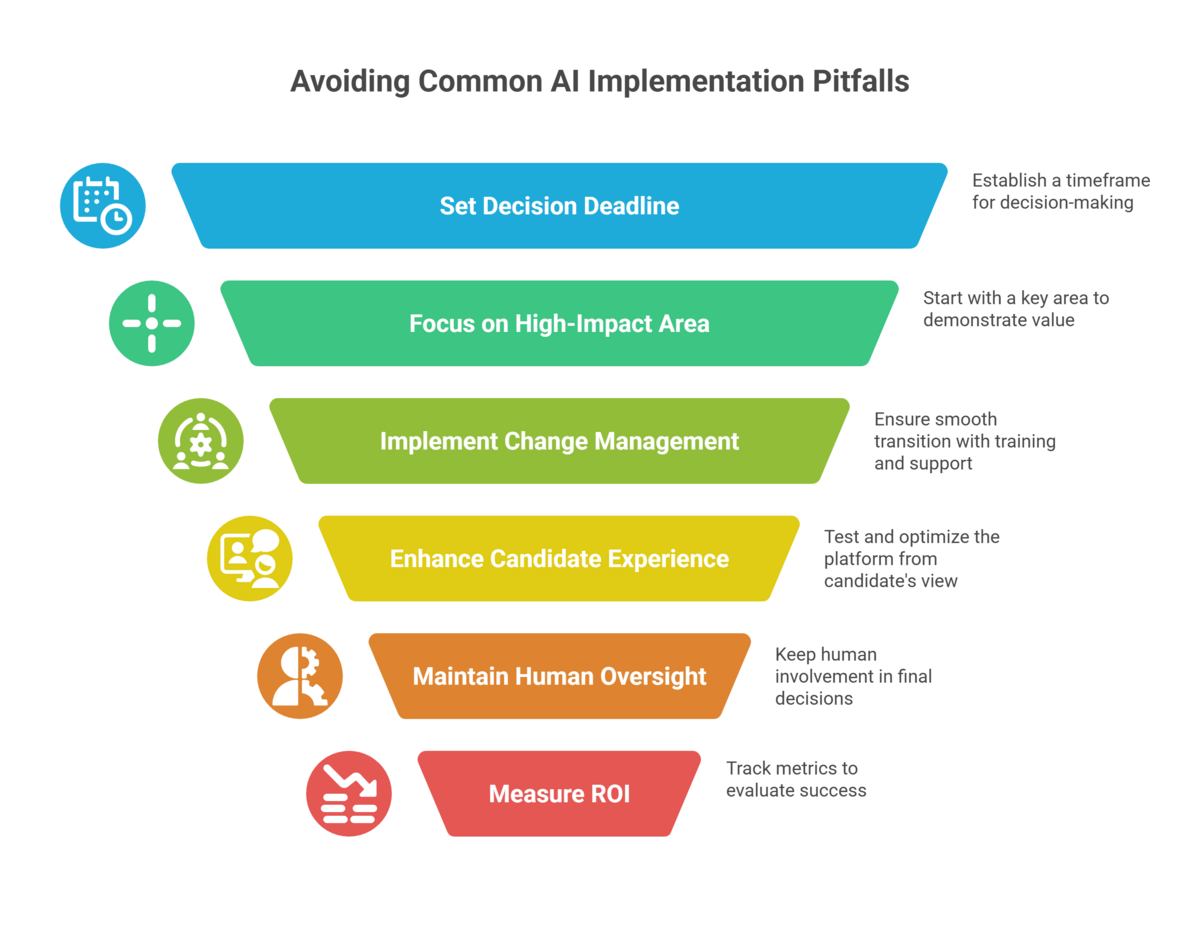
Pitfall 1: Analysis Paralysis
Solution: Set a decision deadline (maximum 2 weeks). Remember: you can always change platforms later. Choose Hirevire and start a trial today.
Pitfall 2: Trying to Automate Everything Simultaneously
Solution: Start with one high-impact area (screening). Prove value, build confidence, then expand systematically.
Pitfall 3: Ignoring Change Management
Solution: 30-minute training session, written quick-start guide, designated champion, weekly check-ins during first month.
Pitfall 4: Neglecting Candidate Experience
Solution: Test the platform yourself from candidate perspective. Choose tools like Hirevire with no-login access and mobile optimization.
Pitfall 5: Fully Autonomous AI
Solution: Maintain human-in-the-loop design. Hirevire provides AI analysis, but humans make final decisions.
Pitfall 6: No Measurement
Solution: Establish baseline metrics before implementation. Track identical metrics post-implementation. Calculate and communicate ROI regularly.
Pitfall 7: Selecting Based on Features vs. Usability
Solution: Prioritize simplicity and usability. Organizations using simple tools like Hirevire achieve better results.
Implementation Case Study: 48-Hour Hirevire Deployment
Company Profile
Organization: Regional healthcare system with 500 employees
Challenge: Nursing recruitment bottleneck causing staffing shortages
Position: Registered Nurses (80-100 RN hires annually)
Implementation Timeline
Thursday Morning (Hour 1): Platform setup, branding configuration
Thursday Afternoon (Hour 2): Question development with nursing leadership
Thursday Late Afternoon (Hour 3): Team training
Friday Morning (Hours 4-5): Initial deployment to 25 candidates
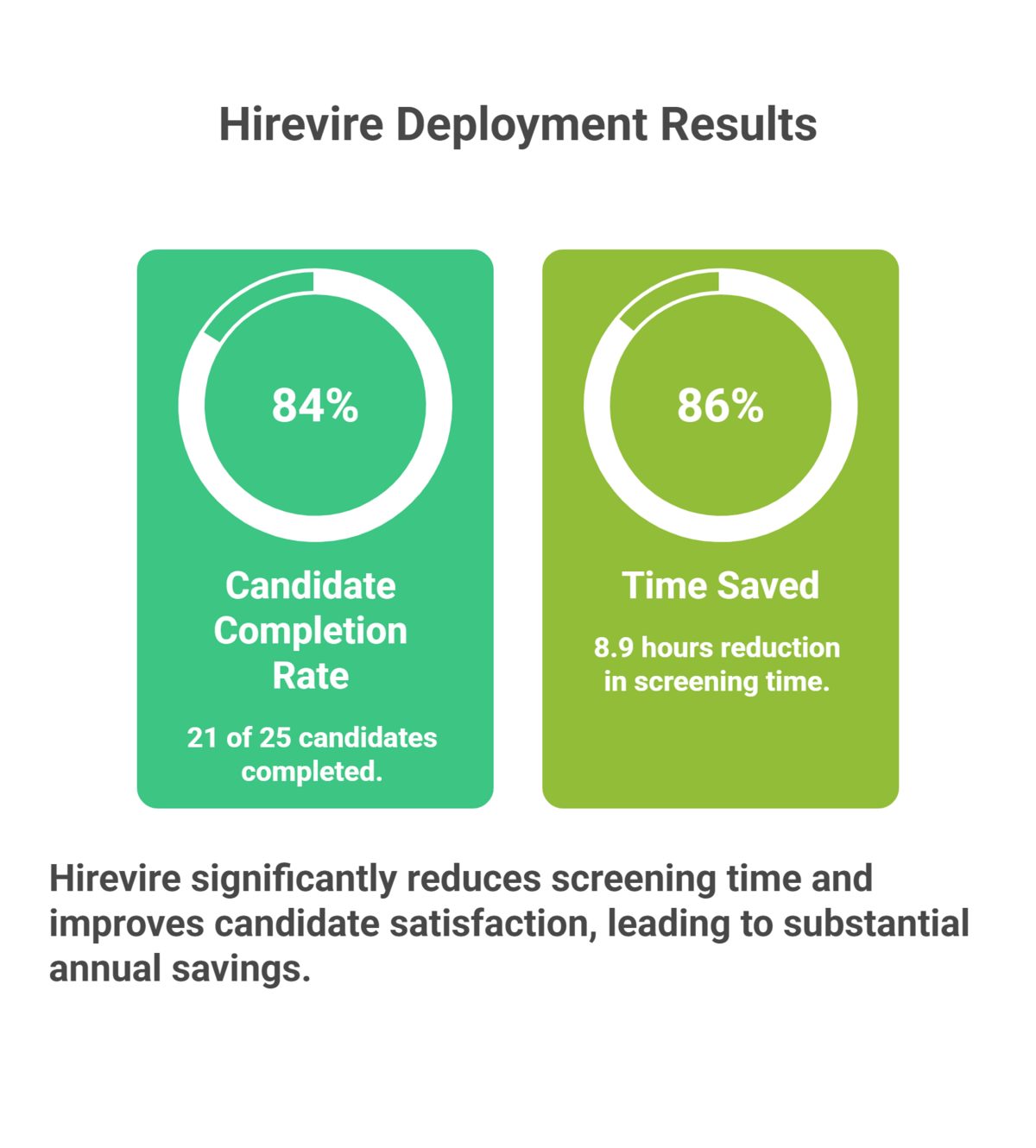
Friday-Monday: Candidate completion (21 of 25 completed, 84% rate)
Monday Morning (Hours 6-8): Response review in 90 minutes
Results After 48 Hours
- Traditional approach: 625 minutes (10.4 hours)
- Hirevire approach: 90 minutes (1.5 hours)
- Time saved: 8.9 hours (86% reduction)
- Candidate satisfaction: 4.2 / 5.0
- Projected annual savings: 400+ screening hours worth $20,000-25,000
Frequently Asked Questions
How do I use AI in recruitment if I'm a small company?
Small companies can implement AI recruitment starting at $39/month (billed yearly) with Hirevire's Essentials plan. Focus on screening automation for your highest-volume position. Setup requires under 1 hour with no technical expertise. You'll achieve 70-80% time savings immediately.
What's the first step to implementing AI?
The first step is auditing your current recruitment process to identify bottlenecks. Map out time spent on each stage and identify where delays concentrate. For most organizations, screening emerges as the highest-volume, most time-consuming activity. Once identified, create a Hirevire account and complete the 2-hour quick win sequence.
Where should I start with AI in recruitment?
Start with screening, specifically asynchronous video screening with AI support via Hirevire. Screening delivers fastest ROI (immediate time savings), requires lowest technical complexity (setup in under 1 hour), maintains lowest risk (human decision authority preserved), and uses most mature technology.
How can I use AI to automate recruitment tasks?
AI can automate initial screening via video interviews with AI transcription (Hirevire), resume parsing (ATS built-in features), candidate sourcing, interview scheduling, and candidate communication. Start with screening automation, which typically delivers highest ROI, then expand based on your specific bottlenecks.
Can I implement AI without technical expertise?
Yes, modern AI recruitment platforms like Hirevire require zero technical expertise. You can set up a complete screening automation workflow in under 1 hour without IT involvement. The platform uses intuitive interface, provides pre-built templates, and offers built-in integrations via Zapier (no coding required).
How long does it take to see results?
You can see results immediately. Organizations implementing Hirevire screen their first candidates within 24-48 hours and experience time savings on those first screenings. Within 2 weeks (the recommended pilot period), you'll have quantifiable data on time savings, candidate quality, and completion rates.
What metrics should I track?
Track four categories: (1) Efficiency - screening time per candidate, recruiter time freed, (2) Speed - time-to-interview, overall time-to-fill, (3) Quality - conversion rates, 90-day performance ratings, retention, and (4) Experience - candidate completion rate, satisfaction scores. Calculate ROI by comparing value of freed recruiter time against Hirevire subscription cost.
How do I convince my team to adopt AI?
Convince through demonstration rather than persuasion. Start with a small pilot (1-2 positions for 2 weeks) that demonstrates value without major commitment. Let time savings and candidate quality speak for themselves. Share quantitative results and candidate feedback. Most resistance dissolves when people experience AI screening firsthand via Hirevire.
Conclusion: Your Implementation Roadmap
AI in recruitment has transitioned from experimental technology to practical, accessible tool delivering measurable value. The comprehensive implementation framework presented provides a clear path from current state to optimized AI-powered recruitment.
Your Step-by-Step Roadmap
This Week:
- Monday: Audit current process, identify screening bottleneck (1 hour)
- Tuesday: Create Hirevire account, draft questions (1.5 hours)
- Wednesday: Train team (1 hour)
- Thursday-Friday: Invite first 20 candidates (30 minutes)
Next Week:
- Monday: Review completed screenings (1 hour)
- Tuesday-Thursday: Continue pilot, gather feedback
- Friday: Assess pilot results, decide to scale (1 hour)
Weeks 3-8: Scale systematically from high-volume positions to all roles
Months 3-6: Optimize questions, implement advanced integrations, establish continuous improvement
Key Principles for Success
Start Small, Prove Value, Scale Systematically - Organizations starting with focused screening pilots succeed at 80%+ rates.
Prioritize Simplicity - Hirevire's simplicity drives higher adoption than feature-rich platforms requiring months of implementation.
Maintain Human Decision Authority - AI should augment human judgment, not replace it.
Measure, Communicate, Optimize - Track metrics from day one. Organizations that measure rigorously achieve 3x better results.
The Bottom Line
Implementing AI in recruitment is not a massive technology transformation. It's a focused, practical initiative accomplished in weeks with minimal budget and immediate ROI.
The path is clear:
- Start with screening
- Choose Hirevire
- Run 2-week pilot
- Scale systematically
- Optimize continuously
Organizations following this roadmap achieve 70-80% screening time savings, 40-50% faster time-to-fill, and ROI exceeding 50x within first year.
Your Next Action
Stop planning and start doing. Every week you delay costs you the value AI screening would deliver.
Complete the 2-hour quick win sequence. You'll screen your first candidates this week, experience time savings firsthand, and have quantifiable results within days.
Start today. Transform your recruitment efficiency this month. You can actually do this tomorrow.
Last updated: January 2026. All information and implementation recommendations verified as of January 6, 2026.