50+ Interview Questions for Offshore Candidates [Template + Video Prompts]
Hiring offshore candidates fails more often from communication breakdown than from skills gaps. The developer who can build anything but can't explain a blocker clearly, the designer who disappears across a timezone gap, the analyst who sends updates that require three follow-up emails to interpret - these failures are predictable and screenable.
Standard interview question banks weren't designed for offshore hiring. They evaluate skills and experience, but they miss the factors that actually determine whether a distributed team member succeeds: async communication quality, timezone self-management, comfort with ambiguity, and cultural fit in a distributed environment.
According to research from Buffer's State of Remote Work, collaboration and communication are consistently cited as the top challenges in remote and distributed work. These aren't soft concerns - they're the difference between a hire that works out and one that doesn't.
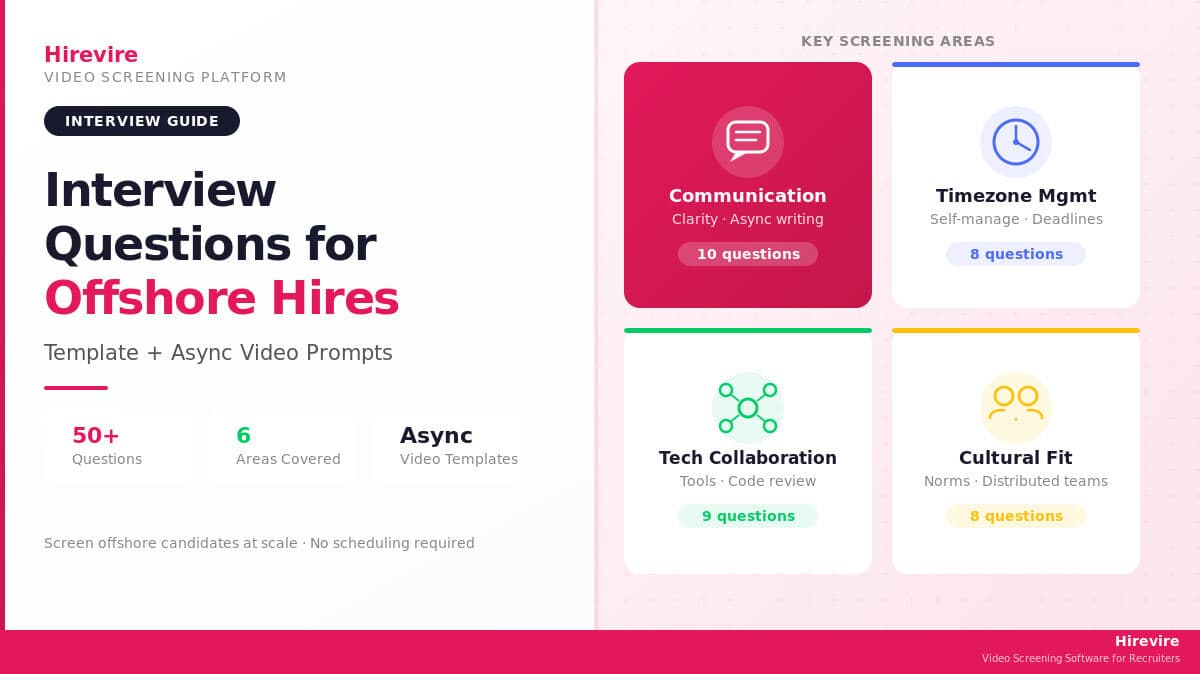
This guide organizes interview questions by the specific assessment areas that matter most for offshore candidates, and includes ready-to-use async video prompt templates for each section. Because offshore = timezone mismatch = scheduling impossible, these questions are built to work as async video prompts in Hirevire. Your candidate in Manila records at their 9am. You review at yours. No scheduling required.
Quick Summary: Use these questions as a structured question bank for offshore candidate screening. Each section includes 5-10 interview questions and a corresponding async video prompt template ready to use in Hirevire. Covers communication, timezone management, technical collaboration, cultural fit, scenario-based assessment, and cross-border hiring checklists for US-Canada and US-Philippines hiring.
Table of Contents
- Why Offshore Screening Requires Different Questions
- Communication and Language Assessment Questions
- Timezone and Availability Questions
- Technical Collaboration Questions
- Cultural Fit for Distributed Teams
- Scenario-Based Questions for Remote Work
- Using Async Video to Screen Offshore Candidates
- Cross-Border Hiring Checklist (US-Canada, US-Philippines)
- Frequently Asked Questions
Why Offshore Screening Requires Different Questions
Standard interview questions evaluate skills, experience, and motivation. Those still matter. But offshore hiring adds three specific risk factors that standard questions don't address.
Risk 1: Async Communication Quality
Most work on distributed teams happens asynchronously - Slack messages, email, documentation, pull request reviews, written updates. If a candidate communicates poorly in writing, that problem is invisible on a resume and easy to miss in a 30-minute live interview where the conversation flows naturally.
Async video pre-screening exposes communication quality under normal (not peak-performance) conditions. How clearly does the candidate organize their thoughts? Do they answer the question asked? Can they explain technical concepts without assuming shared context?
Risk 2: Timezone Self-Management
Working across timezones requires active management, not just willingness. The candidate who says "I'm fine with any hours" but doesn't have a system for tracking deadlines, following up across timezone gaps, or protecting focused work time is likely to create coordination problems.
Risk 3: Cultural Context and Assumptions
What "done" means, how disagreement is expressed, what level of initiative is expected versus asking for guidance - these norms vary significantly across cultures and work environments. Offshore candidates who've only worked in local environments may bring assumptions about professional communication that create friction in US or European team contexts, and vice versa.
Standard questions don't surface these differences. The questions in this guide are designed to.
What Changes in the Question Strategy
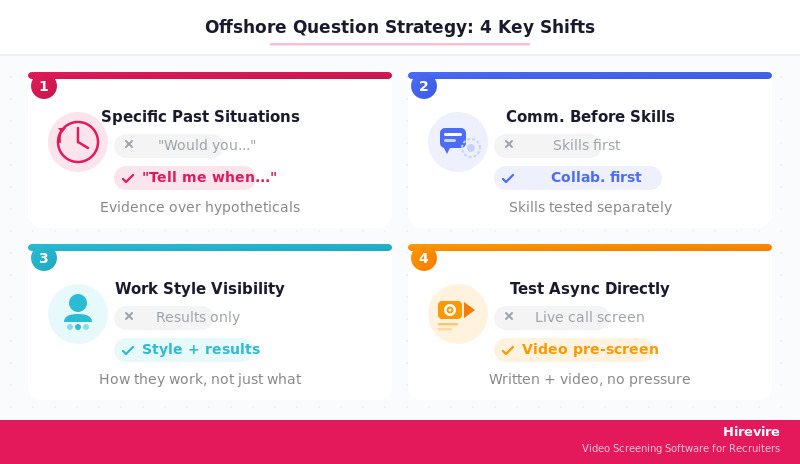
For offshore candidates:
- Ask about specific past situations (not "would you" but "tell me about a time when")
- Prioritize communication and collaboration questions over pure skills assessment (skills can be tested separately)
- Include questions that reveal work style explicitly, not just results
- Test async communication directly (written pre-screen questions, video responses without interview pressure)
Communication and Language Assessment Questions
Communication assessment for offshore candidates isn't about English fluency as a checkbox - it's about clarity, precision, and the ability to communicate in writing without losing information.
Interview Questions
Clarity and precision:
- "Walk me through how you would explain a technical problem to a non-technical stakeholder. Use a real example from a past project if possible."
- "Describe a situation where a miscommunication with a teammate caused a problem. What happened, what was your role in the miscommunication, and what did you do to fix it?"
- "How do you write a status update when a project is behind schedule? Walk me through what you would include and what you would leave out."
- "Describe a situation where you had to push back on a decision or a request from a manager or client. How did you communicate your concerns?"
- "Tell me about a time you received feedback on your communication (written or spoken) and changed how you work based on it."
Language and written communication:
- "We work primarily in English. On a scale of 1-10, how would you rate your written English compared to your spoken English? What kinds of writing do you find most challenging?"
- "Describe your experience writing technical documentation, email updates, or reports in English. What's the longest document you've written in English professionally?"
- "If you receive a Slack message that you don't fully understand, what do you do? Walk me through your exact process."
Async Video Prompt Template - Communication
Hirevire Question Set: Communication Assessment (Offshore)
Question 1 (90 sec): "Describe a situation where you had to explain a complex problem to someone who didn't have your technical background. What did you leave out, and how did you decide what to include?"
Question 2 (90 sec): "Tell me about a miscommunication you had with a colleague or client. What caused it and what would you do differently now?"
Question 3 (60 sec): "How do you decide whether to send a Slack/chat message or write a longer email? Give me a recent example of each."
These questions work well as async video prompts because they require specific examples, not generic answers. A candidate who gives a vague response to "describe a situation where..." is revealing something meaningful about their communication approach.
Timezone and Availability Questions
Timezone management is a skill. The questions in this section separate candidates who have actively managed distributed team work from those who are new to it.
Interview Questions
Timezone experience:
- "What timezones have you worked across, and how did you coordinate with teammates in significantly different time zones? Be specific about what tools and processes you used."
- "Describe a week when your overlap window with your primary team was less than 2 hours per day. How did you keep the work moving?"
- "Have you ever missed a deadline or dropped the ball because of a timezone communication gap? What happened?"
- "How do you handle urgent requests that come in outside your working hours? Walk me through your actual process, not an ideal scenario."
- "Tell me about your experience with async-first teams versus teams that relied heavily on live meetings. Which have you worked in more, and what's your preference?"
Self-management and boundaries:
- "How do you protect focused work time when you're the only team member in your timezone?"
- "Describe your typical workday. What time do you start and end, and how do you handle requests from teammates who are working when you're not?"
- "Have you ever had to adjust your working hours significantly (start earlier, stay later, split your day) to overlap with a client or team? How did you manage it?"
Availability and reliability:
- "For this role, there is a [X]-hour overlap requirement with our [team location] team. How does that fit with your current situation?"
- "What's your approach to communicating your availability and out-of-office periods to distributed teammates?"
Async Video Prompt Template - Timezone
Hirevire Question Set: Timezone Management (Offshore)
Question 1 (90 sec): "Describe your most challenging timezone management situation. What was the overlap window, how did you coordinate with the team, and what problems came up?"
Question 2 (60 sec): "Walk me through a typical day for you, including when you're most productive and how you coordinate with people in different time zones."
Question 3 (60 sec): "Our team is based in [location]. We need [X] hours of daily overlap. How does that work with your current schedule, and what adjustments would you need to make?"
The third question is particularly revealing: candidates who've thought about this give specific answers. Those who haven't give vague reassurances.
Technical Collaboration Questions
For technical offshore roles, collaboration quality matters as much as individual skill. These questions assess how candidates work within distributed technical teams.
Interview Questions
Code review and documentation:
- "Describe your approach to writing code comments and documentation. How detailed do you go, and who is your intended reader?"
- "Walk me through how you give feedback on a pull request. What do you include, and how do you deliver critical feedback in writing?"
- "Tell me about a time you reviewed code with a significant problem. How did you communicate your concerns, and what was the outcome?"
- "How do you handle a situation where you disagree with a technical decision made by a remote senior engineer or tech lead?"
Async technical communication:
- "Describe how you communicate a blocker to your team. What information do you include, and how quickly do you escalate?"
- "Tell me about a time you had to scope or estimate a technical project without being able to talk through it in real time. How did you handle the ambiguity?"
- "How do you stay aligned with a distributed team on architectural decisions when you can't have a quick whiteboard session?"
Tools and workflow:
- "What project management tools have you used in distributed team settings? How do you use them differently from teams working in the same office?"
- "Describe your experience with async-first communication platforms (Basecamp, Linear, Notion, etc.). What makes a good async update versus a poor one?"
- "Have you worked in a team that uses strong code review practices? What did the best review culture you've experienced look like?"
Async Video Prompt Template - Technical Collaboration
Hirevire Question Set: Technical Collaboration (Offshore)
Question 1 (90 sec): "Walk me through how you handle a technical blocker when you can't reach your team lead synchronously. What information do you document, and how do you decide when to escalate versus solve it yourself?"
Question 2 (90 sec): "Describe a time you had to give critical feedback on someone else's code or work product in writing. What did you include, and how did the person respond?"
Question 3 (60 sec): "What does a good async work update look like to you? Walk me through what you include in a typical end-of-day status update."
Cultural Fit for Distributed Teams
Cultural fit questions for distributed teams are less about values alignment and more about work style compatibility. The goal is to identify candidates who thrive with autonomy, can handle ambiguity, and communicate proactively without needing constant direction.
Interview Questions
Autonomy and initiative:
- "Describe a project where you had significant autonomy over how to approach the work. How did you structure your time and communicate your progress?"
- "Tell me about a time you took initiative on something that wasn't strictly in your scope. What prompted it, and what was the outcome?"
- "How do you handle situations where you're unclear about priorities or expectations? Walk me through your actual process."
- "Describe your working style when you're at your most productive. What conditions do you need, and how do you create them in a remote environment?"
Proactive communication:
- "Tell me about a time you communicated bad news to a client or manager across a timezone gap. How did you do it, and what was the reaction?"
- "How do you build working relationships with distributed teammates you've never met in person?"
- "Describe a situation where you disagreed with a decision your team or manager made. How did you express your disagreement, and what happened?"
Feedback and improvement:
- "Tell me about the most useful feedback you've received about your work style in a distributed environment. What changed?"
- "How do you know when you're doing a good job when you're not in the same office as your manager?"
- "What's the hardest part of working on a distributed team for you personally? How do you manage it?"
Async Video Prompt Template - Cultural Fit
Hirevire Question Set: Cultural Fit - Distributed Teams
Question 1 (90 sec): "Tell me about a time you worked on a distributed team and communication broke down. What caused it, what was your role, and how was it resolved?"
Question 2 (90 sec): "Describe your working style in a remote environment. What do you do to stay productive and stay connected to your team without micromanagement?"
Question 3 (60 sec): "What's the most important thing a distributed team needs to do well to be effective? Give me a specific example from your experience."
Scenario-Based Questions for Remote Work
Scenario questions for offshore candidates should present realistic distributed work situations - not generic "tell me about a conflict" prompts. The scenarios below reflect actual failure patterns in offshore team hiring.
Interview Questions
Communication and coordination scenarios:
- "You're halfway through a sprint when you discover a requirement was misunderstood. Your tech lead is 12 time zones away and won't be online for 8 hours. The sprint review is in 3 days. What do you do?"
- "You've sent two follow-up messages to a client about a needed decision and haven't received a response. The project timeline depends on this decision. How do you handle it?"
- "You're in a team standup (async via Slack) and you realize a teammate's update suggests their work will block yours tomorrow. They won't be online again for 12 hours. What do you do right now?"
- "You disagree with a technical approach your team has decided on. The decision was made in a meeting you didn't attend because of the timezone. How do you raise your concerns?"
Timezone and deadline scenarios:
- "A client sends an urgent request at 4pm your time. Their deadline is 8am their time, which is 3am your time. How do you handle this?"
- "Your team is launching a feature on Friday. It's Wednesday morning your time, and a critical bug is discovered. The team lead is offline until Thursday. What steps do you take?"
- "You're managing a project for a US-based client from the Philippines. The client wants a daily 9am EST standup. That's 10pm your time. How do you respond to this request?"
Work quality scenarios:
- "You've delivered a piece of work and received feedback that it didn't meet the expectations - but the feedback is vague. How do you get clarity without seeming defensive?"
- "You're working on a project with an unclear specification. You've asked for clarification twice and the response has been incomplete both times. What do you do?"
- "You're the only technical person on your team in your timezone. A non-technical client is reporting a critical bug in production. Walk me through exactly how you handle the first 30 minutes."
Async Video Prompt Template - Scenarios
Hirevire Question Set: Remote Work Scenarios
Question 1 (2 min): "You're halfway through a project when you realize a key requirement was misunderstood. Your manager is 12 time zones away and won't be online for 8 hours. What do you do right now, and what do you communicate to your team?"
Question 2 (90 sec): "A client wants a daily meeting at a time that's 10pm your time. How do you respond to this request? Walk me through your exact approach."
Question 3 (90 sec): "You've delivered work and received feedback that it missed the mark, but the feedback is unclear. How do you respond and what do you ask for?"
Scenario questions work particularly well in async video because candidates can't rely on the back-and-forth of a live conversation to clarify the scenario. They have to work with the information given - which is exactly the condition they'd face in actual distributed work.
Using Async Video to Screen Offshore Candidates
The offshore hiring use case is the strongest argument for async video pre-screening. You can't solve the timezone problem with a better scheduling tool - you solve it by removing the scheduling requirement entirely.
The Standard Offshore Interview Problem
A US-based recruiter trying to conduct live phone or video screens with candidates in:
- Philippines (GMT+8): 12-15 hour difference from US East Coast
- India (GMT+5:30): 10-13 hour difference
- Eastern Europe (GMT+2-3): 6-9 hour difference
- Latin America (GMT-3 to -6): 1-4 hour difference
For Asia-Pacific candidates, there is essentially no overlap with standard US business hours. A phone screen at 9am EST is 10pm Manila. Either the recruiter takes a late evening call or the candidate takes a late night call. Neither is ideal. Both create friction that causes good candidates to drop out.
How Async Video Solves This
With Hirevire:
- Recruiter creates a question set using the templates in this guide
- Candidate receives a link valid for 48-72 hours
- Candidate records their responses at 9am Manila time - during their normal workday
- Recruiter reviews responses at 9am New York time - during their normal workday
- No scheduling. No 10pm calls. No calendar friction.
The 5-question pre-screen set typically takes candidates 10-12 minutes to complete. The recruiter reviews all responses for a shortlist of 15 candidates in about 2 hours.
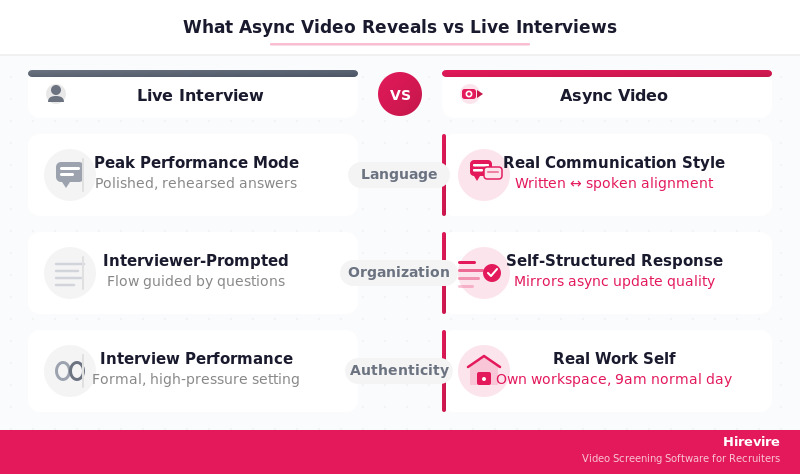
What Async Video Reveals That Live Interviews Miss
For offshore candidates specifically, async video reveals:
Written-to-spoken language alignment. A candidate whose written English is stronger than their spoken English (common for technical offshore candidates) will perform better in actual distributed work than a live interview suggests. Video lets you calibrate what their communication is actually like.
Response organization. How does the candidate structure a 90-second answer with no prompting? Do they get to the point? Do they give a specific example? Do they end with a clear conclusion? This mirrors exactly how they'll write async updates.
Authenticity. A candidate recording at 9am in their own workspace is showing you something close to their actual work self - not a performance in a formal interview setting.
Setting Up Your Offshore Pre-Screen in Hirevire
Hirevire setup for offshore pre-screening:
- Create a new job in Hirevire and add the question set (use the templates from each section in this guide)
- Set response time limits: 60-90 seconds for specific questions, 2 minutes for scenario questions
- Set a submission deadline: 72 hours works well for offshore candidates (gives them time across work cycles)
- Enable candidate re-recording so they can submit their best response
- Share the link with shortlisted candidates via email or LinkedIn message
- Review responses in the Hirevire dashboard; AI transcripts let you scan quickly
For roles that require specific technical skills, combine the communication/timezone questions from this guide with a separate technical assessment or coding test.
Hirevire Pricing for Offshore Hiring Teams
| Plan | Monthly | Yearly | Interviews/Year | Active Jobs |
|---|---|---|---|---|
| Essentials | $49/month | $39/month | 300 | 1 |
| Professional | $149/month | $99/month | 1,200 | 5 |
| Agency | $249/month | $199/month | 12,000 | 20 |
For teams hiring offshore development teams or distributed technical talent consistently, the Professional plan covers most needs.
Ratings: G2: 4.7/5 (25+ reviews) | Capterra: 5/5 (20+ reviews) | AppSumo: 4.9/5 (70+ reviews)
Cross-Border Hiring Checklist (US-Canada, US-Philippines)
This checklist covers the two most common cross-border patterns: US companies hiring in Canada, and US companies hiring in the Philippines.
US-Canada Hiring Checklist
Legal and work authorization:
- [ ] Confirm candidate is a Canadian citizen or permanent resident (or has valid work permit)
- [ ] Verify whether role requires physical presence in Canada or is fully remote
- [ ] Confirm whether you're hiring as employee (requires Canadian payroll) or contractor (requires compliant contractor agreement)
- [ ] For employees: set up Canadian payroll through a Canadian PEO or employer of record service
- [ ] Include Canadian employment law terms (notice periods, severance, statutory leave) in offer letter
Tax and compensation:
- [ ] Confirm compensation in CAD or USD and set exchange rate handling
- [ ] For contractors: confirm they have a Canadian Business Number (BN) for invoicing
- [ ] Set expectation on benefits (Canadian employees often expect health benefits; contractor relationships typically don't include benefits)
Communication and collaboration:
- [ ] Confirm timezone (Canada spans UTC-2:30 to UTC-8; clarify specific province)
- [ ] For Atlantic/Eastern Canada: 0-1 hour US time difference (essentially same timezone)
- [ ] For Western Canada: 2-3 hour difference from US East Coast
Interview questions specific to US-Canada candidates:
- "Are you a Canadian citizen, permanent resident, or do you hold a work permit? What type and when does it expire?"
- "Are you comfortable invoicing in USD, or do you need CAD payments? How have you handled currency in past contracts?"
- "Have you worked with US-based teams before? What adjustments did you make to communication style or expectations?"
US-Philippines Hiring Checklist
Legal and work authorization:
- [ ] Confirm work setup: Filipino citizens working in Philippines for US company are not subject to US work authorization requirements
- [ ] Hiring as contractor vs. employer of record - most US companies hire Philippines talent as contractors
- [ ] For contractor: use a compliant independent contractor agreement with Philippines law carve-outs
- [ ] For employee: use Philippines-based employer of record (local entity required for formal employment)
Tax and payroll:
- [ ] Payments typically in USD to Philippine bank accounts via wire or services like Wise, Payoneer, or Deel
- [ ] Philippine independent contractors handle their own local tax registration (BIR)
- [ ] Agree on payment frequency and timing upfront (monthly vs. bi-monthly is standard)
Communication and time:
- [ ] Philippines is GMT+8 - typically 12-13 hours ahead of US Eastern time
- [ ] Establish overlap window expectations explicitly (most Philippines-US arrangements work with a 3-4 hour overlap window)
- [ ] Filipino professionals generally have strong English proficiency (Philippines is in the top 5 globally for English proficiency per EF EPI data)
Interview questions specific to US-Philippines candidates:
- "What's your current availability window that overlaps with US Eastern or Pacific time?"
- "Have you worked with US clients before? What was the timezone overlap arrangement, and how did it work in practice?"
- "Are you comfortable with our payment method [wire/Wise/Payoneer/Deel]? Have you used these platforms before?"
- "Describe your experience with US business communication expectations compared to local Philippines work culture. What differences did you notice?"
Frequently Asked Questions
What are the most important interview questions for offshore candidates?
The questions that matter most for offshore candidates fall into three categories: communication quality (can they explain things clearly in writing?), timezone management (do they have actual systems for working across time zones, not just willingness?), and async collaboration (have they worked on teams where most communication happens asynchronously?).
Scenario questions - presenting realistic distributed work situations - are often more revealing than experience questions because they show how the candidate thinks through problems they'll actually face.
How do you assess communication skills for offshore roles without a live interview?
Async video pre-screening is the most direct approach. When you send a candidate a set of structured questions to answer on video, you're seeing their communication under conditions similar to actual work: they have time to think, they're in their own environment, and they have to organize their answer without the back-and-forth of a live conversation.
Hirevire makes this easy to set up - create a question set, share a link, and review responses in your own time. The AI transcript feature lets you scan written communication quality even before watching the video.
What timezone overlap should you require for offshore roles?
The minimum workable overlap for most distributed roles is 2-3 hours per day of real-time availability (for live meetings, quick questions, and collaborative work). Below that, almost all coordination must be async, which requires very mature async communication practices on both sides.
For roles with significant client interaction or real-time collaboration requirements, 4+ hours of overlap is more practical. For purely independent technical work with well-defined specifications, 1-2 hours of overlap can work if both parties are experienced with async-first processes.
How do you screen for English proficiency for offshore roles?
The practical approach: assess their actual communication in your screening process, don't ask for test scores. An async video pre-screen gives you a sample of their spoken English. Written communication can be assessed through email exchanges or a brief written exercise.
What to look for: Can they explain a complex idea clearly? Does their writing require significant editing to understand? Do their answers get to the point? These practical markers matter more than IELTS scores for most professional roles.
What's the best way to hire offshore developers or technical roles?
The hiring process for offshore technical roles typically includes: an async pre-screen (communication and collaboration questions), a technical assessment or take-home exercise, a live video interview with the technical lead, and a final conversation with the hiring manager.
Hirevire handles the async pre-screen step, which is often where timezone friction is highest. Technical assessments are handled separately through platforms like HackerRank or Codility. The combination gives you communication quality assessment (pre-screen) and technical skill assessment (coding test) before investing any live time.
How do you check references for offshore candidates?
For offshore candidates, written reference surveys (sent by email to references the candidate provides) are often more practical than phone calls because of timezone constraints. Most professional references can fill out a structured questionnaire in 5-10 minutes.
Ask references specifically about: communication style and quality, reliability in distributed or async settings, how the candidate handled ambiguity or unclear requirements, and any specific weaknesses to be aware of. These questions yield more useful information for offshore roles than standard "would you rehire?" references.
What documents do you need to hire offshore contractors?
Requirements vary by country and hiring structure. For US companies hiring international contractors (the most common arrangement), you typically need: a signed independent contractor agreement specifying jurisdiction, a completed W-8BEN form (for non-US contractors), and payment setup (Wise, Payoneer, Deel, or direct bank transfer).
You don't need a US work visa for someone working in their home country as a contractor - they're not working in the US. Work authorization questions arise when the person needs to physically be in the US.
How do you structure an offshore team interview process?
A practical offshore hiring process has four stages: (1) resume review against must-have criteria, (2) async video pre-screen focused on communication and timezone management (3-5 questions via Hirevire), (3) technical assessment or work sample (for technical roles), and (4) live video interview with the hiring team focused on culture fit and final questions.
This process eliminates the timezone scheduling problem at the highest-volume stage (pre-screening) while still including a live interview at the final stage when it's worth investing the scheduling effort for a strong candidate.
What are good questions to ask about offshore candidates' remote work setup?
Setup questions for offshore candidates: "Describe your home office setup - where you work, your internet connection, and any backup plans for connectivity issues." "What time of day are you most productive, and how does that align with our required overlap window?" "Do you have a dedicated workspace, or do you work from shared spaces?"
For roles requiring video calls, ask specifically about their webcam, lighting, and audio setup. These practical details matter more than they might seem - candidates who've invested in their remote setup tend to take distributed work more seriously.
Conclusion
Offshore hiring fails when the screening process treats it like domestic hiring with a time zone difference. It's not. The communication requirements, collaboration patterns, and cultural adjustments for distributed international work deserve their own screening framework.
The questions in this guide are organized around the actual risk factors in offshore hiring: communication quality, timezone self-management, technical collaboration practices, and cultural compatibility with distributed teams. Use them as a question bank - pick the most relevant for each role and adapt the wording to your specific context.
The async video format fits offshore hiring naturally. The candidate records when it's convenient for them. You review when it's convenient for you. No scheduling friction, no late-night calls, and better information than a rushed phone screen could provide.
Key Takeaways
- Standard interview questions miss the specific risks in offshore hiring (communication quality, timezone management, async collaboration)
- Scenario questions reveal how candidates will actually handle distributed work situations
- Async video pre-screening solves the timezone problem while providing better communication assessment than phone screens
- US-Canada and US-Philippines hiring have different legal, tax, and communication considerations
- A 4-stage offshore hiring process (review, async pre-screen, technical assessment, live interview) balances thoroughness with efficiency
Your Next Steps
- Pick 4-5 questions from the sections most relevant to your open role
- Create an async pre-screen question set using the templates in this guide
- Try Hirevire free to run your offshore pre-screening without timezone scheduling
Ready to screen offshore candidates without the timezone headache?
Last updated: March 2026. All information verified as of March 2026.