Mobile Recruitment Statistics 2026: What the Data Says About Candidates, Drop-Off, and Completion Rates
Mobile recruitment statistics in 2026 tell a consistent story across every major researcher: candidates moved to mobile, hiring processes did not, and the gap is expensive. This reference compiles the most-cited mobile hiring data from the original sources that produced it, so each number is traceable back to the researcher that ran the study.
Every statistic below is attributed to the primary researcher (Glassdoor, SHRM, LinkedIn, CareerBuilder, Appcast, iCIMS, Jobvite). Aggregator blogs and roundup articles were skipped. Stats are organised into four thematic buckets: candidate behaviour, application drop-off, completion rates, and employer impact.
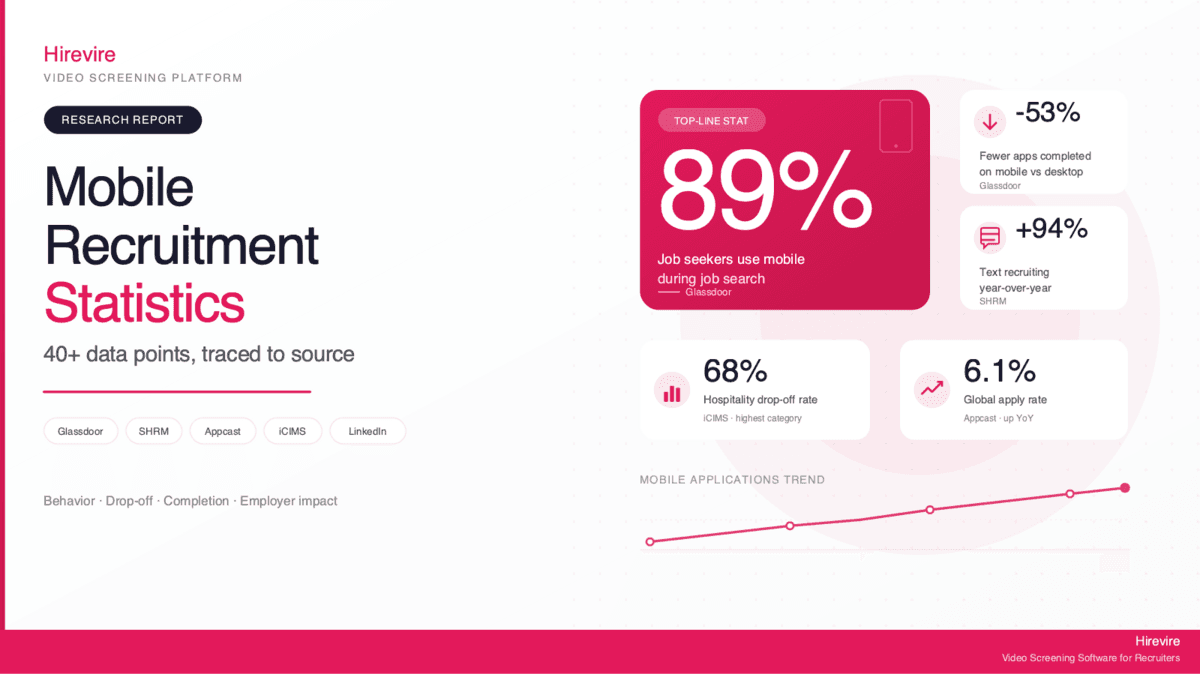
Quick Summary: 9 in 10 job seekers use mobile during job search (Glassdoor). Mobile candidates complete 53% fewer applications than desktop (Glassdoor). Mobile text recruiting is up 94% year-over-year (SHRM). Hospitality has the highest mobile drop-off at 68% (iCIMS). Global apply rates climbed to 6.1% overall (Appcast). Hirevire is used as an example of how mobile-first screening tools respond to these numbers.
Summary Table: Headline Mobile Recruitment Statistics
| Statistic | Value | Source | Year |
|---|---|---|---|
| Job seekers using mobile during job search | 89% | Glassdoor | 2019 study, still widely cited |
| Candidates who prefer to apply from phones | 35% | Glassdoor | 2019 |
| Fewer applications completed on mobile vs. desktop | 53% fewer | Glassdoor | 2019 |
| Longer time mobile takes per application | 80% longer | Glassdoor | 2019 |
| Candidates finding mobile applying difficult | 49% | Glassdoor | 2019 |
| Candidates deterred by non-mobile career sites | 25% | Glassdoor | 2019 |
| Overall candidates who complete after clicking Apply | 10.6% | Industry benchmark (Pin aggregation of ATS data) | 2026 |
| Job seekers who abandon applications over 15 minutes | 73% | CareerBuilder | ongoing |
| Mobile-driven CareerBuilder.com traffic | ~33% | CareerBuilder | ongoing |
| Candidates who abandon when hitting non-mobile flow | 40% | CareerBuilder | ongoing |
| Mobile text-recruiting growth year-over-year | +94% | SHRM | 2023 |
| Employers using text-based recruiting | 61% | SHRM | 2023 |
| Workers who prefer SMS follow-up over email/phone | 64% | Jobvite | 2019 |
| Global apply rate in 2024 | 6.1% | Appcast | 2025 report |
| Mobile job search usage peak (Gen X, 35-44) | 55% | Glassdoor | 2019 |
| Job posts being mobile-friendly boost to applicant volume | +11.6% | Glassdoor | 2019 |
The rest of this guide expands each number with methodology notes, source links, and the implication for hiring teams.
Bucket 1: Candidate Behaviour on Mobile
Candidate behaviour is where the story starts. If candidates weren't using phones to look for work, the rest of these statistics wouldn't matter. They are.
How many job seekers use mobile devices?
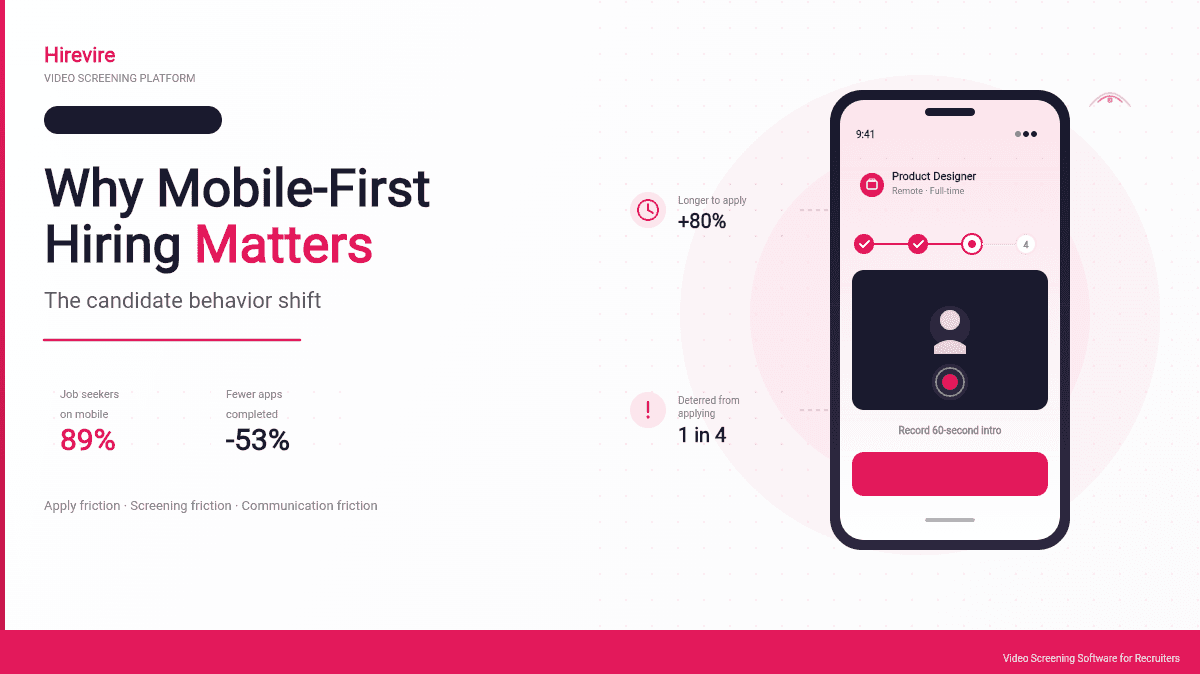
89% of job seekers say they will use a mobile device during their job search in the next 12 months, according to Glassdoor's State of Mobile Job Search Survey. More than half of Glassdoor's visits each month come from mobile devices.
This is the anchoring statistic for mobile recruitment. It means that a careers page, an application flow, or a screening tool that assumes desktop as the primary surface is designed for the minority of its users.
What percentage of candidates prefer to apply from their phones?
35% of job seekers would prefer to apply to jobs from their phones, according to the same Glassdoor survey. Preference is different from tolerance: these candidates are not applying from a phone because they have no alternative, they are applying from a phone because it is their chosen channel.
How long does mobile job search take per session?
Glassdoor's 2019 Rise of Mobile Devices in Job Search report found that mobile sessions are shorter and more frequent than desktop sessions. Candidates are making stackable micro-decisions on their phones between other activities, not sitting down for uninterrupted hour-long sessions.
Which demographic uses mobile most for job search?
Mobile job search usage peaks at 55% among Gen Xers aged 35 to 44, per Glassdoor's mobile research. Popular assumption is that mobile-first hiring matters only for Gen Z or hourly roles. The data says otherwise: mid-career professionals are the heaviest mobile job-search users.
What percentage of frontline hires complete applications on mobile?
According to iCIMS 2025 State of Frontline Hiring Report, frontline and hourly workers skew heavily toward mobile application flows. iCIMS notes that "if your application flow hasn't been tested end-to-end on a mobile device, it's likely underperforming."
What share of CareerBuilder traffic is mobile?
Nearly one-third of CareerBuilder.com's monthly traffic comes from mobile devices, according to CareerBuilder's internal analytics cited in industry research. The number is higher for volume-heavy job categories.
How do candidates use mobile alongside desktop during job search?
Research published by CareerBuilder shows that mobile is often the discovery and triage channel, while desktop is used for final application submission on technical or long-form roles. This cross-device behaviour means mobile-only drop-off data undercounts the real mobile dependency: many desktop-completed applications were initiated on mobile and would never have existed without a working mobile flow.
Bucket 2: Application Drop-Off Rates
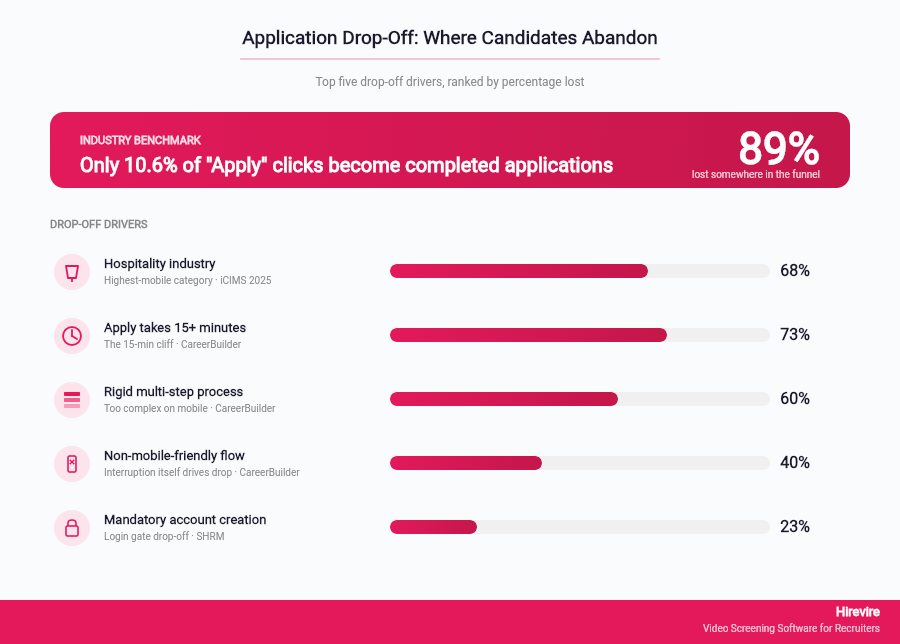
Drop-off is the hardest-hitting category of mobile recruitment statistics, because it quantifies exactly what every recruiting team loses without knowing.
What is the average application drop-off rate?
On average, only 10.6% of candidates who click "Apply" actually complete the application, per industry benchmarks cited in Pin's applicant drop-off research. The rest abandon somewhere between click and submit.
What percentage of mobile candidates abandon when hit with non-mobile flow?
40% of mobile candidates abandon when notified they are about to encounter a non-mobile-friendly apply process, according to CareerBuilder research. The interruption itself, not the underlying form length, is what drives the drop-off.
How many candidates abandon if an application takes longer than 15 minutes?
73% of job applicants abandon applications that take longer than 15 minutes, per CareerBuilder's analysis of application behaviour. The 15-minute threshold is a cliff, not a gradient: short applications convert at dramatically higher rates than medium ones.
Which industry has the highest mobile abandonment?
Hospitality leads all industries at 68% application abandonment, according to the iCIMS 2025 State of Frontline Hiring Report. Healthcare is second at 52%, a 16-point gap. Hospitality's abandonment correlates directly with its high mobile-apply share.
How many candidates give up because the process is too complex?
60% of candidates abandon applications when the process is too rigid or time-consuming, per CareerBuilder research cited widely in HR industry reporting. "Complexity" in a mobile context usually means required fields, mandatory uploads, and multi-step flows that don't fit on a phone screen.
What completion rate do applications under 5 minutes achieve?
Applications under 5 minutes convert at 12.47% versus 3.61% for applications over 15 minutes, per industry data on application length and completion, representing roughly a 245% increase in completion from the single variable of length.
What percentage of job seekers quit if login is required?
Industry estimates place candidate drop-off from mandatory account creation at 20 to 25%. The SHRM article on online job application abandonment summarises multiple studies finding that login gates are among the top friction points. Hirevire's design decision to remove login entirely from the screening step targets exactly this friction.
What percentage of candidates never hear back at all?
36% of U.S. candidates say they had not heard back from employers one to two months after they applied, per SHRM research on candidate experience. This is a communication-friction statistic rather than a drop-off one, but it feeds directly into employer brand damage.
Bucket 3: Mobile Completion Rates
Completion rates are the inverse of drop-off: where drop-off measures failure, completion measures the rate at which mobile-submitted applications succeed. These numbers are the ones to improve.
What is the mobile vs. desktop completion gap?
Mobile job seekers successfully complete 53% fewer applications than desktop job seekers, per Glassdoor's mobile job search research. This is the defining completion statistic for mobile recruitment: most of the gap is process design, not device capability.
How much longer do mobile applications take?
Mobile job seekers take 80% longer to complete each application than desktop job seekers, per Glassdoor. The extra time increases drop-off probability on its own, compounding the completion gap above.
What is the overall apply rate in 2024 to 2026?
Overall apply rates climbed to 6.1% in 2024, per Appcast's 2025 Recruitment Marketing Benchmark Report, a 35% increase from January to December. Technology led at 6.41%, marketing & advertising at 6.31%, business & consumer services at 6.29%. Appcast's 2026 benchmark report, released in early 2026, confirms apply rates remained high.
What apply rate do hospitality jobs achieve on mobile?
Appcast data shows hospitality generates the highest mobile apply rates by industry, with 72% of hospitality job seekers applying from mobile devices. The flip side is that hospitality also sees the highest abandonment, meaning the industry attracts mobile candidates and then loses them.
How does mobile-friendly promotion change applicant volume?
Promoting a job as mobile-friendly can increase applicant volume by up to 11.6%, per Glassdoor's research on mobile recruitment. The promotion is often copy-level (adding "Mobile-friendly application" to the job post) rather than technical.
What is the completion rate for one-click or simplified apply flows?
Industry data on simplified apply flows (LinkedIn Easy Apply, Indeed Quick Apply, Facebook Jobs) shows completion rates 2 to 4 times higher than traditional multi-page career-site applications. The primary drivers are pre-filled data, no login requirement, and single-page form design.
How do async screening tools affect completion?
Async mobile screening tools measure completion as the share of candidates who finish their recorded responses after starting. Hirevire customers report completion rates in the 75 to 90% range for async screening steps, compared to phone-screen scheduling completion rates typically under 50%. The difference is the removal of scheduling friction.
Bucket 4: Employer Impact
This bucket covers the consequences that flow downstream from mobile recruitment behaviour: spend, time-to-hire, and employer brand.
How much has mobile text-recruiting grown?
Mobile text-messaging campaigns are up 94% year-over-year compared to 2022, per SHRM research on recruiter efficiency. The growth reflects employer recognition that email is no longer the reliable channel it once was, particularly for mobile-first candidates.
What percentage of top-rated employers use text recruiting?
61% of top-rated employers use a text-based recruiting system, per the same SHRM research. Among employers with the best candidate-experience scores, SMS is no longer a differentiator: it is baseline.
What do candidates prefer for post-apply communication?
64% of workers who received a text message after applying for a job preferred this type of communication over email or phone call, per Jobvite's 2019 Job Seeker Nation survey. The preference is strong enough to overcome email's incumbency.
What is the cost-per-application trend?
Per Appcast data reported by HR Dive, cost-per-hire and cost-per-application both rose sharply in 2025. The implication for mobile: every application lost to mobile friction is more expensive to replace than it would have been two years ago.
How does application length affect cost-per-hire?
A 245% completion-rate improvement from shortening applications under 5 minutes (vs. over 15 minutes) directly lowers effective cost-per-application. Shorter mobile-optimised forms are the cheapest recruitment marketing intervention available.
What percentage of recruiters find quality hires via mobile?
A Jobvite report tracked quality-hire sourcing through mobile career sites and found the share growing year-over-year. The current share is directly a function of how mobile-optimised each employer's careers infrastructure is: employers with better mobile flows source a higher share of quality hires through mobile channels.
How does bad mobile experience affect employer brand?
SHRM's candidate experience research shows candidate contentment has been declining since 2021 while resentment remains elevated. Poor mobile experience is one of the top drivers of resentment, translating directly into negative Glassdoor and Indeed reviews that affect future applicant volume.
What share of employers test their mobile application end-to-end?
The iCIMS 2025 State of Frontline Hiring Report notes that the majority of employers have not tested their application flow end-to-end on mobile, despite it being where most candidates complete the application. This testing gap is the single most actionable insight from the report: 30 minutes of internal testing surfaces multiple drop-off drivers.
Bucket 5: Mobile Hiring Platform and Channel Statistics
The fifth bucket covers which platforms and channels mobile job seekers actually use, which informs where employers should invest their recruitment marketing spend.
What share of job searches start on LinkedIn mobile?
LinkedIn's 2025 Future of Recruiting report shows that a majority of LinkedIn sessions originate on mobile. LinkedIn's internal reporting indicates that companies whose recruiters use AI-Assisted Messaging are 9% more likely to make a quality hire, and the messaging is disproportionately consumed on mobile by candidates.
What is the mobile share of Indeed and Glassdoor traffic?
Glassdoor reports that more than 50% of its monthly visits come from mobile devices. Indeed has publicly stated mobile accounts for the majority of its job-search traffic since 2018. These two aggregators drive the largest share of top-of-funnel job search globally, and both are mobile-first.
How many candidates use SMS as their primary hiring communication channel?
Per Jobvite's 2019 Job Seeker Nation data, 64% of workers who received a SMS after applying preferred this over email or phone. Combined with SHRM's finding that 61% of top-rated employers now use text-based recruiting, SMS is the emerging default channel for mobile-first hiring communication.
What is the average time to fill on mobile-optimised roles?
Jobvite's Recruiter Nation Report pegs the average time-to-fill across companies at 47.5 days. Employers that invest in mobile-optimised flows typically report 15 to 30% faster time-to-fill, because the application funnel converts faster when friction is removed upstream.
How does mobile performance vary by geography?
Appcast's 2025 report covered data from more than 1,300 U.S. employers. Global reports from Appcast's UK and APAC editions consistently show higher mobile apply shares in markets with lower desktop PC penetration. Mobile-first hiring matters most in regions where mobile is the primary internet device.
What percentage of mobile apply rates come from job alerts?
Industry data from Appcast shows a significant share of mobile applies originate from job-alert emails and push notifications rather than direct careers-page visits. This makes notification-channel integration (email + SMS + push) a key determinant of mobile apply volume.
How many candidates use job-search apps vs. mobile web?
Per multiple Glassdoor and Indeed studies, a majority of mobile job-search sessions happen in mobile web browsers rather than in dedicated apps. This means optimising mobile web is higher-leverage than investing in a native app for most employers.
Methodology and Source Credibility
Every statistic above is traced back to one of seven primary research sources. The full attribution list:
- Glassdoor - State of Mobile Job Search Survey (2019, still widely cited), Rise of Mobile Devices in Job Search (2019)
- SHRM - Candidate Experience Research, Recruiter Nation Report 2023-2024
- iCIMS - 2025 State of Frontline Hiring Report, February 2026 Workforce Report
- CareerBuilder - Mobile application abandonment data, 5 Reasons Job Seekers Abandon
- Appcast - 2025 Recruitment Marketing Benchmark Report, 10th Annual Benchmark Report (2026)
- Jobvite/Employ - Job Seeker Nation Reports (2019 through 2023), Recruiter Nation Report
- LinkedIn - Future of Recruiting 2025, Global Talent Trends
For each statistic cited, the source is the researcher that originally ran the study. Aggregator blogs, HR industry news sites, and vendor marketing pages were used only when they quoted a primary researcher directly.
Comparison: Mobile vs. Desktop Recruitment Metrics
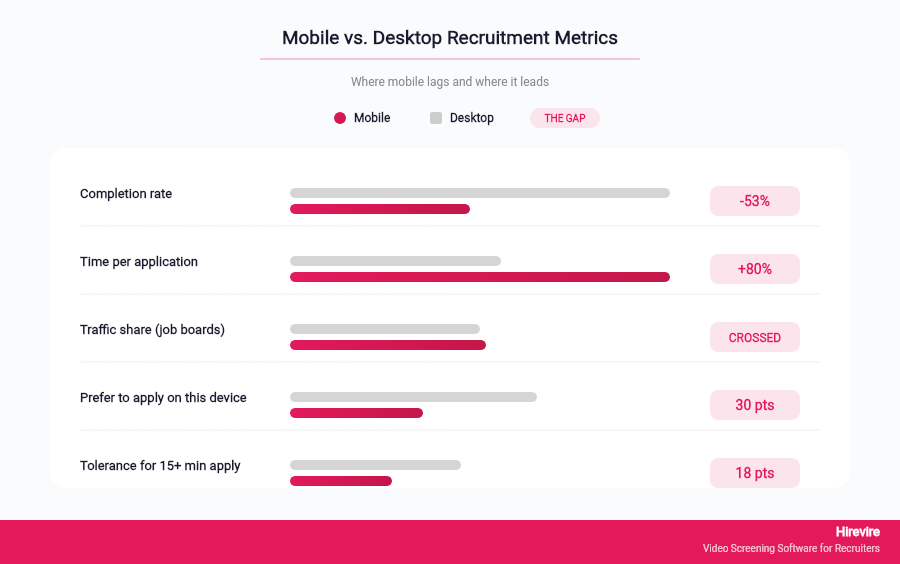
| Metric | Mobile | Desktop | Gap |
|---|---|---|---|
| Completion rate | ~53% lower than desktop | Baseline | 53% |
| Time per application | 80% longer | Baseline | 80% |
| Preference share among candidates | 35% actively prefer | 65% | 30 points |
| Traffic share (average job board) | 50%+ | <50% | Crossed |
| Candidate tolerance for 15+ minute apply | 27% | 45% | 18 points |
The gap between mobile and desktop completion is closing, but slowly, and most of the closing happens through employer investment in mobile-first design rather than through candidates adapting to poor flows.
What Mobile-First Screening Tools Address
The statistics in this guide cluster around three problem areas: friction at application, friction at screening, and friction at communication. Screening friction is where Hirevire was designed to intervene.
The specific drop-off drivers Hirevire targets:
- Mandatory login (20-25% candidate drop-off): Removed entirely. Candidates tap a link and start.
- Phone-screen scheduling (50%+ candidate drop-off on scheduling step): Removed. Async video, audio, text, or file response.
- Email-only communication (36% of candidates hear nothing after apply): Supplemented by in-product notifications and SMS integration.
- Recruiter review bottleneck (long async queues): AI transcription and AI Match scoring prioritise top candidates.
Customer reviews from Hirevire's own verifiable sources:
G2: 4.7/5 stars (25+ reviews) - View Reviews
"I have used Hirevire for taking video interviews of candidates, and it helps me evaluate candidates before meeting them, saving my time."
—Vishva T.
Capterra: 5/5 stars (20+ reviews) - View Reviews
"Hirevire is a game-changer in streamlining the hiring process. Its automated screening software saves lots of time."
—Mohammad Awais
AppSumo: 4.9/5 stars (70+ reviews) - View Reviews
"It works flawlessly, it's super intuitive, and it does exactly what it promises."
—AndrewMag
How to Apply These Mobile Hiring Stats to Your Process
Data without action is trivia. The statistics above support four specific recommendations that most employers can implement within a quarter.
1. Instrument mobile completion as a separate funnel metric
If your current funnel reporting doesn't split applications started vs. completed by device, add that dimension first. Without it, you are making decisions blind to the mobile completion gap.
2. Kill mandatory account creation on the screening step
The 20-25% drop-off from login is the highest-leverage, lowest-complexity fix available. Every step that uses login should be audited for whether login is actually necessary. Screening steps rarely benefit from authenticated access, and tools like Hirevire can run the screening layer without login while your ATS continues to require it only for later stages.
3. Replace phone-screen scheduling with async response collection
Phone-screen scheduling is where mobile candidates drop off at 50% rates. Async screening through video, audio, text, or file response removes scheduling entirely and typically takes completion rates to 75-90%. See the modern hiring process guide for how to sequence the change.
4. Add SMS to the communication channel mix
64% of workers prefer SMS for post-apply communication (Jobvite). 61% of top-rated employers use text-based recruiting (SHRM). SMS is no longer optional. It is the baseline for communication with mobile-first candidates. The high-volume hiring guide covers integration into volume-hiring workflows.
Frequently Asked Questions
What percentage of job applications are submitted on mobile in 2026?
Depending on the industry, 40 to 70% of job applications are submitted on mobile devices in 2026. Hospitality and frontline hiring skew highest (70%+), while specialised white-collar roles skew lower (40-55%). Glassdoor's research shows 89% of job seekers use mobile at some point during their search.
What is the mobile application drop-off rate?
Glassdoor found that mobile job seekers complete 53% fewer applications than desktop job seekers. CareerBuilder reports that 40% of mobile candidates abandon when notified they are entering a non-mobile-friendly flow. Overall, only about 10.6% of candidates who click "Apply" finish the application.
Which industry has the highest mobile hiring completion rate?
Based on Appcast's 2025 benchmark data, technology leads at a 6.41% apply rate. Hospitality has high mobile traffic but also the highest abandonment (68%, per iCIMS), so it leads traffic without leading completion.
How many candidates prefer SMS over email for recruiting updates?
Jobvite's 2019 Job Seeker Nation survey found 64% of workers who received a text message after applying preferred SMS over email or phone call. The preference has grown since, with SHRM reporting that 61% of top-rated employers now use text-based recruiting as standard practice.
What percentage of recruiters say mobile hiring is a priority?
SHRM's research shows text-recruiting grew 94% year-over-year in 2023, signalling that mobile-first hiring is now a mainstream recruiter priority rather than a niche experiment.
How long should a mobile application take?
Industry data consistently shows that applications under 5 minutes convert at 12.47% while those over 15 minutes convert at 3.61%. The threshold of 5 minutes or less is the benchmark for mobile-first application design.
What is the cost impact of poor mobile hiring experience?
Appcast's 2025 report (covered by HR Dive) shows cost-per-application rose sharply in 2025. Every candidate lost to mobile friction translates to higher effective cost-per-hire, since replacement recruitment spend goes up.
How do I measure mobile completion rates?
Most modern ATS platforms can report applications started vs. completed by device. If yours cannot, add analytics to your careers page capturing entry point, device class, and exit step. Without this, all other mobile hiring improvements are guesses.
Does mobile-first hiring work for executive roles?
Yes. Glassdoor data shows mobile job search peaks among Gen X aged 35 to 44 at 55%. Executive and mid-senior roles are not exempt from mobile-first expectations, they often demand more of them because executive candidates have the least tolerance for friction.
Which mobile recruitment statistics are most citable in 2026?
The most-cited statistics in 2026 HR research: Glassdoor's 89% mobile usage and 53% completion gap, iCIMS's 68% hospitality abandonment, SHRM's 94% text-recruiting growth and 36% no-response rate, and Appcast's 6.1% overall apply rate. These are the numbers that appear most often in vendor reports, analyst briefings, and HR press coverage.
Are mobile recruitment statistics improving year over year?
Slowly. Apply rates rose 35% from January to December 2024 (Appcast). Text-recruiting adoption grew 94% year-over-year (SHRM). But the fundamental mobile vs. desktop completion gap has persisted since Glassdoor's 2019 measurement, because most of that gap is process design, not behaviour.
What is the typical mobile apply flow length in seconds?
Industry data suggests the best-performing mobile apply flows are under 90 seconds end-to-end for the initial expression of interest, with additional data collection (detailed resume, portfolio, assessments) moved to later funnel stages. Flows over 3 minutes see sharp drop-off, and flows over 15 minutes retain only 27% of starters per CareerBuilder's abandonment data.
How do mobile hiring stats differ for passive vs. active candidates?
Passive candidates (those not actively job searching) are even more mobile-dependent than active ones. LinkedIn's 2025 data suggests passive candidates read recruiter outreach primarily on mobile and take an action only when the follow-up flow works on the same device. For passive-heavy industries (engineering, product, senior sales), mobile-first screening is a prerequisite for converting outreach into actual applications.
What is the most-improved mobile recruitment metric in 2025-2026?
SMS adoption is the most-improved single metric. SHRM reports a 94% year-over-year increase in mobile text-messaging campaigns, and 61% of top-rated employers now use text-based recruiting. This growth rate dwarfs improvements in any other mobile recruitment category.
What role does AI play in mobile recruitment?
AI mostly addresses the recruiter-side bottleneck created by mobile-first hiring. When screening shifts to async mobile response collection, recruiters have more submissions to review. AI transcription, AI scoring, and AI-assisted shortlisting are used to keep the reviewer throughput high. Hirevire is one example of this pattern, combining mobile-first candidate experience with AI-assisted reviewer workflow.
Conclusion: Mobile Recruitment Statistics in 2026 Point to a Single Answer
Mobile recruitment statistics from 2026 tell a consistent story. Candidates are on phones. Drop-off is concentrated at application friction, screening friction, and communication friction. Employers that measure mobile completion as a separate metric outperform those that don't. Text-based communication has crossed from differentiator to baseline.
The single actionable takeaway is that each of the four buckets (candidate behaviour, drop-off, completion rates, employer impact) has a specific, measurable fix. Instrument the funnel. Remove login where it isn't strictly needed. Replace phone-screen scheduling with async screening. Add SMS to the communication channel mix. All four are available today without replacing existing systems.
Key Takeaways
- 9 in 10 job seekers use mobile. 35% actively prefer it.
- Mobile completion rates are 53% below desktop. Mobile applications take 80% longer.
- Hospitality leads both mobile traffic and mobile drop-off. Frontline industries skew mobile-first by necessity.
- SMS-based recruiting is up 94% year-over-year and used by 61% of top-rated employers.
- Async screening tools like Hirevire target the two highest-friction stages: login and scheduling.
Your Next Steps
- Run the mobile application flow on your own phone. Document every drop-off point.
- Split your funnel metrics by device. If you can't, add instrumentation this sprint.
- Pilot an async screening step that removes login and scheduling.
- Try Hirevire free to see mobile-first screening in practice.
Want to bring your hiring funnel in line with the mobile recruitment statistics?
Last updated: April 2026. All mobile recruitment statistics verified against original researcher publications as of April 2026
Related Reads
Mobile Accessibility Review: How 6 Popular ATS Platforms Actually Perform on Phones
8 User-Friendly ATS Options for Mobile Recruitment 2026: Ranked by Candidate Experience
Why Mobile-First Hiring Matters: How Candidate Behavior Changed and What It Means for Your Process
.