SWOT Analysis of AI in Recruitment: Complete Framework for HR Leaders
AI is transforming recruitment faster than most HR leaders anticipated. What started as a technological curiosity has become a strategic imperative, fundamentally reshaping how organizations find, evaluate, and hire talent.
According to LinkedIn's 2025 Global Talent Trends report, 76% of talent professionals say AI and automation are transforming the recruiting function, with adoption accelerating by 142% year-over-year. Organizations using AI in recruitment report 40% faster time-to-hire and 35% improvement in candidate quality.
Yet despite these compelling benefits, 63% of HR leaders remain uncertain about where to start or how to evaluate the risks alongside the rewards. This comprehensive guide provides HR leaders, talent acquisition managers, and executives with a complete SWOT analysis framework for evaluating AI in recruitment.
Quick Summary: AI in recruitment delivers measurable strengths in efficiency and scalability, manageable weaknesses through proper implementation, significant opportunities for competitive advantage, and addressable threats with appropriate safeguards. Platforms like Hirevire demonstrate how modern AI screening solutions keep humans in the decision loop while delivering 70-80% time savings and improved candidate experience.
What is a SWOT Analysis of AI in Recruitment?
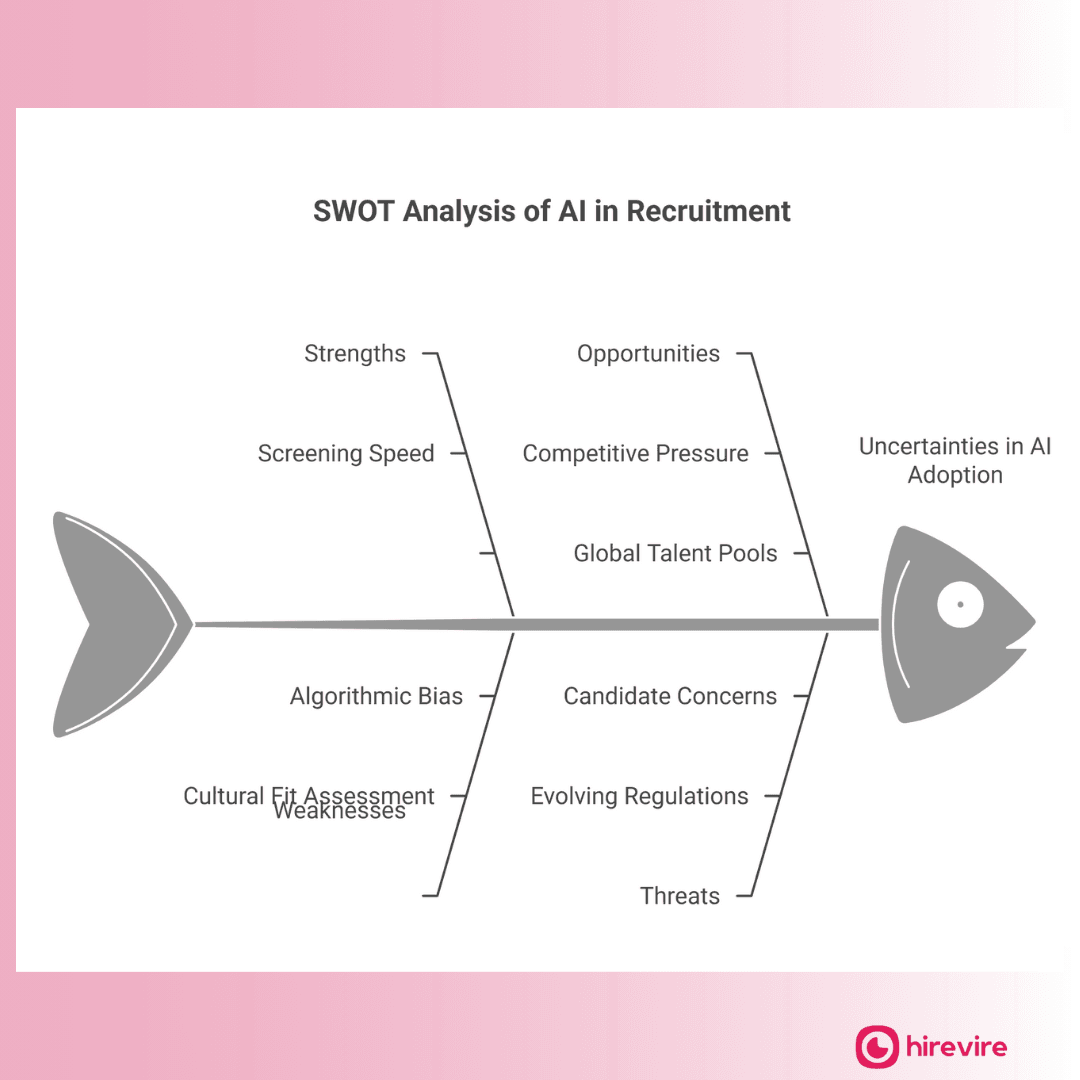
A SWOT analysis of AI in recruitment is a strategic planning framework that examines four critical dimensions: Strengths (internal advantages AI brings), Weaknesses (internal limitations), Opportunities (external favorable conditions), and Threats (external risks).
Unlike general technology assessments, a recruitment-specific SWOT analysis focuses on AI's impact across the entire hiring lifecycle, from candidate sourcing and screening through final selection and onboarding. This framework helps organizations move beyond hype and fear to make data-driven decisions about AI adoption.
Purpose and Core Components
Strategic Clarity - A SWOT analysis transforms vague impressions about AI into concrete, actionable insights. Rather than asking "should we use AI?" organizations can ask "which AI capabilities address our specific recruitment challenges while managing identified risks?"
Risk Mitigation - By explicitly identifying weaknesses and threats, organizations can implement safeguards before problems emerge. Research from SHRM indicates that organizations conducting thorough pre-implementation analysis experience 67% fewer compliance issues and 54% better candidate satisfaction.
Components:
- Strengths: Internal capabilities like screening speed, volume capacity, consistency, and scalability
- Weaknesses: Limitations including inability to assess cultural fit nuances, dependence on training data quality, and potential algorithmic bias
- Opportunities: External conditions like competitive pressure, global talent pools, and remote work trends enabling asynchronous evaluation
- Threats: External risks including evolving regulations, candidate concerns about algorithmic decisions, and potential for gaming AI systems
Strengths of AI in Recruitment: The Compelling Advantages
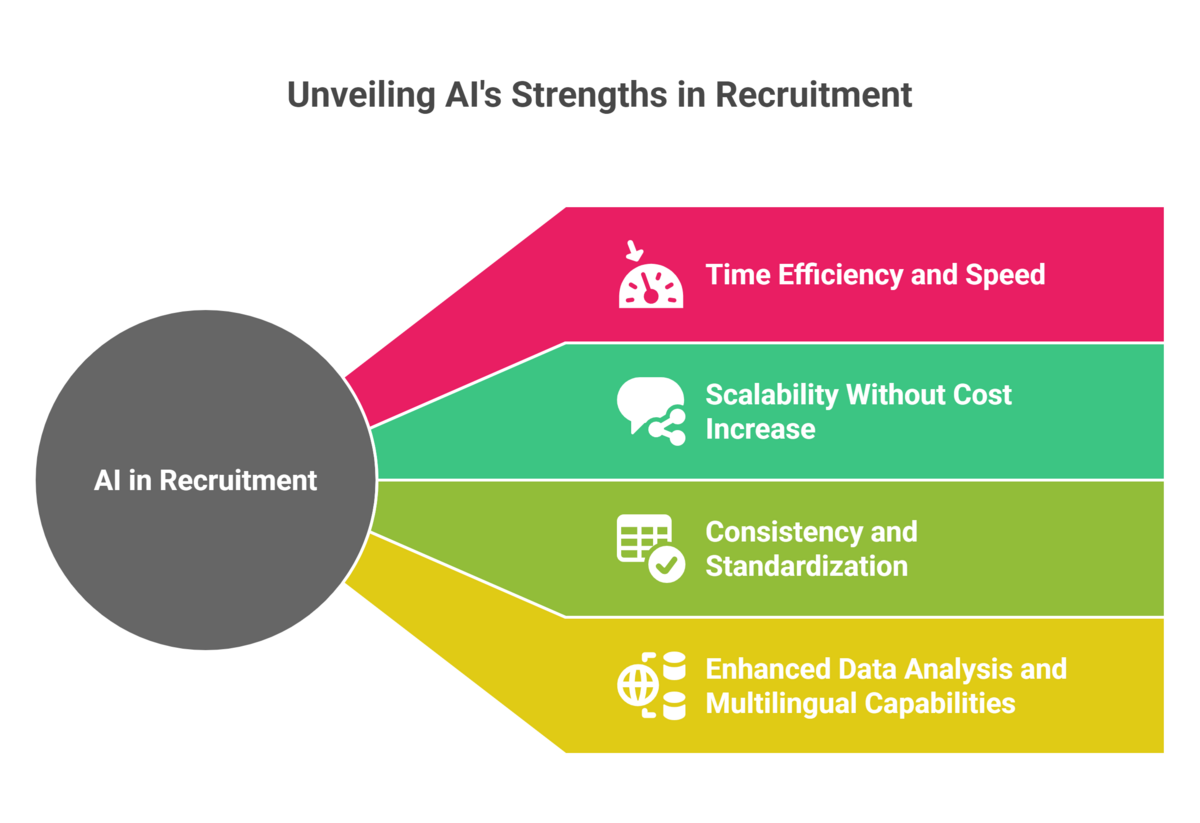
1. Unprecedented Time Efficiency and Speed
AI-powered screening tools process initial candidate evaluation 10-20 times faster than manual review. What traditionally required 15-20 minutes per candidate for phone screens now takes 90 seconds for AI review of asynchronous responses.
Hirevire's clients report screening 500 candidates in the same time previously required for 50 phone screens. This time compression enables evaluation of candidate pools that would be completely impractical manually.
2. Scalability Without Proportional Cost Increase
AI systems handle 10 candidates or 10,000 candidates with the same per-candidate cost structure. Traditional recruitment scales linearly - doubling candidate volume requires doubling interviewer time and costs. AI scales dramatically differently. After initial setup, marginal costs for additional candidates approach zero.
Hirevire's asynchronous screening platform allows candidates to respond at their convenience while evaluation happens automatically, supporting global hiring operations without requiring round-the-clock human staffing.
3. Consistency and Standardization
Research from the American Psychological Association shows that unstructured human interviews have validity coefficients around 0.20, barely better than chance. Much of this poor performance stems from inconsistent evaluation.
AI systems apply identical evaluation criteria to every candidate. The same questions, same rubrics, same analysis methodology, every time. This consistency dramatically improves predictive validity and defensibility.
4. Enhanced Data Analysis and Multilingual Capabilities
AI systems simultaneously analyze multiple dimensions: verbal content, communication clarity, keyword relevance, response completeness, and structural coherence. Modern AI understands context and meaning, not just keyword matching.
Tools like Hirevire provide AI transcription and evaluation in over 90 languages, enabling truly global talent pools without requiring multilingual human reviewers.
Quantifying the Strengths
Organizations implementing AI screening report measurable improvements:
- 70-80% time savings on initial screening
- 40-50% faster time-to-hire
- 35% improvement in candidate quality measured by 90-day performance ratings
- 60% reduction in recruiter workload
- 95% consistency in evaluation criteria application
Weaknesses of AI in Recruitment: Limitations Demanding Attention
1. Limited Ability to Assess Cultural Fit and Soft Skills
AI excels at analyzing structured competencies but struggles with subtle cultural fit assessment. Questions like "will this person thrive in our fast-paced, ambiguous startup environment?" involve complex, context-dependent judgment that current AI cannot replicate.
Emotional intelligence evaluation - assessing empathy, emotional regulation, and interpersonal effectiveness - requires human-to-human interaction. AI can analyze what candidates say about these competencies but cannot effectively evaluate actual emotional intelligence in action.
2. Dependence on Training Data Quality
AI systems learn patterns from training data. If training data contains biases, the AI perpetuates and potentially amplifies those biases. Organizations that have historically undervalued certain candidate profiles will train AI systems to continue that undervaluation.
This data dependence creates a fundamental challenge: AI learns from the past to predict the future, potentially perpetuating historical inequities rather than challenging them.
3. Potential for Algorithmic Bias
Even well-intentioned AI systems can develop unexpected biases. An AI might learn to favor candidates who describe experience using jargon more common in certain demographics, or penalize communication styles more prevalent in particular cultural groups.
Research from MIT's Computer Science and Artificial Intelligence Laboratory demonstrates that facial analysis and speech recognition AI often perform less accurately for women and people of color, potentially disadvantaging these groups in video interview analysis.
4. Candidate Experience Concerns
Candidates may feel devalued by AI evaluation, perceiving the organization doesn't consider them worth human attention. According to Candidate Experience Research by Talent Board, 58% of candidates report less favorable impressions of companies using AI in early screening stages.
AI systems may also disadvantage candidates with disabilities depending on implementation. Video-based AI might not accommodate candidates with visual impairments, speech impediments, or neurological differences affecting facial expressions.
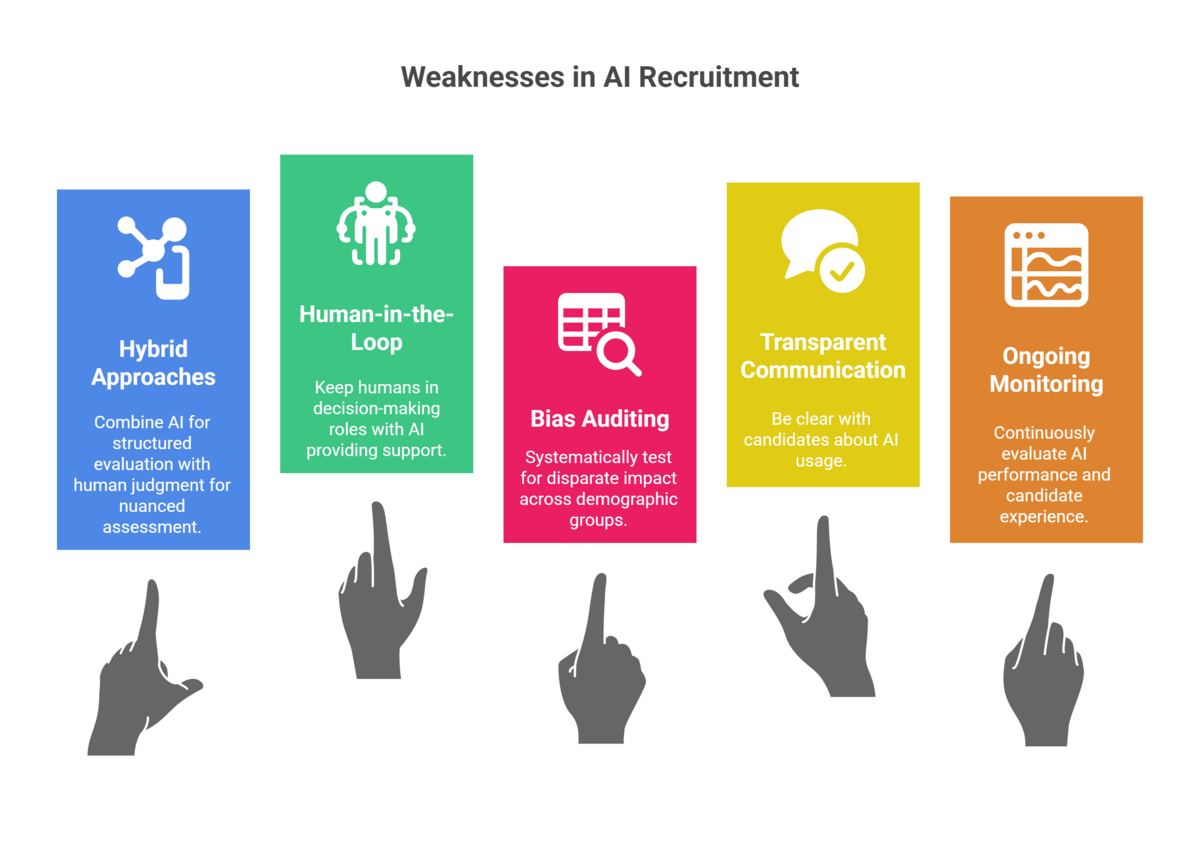
Addressing Weaknesses Through Implementation Strategy
Organizations can mitigate AI recruitment weaknesses through:
- Hybrid Approaches: Using AI for structured evaluation while preserving human judgment for nuanced assessment
- Human-in-the-Loop Design: Keeping humans in decision-making roles with AI providing support
- Regular Bias Auditing: Systematic testing for disparate impact across demographic groups
- Transparent Communication: Being clear with candidates about AI usage
- Ongoing Monitoring: Continuously evaluating AI performance and candidate experience
Platforms like Hirevire address several key weaknesses by keeping humans in the decision loop while providing AI-powered support. Hiring managers review AI analysis but make final decisions, combining AI efficiency with human judgment.
Opportunities for AI in Recruitment: Strategic Advantages
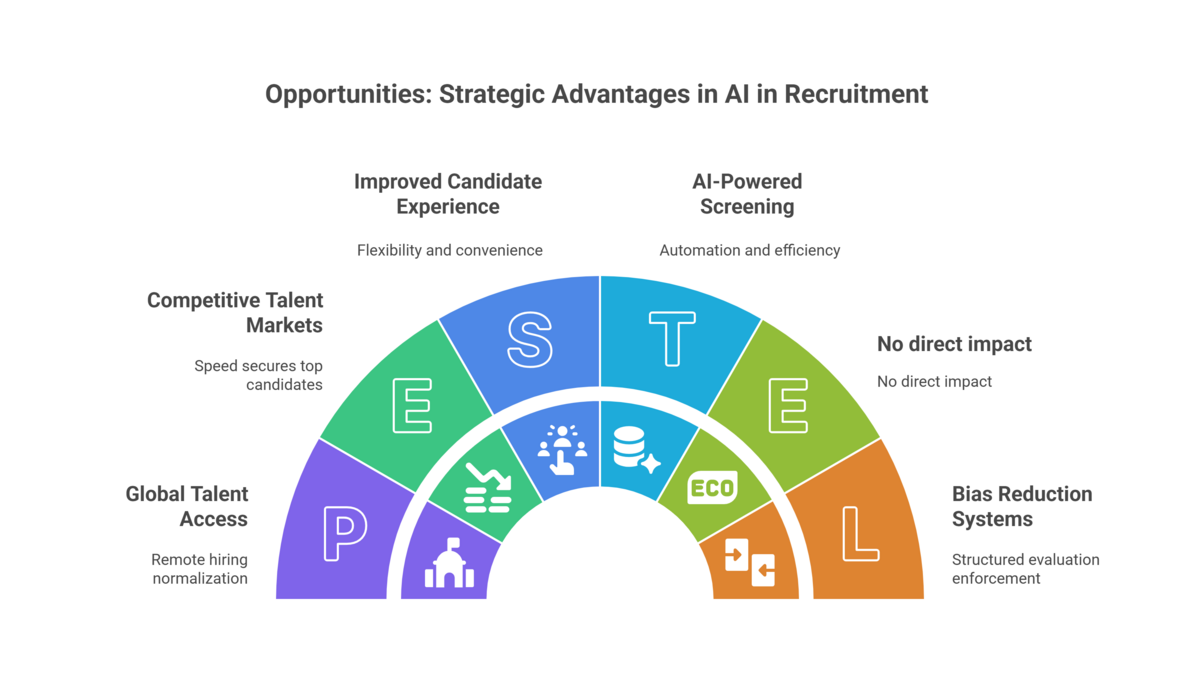
1. Competitive Advantage Through Speed and Quality
In competitive talent markets, speed determines who secures top candidates. According to LinkedIn Talent Solutions, 60% of candidates accept the first strong offer they receive, and 30% of quality candidates are off the market within 10 days.
Organizations using AI screening respond to applications in hours rather than days, conducting initial evaluation in days rather than weeks. This speed advantage translates directly to winning talent competitions.
2. Global Talent Pools and Remote Hiring
Remote work normalization means organizations can hire globally. AI-powered asynchronous screening solves global hiring challenges: time zone coordination, multilingual evaluation, and cultural assessment complexity.
Hirevire's platform with 90+ language AI transcription enables organizations to evaluate candidates worldwide without requiring multilingual recruiters or complicated scheduling across time zones.
3. Bias Reduction Through Structured Evaluation
While AI can perpetuate bias, properly designed AI systems reduce many common human biases. The key lies in using AI to enforce structured evaluation rather than replacing human judgment entirely.
AI provides mechanisms for operationalizing DEI commitments:
- Ensure identical questions for all candidates
- Apply consistent rubrics
- Evaluate blind responses before seeing demographic information
- Flag potentially biased language
4. Improved Candidate Experience Through Flexibility
Asynchronous AI screening provides candidates control over timing. They complete evaluations when convenient, from devices they prefer, with ability to re-record responses until satisfied.
Research indicates that asynchronous screening via platforms like Hirevire reduces candidate drop-off by 20-25% compared to traditional scheduling-dependent phone screens.
5. Gaming Resistance Compared to Resume Optimization
Candidates can craft perfect resumes using templates, AI writing tools, and keyword optimization. Video screening proves more resistant to gaming. While candidates can prepare and practice responses, they must actually speak, think, and articulate answers.
Hirevire's video screening approach resists gaming because candidates must demonstrate actual communication skills, thinking processes, and subject matter knowledge rather than optimizing keywords.
Threats from AI in Recruitment: Risks Requiring Mitigation
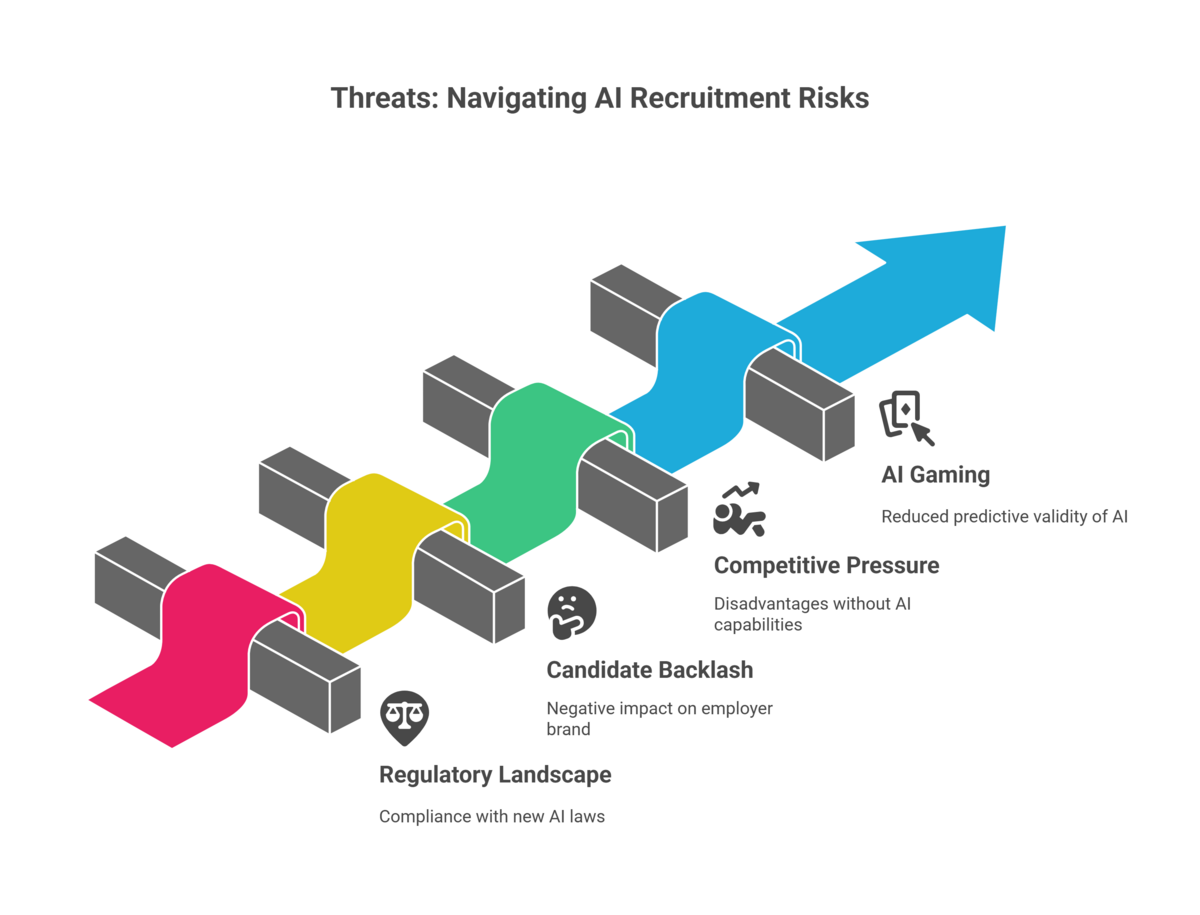
1. Evolving Regulatory and Compliance Landscape
Regulatory bodies worldwide are establishing frameworks for AI usage in employment decisions. The EU's AI Act classifies AI-based hiring systems as "high-risk," mandating transparency, accuracy, and human oversight requirements.
Proactive threat mitigation requires:
- Regular bias auditing across demographic groups
- Documentation of validation studies and business necessity
- Transparent decision processes
- Human oversight preventing fully autonomous AI decisions
2. Candidate Backlash and Employer Brand Risk
Some candidates resent AI evaluation, feeling organizations don't value them enough to provide human attention. According to Glassdoor research, 69% of job seekers would reject offers from companies with poor reputations.
Mitigation strategies include:
- Transparent communication about AI usage
- Maintaining human touchpoints throughout process
- Providing feedback and explanation of decisions
- Monitoring candidate experience metrics
3. Competitive Pressure Creating Table Stakes
As competitors implement AI screening, organizations without AI capabilities face disadvantages: slower response times, higher costs, limited candidate pool evaluation, and perceived "old-fashioned" employer brand.
4. AI Gaming and Manipulation
As AI screening becomes prevalent, services emerge coaching candidates on "beating the AI." Organizations may find AI screening loses predictive validity as gaming becomes widespread.
Authentic assessment approaches like Hirevire's video screening where candidates must actually demonstrate skills resist simple gaming strategies.
How Hirevire Addresses SWOT Considerations
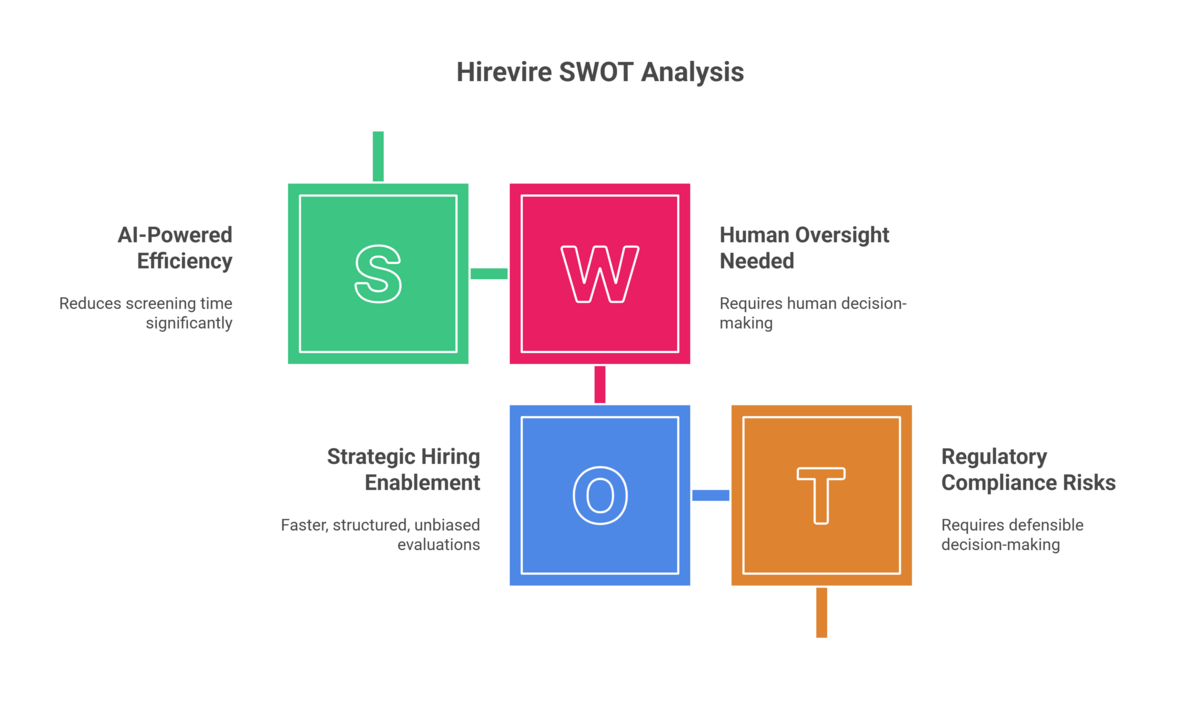
Leveraging AI Strengths
Hirevire's asynchronous video screening delivers 70-80% reduction in screening time. Organizations can screen 500 candidates as easily as 50. The platform handles bulk candidate invitations, automated workflows, and simultaneous evaluation. AI transcription supports 90+ languages, enabling global hiring without multilingual recruiting staff.
Mitigating AI Weaknesses
Hirevire keeps humans at the center of decision-making. AI provides transcription, analysis, and insights, but hiring managers watch videos and make final decisions. This hybrid approach combines AI efficiency with human judgment for nuanced assessment.
Unlike rigid AI interview platforms, Hirevire's approach addresses candidate experience concerns:
- No Login Required: Eliminates 20-25% drop-off from account creation requirements
- Unlimited Re-Recording: Reduces anxiety and enables best-self presentation
- Multi-Format Options: Video, audio, text, and file submissions accommodate preferences
Capturing Strategic Opportunities
Hirevire enables organizations to respond to applications in hours rather than days. The platform enforces structured evaluation with identical questions, consistent rubrics, and standardized analysis. Organizations can implement blind review to further reduce implicit bias.
Addressing Threats and Risks
Hirevire's human-in-the-loop approach addresses regulatory concerns by maintaining human decision authority. The consistent evaluation framework and documentation capabilities support defensibility if decisions are challenged.
Pricing and Accessibility
| Plan | Price | Features | Best For |
|---|---|---|---|
| Essentials | $39/month | 300 interviews per year, AI transcription, multi-format responses | Single position hiring |
| Professional | $99/month | Multiple jobs, advanced analytics, full integrations | Regular hiring needs |
| Agency | $199/month | Agency features, white-label, API access | High-volume teams |
Customer Reviews:
G2: 4.8/5 stars (25+ reviews) - View Reviews
Capterra: 4.7/5 stars (15+ reviews) - View Reviews
Implementation Decision Framework: Where to Start
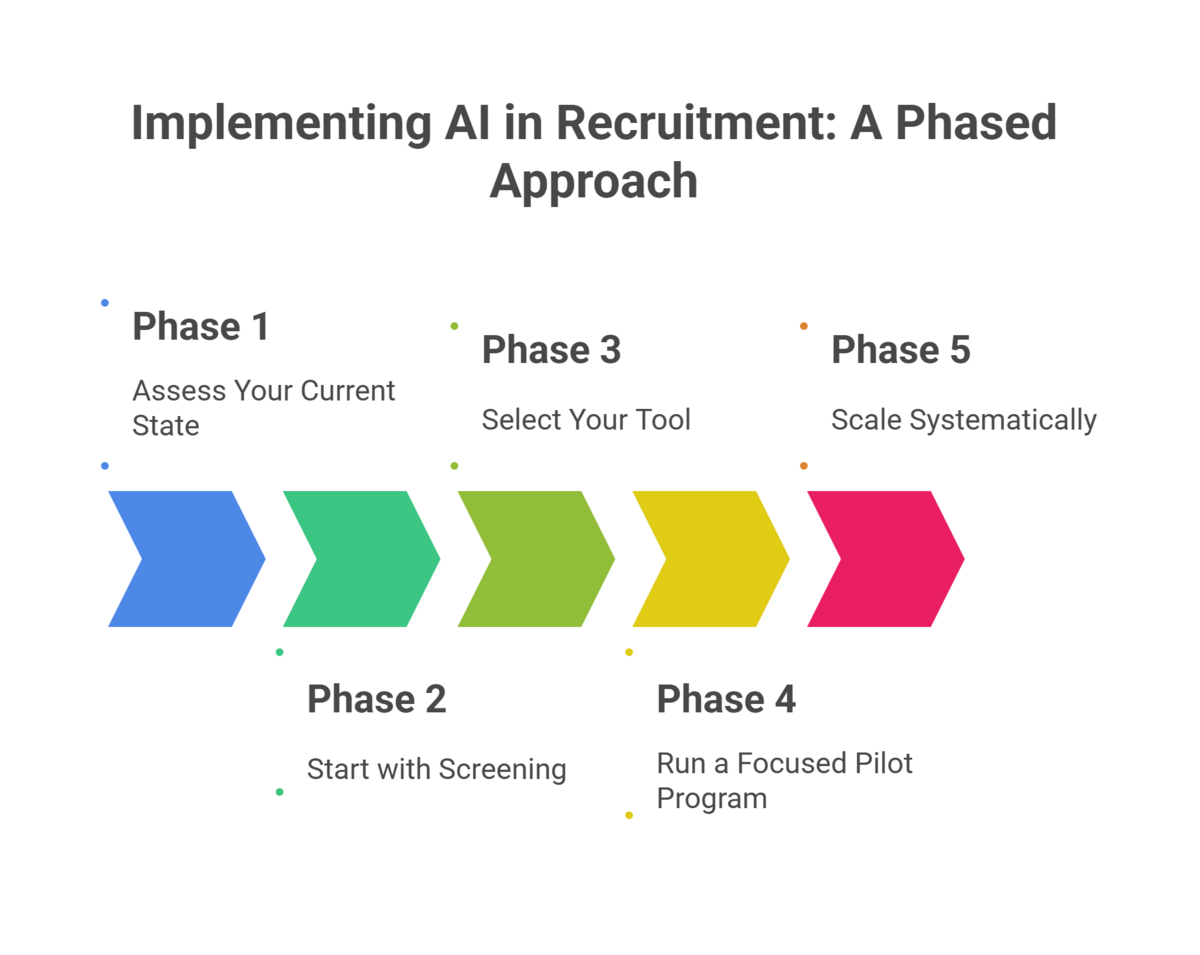
Phase 1: Assess Your Current State
Map your current recruitment process and quantify challenges:
- What's your average time-to-hire, and where are delays concentrated?
- How many hours per week do recruiters spend on screening?
- What's your candidate-to-interview conversion rate?
- Where do candidates drop out most frequently?
Calculate potential ROI:
- Current recruiter hours spent on screening × hourly cost = screening cost
- Multiply by 0.75 (75% time reduction) = potential savings
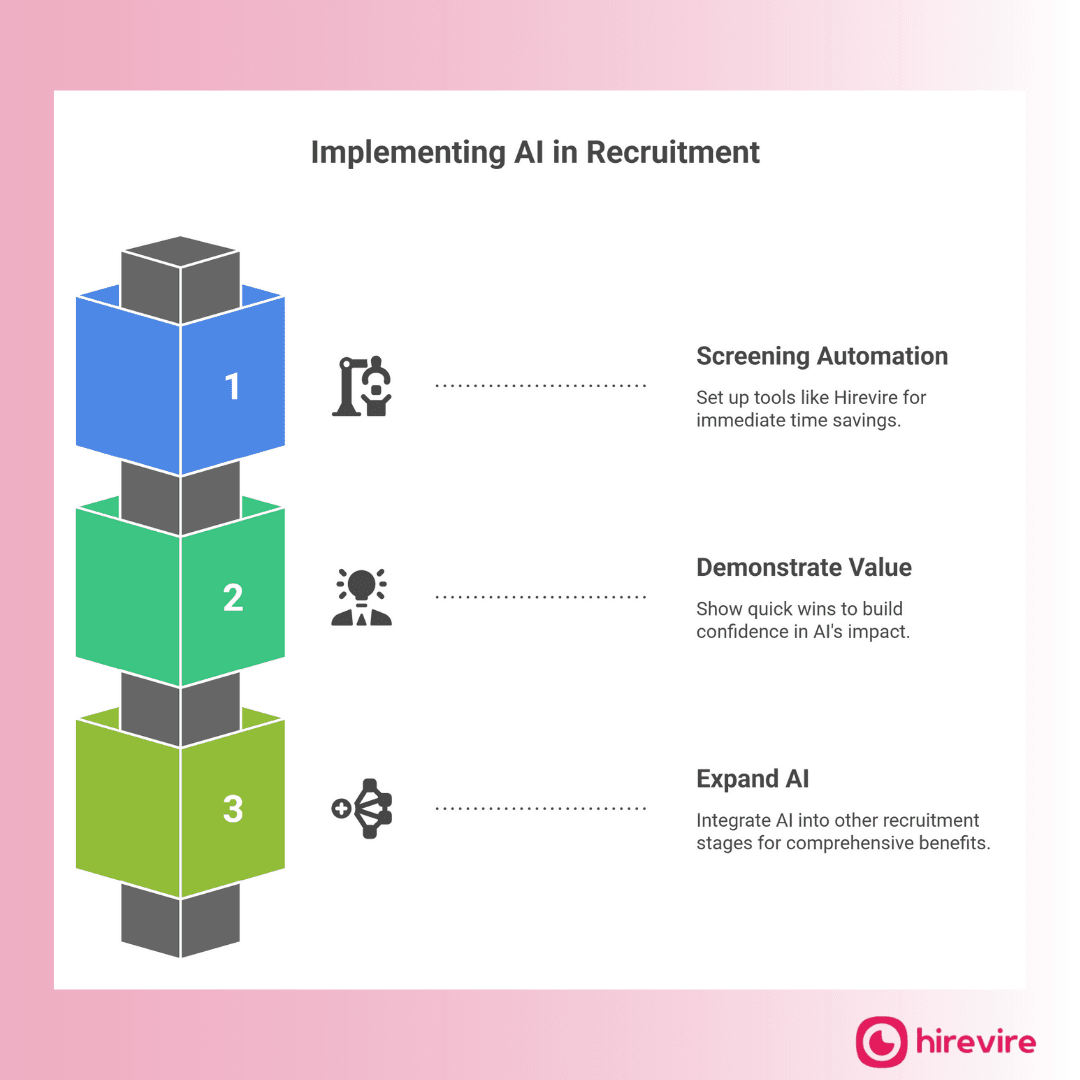
Phase 2: Start with Screening
Screening represents the optimal starting point because it delivers highest-ROI AI application:
- Highest volume activity: Most time-consuming task
- Well-structured evaluation: Clear competency assessment
- Immediate value: Time savings from day one
- Low risk: Maintains human decision authority
- Proven technology: Mature platforms with documented results
Phase 3: Select Your Tool
When evaluating AI screening platforms, assess:
- Multi-format response options (video, audio, text)
- Candidate experience (login requirements, mobile optimization)
- AI capabilities (transcription languages, analysis depth)
- Integration options (ATS, Zapier, webhooks)
- Pricing transparency and structure
Hirevire scores strongly across these criteria with multi-format responses, no candidate login requirement, 90+ language support, extensive integrations, and transparent pricing starting at $39/month.
Phase 4: Run a Focused Pilot Program
Two-Week Test Framework:
Week 1: Setup and Initial Use
- Configure platform for 1-2 positions
- Define screening questions and evaluation criteria
- Send invitations to 20-30 candidates
- Train hiring team on review process
Week 2: Evaluation and Refinement
- Review AI analysis quality
- Compare AI recommendations to human judgment
- Assess candidate completion rates
- Measure time savings quantitatively
- Refine based on learnings
Pilot Success Criteria:
- 70%+ candidate completion rate
- 75%+ time savings vs traditional phone screens
- High agreement between AI analysis and human review (80%+)
- Positive candidate feedback (4+ / 5 average rating)
Phase 5: Scale Systematically
After successful pilot, expand systematically:
- Month 1-2: All high-volume positions
- Month 3-4: Standard recurring roles
- Month 5-6: All positions
This phased rollout allows continuous learning, gradual change management, and building of organizational expertise.
Frequently Asked Questions
What is the biggest strength of using AI in recruitment?
The biggest strength is dramatic time efficiency combined with consistent evaluation. AI-powered screening reduces initial candidate evaluation time by 70-80%, enabling organizations to screen 500 candidates in the time previously required for 50 phone screens. This efficiency comes without sacrificing consistency - AI improves evaluation reliability by applying identical criteria to every candidate.
Hirevire exemplifies this strength, enabling hiring teams to evaluate comprehensive candidate pools with AI-supported analysis while maintaining human decision authority.
What are the main weaknesses of AI in recruitment?
Primary weaknesses include limited ability to assess cultural fit nuances, dependence on training data quality, potential for algorithmic bias, and inability to handle truly novel situations. AI struggles with subtle soft skill evaluation, emotional intelligence assessment, and context-dependent judgment.
These weaknesses don't preclude AI adoption but demand hybrid approaches where AI handles structured competency evaluation while humans provide nuanced judgment, final decision authority, and relationship building.
How does AI in recruitment create opportunities?
AI creates significant opportunities including competitive speed advantage (responding to candidates in hours rather than days), global talent pool access (90+ language support eliminates geographic barriers), improved candidate experience through flexible asynchronous screening, bias reduction via structured evaluation frameworks, and comprehensive data analytics enabling continuous optimization.
Organizations implementing AI screening via platforms like Hirevire report 40-50% faster time-to-hire, enabling them to win competitive talent battles.
What threats should organizations consider?
Key threats include evolving regulatory requirements (EU AI Act, state-level regulations), candidate backlash and employer brand risk from impersonal AI experiences, competitive pressure making AI capabilities table stakes, vendor dependency creating lock-in risks, AI gaming by sophisticated candidates, and over-reliance on AI causing human judgment atrophy.
Organizations can mitigate these threats through human-in-the-loop implementation maintaining decision authority, transparent candidate communication, regular bias auditing, authentic assessment methods like video screening, and balanced hybrid approaches.
Where should organizations start with AI in recruitment?
Organizations should start with screening, specifically asynchronous video screening with AI support. Screening represents the highest-ROI AI application because it's the most time-consuming activity, involves structured evaluation suitable for AI, delivers immediate value, maintains low risk with human oversight, and uses mature, proven technology.
A recommended path: (1) Assess current screening bottlenecks, (2) Evaluate platforms like Hirevire offering multi-format responses and human-in-the-loop design, (3) Run a 2-week pilot, (4) Measure results, (5) Scale to all high-volume positions after successful validation.
Should AI make final hiring decisions?
Humans should maintain final decision authority for hiring decisions, with AI providing analysis, insights, and recommendations to support human judgment. This "human-in-the-loop" approach combines AI efficiency with human nuance, satisfies regulatory requirements, maintains accountability, enables handling of edge cases, and preserves relationship building.
Hirevire exemplifies best-practice design: AI handles transcription, analysis, and initial screening, while humans review AI insights, watch videos, assess cultural fit, and make final decisions. This balanced approach delivers 70-80% time savings while maintaining human judgment.
Conclusion: Your Strategic Next Steps
AI in recruitment has transitioned from emerging technology to strategic imperative. The SWOT analysis demonstrates clear value proposition: measurable strengths in efficiency and scalability, manageable weaknesses through proper implementation, significant opportunities for competitive advantage, and addressable threats with appropriate safeguards.
Key Takeaways
Strengths: AI delivers 70-80% time savings, enables volume handling impossible manually, provides consistent evaluation, supports global hiring through multilingual capabilities, and generates comprehensive analytics.
Weaknesses: AI struggles with cultural fit nuance, depends on training data quality, risks algorithmic bias, and may create impersonal candidate experiences if poorly implemented.
Opportunities: Organizations implementing AI gain speed advantages, access global talent pools, improve diversity through structured evaluation, enhance candidate experience, and build data-driven optimization capabilities.
Threats: Evolving regulations require compliance attention, candidate backlash risks employer brand, competitive adoption creates urgency, and over-reliance on AI risks judgment atrophy.
Recommended Implementation Path
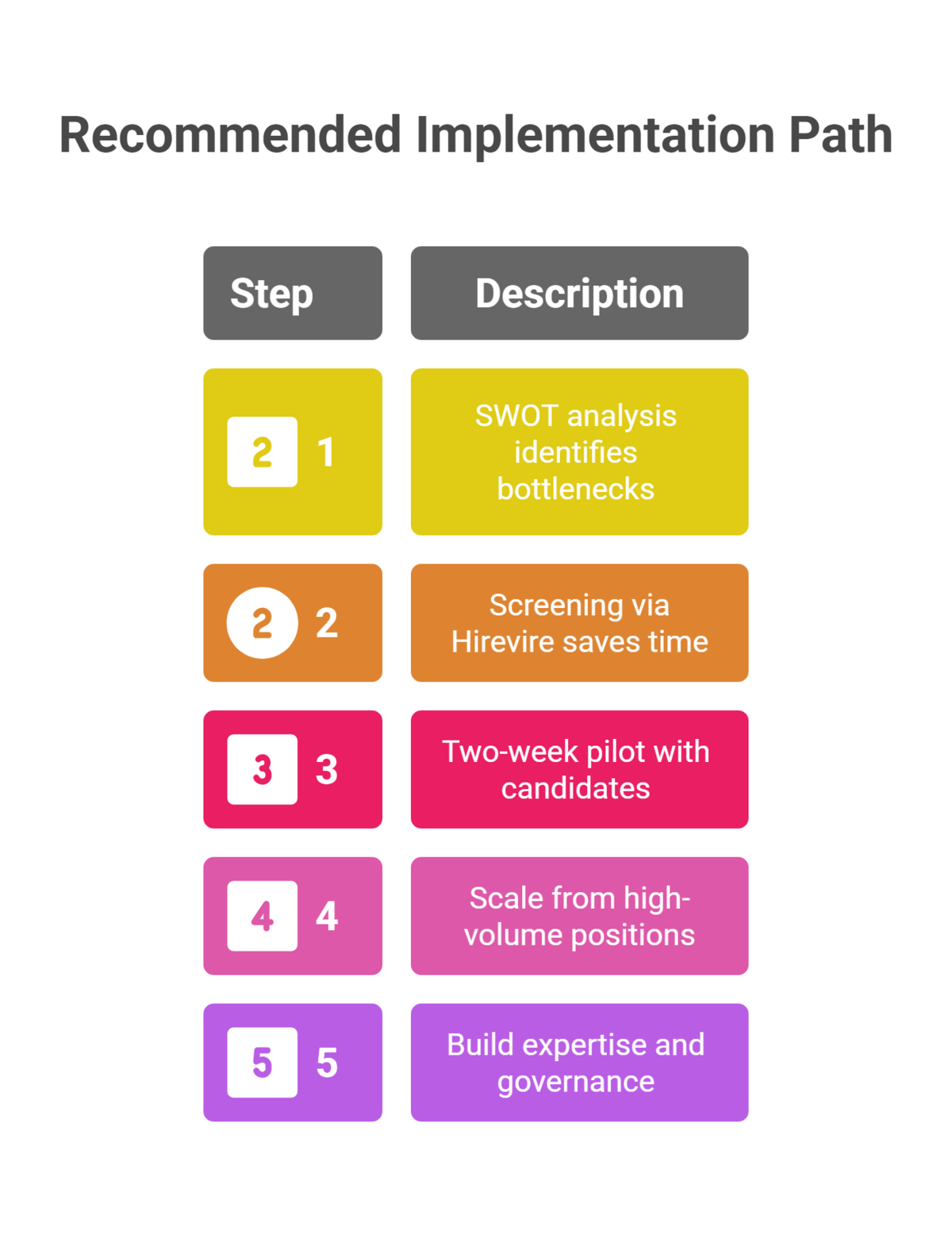
Step 1: Conduct organization-specific SWOT analysis identifying your bottlenecks and opportunities
Step 2: Start with screening via Hirevire - proven technology delivering 70-80% time savings with human-in-the-loop design, multi-format responses, 90+ language support, and affordable transparent pricing ($39-199/month)
Step 3: Run a structured 2-week pilot with 1-2 positions and 20-30 candidates
Step 4: Scale systematically from high-volume positions to all roles over 3-6 months
Step 5: Build expertise and governance through documentation, bias auditing, training programs, and continuous improvement
The Bottom Line
Organizations conducting thorough SWOT analysis before AI adoption achieve 3x higher ROI and significantly smoother implementation. This framework provides the strategic clarity needed for confident, successful AI recruitment adoption.
The question is no longer whether to implement AI in recruitment but how to do so strategically, effectively, and ethically. Organizations moving deliberately but decisively gain measurable advantages in talent competition.
Ready to act on your SWOT findings?
Begin with a risk-free trial, experience 70-80% screening time savings firsthand, and discover how strategic AI adoption transforms your recruitment effectiveness.
Last updated: January 2026. All information and statistics verified as of January 6, 2026.