What is AI in Recruiting? The Complete Guide to AI Recruiting (2026)
Drowning in 500 resumes for one position? You're not alone. The modern recruiter faces an overwhelming challenge: finding top talent quickly while maintaining quality in candidate evaluation.
Here's the uncomfortable truth: recruiters spend up to 78% of their time on administrative tasks, with the average cost per hire exceeding $4,700. Meanwhile, poor hiring decisions compound these challenges, with a single bad hire costing up to five times an employee's annual salary.
Artificial intelligence is transforming how organizations find, evaluate, and hire talent. Companies adopting AI-based recruitment platforms report a 40% productivity boost in recruiting teams, with some cutting time-to-hire by nearly 75%. These aren't just efficiency gains. AI recruitment tools reduce bias, improve candidate experience, and free recruiters to focus on strategic decision-making.
This comprehensive guide explores what AI recruitment is, how it works, the different types of AI recruitment tools available, and how platforms like Hirevire are making AI-powered hiring accessible to organizations of all sizes.
What is AI Recruitment?
AI recruitment refers to the use of artificial intelligence technologies to automate, enhance, and optimize various stages of the hiring process. At its core, AI recruitment applies machine learning algorithms, natural language processing, and data analysis to tasks traditionally performed manually by recruiters.
Rather than replacing human recruiters, AI recruitment acts as an intelligent assistant that handles repetitive, time-consuming tasks while providing data-driven insights that improve hiring decisions.
Core Functions
AI recruitment systems analyze resumes and applications at scale, identifying qualified candidates based on specific criteria. They screen candidates through automated assessments, video interviews, and skill evaluations. AI tools match candidates to positions by analyzing job requirements against candidate profiles, rank applicants based on fit scores, and predict candidate success using historical hiring data.
The Fundamental Shift
Traditional recruitment relies heavily on manual review and subjective judgment. AI recruitment transforms this model by processing large volumes of candidate data in minutes, applying consistent evaluation criteria to every applicant, identifying patterns invisible to human reviewers, and freeing recruiters to focus on relationship-building and strategic decision-making.
Organizations implementing AI recruitment report measurable improvements: time-to-hire decreases by 50-75%, quality of hire improves through data-driven matching, recruiter productivity increases as administrative burdens decrease, and candidate experience enhances through faster response times.
What Does AI Stand for in Recruitment Context?
AI stands for Artificial Intelligence in the recruitment context. In recruitment, artificial intelligence refers to computer systems that can perform tasks typically requiring human intelligence: learning from data, recognizing patterns, making predictions, and continuously improving performance.
The Key Difference from Traditional Software
Traditional recruitment software follows pre-programmed rules. AI recruitment software learns from experience, analyzing thousands of hiring outcomes to identify which candidate characteristics correlate with job success, adapting screening criteria based on feedback, and continuously improving recommendations.
The Technologies Behind Artificial Intelligence in Recruitment
Machine Learning analyzes historical hiring data to identify patterns and learn which characteristics predict successful hires.
Natural Language Processing (NLP) enables AI systems to understand human language in resumes, cover letters, and interview responses. For example, Hirevire uses NLP to analyze video interview responses, learning to recognize communication patterns, keyword relevance, and response completeness indicators that predict candidate success. NLP powers resume parsing, semantic analysis, sentiment assessment, and multilingual support processing applications in 90+ languages.
Computer Vision analyzes video content, enabling AI to assess presentation skills, verify candidate identity, and evaluate non-verbal communication.
Predictive Analytics uses historical data to forecast which candidates are most likely to succeed in roles, accept offers, and remain with the company long-term.
The Evolution: Manual to ATS to AI-Powered Tools
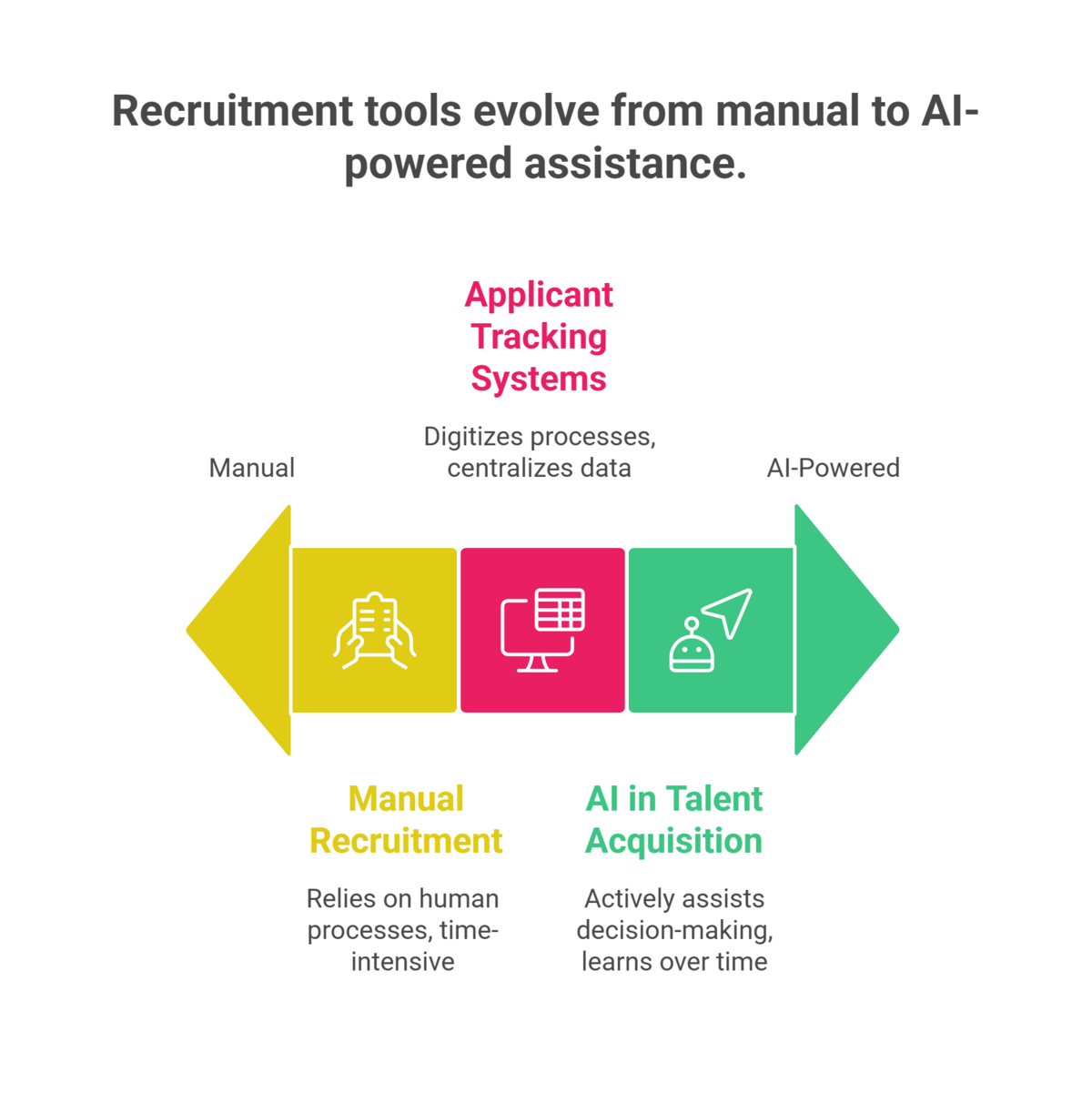
Era 1: Manual Recruitment (Pre-2000s)
Traditional recruiting relied entirely on human processes with manual resume review, physical filing systems, one-at-a-time phone screens, and endless scheduling coordination. Pain points included time-intensive processes, inconsistent evaluation, limited data for decisions, and poor scalability.
Era 2: Applicant Tracking Systems (2000s-2010s)
ATS platforms revolutionized recruitment by digitizing manual processes with online job postings, centralized candidate databases, keyword searching, and automated communications. However, limitations remained: manual review of filtered resumes, subjective evaluation, keyword matching producing false positives, and persistent bias.
Era 3: AI in Talent Acquisition (2015-Present)
AI recruitment platforms represent the third evolutionary leap. Rather than simply organizing processes, AI tools actively assist with decision-making through automatic candidate screening using sophisticated analysis, intelligent skills and fit evaluation, consistent criteria application, candidate ranking and recommendations, and continuous learning improving accuracy over time.
Modern Example
Consider screening for a software developer position. In the manual era, recruiters spent hours reading resumes. With ATS, keyword searches helped but missed variations. With AI-powered tools like Hirevire, natural language processing understands semantic equivalents, analyzes video responses to assess communication skills and problem-solving approach, processes dozens of candidates simultaneously with identical criteria, and provides detailed reasoning for recommendations.
How Does AI Recruitment Work?
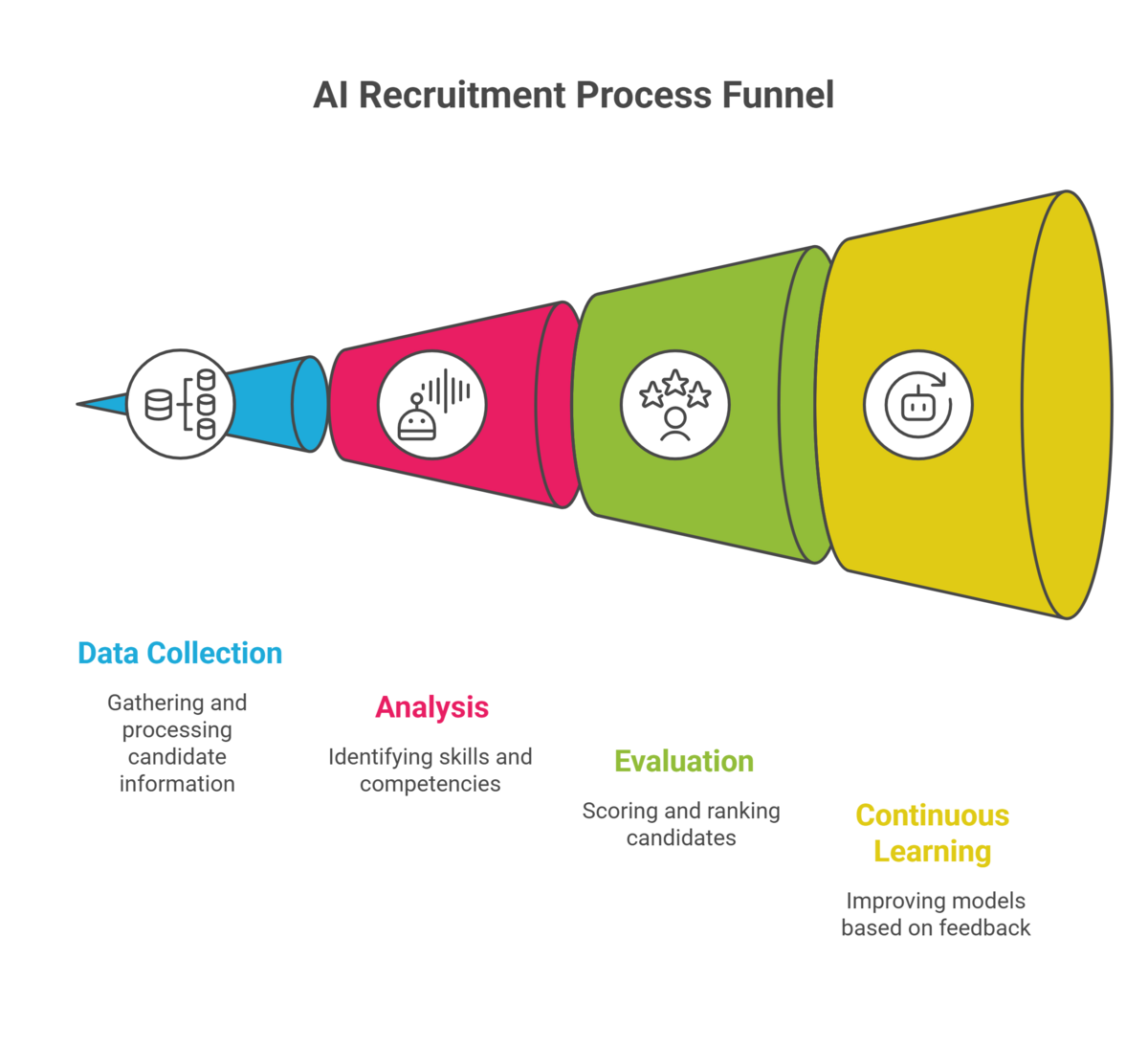
AI recruitment follows a four-stage process that mimics how human recruiters work, but at much greater scale and consistency.
Stage 1: Data Collection and Processing
AI systems gather candidate information from applications, resumes, video interviews, assessment responses, and work samples. Natural language processing parses text to identify skills, experience, education, and qualifications. Computer vision analyzes video content for presentation and communication. Data standardization converts various formats into consistent structures.
Stage 2: Analysis and Pattern Recognition
The AI analyzes processed data to identify relevant skills and competencies, evaluate communication clarity and professional presentation, assess answer completeness and depth, and recognize keywords and concepts matching job requirements. Machine learning models understand which characteristics correlate with job success.
Stage 3: Evaluation and Scoring
Based on analysis, the AI generates candidate evaluations by assigning scores across different criteria, ranking candidates relative to each other, and providing match/non-match recommendations with detailed reasoning. Modern AI recruitment tools like Hirevire don't just provide scores but explain their reasoning, citing specific examples from candidate responses.
Stage 4: Continuous Learning
AI recruitment systems improve over time by incorporating feedback on which candidates succeeded, analyzing outcomes to refine prediction models, adjusting evaluation criteria based on what predicts success, and adapting to changing requirements.
Specific AI Techniques in Action
Video Interview Analysis: When candidates submit video responses through platforms like Hirevire, AI performs multiple analyses simultaneously. Transcription converts speech to text in 90+ languages. Content analysis evaluates whether candidates directly addressed questions, provided relevant examples, demonstrated required competencies, and explained reasoning.
Semantic Keyword Matching: Unlike simple keyword searches, AI uses semantic analysis to understand meaning. When looking for "customer service experience," AI recognizes equivalent expressions like "client support," "customer success," and "customer relations."
Custom Evaluation Criteria: Advanced platforms allow organizations to customize evaluation parameters. Hirevire enables custom evaluation prompts up to 200 characters that guide AI analysis toward role-specific requirements.
Types of AI Recruiting Tools
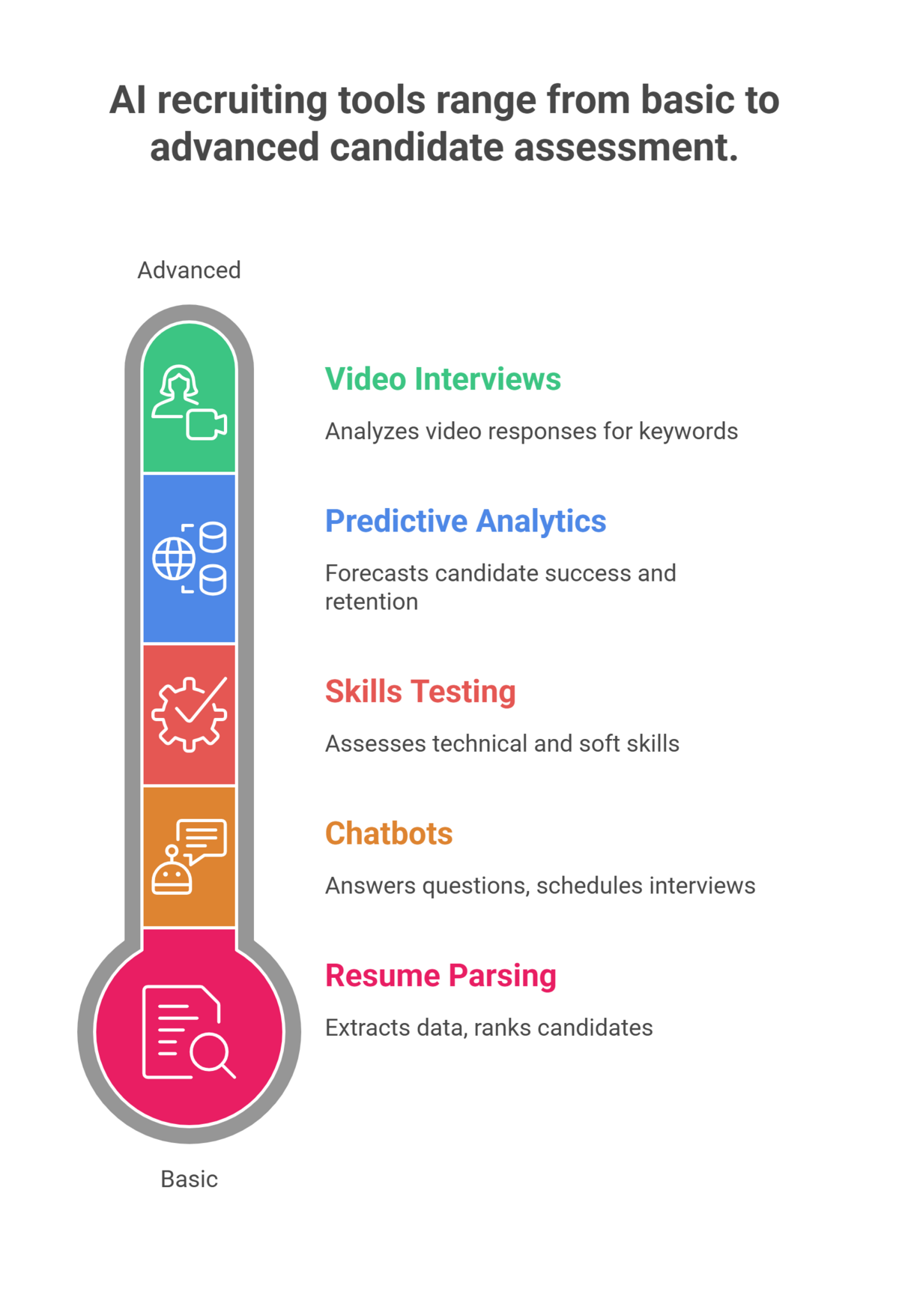
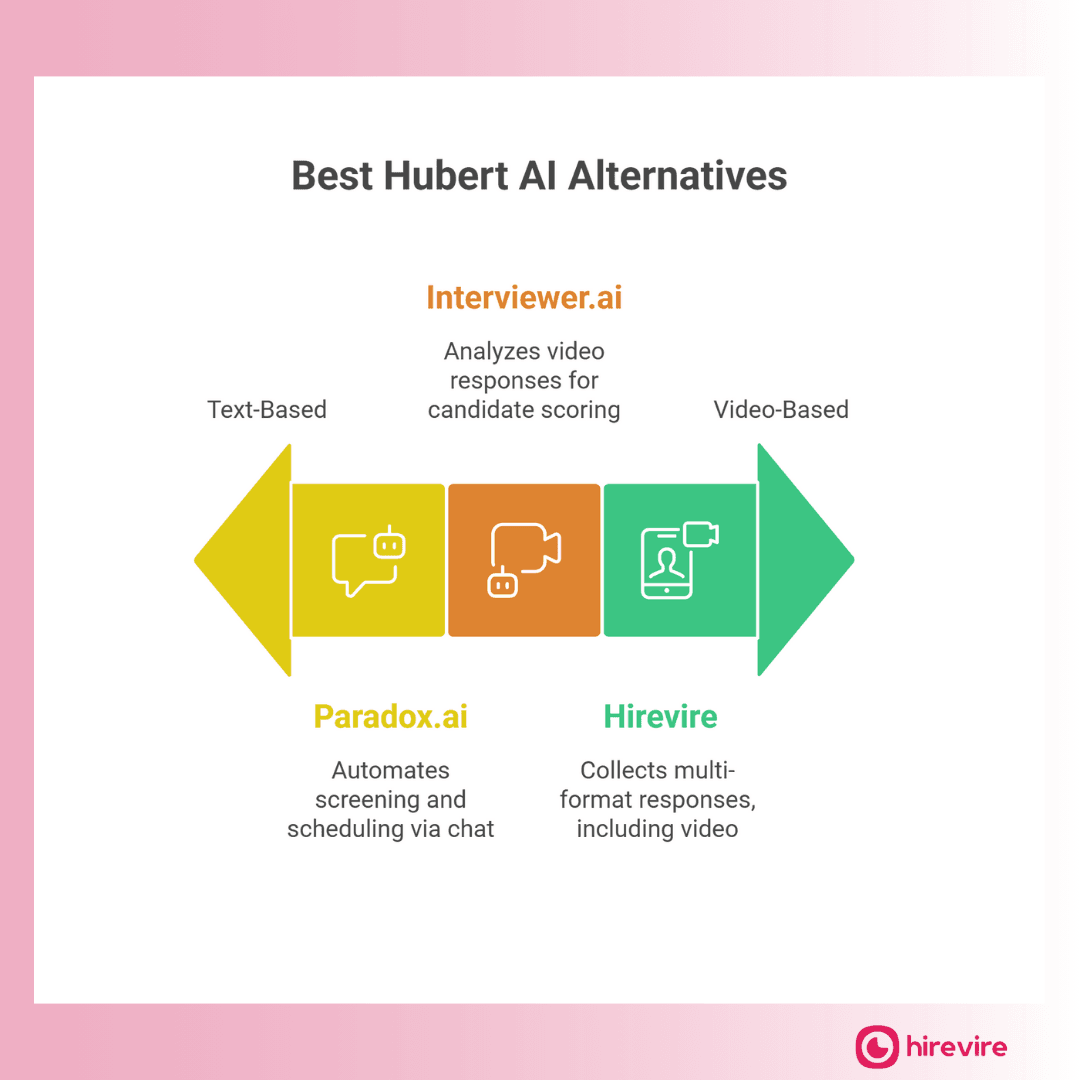
AI Resume Screening and Parsing Tools use NLP to analyze resume content automatically, extracting structured data and ranking candidates based on relevance. These tools address high application volumes, enabling recruiters to process hundreds of resumes in minutes.
Async Video Interview Platforms with AI Analysis represent one of the most impactful innovations. These tools allow candidates to record video responses on their own schedule, enable AI to analyze content for keywords and communication, support multilingual transcription, and facilitate collaborative team review.
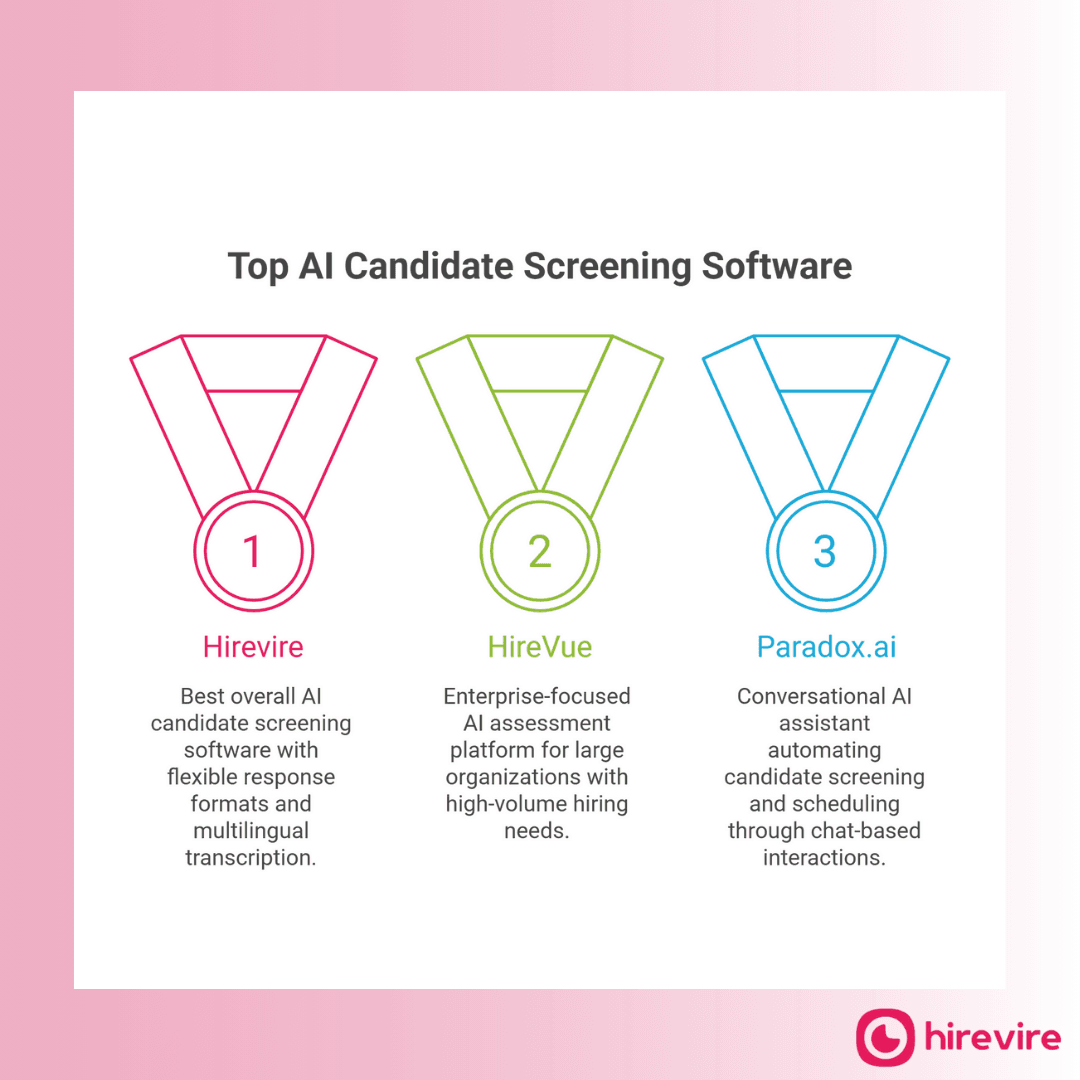
Hirevire exemplifies this category, offering multi-format response collection (video, audio, text, files), AI-powered transcriptions in 90+ languages, custom evaluation criteria, detailed match/non-match recommendations with reasoning, and bulk processing for high-volume hiring.
Key advantages include eliminating scheduling friction, providing richer candidate assessment than resumes alone, enabling consistent evaluation across large candidate pools, and dramatically reducing time spent on initial screening calls.
AI Chatbots provide 24/7 candidate communication through instant answers, interview scheduling, status updates, and pre-screening questionnaires.
AI Assessment and Skills Testing Platforms evaluate technical competencies, cognitive abilities, personality traits, and situational judgment, adapting difficulty based on responses and predicting job performance.
Predictive Analytics Platforms analyze historical hiring data to predict candidate success probability, time-to-productivity, retention likelihood, and offer acceptance probability.
Choosing the Right Tool Category
Choose async video interview platforms with AI (like Hirevire) if you need to screen high volumes efficiently, want consistent evaluation across all applicants, require multilingual capabilities for global hiring, value flexible response formats, seek affordable focused solutions starting at $39/month, and prioritize candidate experience with no-login access.
Hirevire supports integration with other tools, connecting to 5000+ applications via Zapier and Make, enabling seamless workflows with existing ATS and HR systems.
What is an AI Recruitment Tool?
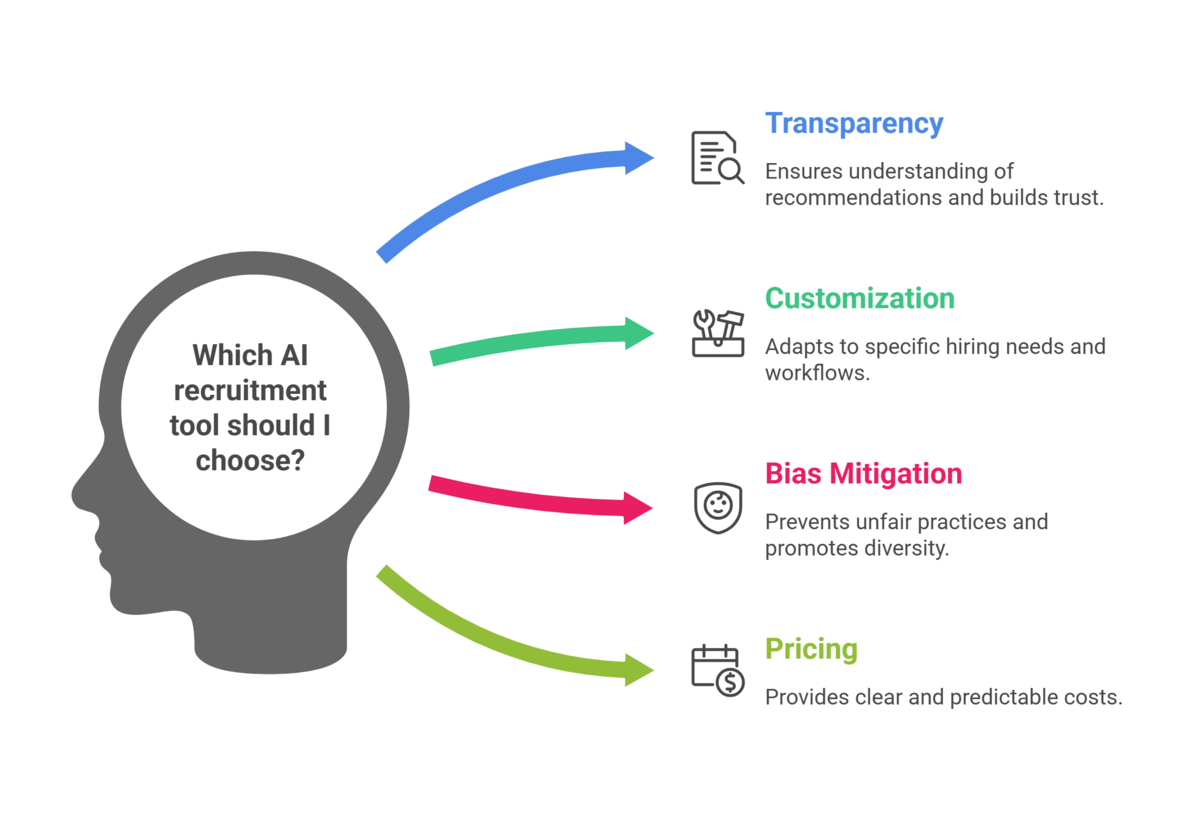
An AI recruitment tool is software that applies artificial intelligence to automate and enhance hiring processes. True AI recruitment tools distinguish themselves through intelligent decision support analyzing data to provide recommendations, learning and adaptation improving over time, pattern recognition beyond explicit programming, and multi-dimensional analysis considering multiple factors simultaneously.
Core Characteristics
True AI tools don't just automate tasks but analyze data to rank candidates by predicted job fit rather than just keyword matching, and evaluate video interviews by assessing communication clarity, answer completeness, and relevant experience rather than simply transcribing audio.
What AI Tools Are Not
AI recruitment tools augment human decision-making rather than replacing it. They handle high-volume initial screening, provide data-driven recommendations, and maintain consistency, while humans make final hiring decisions, evaluate nuanced cultural fit, conduct in-depth interviews, and provide the human touch candidates value.
Evaluating AI Recruitment Tools
When assessing tools, consider transparency and explainability. Does the tool explain its recommendations? Hirevire provides detailed reasoning for all evaluations, citing specific candidate responses that support conclusions.
Consider customization capabilities. Can you adapt the tool to your specific needs? Look for custom evaluation criteria, configurable workflows, and integration options with existing systems.
Consider bias mitigation features. What steps does the vendor take to prevent bias? Ask about training data diversity, bias testing, focus on job-relevant criteria, and regular fairness reviews.
Consider pricing transparency. Is pricing clear and predictable? Look for transparent, straightforward pricing like Hirevire's plans starting at $39/month with unlimited candidates.
The Technology Stack Behind AI Recruitment
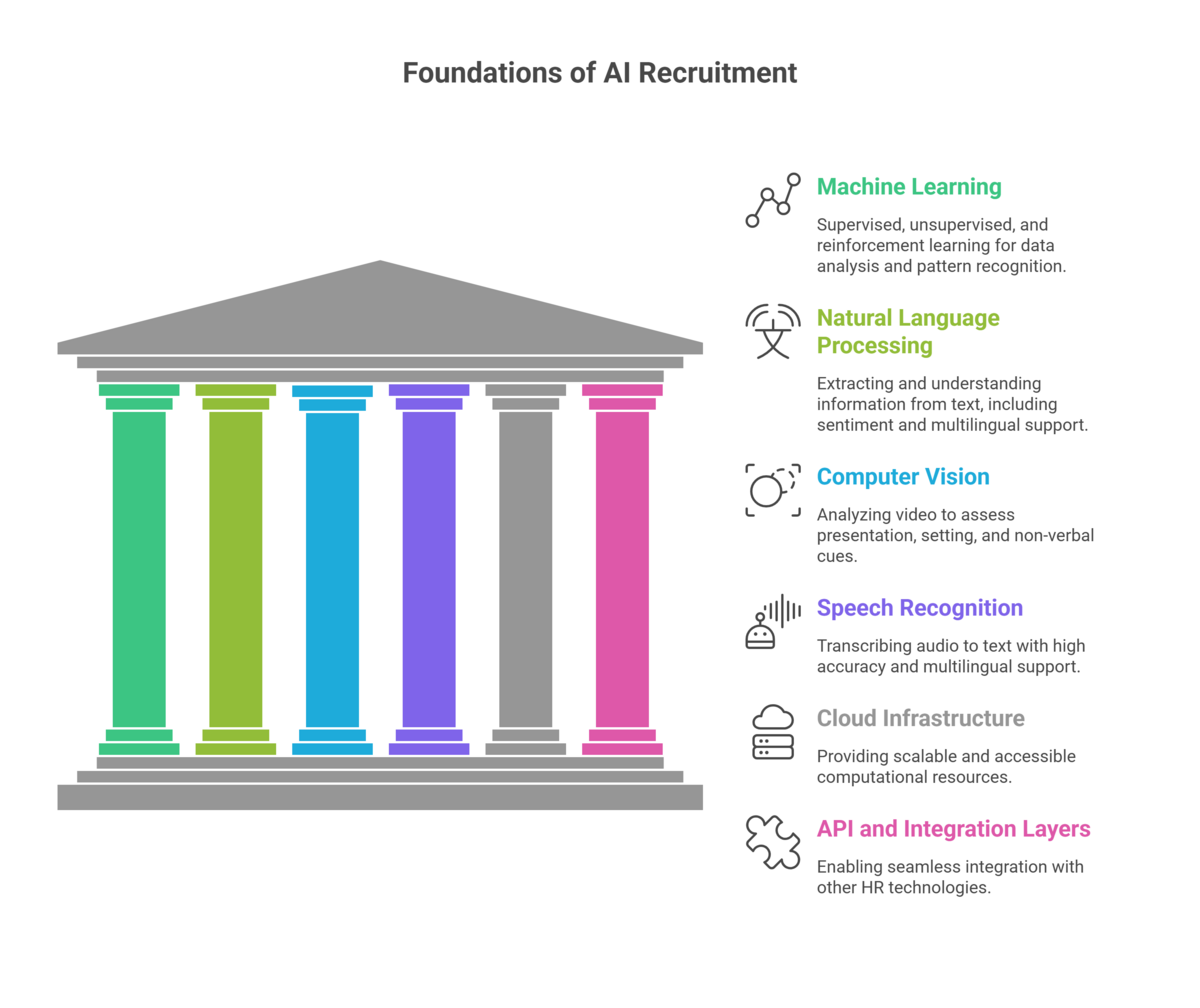
Machine Learning forms the core, with supervised learning training on labeled data from previous hires, unsupervised learning finding patterns in unlabeled data, and reinforcement learning improving through feedback.
Natural Language Processing extracts structured information from unstructured text, provides semantic understanding beyond keyword matching, assesses sentiment in communications, and supports multilingual processing. Hirevire offers AI transcription in 90+ languages.
Computer Vision for video analysis evaluates professional presentation, appropriate setting, video quality, and non-verbal communication indicators.
Speech Recognition transcribes audio to text with high accuracy, handles various accents and speaking styles, filters background noise, and supports multiple languages.
Cloud Infrastructure provides computational resources to process large datasets, scalability to handle varying volumes, global accessibility, and automatic updates.
API and Integration Layers enable integration with other HR technologies through REST APIs, webhook support for real-time notifications, and pre-built integrations. Hirevire integrates with 5000+ applications via Zapier and Make.
Benefits of AI in Recruitment
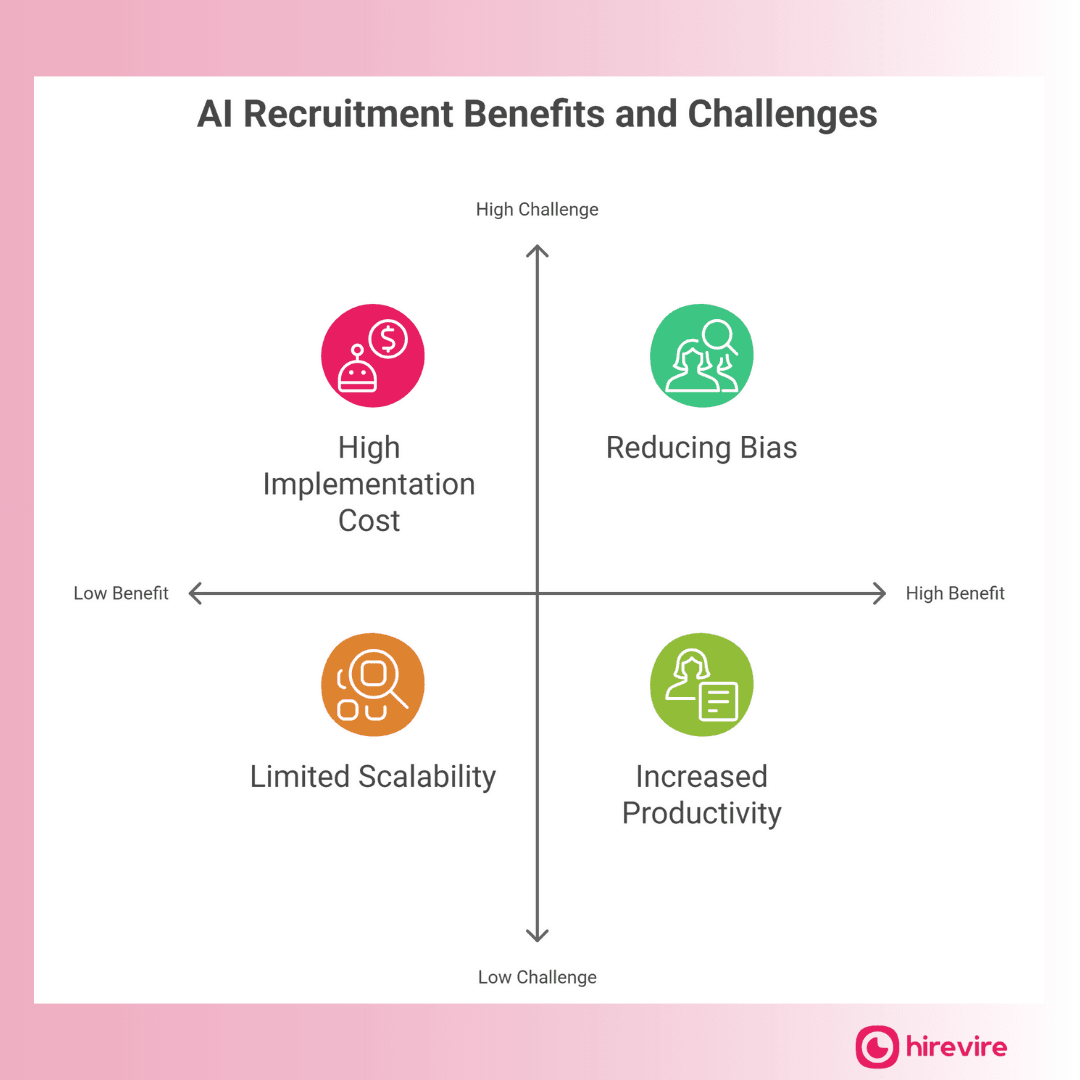
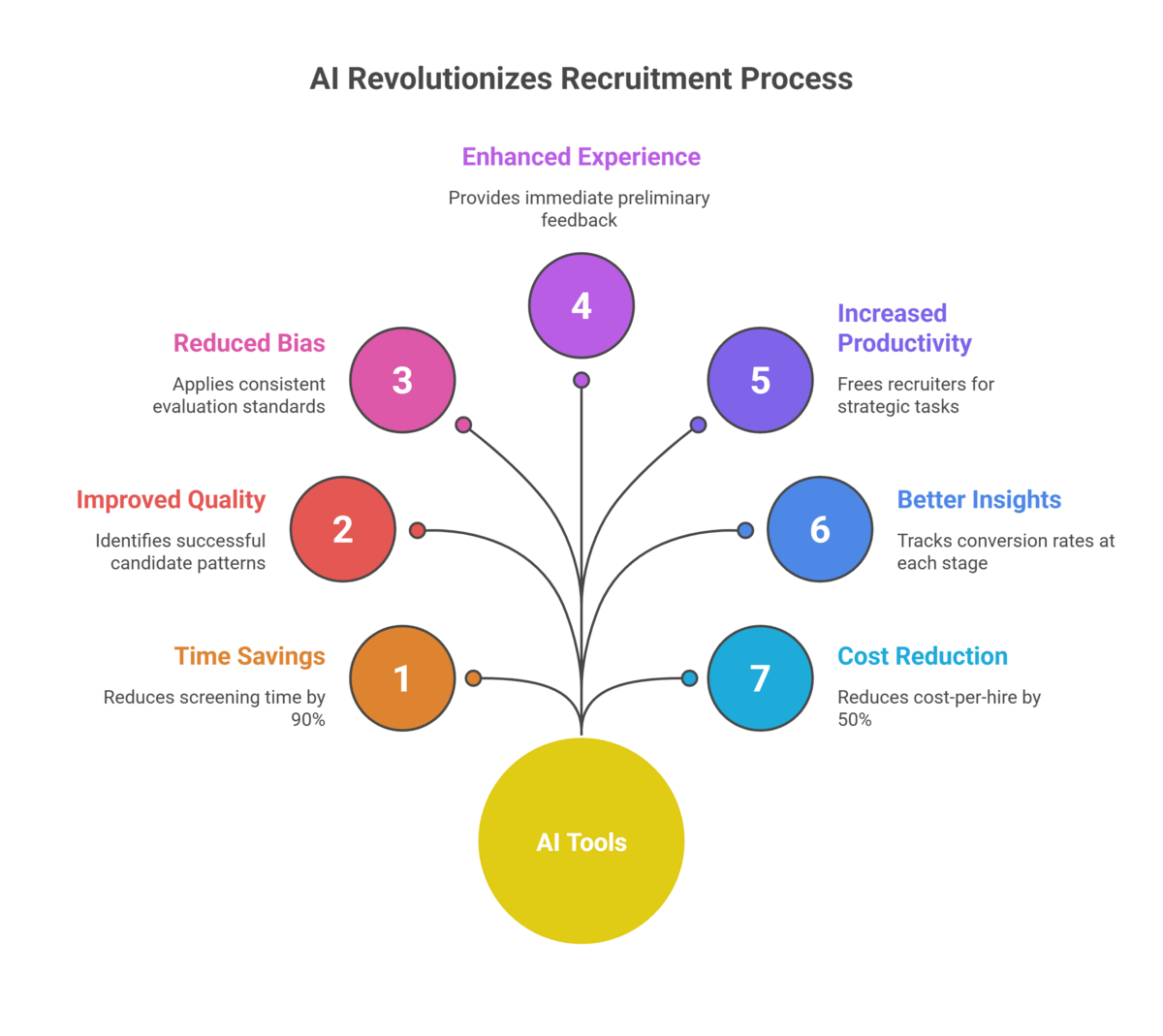
Dramatic Time Savings: AI processes hundreds of resumes in minutes rather than days, reducing screening time by 90-95%. Asynchronous platforms like Hirevire eliminate scheduling coordination. Organizations report 50-75% reductions in time-to-hire.
Improved Hiring Quality: AI applies identical criteria to every applicant, ensures fair comparison, identifies patterns predicting job success, and expands candidate pools by evaluating more applicants than manual processes allow.
Reduced Bias: Properly designed AI tools apply consistent standards regardless of demographics, support blind screening, and enable bias auditing by tracking evaluation patterns across groups.
Enhanced Candidate Experience: Automated screening provides immediate preliminary feedback, modern platforms provide transparent evaluation criteria, and asynchronous interviews let candidates participate on their schedule with re-recording options.
Increased Recruiter Productivity: AI handles repetitive tasks, freeing recruiters for relationship building, conducting in-depth conversations, and strategic activities like employer branding and workforce planning.
Better Data and Insights: Track conversion rates at each hiring stage, understand which sources produce the best candidates, and identify characteristics of candidates likely to succeed.
Cost Reduction: Organizations report 30-50% reductions in cost-per-hire through faster hiring, improved efficiency, fewer bad hires avoiding turnover costs, and reduced reliance on external recruiters.
Real-World Results: A mid-sized tech company reduced time-to-hire from 45 days to 12 days using Hirevire. A retail chain screens 5,000+ seasonal applicants with AI handling 95% of initial evaluation automatically.
How Hirevire Uses AI to Transform Candidate Screening
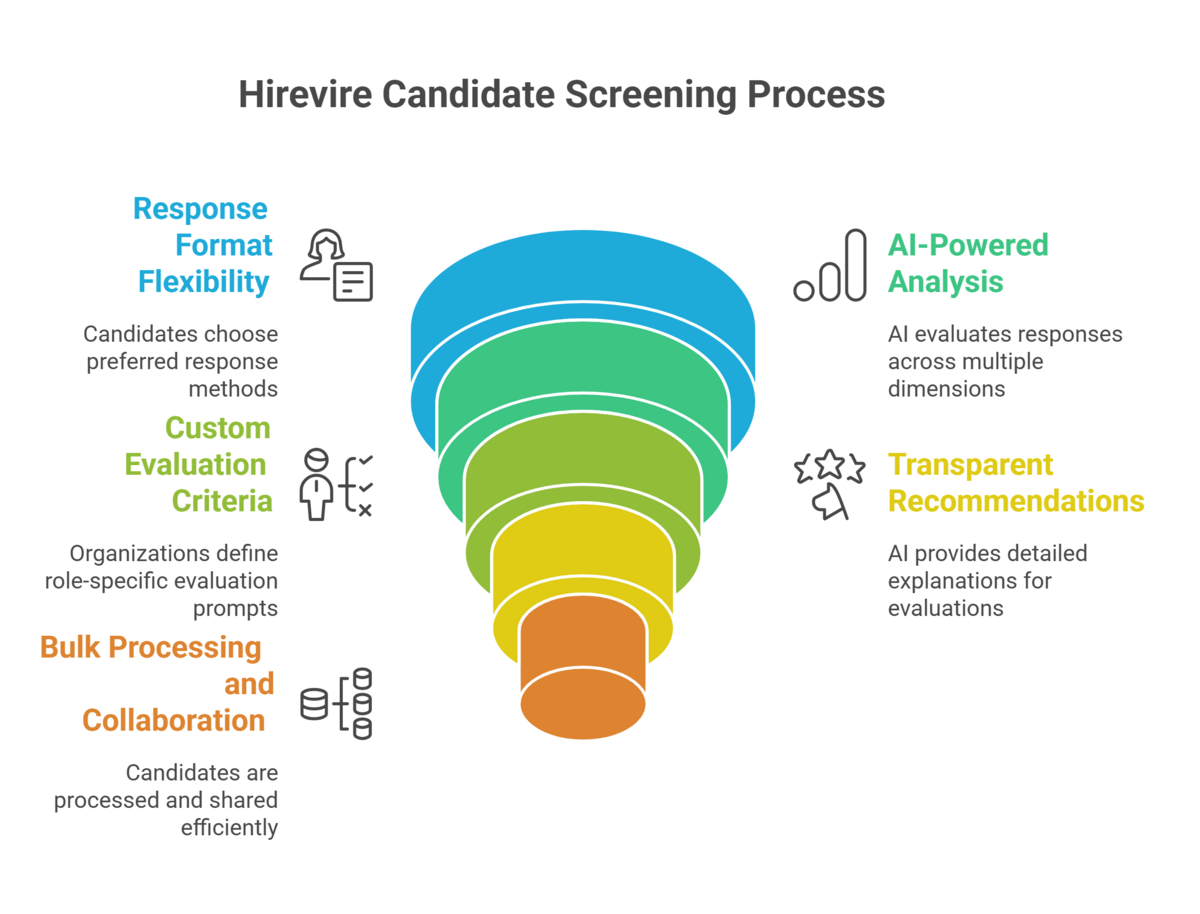
Hirevire exemplifies modern AI recruitment, combining sophisticated technology with user-friendly design.
The Hirevire Approach
Unlike traditional video-only platforms, Hirevire supports multiple response formats: video, audio for candidates uncomfortable on camera, rich text for detailed written responses, and file uploads for portfolios, code samples, or any relevant materials. This flexibility increases candidate completion rates by 20-25%.
No account creation or login required eliminates the 20-25% candidate drop-off caused by mandatory registration.
AI-Powered Analysis
Hirevire's AI evaluates responses across multiple dimensions with advanced transcript generation in 90+ languages, semantic content analysis understanding meaning beyond keywords, answer completeness assessment, and communication clarity evaluation.
Custom Evaluation Criteria
Organizations define specific evaluation prompts up to 200 characters guiding AI analysis toward role-relevant competencies. Organizations can assign different importance weights to evaluation areas, ensuring recommendations align with actual job requirements.
Transparent AI Recommendations
Hirevire provides detailed explanations outlining specific response elements influencing evaluations, identified keywords and concepts matching requirements, areas of strength and development opportunities, and evidence-based reasoning.
Bulk Processing and Collaboration
Process dozens of candidate responses concurrently with identical evaluation criteria, automatically rank candidates based on scores and criteria weightings, share responses easily across teams, and integrate results with existing ATS systems.
Pricing and Accessibility
Essentials Plan at $39/month (billed yearly) provides 300 interviews per year, AI-powered reviews, core automation, and branding customization. Professional Plan at $99/month (billed yearly) adds multiple jobs, advanced analytics, and full integrations. Agency Plan at $199/month (billed yearly) includes agency features, white-label options, and API access. All plans include AI scorecards and transcripts with no per-use charges.
Implementing AI Recruitment
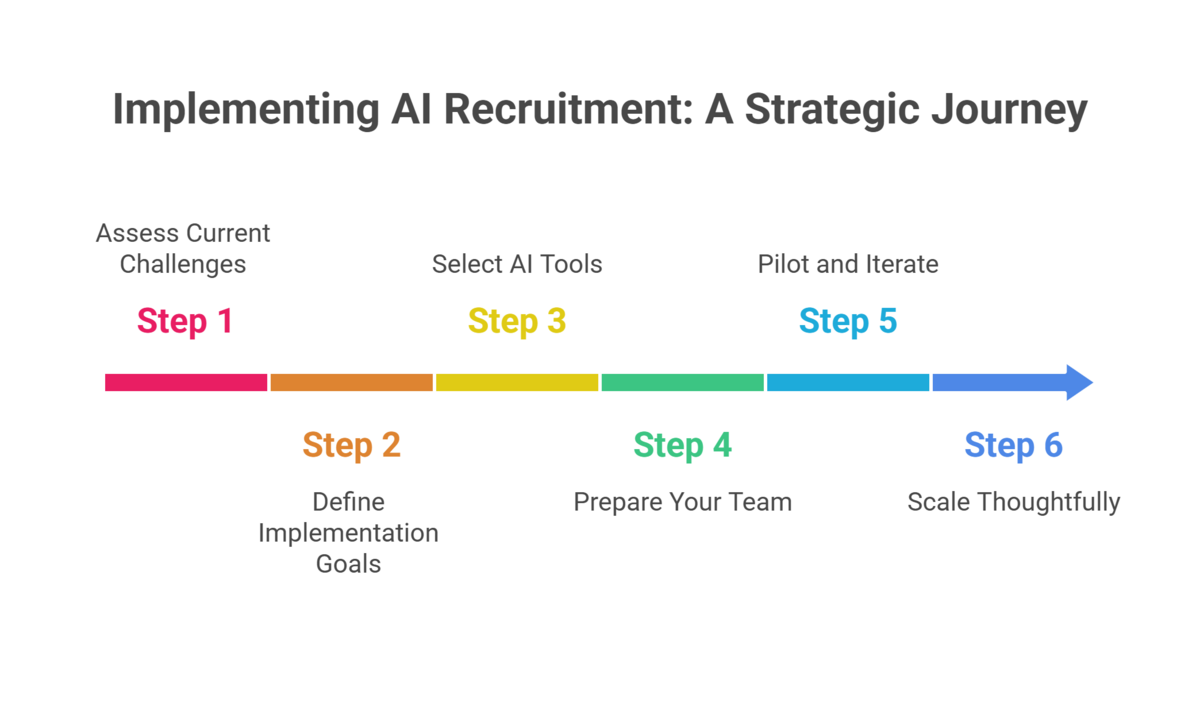
Step 1: Assess Current Challenges
Identify pain points: high application volumes, extended time-to-hire, inconsistent evaluation, limited diversity, poor candidate experience, or high cost-per-hire. Measure baseline metrics including average time-to-hire, cost-per-hire, candidate drop-off rates, and quality of hire.
Step 2: Define Implementation Goals
Set specific objectives like reduce time-to-hire by 50%, decrease cost-per-hire by 30%, improve candidate completion rates by 25%, or screen 3x more candidates with existing team.
Step 3: Select AI Tools
Evaluate based on required capabilities, candidate volume, integration requirements, budget, and implementation complexity. Prioritize transparency with tools providing detailed explanations, clear bias mitigation practices, and compliance with data protection regulations.
Platforms like Hirevire excel in transparency with comprehensive reasoning for all evaluations. Consider starting with focused implementation like AI-powered video interview screening rather than overhauling entire processes.
Step 4: Prepare Your Team
Educate about how AI augments rather than replaces recruiters, demonstrate tangible benefits, provide hands-on training, and address concerns about bias and job security. Define roles clarifying that AI handles initial screening while humans conduct in-depth interviews and make final decisions.
Step 5: Pilot and Iterate
Select specific roles for initial implementation, run AI screening parallel to existing processes initially, compare recommendations to human evaluations, gather feedback, and measure impact on key metrics. Adjust based on learning.
Step 6: Scale Thoughtfully
Add additional roles incrementally, deepen AI capabilities as comfort grows, integrate with more systems, and continuously monitor and optimize while maintaining human oversight.
Timeline: Organizations using focused tools like Hirevire can deploy in 1-2 weeks. Comprehensive rollouts typically require 1-3 months.
The Future of AI in Recruiting
AI recruitment continues evolving with enhanced natural language understanding approaching human-level comprehension, predictive success modeling accurately forecasting job performance, conversational AI conducting interactive interviews, behavioral pattern recognition across multiple formats, real-time adaptive evaluation adjusting dynamically, enhanced bias detection and mitigation with self-correcting algorithms, integration with broader talent management, and democratization making capabilities accessible to all business sizes.
Hirevire continues evolving with planned enhancements including text response analysis, document analysis for portfolios, enhanced cultural assessment, predictive analytics correlating assessments with performance, and expanded integration ecosystem.
Frequently Asked Questions
What is AI recruitment?
AI recruitment uses artificial intelligence like machine learning and natural language processing to automate and enhance hiring. AI analyzes resumes, evaluates candidate responses, matches applicants to jobs, and predicts success. Hirevire applies AI to video interview analysis with detailed candidate evaluations and transparent reasoning.
How does AI recruitment work?
AI recruitment works through four stages: collecting and processing candidate data, analyzing data using NLP and machine learning to identify relevant skills, generating evaluations and rankings based on job requirements, and continuously learning from feedback to improve accuracy.
What are the benefits of AI in recruitment?
Benefits include 50-75% reduction in time-to-hire, improved hiring quality through consistent evaluation, reduced bias with objective criteria, enhanced candidate experience through faster responses, increased recruiter productivity, better data and insights, and 30-50% cost reduction per hire.
Does AI recruitment have bias?
AI can have bias if trained on biased historical data, but properly designed systems reduce bias compared to human-only processes. Responsible tools focus on job-relevant criteria, apply consistent standards, enable bias auditing, and provide transparent recommendations. Hirevire prioritizes fairness with detailed reasoning enabling bias detection.
How much does AI recruitment software cost?
Costs range from $39/month for focused tools like Hirevire to thousands monthly for comprehensive enterprise platforms. Hirevire offers transparent pricing starting at $39/month with unlimited candidates and no hidden fees.
Can small businesses use AI recruitment?
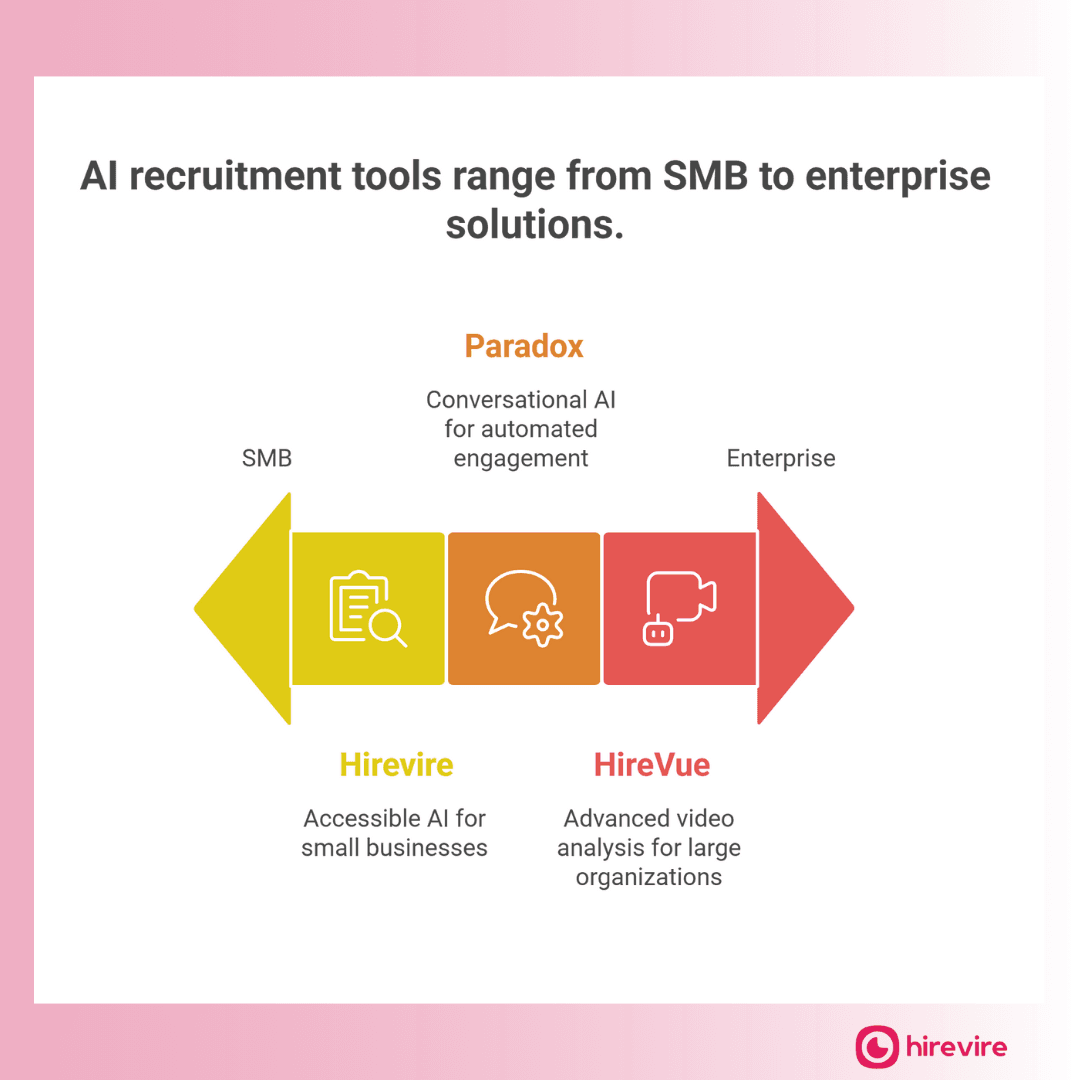
Yes, modern AI recruitment tools are accessible to businesses of all sizes. Hirevire specifically serves small and medium businesses with affordable pricing starting at $39/month, quick deployment requiring no technical expertise, intuitive interfaces, and scalable capabilities.
Is AI recruitment legal?
Yes, but organizations must comply with employment discrimination laws and data protection regulations like GDPR and CCPA. Legal considerations include ensuring AI doesn't produce discriminatory outcomes, maintaining human oversight, obtaining proper consent, and documenting bias testing.
Conclusion
AI recruitment represents a fundamental shift in how organizations find and evaluate talent. AI doesn't replace human recruiters but empowers them with tools that handle repetitive tasks while improving decision quality.
Key Takeaways
Organizations adopting AI report 50-75% reductions in time-to-hire and 30-50% decreases in cost-per-hire. Properly designed AI tools reduce bias by applying consistent, objective criteria. Modern platforms like Hirevire make AI accessible to businesses of all sizes starting at $39/month.
For organizations ready to implement AI recruitment, Hirevire provides an accessible solution with multi-format candidate responses, no-login frictionless experience, AI-powered analysis in 90+ languages, custom evaluation criteria, transparent reasoning, and affordable pricing starting at $39/month.
Ready to see AI recruitment in action?
Try Hirevire's AI-powered candidate screening free
Last updated: January 2026. All information verified as of January 7, 2026.