Willo Interview Platform: Reviews, Pricing, Features and Better Alternatives (2026)
Willo is a one-way interview tool rated 4.6 out of 5 from 283 reviews on G2. It costs $59 for each live role each month on the Lite plan, or from $3,799 a year on Enterprise. Willo suits a team that hires a few times a year, because Lite charges only in the months a role is open. A team with roles open all year pays less on a plan-priced tool: Hirevire costs $468 a year for one open job against $708 on Willo Lite.
Key takeaways
| Question | Short answer |
|---|---|
| What is Willo? | A one-way interview tool where candidates answer your questions in their own time |
| What does it cost? | $59 for each live role each month on Lite. From $3,799 a year on Enterprise |
| How is it rated? | 4.6 out of 5 from 283 reviews on G2, and 4.7 out of 5 from 39 reviews on Capterra |
| Who is it best for? | Teams that hire a few times a year, and enterprises on Workday, SAP SuccessFactors or Oracle |
| What do users complain about? | Only two outcomes after review, basic scoring setup, and no way to message candidates from the platform |
| What is the lowest-priced alternative? | Hirevire, at $468 a year for one open job |
What is Willo?
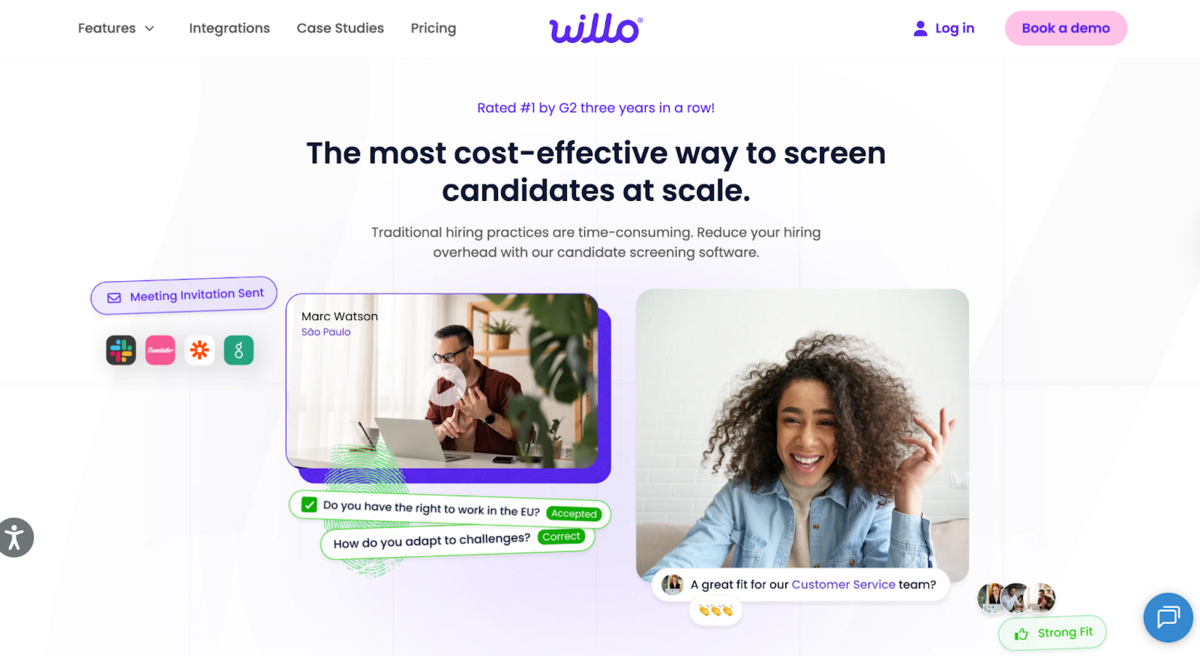
Willo is a one-way interview tool. You set the questions once, candidates answer in their own time, and your team reviews the answers when it suits them. Nobody has to find a shared slot in a calendar.
The company was founded in 2018 in Scotland, and its team works across six time zones in the UK, Europe, North America and Asia. Willo says more than 5,000 businesses use it and that it has assessed more than 11 million candidates. Its named customers include HelloFresh, Toyota GB and EDF UK.
Who uses Willo?
Willo sells to three kinds of hiring: graduate hiring, frontline hiring and high-volume hiring. Its industry pages cover education, healthcare, hospitality, professional services, the public sector, retail and technology.
Reviews on G2 come from small businesses, mid-market companies and enterprises. Two uses stand out in them. A campus recruiter uses Willo to screen students quickly, and a university admissions team uses it to interview applicants across time zones without scheduling calls.
How does Willo work?
Willo works in four steps.
- You create an interview, write the questions and set a time limit for each one. Willo can suggest questions for the role.
- You invite candidates one at a time, by CSV upload, or with one shared link on a job board. Willo sends the email or SMS and the reminders.
- Candidates answer in a browser on a phone, tablet or computer.
- Your team reviews, rates and shares the answers.
One G2 reviewer says an interview can be live in less than a day.
What is Willo like for candidates?
Candidates answer at any hour, on a phone or a computer, and Willo says the recording works on low-bandwidth connections. Each question can ask for video, audio, text, a multiple-choice answer or a file of up to 25 MB.
The interview runs in 18 languages, and Willo states that the platform meets the WCAG 2.0 accessibility standard.
Reviewers describe the candidate side in three ways.
- Candidates like choosing their own time. This is the most common praise on G2.
- Recording an answer feels less natural than a live conversation, according to one G2 reviewer, who also wants more flexibility on retakes.
- A team that uses one shared link for every applicant reports that candidates cannot save their progress and come back later.
Willo Platform Key Features
Willo's features fall into six groups.
Questions and answer formats
Candidates can answer with video, audio, text, multiple choice or a file upload. Willo suggests questions for a role, and there are more than 1,500 ready-made assessments to start from.
Inviting candidates
You can invite candidates one at a time, upload a CSV, or post one shared link on a job board. Willo sends the invitation by email or SMS and follows up with automated reminders. A reviewer on G2 likes that reminders can be sent as many times as needed.
Reviewing and sharing
Your team reviews and rates each answer. A Showcase link shares an interview with a hiring manager or a client outside your account so they can give feedback.
Willo Intelligence
Willo Intelligence is the AI layer. You describe what a good hire looks like in a Blueprint, and Willo ranks candidates by how closely they match it. The ranking updates as new candidates come in. It also writes a summary of each candidate, suggests follow-up questions and can send rejection emails. Willo describes it as AI-assisted insights with human-led decisions.
Identity checks and anti-cheat
Willo sells identity, right-to-work and criminal background checks with a certified report. It also has systems meant to catch deepfakes and scripted answers.
Integrations
Willo lists more than 50 native integrations. The applicant tracking systems (ATS) named on its integrations page include Ashby, BambooHR, Breezy HR, Bullhorn, Greenhouse, iCIMS, JazzHR, Lever, Personio, Recruitee, SAP SuccessFactors, SmartRecruiters, Teamtailor, Workable and Workday. Zapier and Integrately connect it to other apps, and there is an API for developers.
On the Lite plan the listed integrations are Zapier and Integrately. The ATS integrations are on Enterprise.
Security and accessibility
Willo is ISO 27001 certified and GDPR compliant, supports two-factor login and states 99.95% uptime. The platform meets WCAG 2.0.
Willo Pricing StructureWillo has two plans.
| Plan | Price | What you get |
|---|---|---|
| Lite | $59 for each live role each month, no contract | Up to 5 live roles and 5 users, 150 assessed candidates for each live role, Zapier and Integrately |
| Enterprise | From $3,799 a year | Custom roles and users, plus the ATS integrations |
What Willo costs over a year
One role open all year comes to $708 on Lite. Five roles open all year come to $3,540. A team that needs more than 5 live roles or 5 users moves to Enterprise.
Free trial and discounts
Willo's pricing page lists no free plan and no free trial. Non-profits get 50% off.
Pricing comparison
Hirevire starts at $39 a month billed yearly, which is $468 a year for one open job. Hireflix costs $900 a year for a company under 50 employees, and Spark Hire costs $2,988 a year on its annual plan. The Willo alternatives guide shows what each tool costs over a year.
What Willo costs for five common hiring patterns
| How you hire | Willo cost for the year | Hirevire cost for the year | Lower price |
|---|---|---|---|
| One role, open for two months | $118 on Lite | $468 | Willo, by $350 |
| One role, open all year | $708 on Lite | $468 | Hirevire, by $240 (34%) |
| Three roles, open all year | $2,124 on Lite | $1,188 | Hirevire, by $936 (44%) |
| Five roles, open all year | $3,540 on Lite | $1,188 | Hirevire, by $2,352 (66%) |
| Six to twenty roles, open all year | From $3,799 on Enterprise | $2,388 | Hirevire, by at least $1,411 (37%) |
Hirevire's plans also cap interviews: 300 a year on the $468 plan, 1,200 on the $1,188 plan and 12,000 on the $2,388 plan. Willo Lite includes 150 assessed candidates for each live role.
What results does Willo claim?
Willo's website claims 75% less screening time, 30% faster time to hire and a candidate experience score (NPS) of 68. These are Willo's own figures.
Willo Reviews and Ratings Analysis
Willo is rated 4.6 out of 5 from 283 reviews on G2 and 4.7 out of 5 from 39 reviews on Capterra.
What do users like about Willo?
Reviewers praise five things most often.
- Candidates can interview at a time that suits them.
- Setup is quick. Reviewers call the platform intuitive, and one says interviews go live in less than a day.
- It saves the time spent scheduling first-round calls, which matters most across time zones.
- Teams can share an interview with a colleague when they are undecided about a candidate, and go back to it later.
- Reminders go out automatically, so fewer invitations go unanswered.
What do users complain about?
Six complaints come up in recent reviews.
- After reviewing a candidate, the choice is accept or reject. One G2 reviewer wants a "keep for later" option and calls the choices "very rigid".
- The AI feedback can read as harsh. The same reviewer worries about copying it into a candidate record.
- The scoring setup feels basic for roles that need weighted or structured scoring, according to another G2 reviewer.
- There is no simple way to message a candidate or ask a follow-up question from inside the platform.
- Reviewing many videos still takes time on high-volume roles.
- Scores and comments do not export to a spreadsheet, so one Capterra reviewer re-enters them by hand to compare candidates.
Pros and Cons of Willo
Pros of Willo
- Lite has no contract, so you pay only in the months a role is open.
- Candidates can answer with video, text, files or multiple choice.
- Enterprise connects to Workday, SAP SuccessFactors, Oracle and the main applicant tracking systems.
- Identity and right-to-work checks are available from the same vendor.
- Non-profits get 50% off.
Cons of Willo
- The bill grows with every open role. Five roles open all year cost $3,540.
- Lite stops at 5 live roles and 5 users.
- The ATS integrations sit on Enterprise, which starts at $3,799 a year.
- The pricing page lists no free trial.
- Reviewers want more outcomes than accept or reject, and more control over scoring.
Who should use Willo, and who should look elsewhere?
Willo fits two kinds of team. The first hires once or twice a year: one role open for two months costs $118. The second is an enterprise on Workday, SAP SuccessFactors or Oracle that wants identity checks from the same vendor.
A team with a role open most of the year should compare plan-priced tools. So should an agency running many roles for clients, because Lite stops at 5 live roles.
Top 5 Willo Alternatives
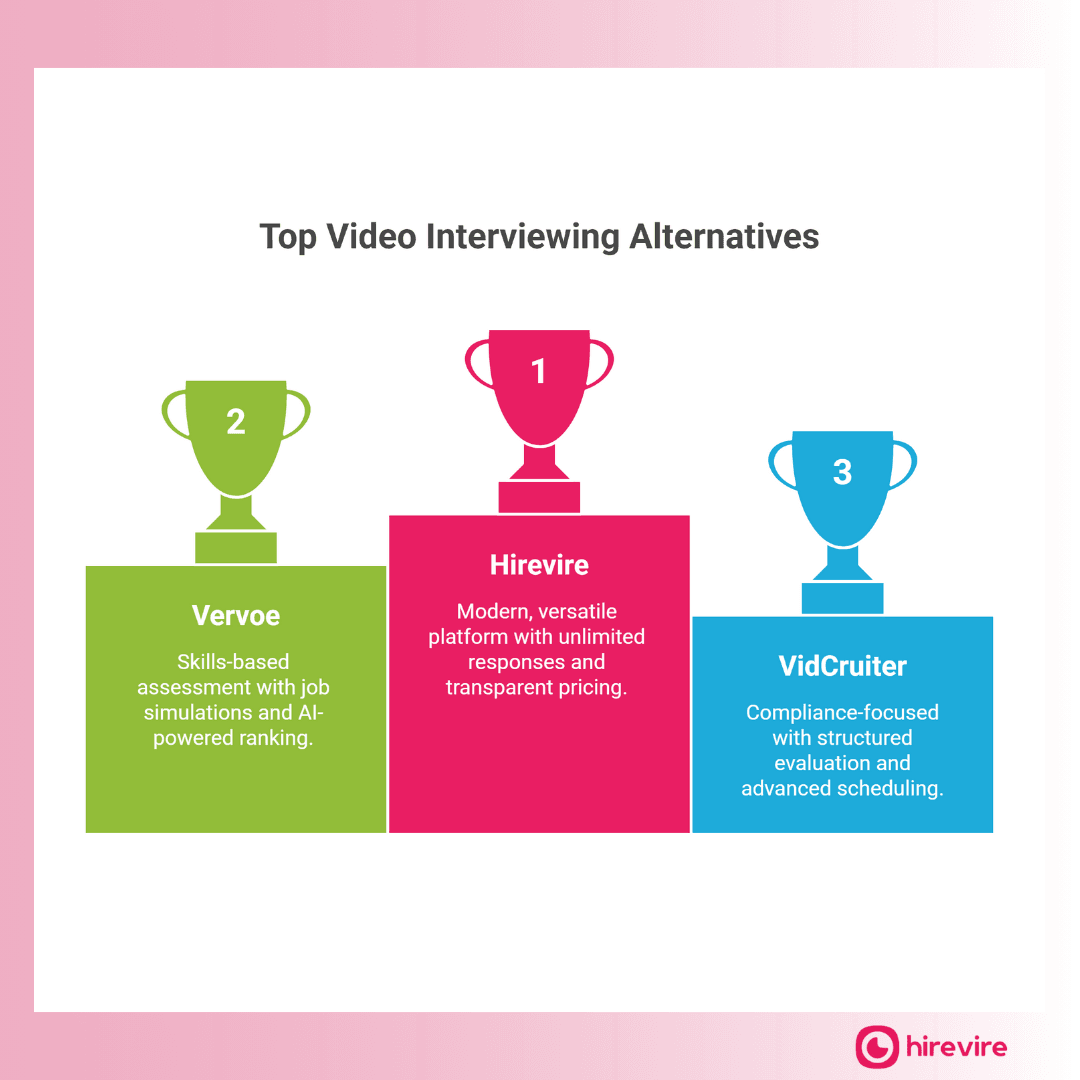
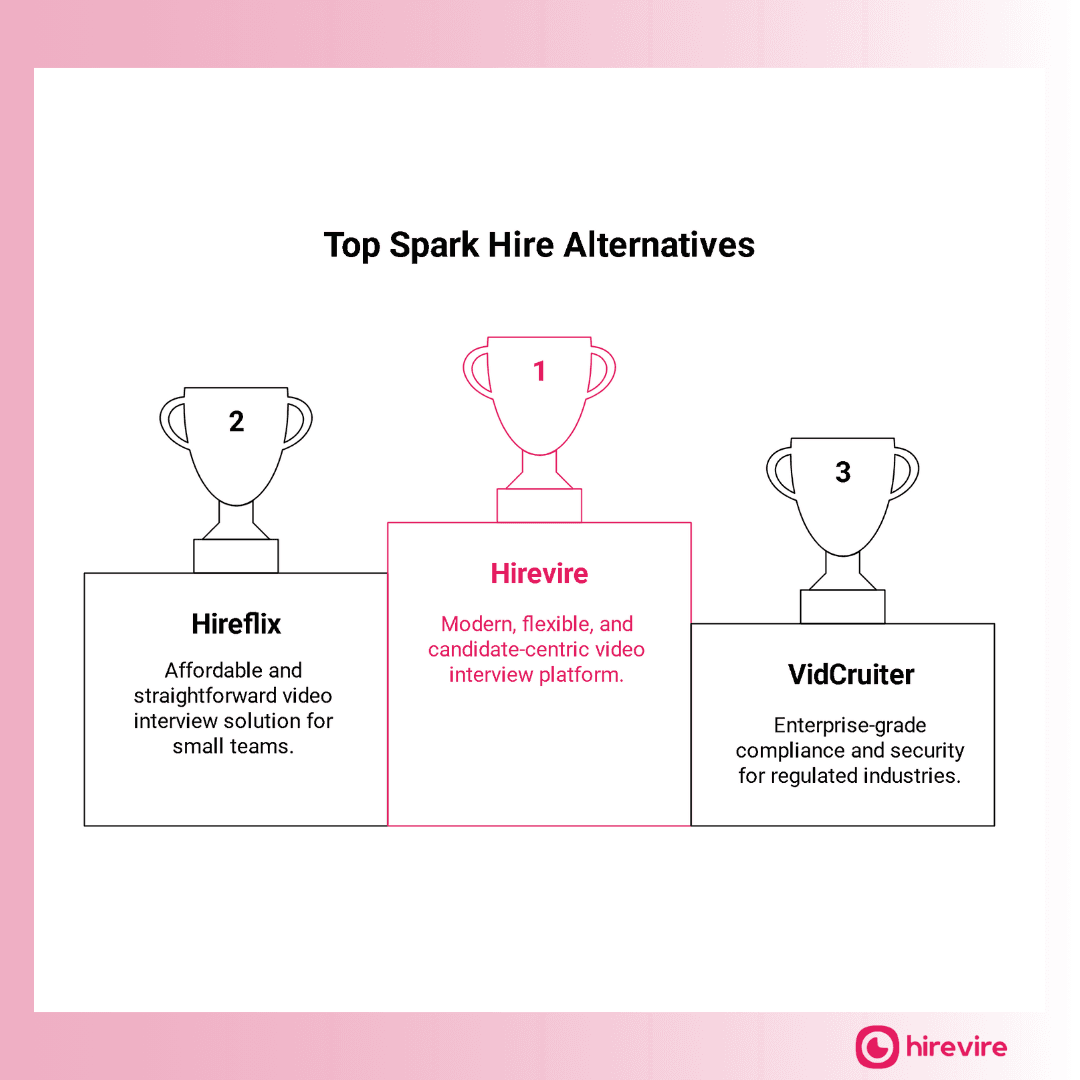
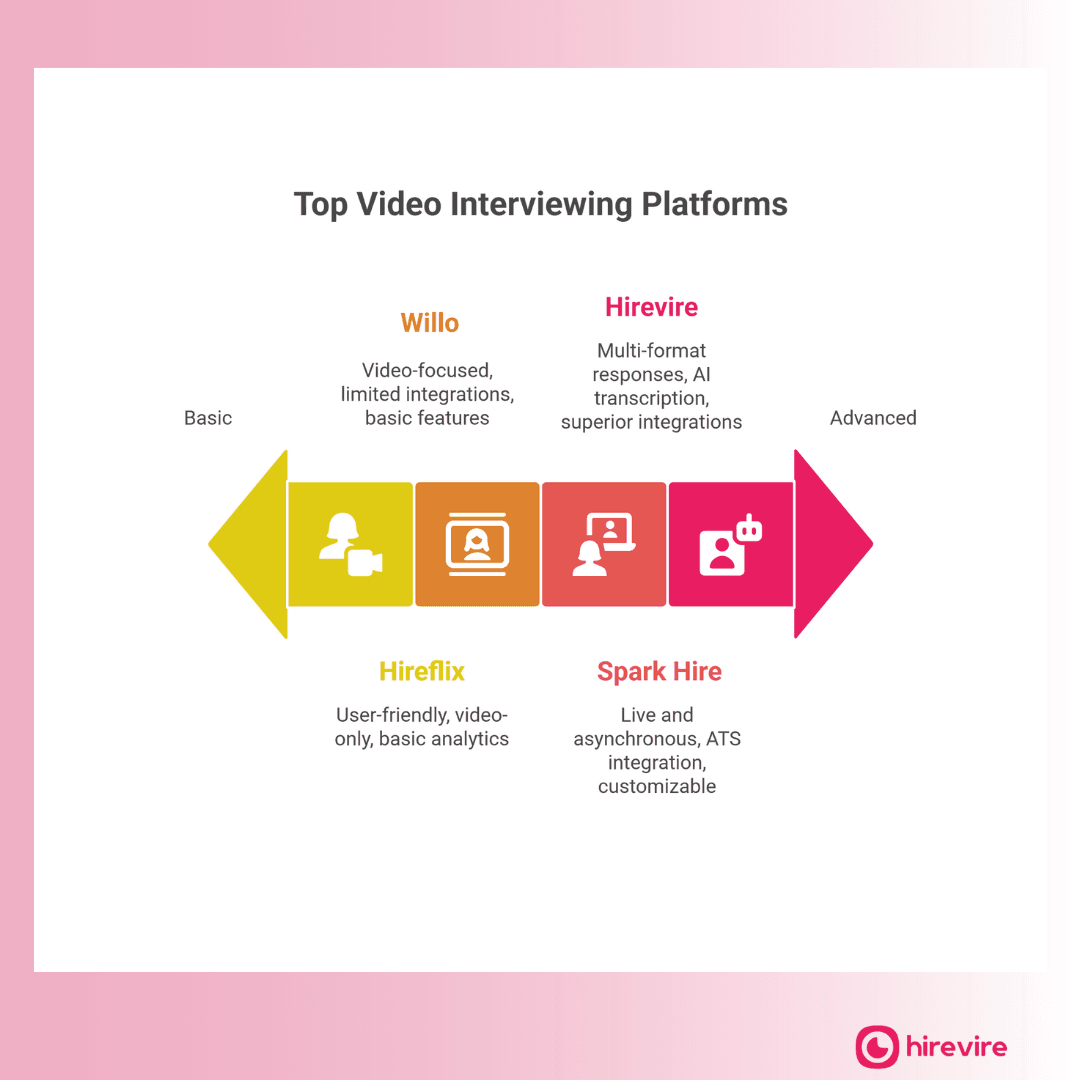
Five tools come up most often when teams compare Willo. The Willo alternatives guide covers eight, with a year-by-year cost table.
Hirevire
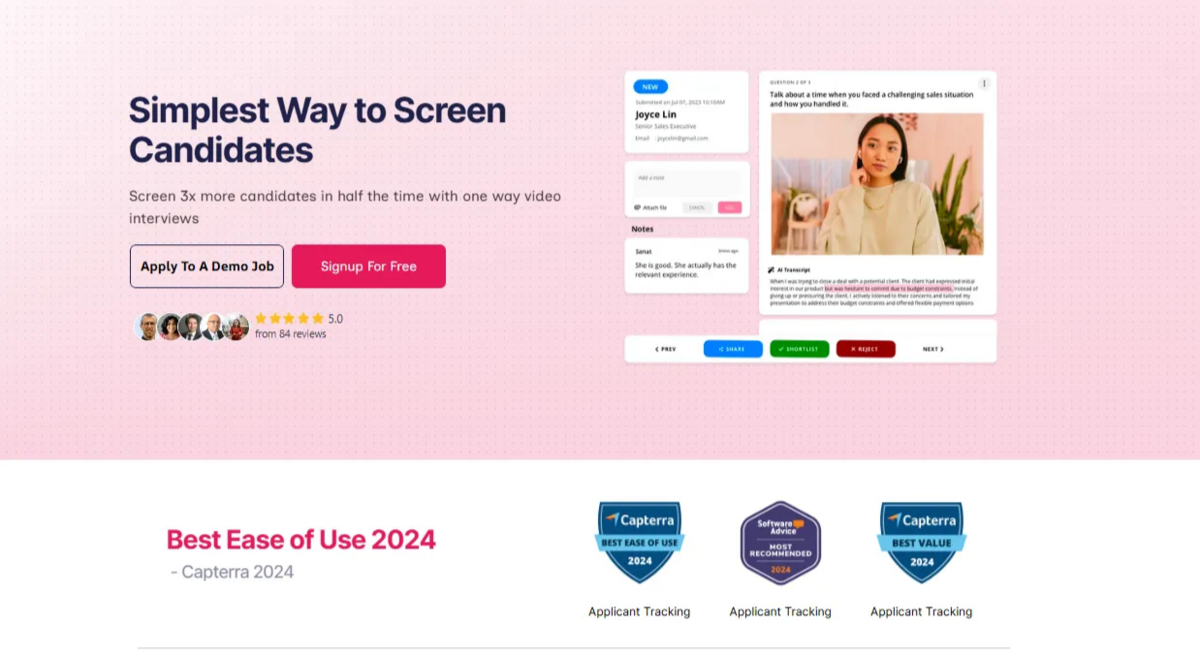
Hirevire is async screening software: you write the questions once, and candidates record video, audio or text answers in their own time. They answer in the browser with no account or password.
Every plan includes AI transcripts in 90+ languages and AI scorecards that show the reasoning behind each score. Candidates can also answer with a screen recording or a file upload, which helps for roles where a spoken answer is only part of the picture.
Pricing is by plan, with a 7-day free trial and no credit card. $468 a year covers 1 open job and 25 interviews a month, which fits a manager filling one role at a time. $1,188 covers 5 jobs and 100 interviews a month for a small team with a few roles always open. $2,388 covers 20 jobs and 1,000 interviews a month for an agency screening for several clients. Zapier, Make, Pabbly Connect, Ashby, Tellent Recruitee and Manatal work on every plan.
Rated 4.7 out of 5 from 30 reviews on G2.
Switching from Willo to Hirevire
Create the same job in Hirevire, add the questions you already ask, and share the link with candidates. Your ATS, Zapier and job board setup stays as it is. See the four steps and the price comparison, or write to [email protected] with a question about your setup.
Spark Hire
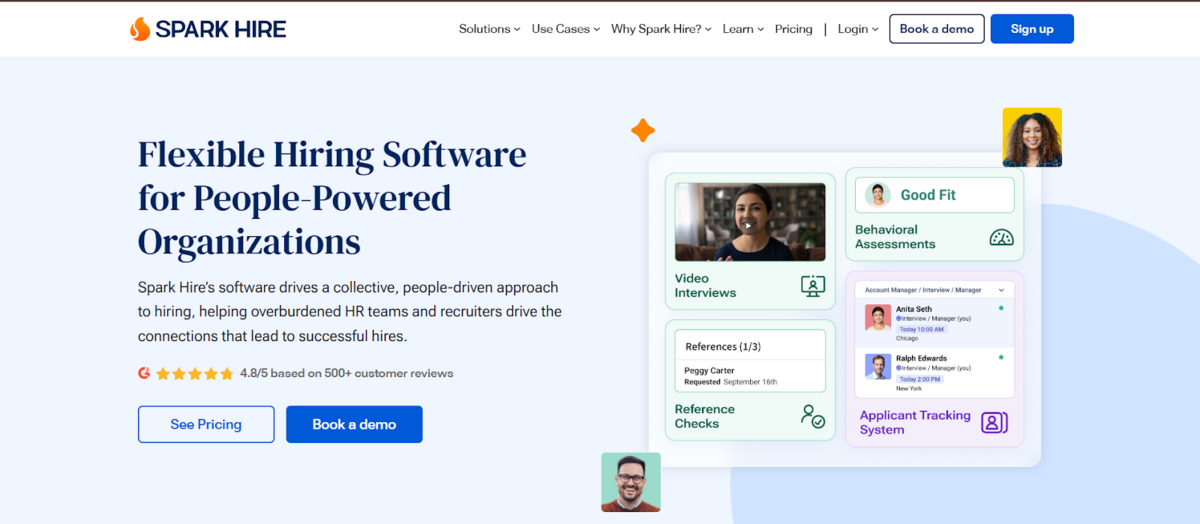
Spark Hire runs one-way and live video interviews in the same tool. It also sells an ATS, a behavioural assessment and reference checks.
It costs $249 a month billed annually ($2,988 a year) with unlimited jobs and users, or $299 month to month for up to 5 jobs and 5 users. The pricing page mentions no free trial.
Rated 4.7 out of 5 from 707 reviews on G2. It suits a team that wants the recorded screen and the live follow-up in one place.
Hireflix
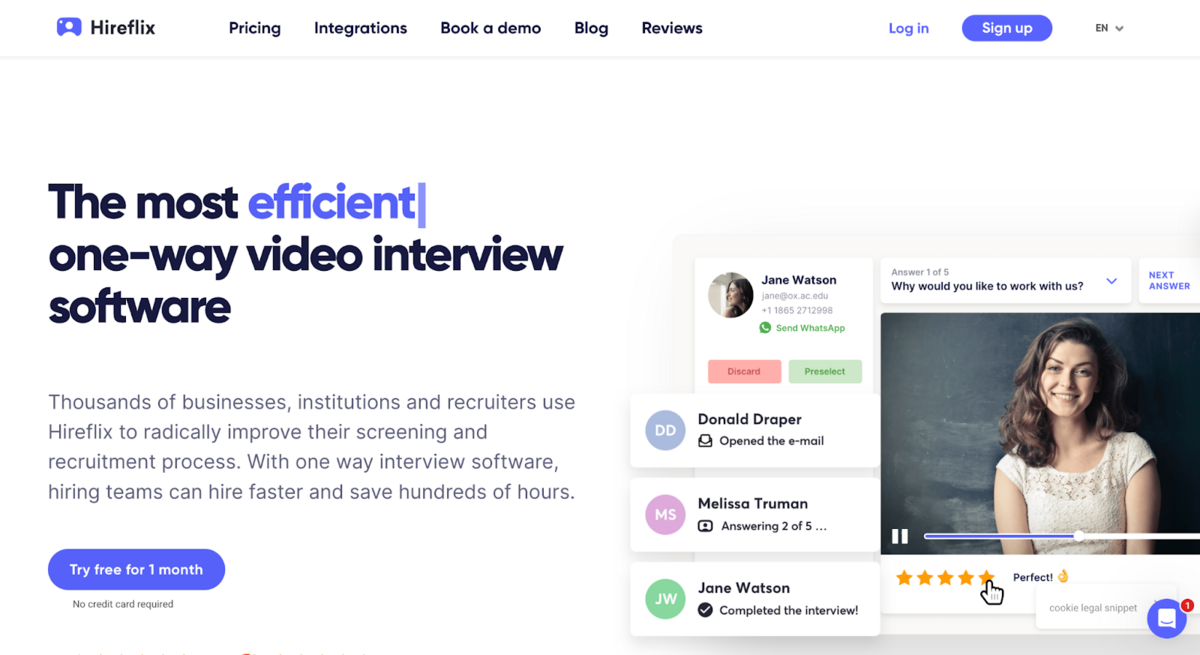
Hireflix does one thing: one-way video interviews. Candidates need no app and no registration.
Its price depends on company size: $900 a year under 50 employees and $1,800 a year for 50 to 250 employees, with unlimited positions, users and responses. The first month is free.
Rated 5.0 out of 5 from 441 reviews on G2. It suits a small company with many roles open at the same time.
myInterview
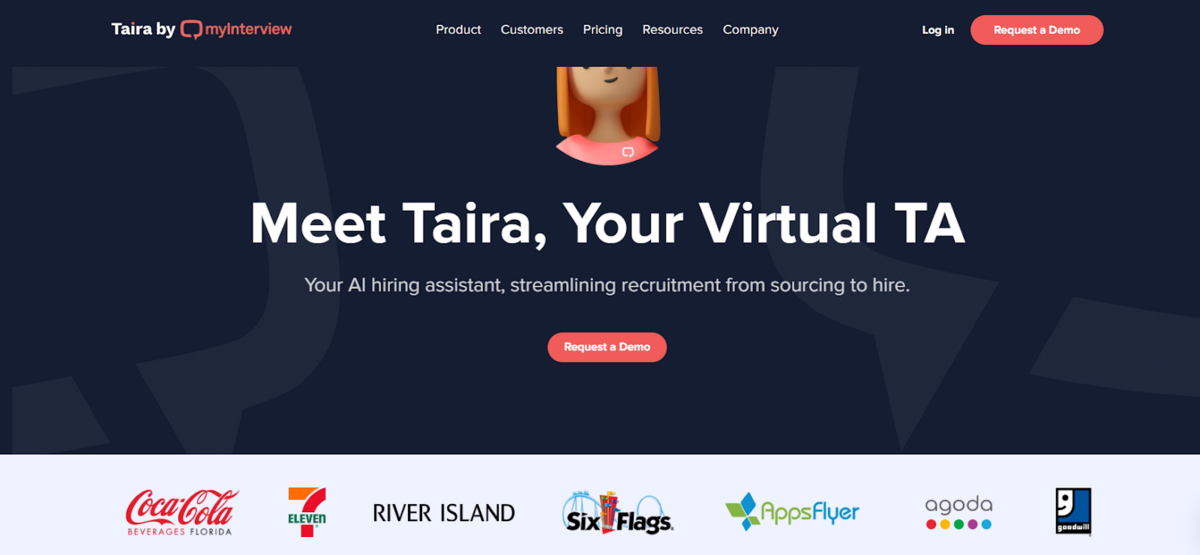
myInterview's website now sends visitors to Radancy's screening and scheduling product, which is sold as part of a larger hiring platform. Pricing is by quote. It suits an enterprise buying the whole platform.
VidCruiter
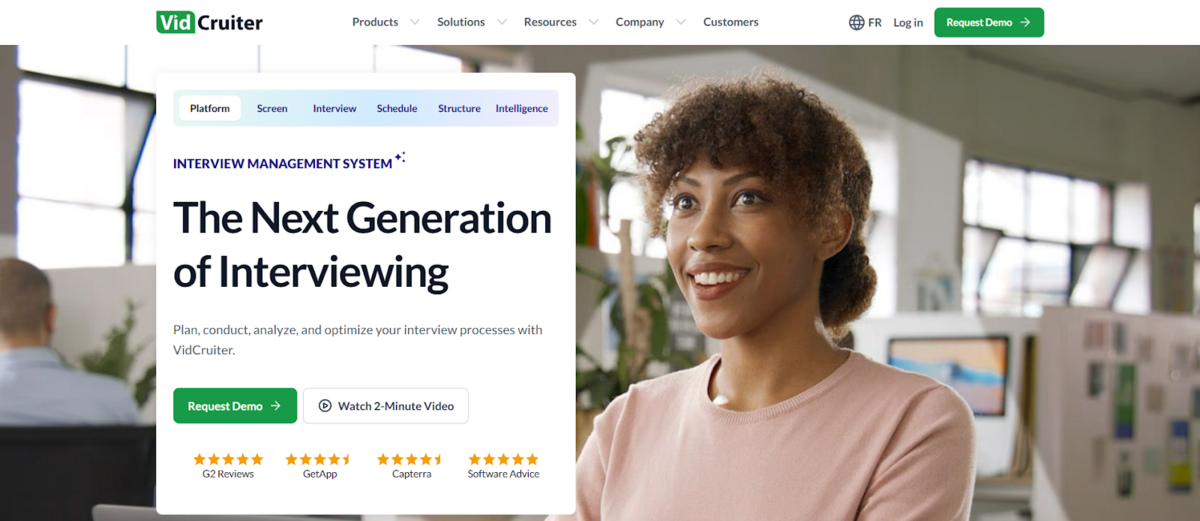
VidCruiter is built for structured hiring, with a competency scorecard and a set rating scale for each question. It is SOC 2 Type II and ISO 27001 certified and names connectors for Workday, SAP SuccessFactors and Oracle.
Pricing is by quote. Rated 4.8 out of 5 from 282 reviews on G2. It suits a large or regulated employer that must document every hiring step.
Comparison Table: Willo vs Alternatives
| Willo | Hirevire | Spark Hire | Hireflix | VidCruiter | |
|---|---|---|---|---|---|
| Starting price | $59 for each live role each month | $39 a month, billed yearly | $249 a month, billed annually | $75 a month, billed yearly | Quote only |
| Cost for one role open all year | $708 | $468 | $2,988 | $900 | Quote only |
| You pay by | Live role | Plan | Plan | Company size | Quote |
| Free trial | None listed | 7 days, no card | None listed | First month | Not published |
| G2 rating | 4.6 from 283 | 4.7 from 30 | 4.7 from 707 | 5.0 from 441 | 4.8 from 282 |
| Best for | Occasional hiring | Small teams screening 25 to 100 candidates a month, and agencies screening up to 1,000 | Live and one-way in one tool | Small companies with many roles | Large and regulated employers |
Willo vs Hirevire at a glance
| Willo | Hirevire | |
|---|---|---|
| You pay by | Live role, each month | Plan, with a set number of open jobs |
| Lowest yearly cost for a role open all year | $708 | $468 |
| Open roles on published plans | Up to 5 | 1, 5 or 20 |
| Users on published plans | Up to 5 | 1, 5 or 15 |
| How candidates answer | Video, written answers, file uploads, multiple choice | Video, audio, screen recording, file upload, text |
| AI | Transcripts, summaries and a match percentage | Transcripts in 90+ languages and scorecards on every plan |
| After you review a candidate | Accept or reject, according to a G2 reviewer | Hiring stages you define, and follow-up questions |
| ATS integrations | On Enterprise | Ashby, Tellent Recruitee and Manatal on every plan |
| Free trial | None listed | 7 days, no credit card |
| G2 rating | 4.6 from 283 reviews | 4.7 from 30 reviews |
How to Choose the Right Video Interview Platform for Your Needs
Choose by checking five things in this order.
- How many roles you keep open. Count the months each role was live last year and multiply by $59. That is your real Willo bill to compare against.
- How many candidates you screen each month. Some tools cap interviews by plan and some are unlimited.
- How your candidates like to answer. A support agent can record a two-minute video. A developer may want to share a screen or upload a file.
- Which tools must stay connected. List your ATS and automation tools, then check which plan includes them.
- Whether you can try it first. Hirevire has a 7-day free trial with no credit card, and Hireflix gives the first month free.
Frequently asked questions
Pricing
How much does Willo cost? Willo Lite costs $59 for each live role each month, and Enterprise starts at $3,799 a year. One role open all year comes to $708 on Lite.
Does Willo have a free plan or a free trial? Willo's pricing page lists no free plan and no free trial. Lite has no contract, so you can stop paying for a role in the month you close it.
Features
Can candidates answer in formats other than video? Yes. Willo accepts video, written answers, file uploads and multiple-choice questions.
Can Willo integrate with my ATS? Yes, on the Enterprise plan. Willo lists more than 50 native integrations, including Greenhouse, Lever, Workday and Ashby. The Lite plan lists Zapier and Integrately.
Does Willo use AI? Yes. Willo Intelligence adds transcripts, summaries and a match percentage against your criteria, and a person makes the decision.
Alternatives
Is Willo good for small businesses? Willo Lite suits a small business that hires once or twice a year. A small business with a role open most of the year pays less on Hirevire, which costs $468 a year for one open job.
What is the best Willo alternative? Hirevire is the lowest-priced alternative at $468 a year. Hireflix suits a company under 50 employees with many roles open at once. The Willo alternatives guide compares eight tools.
How does Willo compare with Hirevire? Willo charges by live role and Hirevire charges by plan. For one role open all year, Hirevire costs $240 less, which is 34% less. The Willo vs Hirevire page shows them side by side.
Sources
- Willo, "Pricing". https://www.willo.video/pricing
- Willo, homepage. https://www.willo.video/
- G2, "Willo Video Interviewing reviews". https://www.g2.com/products/willo-video-interviewing/reviews
- Capterra, "Willo". https://www.capterra.in/software/198022/willo
- Hirevire, "Pricing". https://hirevire.com/pricing
- Hireflix, "Pricing". https://www.hireflix.com/pricing
- Spark Hire, "Pricing". https://www.sparkhire.com/pricing