Stop Screening Resumes. Start Screening People.
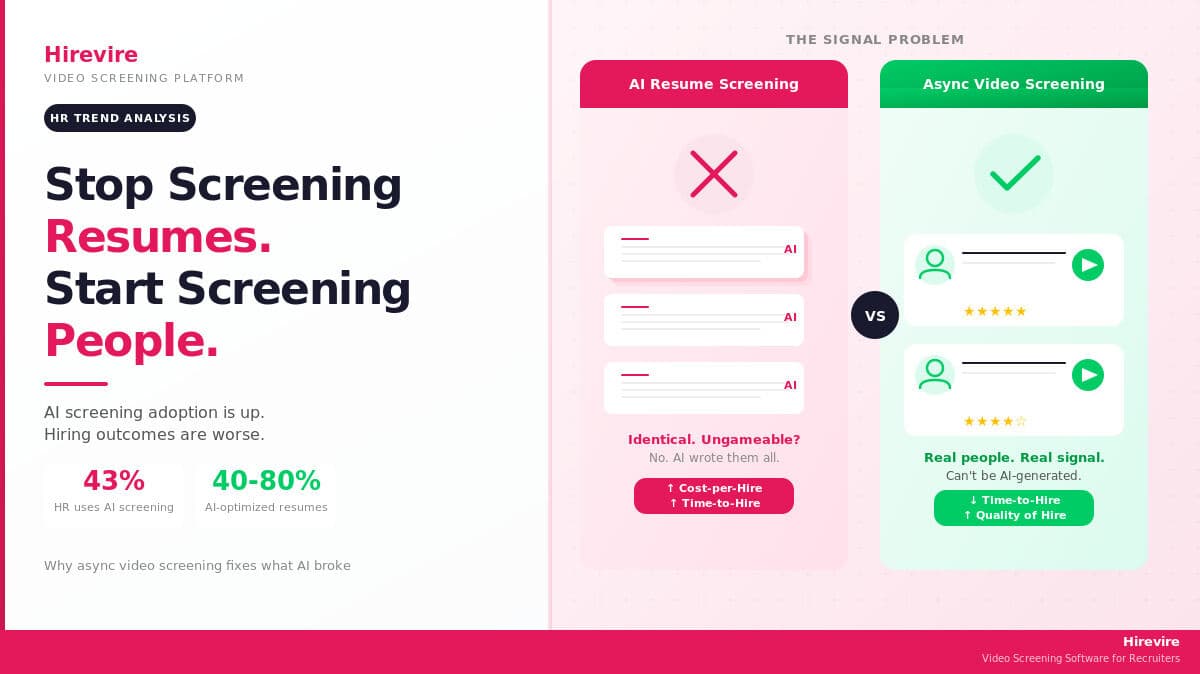
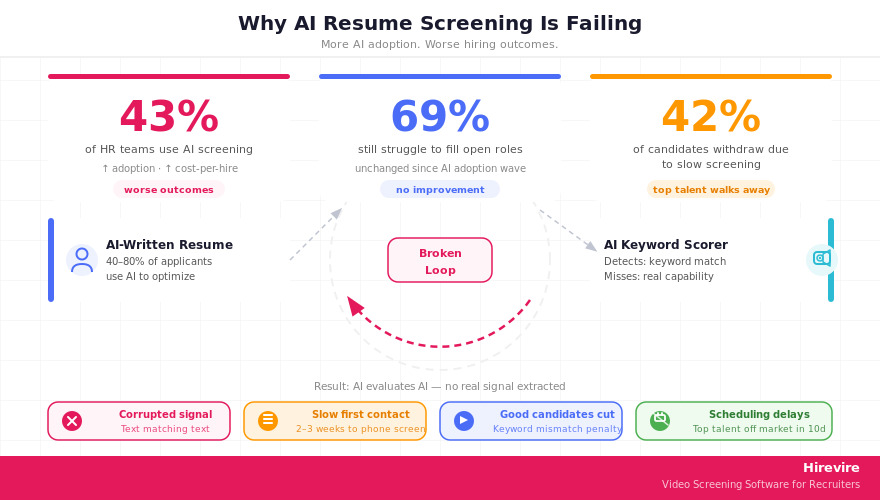
SHRM's latest benchmarking data confirms what many recruiters already sense: despite 43% of HR organizations now using AI for resume screening, cost-per-hire went up, time-to-hire went up, and 69% of organizations still report struggling to fill open roles. More AI screening, worse outcomes.
The reason is not that the AI tools are bad. It is that resumes have become a corrupted signal, and applying better pattern recognition to a corrupted signal just produces confident-sounding mistakes faster.
This article explains what is happening, why it matters for hiring teams of every size, and what a small but growing number of teams are doing differently.
Key Takeaways
- AI resume screening adoption has nearly doubled in three years, but hiring difficulty and cost have increased alongside it
- Between 40-80% of applicants now use AI to write or optimize their resumes, flooding systems with keyword-identical applications
- The fundamental problem is text matching text: any text-based signal is gameable by AI at scale
- Async video screening shifts the signal to communication, clarity, and genuine motivation, things that cannot be mass-produced
AI Screening Made Hiring Slower and More Expensive
The case for AI resume screening was straightforward: fewer hours spent reading applications, faster time to phone screen, more consistent filtering. And on those narrow metrics, the tools often deliver.
The broader hiring metrics tell a different story.
SHRM's 2025 Talent Trends research on AI in HR found that 51% of organizations now use AI somewhere in recruiting, with 44% applying it specifically to resume screening. Yet SHRM's recruitment state-of-the-field data documents rising cost-per-hire and time-to-hire over the same period. According to SHRM, 69% of organizations say they still struggle to fill open roles, a figure nearly unchanged from before the AI adoption wave.
The throughput improved. The outcomes did not.
Part of this gap is explained by AI on the other side of the equation. When AI tools evaluate AI-written content, the screening step becomes pattern recognition against noise. Tools trained to find keywords find keywords, regardless of whether any real signal about a candidate's capability sits behind them.
There is also a candidate experience dimension. SHRM data on candidate ghosting and employer competition shows 42% of candidates withdraw from processes due to slow communication, and 58% have declined offers based on poor hiring experience. AI screening often extends the first-contact window rather than compressing it, because the filtered pipeline still requires human review before any outreach happens.
The tools accelerated part of the process while leaving the parts that most affect candidate experience untouched.
The Arms Race: Why Resumes Are a Corrupted Signal
Forty to eighty percent of job applicants now use AI tools to write or optimize their resumes, depending on the role category and seniority level. This is not speculation, SHRM has documented the phenomenon directly, describing it as an arms race that benefits neither hiring teams nor candidates.
The mechanism is simple. AI screening tools score resumes against keyword criteria derived from job descriptions. Candidates learn what the tools are looking for, often by running their resumes through the same AI systems that recruiters use. They optimize their language to match. As Inc. documented in its analysis of the broken hiring loop, the result is a pile of virtually identical applications, all passing the screen with high scores, none of them meaningfully differentiated.
Hiring managers then receive a shortlist of candidates who are excellent at writing resumes about themselves, which is not, for most roles, the primary job requirement.
SHRM experts have noted that the arms race creates a credentialing theater: both parties performing for the system rather than communicating with each other. The candidate crafts a document that will pass the filter. The AI evaluates the document against its pattern library. Human judgment enters the process later, after the initial narrowing has already happened on questionable criteria.
The underlying issue is structural. Text matching text is inherently gameable. A resume is a marketing document composed by the applicant for the purpose of impression management. Applying AI to score marketing documents does not extract ground truth about the applicant, it extracts information about how well the applicant understood what the scoring system rewards.
This does not mean AI has no role in hiring. It means that using AI to evaluate a signal that AI has already corrupted produces circular results.
You're Losing Candidates While Sorting Junk Resumes
While hiring teams process an inflated volume of AI-optimized applications, the candidates they actually want are making decisions on shorter timelines.
Radancy's 2026 AI Trends in Candidate Screening research documents that top candidates are off the market within 10 days of beginning a search. Screening processes that take two to three weeks to produce a phone interview do not work on that timeline.
CareerPlug data cited by RecruitCRM reinforces the pattern: 42% of candidates withdraw specifically due to slow or absent communication during the screening stage. A further 58% have declined offers because of poor candidate experience, meaning teams that moved slowly through the earlier stages lost candidates after extending offers.
The volume problem compounds the timeline problem. When AI screening is working as designed, filtering 500 applications down to 30, it compresses the review load. When 400 of those 500 applications were AI-optimized to pass the screen, the filter produces a larger qualified pool of indistinguishable candidates, not a smaller one. Recruiters end up spending more calendar time on first-round reviews, not less.
Meanwhile, the candidates who wrote genuine, unoptimized applications, sometimes the most direct communicators, are more likely to be filtered out by keyword-matching tools that penalize unconventional phrasing.
The operational result for many teams: more applications, more screening time, slower first contact, and higher withdrawal rates from the candidates who do make it through.
Async Video Screening: A Signal AI Can't Fake
Async video screening inverts the dynamic. Instead of asking candidates to produce a text document that will be scored by an algorithm, it asks them to respond to role-specific questions on video, in their own words, at a time convenient to them, without scheduling coordination.
What gets evaluated: how they communicate, whether their reasoning is clear, what they actually say about the role and their experience, their energy and engagement. These are not things that can be produced in bulk by an AI writing assistant.
The distinction from AI-scored video tools like HireVue is important. In AI-scored video systems, an algorithm analyzes facial expressions, word choice, or speech patterns to generate a candidate score. That approach carries documented bias risks and has attracted regulatory scrutiny. Async video screening as practiced by Hirevire places the automation entirely in the workflow, sending invitations, collecting responses, organizing the review queue, while keeping evaluation in human hands.
A recruiter watches a three-to-five minute response. They decide whether to advance the candidate. No algorithm assigns a score based on microexpressions.
The candidate experience is also materially different from resume submission. There is no account to create, no portal to navigate. Candidates receive a link, record their responses when convenient, and submit. Hirevire supports video, audio, and text response formats, accommodating candidates who have connectivity limitations or accessibility needs.
For hiring teams, the practical outcome is a screening step that is faster to execute, produces genuinely differentiated candidate profiles, and does not require synchronous scheduling. A recruiter can review 20 async responses in the time it takes to schedule and conduct two phone screens.
Pricing matters here. Enterprise async video platforms like Spark Hire start at $299/month for limited job postings. Hirevire starts at $39/month billed annually, with AI scorecards and transcripts on every plan, making async video accessible to small businesses and growing teams, not just enterprise HR departments.
How to Replace Your Resume Screen in 3 Steps (method of assessing candidate capabilities and potential)
Transitioning from resume-first to video-first screening does not require a process overhaul. The change is primarily in what candidates submit first, not in the downstream evaluation.
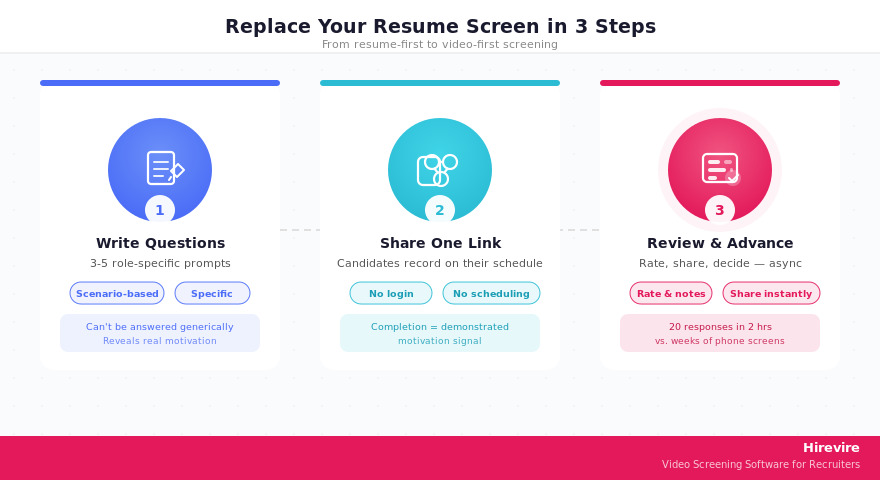
Step 1: Write 3-5 Role-Specific Questions
The questions should target what actually predicts success in the role, not generic prompts like "Tell me about yourself" but specific scenarios: "Walk me through how you'd handle [common situation in this role]" or "What drew you to apply for this specific position and what do you know about us?"
Good screening questions cannot be answered generically. A candidate who researched the role and organization will give a noticeably different response than one who did not.
Step 2: Share One Link
Hirevire generates a single link per screening stage. Candidates click it, see the questions, and record their responses. No login, no app download, no scheduling email chain.
Including the link in the job posting or application confirmation email means candidates self-select into the async video step. Completion rate is a data point itself: candidates motivated enough to complete a brief video screen are demonstrably more engaged than those who only submitted a resume.
Step 3: Review, Rate, and Share Async
Responses are organized in the Hirevire dashboard. Hiring managers can review independently and add ratings or notes without scheduling a calibration call. When there is a clear standout, sharing the response takes seconds.
For teams already using an ATS, Hirevire integrates with major systems via Zapier, so candidate data moves through the existing workflow rather than creating a parallel process.
This Isn't Anti-AI: It's About the Right Signal
AI is genuinely useful in sourcing (identifying candidates who match a profile across platforms), in scheduling (coordinating availability for live interviews), and in transcription (making async video responses searchable and summarizable).
The problem is specific: using AI to evaluate a document that candidates have already used AI to optimize. That loop produces an evaluation of AI performance, not candidate capability.
Async video changes what is being evaluated. The question is no longer "does this document contain the right keywords" but "does this person communicate clearly, understand the role, and give me a reason to spend 30 minutes with them on a phone screen."
That is a signal that requires a human to generate and a human to evaluate. The automation lives in the logistics, routing, scheduling, organizing, transcribing, while judgment stays where it produces reliable results.
As Hirevire is designed: the platform handles everything except the actual evaluation. Sending invitations, collecting responses, notifying reviewers, organizing the queue, generating transcripts, all automated. The decision about who to advance is the recruiter's.
How Hirevire Helps You Navigate the AI Resume Arms Race
As AI-optimized resumes flood screening systems, hiring teams need a first filter that produces genuine signal rather than amplified noise. Hirevire addresses this at the workflow level.
Async video screening without AI scoring. Candidates record responses to role-specific questions on their schedule. Evaluation stays with the recruiter, no algorithmic scoring of facial expressions or speech patterns, which means no bias amplification and no regulatory exposure.
No scheduling required. The biggest practical barrier to replacing phone screens is calendar coordination. Hirevire eliminates it. One link, candidates respond when convenient, reviewers watch when available. A screening step that previously took 2-3 weeks of scheduling and execution compresses to 3-5 days.
300 interviews a year at $39/month. Most async video tools price per response or per active job at enterprise rates. Hirevire's pricing lets growing teams screen at volume without per-candidate costs that scale against them.
Collaborative review. Hiring managers can review the same response independently and add notes, creating a calibrated shortlist without requiring a synchronous meeting.
Try Hirevire free and replace your resume screen with one that actually produces differentiated candidate profiles.
Frequently Asked Questions
What is wrong with AI resume screening?
AI resume screening evaluates text documents against keyword criteria. When 40-80% of applicants use AI to optimize those documents, the screen measures optimization skill rather than job-relevant capability. SHRM data shows hiring outcomes have worsened as AI screening adoption has grown, suggesting the signal has become too corrupted to yield reliable filters.
How is async video screening different from AI video interviewing tools like HireVue?
AI video interviewing tools like HireVue use algorithms to score candidates based on facial expressions, tone, or speech patterns. Async video screening tools like Hirevire use automation for workflow only, sending invitations, organizing responses, generating transcripts, and leave evaluation entirely to human reviewers. The distinction matters for bias risk and regulatory compliance.
Will candidates actually complete async video screens, or will they drop off?
Completion rates vary by role and how the step is positioned. Candidates who are genuinely interested in the role tend to complete it. Drop-off from candidates who would have submitted a resume but were not actually engaged is often a feature rather than a bug, it reduces the review load to candidates with demonstrated motivation.
How long does it take to set up async video screening with Hirevire?
Setup is a matter of minutes: write 3-5 questions, configure the response format (video, audio, or text), and share the link. Hirevire does not require IT involvement or ATS integration to begin using, with existing systems is available via Zapier for teams that want candidate data to flow through their current workflow.
Does async video screening work for high-volume roles?
Yes, this is where it has the most impact. For roles receiving hundreds of applications, resume-based screening creates a large indistinguishable shortlist. Async video creates a genuinely differentiated one, and reviewers can move through responses faster than reading equivalent-length text because the format signals engagement directly. Hirevire does not charge per response, so volume does not change the unit economics.
Is $39/month really the starting price for Hirevire?
Hirevire's Essentials plan starts at $39/month billed annually, with 300 interviews a year. Enterprise async video tools typically start at $249-299/month. The price difference reflects Hirevire's focus on SMBs and growing teams rather than large enterprise HR departments.
What should async video screening questions look like?
Effective questions are role-specific and cannot be answered generically. Examples: "What do you know about this company, and what specifically drew you to this role?" or "Describe a time you had to [core challenge in the role], what did you do?" Generic questions like "Tell me about yourself" reduce differentiation. The goal is a question that a prepared, motivated candidate answers notably better than an unprepared one.
Does this approach work for remote and international candidates?
Yes. Async video screening has an inherent advantage for remote and global hiring, there is no timezone coordination required and no scheduling across work-hour gaps. Hirevire supports transcription in 90+ languages, which makes responses searchable regardless of the candidate's first language.
What to Watch Next
Three developments worth tracking in the next 12-18 months:
Regulatory pressure on AI scoring. NYC Local Law 144, which requires bias audits for automated employment decision tools, took effect in 2023. Illinois and Maryland have enacted related legislation. The regulatory arc is toward greater scrutiny of AI that scores candidates directly, which may accelerate adoption of tools that keep human evaluation in the loop.
Resume signal degradation accelerating. As AI writing tools improve and candidate awareness of screening algorithms grows, the signal-to-noise ratio in resume-based screening will continue to fall. Teams that establish video-first screening workflows now will have operational experience before the degradation reaches the point where resume screening stops working for them.
ATS vendors adding async video. Several larger ATS platforms are building async video modules. Teams evaluating new ATS contracts in 2026 should expect this as a standard feature request rather than a specialty tool. For teams not changing their ATS, standalone tools like Hirevire continue to offer the same capability without requiring an ATS switch.
The prediction: within 18 months, async video will be the default first screening step for knowledge-work roles at companies under 500 employees, in the same way that phone screens displaced in-person first interviews two decades ago.
Conclusion
AI resume screening adoption has grown substantially and hiring outcomes have gotten worse. Those two facts are related: when the majority of applicants use AI to optimize for resume screening, resume screening stops filtering on the criteria it was designed to measure.
The fix is not better resume AI. It is moving to a signal that cannot be mass-produced: a candidate responding to role-specific questions on video, evaluated by a human who can tell the difference between a prepared, motivated applicant and someone running a high-volume job search.
Prepared hiring teams will treat this shift as a process improvement, not an emergency response.