Improve Healthcare Recruitment Process and Reduce Time-to-Hire for Nurses and Healthcare Staff
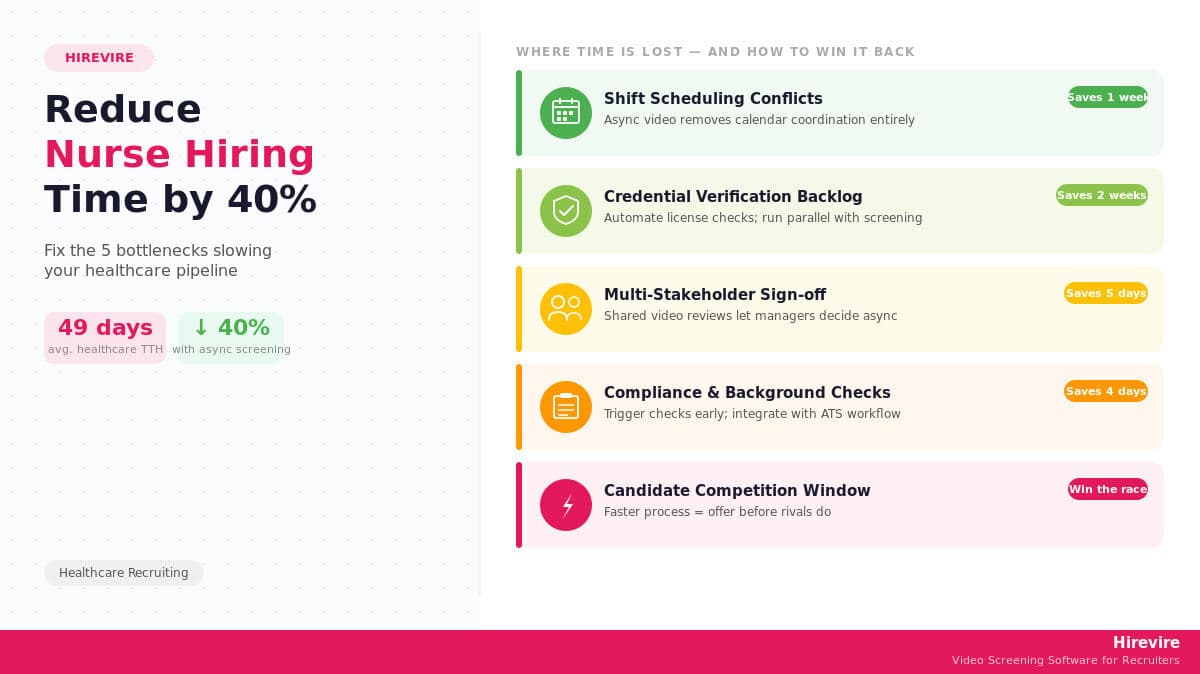
Healthcare hiring takes more than twice as long as most other industries. According to data from the Society for Human Resource Management, the average time-to-fill for healthcare roles runs 49 days - compared to roughly 20-25 days for professional services positions. For nursing specifically, the number frequently runs longer.
This isn't primarily a sourcing problem. Most healthcare organizations have enough applicants. The delays happen inside the process: credential verification takes weeks, phone screens are impossible to schedule across three nursing shifts, and hiring managers reviewing applications in between patient care don't move fast enough to compete with the next employer sending an offer.
By the time the average healthcare organization is ready to make an offer, the best candidates have already accepted one elsewhere.
This guide covers the specific bottlenecks that make healthcare hiring slow and the practical steps to fix each one. The focus is on what actually moves the needle - primarily the scheduling problem at the pre-screen stage - not generic recruitment advice.
Quick Summary: Healthcare hiring is slow because of shift-scheduling conflicts, credential verification backlogs, and compliance requirements that don't exist in other industries. Hirevire solves the scheduling problem with async video pre-screening: candidates record responses at their own convenience (including 11pm after a night shift), and recruiters review on their schedule. No calendar coordination needed.
Table of Contents
- Why Healthcare Hiring Takes 2x Longer Than Other Industries
- The Credential Verification Bottleneck
- The Scheduling Problem - Why Phone Screens Fail for Shift Workers
- Using Async Video to Assess Bedside Manner
- Compliance and Background Check Automation
- Reducing Homecare Staff Hiring Time
- Case Study: Cutting Nurse Hire Time by 40%
- Frequently Asked Questions
Why Healthcare Hiring Takes 2x Longer Than Other Industries
The healthcare hiring process has four structural differences from most other industries that make it slower by design.
Shift Coverage Creates Scheduling Conflicts
Nursing is a 24/7 profession. A recruiter working 9-to-5 trying to schedule a 15-minute phone screen with a night-shift nurse faces a genuine coordination problem. The nurse finishes work at 7am, sleeps until 3pm, and starts her next shift at 11pm. Her "free time" is 3-11pm - which overlaps only briefly with recruiter availability.
Multiply this by 20 shortlisted candidates across day, evening, and night shifts, and scheduling alone becomes a week-long project.
Credential Verification Takes Weeks, Not Days
Every clinical hire requires license verification, often from multiple state boards. A travel nurse who has worked in three states needs three separate license checks. Nurses who recently graduated need to show NCLEX passage. Specialties like ICU, OR, or L&D require additional certification checks.
This verification process runs in parallel with other hiring steps, but when it takes 2-3 weeks, it becomes the rate-limiting factor regardless of how fast other stages move.
Multiple Stakeholders Slow Decision-Making
Most healthcare facilities require sign-off from the unit manager, the department director, and sometimes HR compliance before an offer goes out. Unit managers are often working clinical shifts themselves. Getting three busy clinicians to align on a candidate decision within a reasonable window is a consistent challenge.
Competition is Immediate
The nursing shortage is well-documented. The American Association of Colleges of Nursing reports ongoing shortfalls in nursing program graduates relative to projected demand. When qualified candidates are scarce and multiple employers are competing for the same pool, a slow process means losing candidates to offers you never got to make.
Healthcare Time-to-Hire by Role Type
| Role Type | Average Time-to-Hire | Primary Bottleneck |
|---|---|---|
| Staff Nurse (RN) | 45-60 days | Credential verification + scheduling |
| Travel Nurse | 20-30 days | License checks (multiple states) |
| LPN/LVN | 35-50 days | Scheduling + background check |
| Homecare Aide | 25-40 days | Background + reference checks |
| Allied Health (OT, PT) | 50-70 days | Specialized credential verification |
| Healthcare Recruiter | 20-30 days | Standard process |
The Credential Verification Bottleneck
Credential verification is non-negotiable in healthcare hiring - it's a compliance requirement, not optional. The question isn't whether to verify; it's how to run it faster without creating compliance risk.
What Needs to Be Verified
For a registered nurse, a complete credential check includes:
- State nursing license verification (current status, expiration, any disciplinary actions)
- NCLEX passage confirmation
- Education verification (nursing degree from accredited program)
- CPR/BLS certification
- Specialty certifications (ACLS, PALS, NRP as applicable)
- Past employment verification (dates, title, reason for leaving)
- Reference checks (typically 2-3 professional references)
- Background check (criminal, sex offender registry, OIG exclusion list)
- Drug screening
For specialties, add: competency verifications, specific equipment certifications, and sometimes peer references from clinical colleagues.
Running Verification in Parallel, Not in Series
The most common mistake in healthcare credential verification is running checks sequentially. Organization waits for the background check to clear before ordering the drug screen. Waits for education verification before calling references. Each sequential step adds days.
Run every check that can start in parallel at the same time:
- Order background check + OIG check the day a conditional offer goes out
- Send education verification request simultaneously
- Initiate license verification through the state board portal (most are instant for current/clear licenses)
- Send reference check surveys at the same time
Only drug screening needs to be sequenced (requires the candidate to go to a collection site, which needs to be scheduled).
Automation Tools for Credential Verification
Several platforms specifically address healthcare credential verification:
- Nursys - Direct state board license verification for nurses, available in most US states
- OIG Exclusion Check - Federal database for healthcare exclusions; can be integrated via API
- Background check integrations - Providers like Checkr or Sterling integrate directly with most ATS platforms
Many credential verification steps that took days by phone can now be completed via API in minutes. The bottleneck shifts from verification time to getting the candidate to submit their documentation - which is a candidate experience problem, not a technology problem.
Credential Document Collection
Getting candidates to submit their credentials quickly is its own challenge. Clear instructions, a single upload link, and a firm deadline work better than email back-and-forth.
Include these in the initial candidate communication after screening:
- List every document needed with exact file formats accepted
- Set a deadline (typically 48-72 hours) with an explicit note that the offer timeline depends on receipt
- Provide a single upload portal - not email
- Send an automated reminder at 24 hours if documents haven't been received
Hirevire supports file upload responses alongside video, so candidates can submit documents, certifications, and licenses as part of the same pre-screen workflow - reducing the number of separate communications.
The Scheduling Problem - Why Phone Screens Fail for Shift Workers
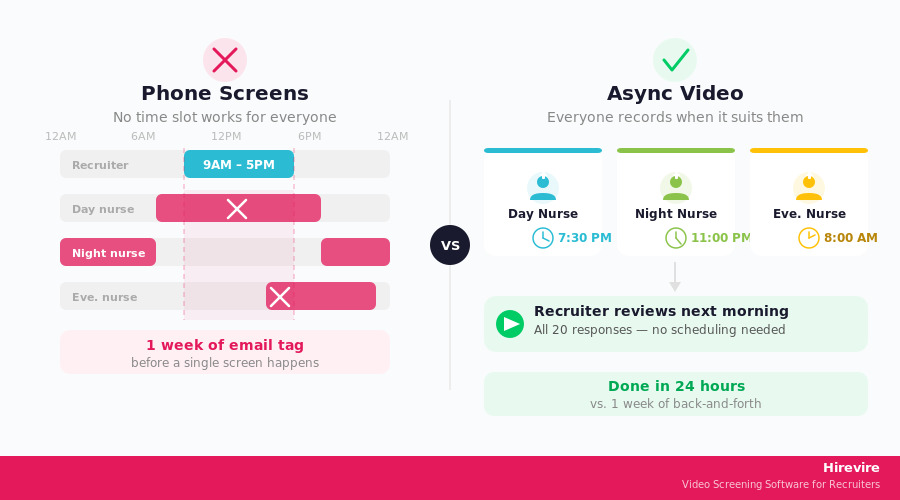
The scheduling problem is the single biggest driver of slow time-to-hire in healthcare. It's also the most fixable.
A healthcare recruiter trying to phone-screen 20 nursing candidates faces a realistic breakdown like this:
- 6 candidates work day shift (7am-7pm): available evenings (7pm+)
- 7 candidates work night shift (7pm-7am): available afternoons (12pm-6pm)
- 4 candidates work evening shift (3pm-11pm): available mornings (9am-2pm)
- 3 candidates are job-seeking and available anytime
There is no single time window when all candidates are available. Scheduling 20 individual 20-minute phone screens across this availability grid takes a week of back-and-forth email coordination - before a single screening conversation happens.
What Async Video Pre-Screening Solves
With Hirevire, the scheduling problem disappears entirely.
Instead of phone screens, the recruiter sends all 20 candidates a link to record their responses to 4-5 structured questions. Each candidate records at their own convenience - the night-shift nurse records at 11pm after her shift, the day-shift nurse records at 7:30pm before bed. No scheduling. No calendar coordination. No back-and-forth.
The recruiter reviews responses the next morning in batches. Twenty candidates at roughly 6-8 minutes per response takes about 2.5 hours - far less than the 8-10 hours of phone time that 20 individual screens would require.
Setting Up Async Pre-Screens for Healthcare Roles
A healthcare-specific pre-screen question set should cover:
Availability and Schedule Questions:
- "What shifts are you available for, and are you open to rotating shifts?"
- "When would you be available to start if selected?"
- "Are you currently employed? If so, what is your notice period?"
Clinical Experience Questions:
- "Walk me through your most recent unit and patient population. What was your typical patient assignment?"
- "Describe your experience with [specific EHR if required - e.g., Epic, Cerner]. How long have you used it and in what capacity?"
Communication and Team Questions:
- "Describe how you handle a situation where you disagree with a clinical decision made by a physician or supervisor."
- "Tell me about a challenging patient situation and how you managed it."
Credential-Specific Questions:
- "What is the current status of your [state] nursing license?"
- "Do you have current ACLS/BLS certification? When does it expire?"
Hirevire allows recruiters to set time limits per question (typically 60-90 seconds for straightforward questions, up to 3 minutes for scenario questions), and candidates can re-record their responses as many times as needed before submitting.
The Time Impact
A healthcare recruiter running async pre-screens instead of phone screens typically saves 8-12 hours per open position. For a team managing 10 concurrent nursing openings, that's 80-120 hours of recruiter time per month - time that can go toward sourcing, candidate relationship management, or simply faster decisions.
Hirevire for Healthcare Teams
Hirevire is designed for exactly this use case. The platform collects video, audio, or text responses from candidates who record at their convenience. Recruiters review in a shared dashboard, with AI-generated transcripts that make it easy to scan responses without watching every video in full.
| Plan | Monthly | Yearly | Interviews/Year |
|---|---|---|---|
| Essentials | $49/month | $39/month | 300 |
| Professional | $149/month | $99/month | 1,200 |
| Agency | $249/month | $199/month | 12,000 |
For healthcare organizations running high volumes of nursing hires, the Professional or Agency plan covers most needs with no per-interview charges within the plan allocation.
Ratings: G2: 4.7/5 (25+ reviews) | Capterra: 5/5 (20+ reviews) | AppSumo: 4.9/5 (70+ reviews)
Using Async Video to Assess Bedside Manner
One argument against async video pre-screening for nursing roles: "We need to assess communication skills. A video can't replace a real conversation."
This argument has it backwards. Async video is better than a phone screen for assessing communication in healthcare candidates.
What a Phone Screen Misses
A 15-minute phone screen under pressure tells you something, but not much. The candidate knows they're being evaluated. They're on guard. They give rehearsed answers. The recruiter is multitasking (taking notes, checking email). Neither party is performing at their best.
What Async Video Shows
When a candidate records an async video response at 11pm after a long shift, they're not "on" in the way a formal phone screen requires. What you actually see:
- Natural communication style: How they explain clinical situations without formal interview pressure
- Vocabulary and clarity: Whether they can describe patient care in terms a hiring manager can evaluate
- Composure on hard questions: The scenario question ("describe a challenging patient situation") reveals a lot more on video than in a phone conversation - facial expression, pacing, how they organize their thoughts
- Professionalism: Appearance, environment, effort put into the response
For patient-facing roles, you want to hire people who communicate clearly and warmly under normal (not peak-performance) conditions. Async video gives you closer to that baseline.
Scoring Bedside Manner Criteria
Build a scoring rubric for healthcare pre-screen video responses that includes:
| Criterion | What to Look For | Score 1-3 |
|---|---|---|
| Communication clarity | Explains clinical scenarios without jargon or with appropriate explanation | 1-3 |
| Professional presentation | Appearance, environment, tone appropriate for patient-facing role | 1-3 |
| Empathy indicators | Language choice when describing patient interactions | 1-3 |
| Composure | Handles the scenario/difficult question without visible agitation | 1-3 |
| Conciseness | Answers the question without excessive rambling | 1-3 |
This rubric gives every reviewer a consistent framework, so the assessment is comparable across candidates regardless of who reviews the video.
Hirevire's scoring feature lets team members rate responses on custom criteria, creating a shared view of each candidate across the hiring team before a single live interview is scheduled.
Compliance and Background Check Automation
Healthcare compliance requirements don't just add time - they create liability if not handled correctly. The key is building compliance checks into the workflow at the right points so they run in parallel rather than sequentially.
OIG Exclusion Screening
The Office of Inspector General maintains a List of Excluded Individuals and Entities (LEIE). Hiring an excluded individual to work with Medicare or Medicaid patients can result in significant civil monetary penalties - up to $10,000 per prohibited service plus three times the amount of any improper claims.
OIG checks should run:
- At offer extension (before the hire is complete)
- Monthly post-hire for all staff (ongoing compliance requirement for most healthcare organizations)
Many background check vendors include OIG screening. Confirm this before selecting a vendor.
State License Verification
Most state nursing boards now offer online license verification. For the most common scenarios:
- Active license in good standing: Verifiable online in minutes via state board portal
- License from another state: Use Nursys for states enrolled in the Nursys e-Notify program (covers most states)
- Recently renewed license: Confirmation typically within 24-48 hours of renewal processing
- License with prior discipline: Requires manual review and documentation
Build state license verification into your initial screening communications: ask candidates to provide their license number and state upfront, and verify before scheduling any live interviews.
Structuring the Compliance Workflow
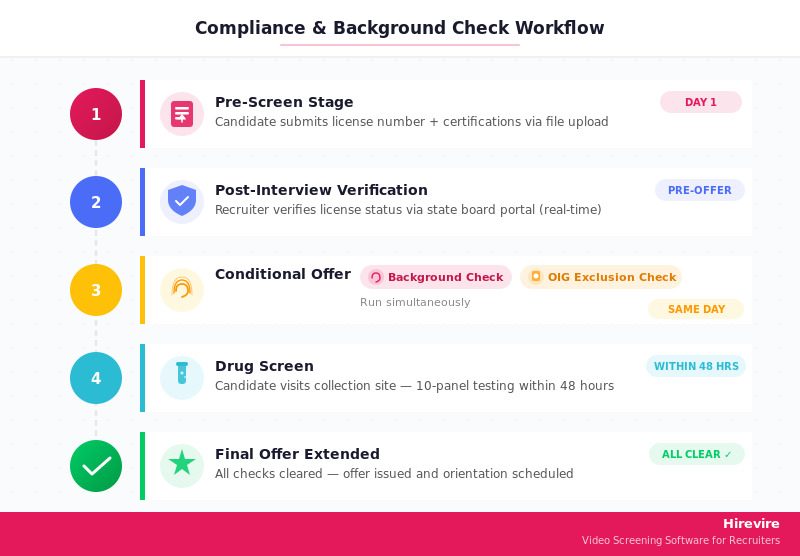
A compliant healthcare hiring workflow has these checkpoints:
- Pre-screen stage: Candidate provides license number + certifications via Hirevire file upload
- Post-interview, pre-offer: Recruiter verifies license status online
- Conditional offer: Background check + OIG check ordered simultaneously
- Drug screen: Candidate goes to collection site within 48 hours of offer
- Final offer: Issued only after all checks clear
Nothing in this workflow is slow by nature. What makes it slow is doing these steps in series instead of parallel, and waiting for candidates to initiate steps rather than pushing them through proactively.
Drug Testing for Healthcare Roles
Drug testing requirements vary by role and facility type. Key considerations:
- Most hospital systems require 10-panel testing for nursing hires
- Some facilities require additional testing (random testing post-hire, return-to-duty testing)
- Collection site availability affects timing - build 2-3 days into your timeline for collection site scheduling
Hirevire integrates with several ATS platforms that have direct connections to background and drug testing providers, so the order can be triggered automatically when a candidate advances to offer stage.
Reducing Homecare Staff Hiring Time
Homecare staff hiring presents a different set of challenges than hospital nursing. The volume is typically higher, turnover rates are greater, margins are tighter, and the candidate pool is broader - meaning less specialized credential verification, but more volume to process.
The Homecare Hiring Challenge
Homecare aides and CNAs face different credential requirements (state CNA certification, CPR, often a health screening), but the volume challenge is significant. A homecare agency filling 30 positions per month with 80% monthly turnover is running a continuous high-volume hiring operation.
For this context, speed matters more than depth. Getting to a decision in 5-7 days rather than 3-4 weeks can have a direct impact on whether clients have covered care.
Async Pre-Screening for Homecare Roles
The scheduling problem in homecare is similar to nursing - candidates often have multiple jobs, irregular hours, or are balancing caregiving responsibilities of their own. Scheduling a 15-minute phone screen is harder than it sounds.
Hirevire async pre-screening works well for homecare volumes. A 4-question pre-screen takes candidates 8-12 minutes to complete and gives you enough information to make a shortlist decision. Effective homecare pre-screen questions include:
- "What's your availability for shifts? Are you open to evenings and weekends?"
- "Tell me about your experience with elderly or disabled clients. What kinds of care tasks have you performed?"
- "Do you have a reliable vehicle and valid driver's license? Are there geographic areas you can't serve?"
- "What's your current certification status (CNA, HHA, etc.)? When does it expire?"
With a 48-hour completion window, most homecare applicants complete the pre-screen before a recruiter would have been able to schedule a phone call.
Homecare Hiring Workflow
Day 1: Application received
Day 1: Automated acknowledgment + async pre-screen link via Hirevire
Day 2-3: Candidate records pre-screen responses
Day 3: Recruiter reviews responses, selects for phone interview
Day 4: Phone interview (30 min) - deeper scenario questions
Day 5: Background check + CNA verification ordered
Day 6-7: Reference checks (2) via automated survey
Day 7-8: Conditional offer extended
Day 8-9: Drug screen completed
Day 9-10: Final offer + orientation scheduling
This 10-day workflow is achievable for homecare roles with available candidate pools. The pre-screen step is what prevents the process from stalling at Day 2-3 waiting for phone screens to be scheduled.
For agencies handling high volume, Hirevire's Agency plan ($199/month billed yearly) covers 12,000 interviews/year - enough for most sustained homecare hiring programs.
Case Study: Cutting Nurse Hire Time by 40%
This section outlines a representative example of what healthcare organizations have achieved by restructuring the pre-screen stage.
The Situation
A regional health system with 8 hospitals was averaging 58 days to fill RN positions. Their process had a specific bottleneck: the coordinator-to-manager handoff between pre-screening and interview scheduling took 7-10 days. Coordinators screened by phone, documented notes in a shared spreadsheet, and manually forwarded information to unit managers for interview approval.
What Changed
The team moved pre-screening to Hirevire async video. Coordinators sent pre-screen links immediately after resume review. Candidates had 72 hours to complete 5 questions (3 standard, 2 unit-specific). Unit managers received access to the Hirevire dashboard and reviewed video responses on their own schedule - from a mobile device during breaks, or from home on off days.
The coordinator-to-manager handoff that previously took 7-10 days now happened in 24-48 hours, because managers could review in real time rather than waiting for a scheduled meeting with a coordinator.
Results
- Average time-to-fill dropped from 58 days to 34 days (41% reduction)
- Phone screen time per position: reduced from ~12 hours to ~2.5 hours
- Hiring manager satisfaction with pre-screened candidates: improved (more consistent information, video reveals fit)
- Candidate completion rate for pre-screens: 68% (comparable to phone screen show rate)
Key Factors
The factors that made this work:
- Simplicity for candidates: The Hirevire link worked on mobile, required no app download, and candidates could record on any device
- Transparency for managers: Managers could see responses without waiting for a coordinator briefing
- Standardized questions: Every candidate answered the same questions, making comparison easier
- Fast follow-up: Candidates who completed pre-screens received interview invites within 24 hours, which reduced drop-off
For organizations running medical recruitment with AI interview tools, this pattern of parallel review (coordinator + manager seeing responses simultaneously) is often the single biggest lever for reducing end-to-end time.
Frequently Asked Questions
Why does healthcare hiring take so much longer than other industries?
Four structural factors slow healthcare hiring: shift-scheduling conflicts that make phone screens hard to coordinate, multi-week credential verification requirements, multiple stakeholder approvals before an offer can go out, and intense competition for a limited pool of qualified candidates.
The longest delays typically happen at the pre-screen stage (scheduling 15-20 phone screens with shift workers) and the verification stage (waiting for background, license, and education checks to clear). Both are addressable with process changes.
How do you screen nurses without scheduling phone calls?
Async video pre-screening is the most effective alternative to phone screens for healthcare candidates. With Hirevire, candidates receive a link to record responses to 3-6 structured questions at their convenience. A night-shift nurse can record at 11pm after her shift. A recruiter can review all responses the next morning in about 2.5 hours instead of spending a week scheduling individual calls.
What questions should you ask in a nursing pre-screen?
Effective nursing pre-screen questions fall into four categories: availability and scheduling (shift preferences, start date, current notice period), clinical experience (patient population, EHR experience, specialty certifications), communication and team scenarios (handling disagreements with physicians, managing challenging patient situations), and credential status (license number and state, current certification expiration dates).
Keep total question time to 10-12 minutes for candidates to maintain completion rates. More than 5-6 questions reduces the percentage of candidates who finish.
How long should a nursing pre-screen take for candidates?
Target 8-12 minutes total for candidates to complete the pre-screen. At 60-90 seconds per question, 4-5 questions is the right range. Give candidates enough time to answer thoughtfully but short enough that they're likely to complete in one sitting.
Hirevire lets you set time limits per question and gives candidates unlimited re-recording attempts, which improves completion rates and answer quality.
What's a realistic time-to-hire target for nursing roles?
The industry average for RN hires is 45-60 days. With structured workflows and async pre-screening, the achievable target for most health systems is 28-35 days. Travel nursing contracts move faster (typically 14-21 days) because credential verification is handled differently and the urgency is higher.
For homecare and CNA roles, the realistic target with optimized workflows is 7-14 days.
How do you verify nursing licenses quickly?
Most state boards offer online license verification that returns results in real time for active, unencumbered licenses. Use Nursys for multi-state verification (covers most US states). For candidates with licenses in states not covered by Nursys, direct state board portal checks take 1-3 business days.
Build license verification into the workflow at the pre-screen stage (ask candidates for their license number and state upfront) rather than waiting until after interviews.
Can async video screening meet healthcare compliance requirements?
Async video screening is used for the pre-screen stage, which is a hiring evaluation tool - not a compliance document. The compliance requirements in healthcare (background checks, OIG screening, license verification, drug testing) happen separately and are not replaced by pre-screening.
Hirevire supports file upload responses alongside video, so candidates can also submit credentials, certifications, and licenses as part of the same pre-screen workflow - which speeds up the compliance documentation collection process.
How do you reduce homecare staff turnover through better screening?
Turnover in homecare is often driven by poor fit rather than poor performance - candidates who accept positions they're not suited for (wrong geography, wrong patient population, incompatible schedule). Pre-screen questions that address fit explicitly (preferred shift patterns, geographic availability, experience with specific patient needs) help identify mismatches before hire rather than after.
Video responses also reveal candidate engagement. A candidate who records a thoughtful, specific response about their homecare experience is meaningfully different from one who gives a 20-second generic answer.
What's the best way to handle reference checks for nurses?
Automated reference check surveys (sent via email to references the candidate provides) are faster and more thorough than phone-based reference checks for most nursing hires. Platforms like Checkster or SkillSurvey send structured questionnaires that references can complete asynchronously, returning results in 24-48 hours without playing phone tag.
For senior clinical roles (charge nurses, nurse managers), a direct phone call with the most recent supervisor is still standard practice and worth the time.
How do you compete with larger health systems for nursing candidates?
Candidate experience matters more in competitive hiring markets. Nurses receive multiple recruiter contacts. Slow, impersonal processes lose candidates to organizations that move faster and communicate better.
Specific differentiators that move candidates toward your organization: same-day response to applications (automated acknowledgment + pre-screen link), clear communication about timeline and process, and faster time-from-application-to-offer. Organizations using Hirevire often cite faster candidate response times as a secondary benefit - candidates appreciate knowing their application was received and acted on immediately.
Conclusion
Healthcare hiring is slow for structural reasons, but those reasons are largely fixable. The scheduling problem at pre-screening accounts for most of the delay, and it can be solved without process complexity or large technology investments.
Async video pre-screening through Hirevire eliminates the scheduling friction that makes nursing pre-screens so expensive in time. Candidates record when it's convenient for them. Recruiters review in batches. Unit managers can evaluate candidates on their own schedule without waiting for coordinator briefings.
The credential verification and compliance steps take as long as they take - but running them in parallel rather than in series, and automating document collection, removes unnecessary delays from that part of the process too.
Key Takeaways
- Healthcare hiring averages 49+ days, but 28-35 days is achievable with structured workflows
- The scheduling problem (phone screens with shift workers) is the biggest preventable delay
- Async video pre-screening removes scheduling friction entirely and reveals communication quality better than phone calls
- Credential verification should run in parallel, not sequentially - start all checks simultaneously
- Video responses show bedside manner and communication style in a more realistic context than formal phone screens
- Homecare hiring at volume requires the same principles applied at higher throughput
Your Next Steps
- Map your current hiring workflow and identify which stage creates the most delay
- Calculate how many hours your team currently spends on phone screens per position
- Try Hirevire free to run your next pre-screen round as async video
Ready to cut your healthcare hiring time by 40%?
Last updated: March 2026. All information verified as of March 2026.