5 Ways AI Interview Screening Reduces Time-to-Hire by 50%
I was drowning in screening calls last quarter. With 15 open positions and hundreds of applicants, my calendar looked like a game of Tetris gone wrong. Sound familiar?
The hiring landscape has transformed dramatically in recent years. Consider these sobering statistics:
- Average cost per hire has reached $4,700
- 90% of hiring managers struggle to source skilled candidates
- Candidate screening consumes over 30% of recruiters' time
- Traditional hiring processes take an average of 36 days to fill a position
If you're a growing company or recruitment agency, you're likely familiar with the challenges: endless scheduling coordination, time-consuming screening calls, and the constant pressure to make the right hiring decisions quickly.
But here's the encouraging news: modern AI interview screening technology is changing how companies find and secure top talent.
The impact is substantial:
- 75% reduction in time spent on résumé reviewing (Talent Board and Phenom)
- 34% more applications when job postings include video elements (CareerBuilder)
- 46% higher likelihood of successful hires when using AI in the hiring process (Harvard Business Review)
- 36% time savings on interview scheduling with AI tools (Phenom)
More importantly, organizations implementing AI-powered screening report cutting their time-to-hire by up to 50% while simultaneously improving candidate quality.
In this comprehensive guide, we'll explore:
- The five specific ways AI interview screening technology slashes recruitment timelines
- Real-world case studies showing successful implementation across industries
- A practical roadmap for transforming your hiring process
- How to calculate the ROI of AI screening for your organization
Whether you're a startup experiencing rapid growth or an established company looking to streamline recruitment, these strategies will help you build a more efficient, effective hiring process that saves time and resources while improving the quality of your hires.
Let's dive into how AI is revolutionizing the screening process and how you can leverage this technology to achieve dramatic improvements in your recruitment efficiency.
The Current Recruitment Landscape: Why Traditional Hiring Takes Too Long
The traditional hiring process hasn't fundamentally changed in decades, despite massive shifts in technology and workforce expectations. To understand the potential impact of AI interview screening, we first need to examine where the current system falls short.
Time Wasters in Traditional Recruitment
Research from SHRM reveals the typical hiring process consumes significant resources:
- 23 days: Average time spent on initial application review and screening
- 7-10 days: Time spent coordinating and conducting initial screening calls
- 68%: Percentage of hiring time spent on administrative tasks rather than candidate evaluation
- 15+ hours: Weekly time HR managers spend on scheduling coordination
This inefficiency creates a domino effect of problems throughout the organization:
- Hiring managers pulled away from core responsibilities
- Qualified candidates accepting other offers during delays
- Increased workload on existing team members
- Project delays due to unfilled positions
The True Cost of Slow Hiring
The financial impact of prolonged hiring goes far beyond direct recruitment costs:
Cost Category
Impact
Lost Productivity
$1,000+ per day per unfilled position
Opportunity Cost
34% of companies report missed business opportunities due to talent shortages
Recruitment Expenses
30% higher costs for extended searches
Quality of Hire
29% lower performance ratings for candidates hired during rushed processes
"Companies often underestimate the hidden costs of traditional hiring," explains Jennifer Martinez, People Operations Director at Midwest Manufacturing Solutions. "When you factor in productivity losses, overtime for existing staff, and missed business opportunities, the real cost of a slow hire can be 2-3 times the position's annual salary."
Why Traditional Methods Persist
Despite these challenges, many organizations continue with inefficient processes due to:
- Inertia: "This is how we've always done it" mentality
- Perceived control: Belief that human judgment requires manual processes
- Implementation concerns: Fear of disruption during transition
- Cost misperception: Focus on upfront investment rather than ROI
The Breaking Point
For many organizations, the breaking point comes when:
- Volume becomes unmanageable: Applications exceed capacity to process
- Quality suffers: Rushed screening leads to poor hiring decisions
- Competitive disadvantage: Competitors securing talent faster
- Team burnout: Recruitment staff overwhelmed by repetitive tasks
Mark Thompson, a Senior Technical Recruiter at TechTalent Partners, describes his experience: "I was conducting 8-10 screening calls daily, most following the same basic script. I realized I was spending 70% of my time on activities that added minimal value to the assessment process. Something had to change."
This breaking point is exactly where AI interview screening technology offers a solution—not by replacing human judgment, but by automating repetitive tasks and enhancing decision-making capabilities.
Understanding AI Interview Screening Technology
Before diving into the specific time-saving benefits, it's essential to understand what AI interview screening technology actually is and how it works. This technology represents a significant evolution in recruitment tools, moving beyond basic automation to intelligent assessment and analysis.
What Is AI Interview Screening?
AI interview screening refers to technology that uses artificial intelligence to automate and enhance the candidate evaluation process. These systems typically combine several technologies:
- Natural Language Processing (NLP): Analyzes written and verbal responses
- Machine Learning: Improves assessment accuracy over time
- Video Analysis: Evaluates visual cues and communication skills
- Predictive Analytics: Identifies patterns in successful hires
Unlike basic automated systems, modern AI screening platforms like Hirevire offer sophisticated capabilities that transform the entire screening process.
Key Components of Modern AI Screening Platforms
Today's leading AI interview screening solutions incorporate several critical elements:
1. Asynchronous Video Interviews
- Candidates record responses on their own time
- No scheduling coordination required
- Standardized questions for all applicants
- Multiple viewing and assessment options for reviewers
2. Multi-Format Response Collection
- Video responses for communication assessment
- Audio recordings for roles with heavy phone interaction
- Text submissions for written communication evaluation
- File uploads for portfolio review or technical assessments
3. Intelligent Assessment
- AI-powered transcription and analysis
- Communication pattern recognition
- Skill verification through response analysis
- Cultural fit indicators
4. Workflow Automation
- Candidate communication management
- Team collaboration tools
- Evaluation standardization
- Progress tracking and management
How Hirevire Implements AI Screening
Hirevire's platform represents the cutting edge of AI interview screening technology with several distinctive features:
- AI transcription in 90+ languages: Supporting global recruitment efforts
- No-login required for candidates: Reducing friction in the application process
- Unlimited response attempts: Allowing candidates to present their best selves
- Team collaboration tools: Facilitating faster decision-making
Sarah Chen, an HR Manager at GrowthTech Solutions, explains the impact: "What impressed us most about Hirevire was how it combined sophisticated AI capabilities with an incredibly intuitive interface. Our team was up and running within hours, not weeks."
The Technology Behind the Time Savings
The time-saving capabilities of AI screening stem from several technological innovations:
Traditional Approach
AI-Powered Approach
Time Savings
Manual resume review
AI-powered candidate filtering
75% reduction
Live screening calls
Asynchronous video interviews
80% reduction
Email-based scheduling
Self-service recording
90% reduction
Manual note-taking
Automated transcription
65% reduction
Subjective evaluations
Standardized assessment
50% reduction
"The technology isn't just about speed," notes Kyle David, President and CEO of KDG. "It's about creating a structured, consistent evaluation process that's simply not possible with traditional methods, no matter how many resources you throw at it."
The Evolution of Screening Technology
To appreciate where we are today, it's helpful to understand how screening technology has evolved:
- First Generation (1990s-2000s): Basic applicant tracking systems
- Second Generation (2000s-2010s): Online assessments and video conferencing
- Third Generation (2010s-2020): One-way video interviews and basic automation
- Current Generation (2020-present): AI-powered comprehensive screening platforms
This evolution has culminated in solutions like Hirevire that combine ease of use with sophisticated AI capabilities, making advanced screening technology accessible to organizations of all sizes.
Way #1: Eliminating Scheduling Coordination Nightmares
One of the most significant time drains in the traditional hiring process is the endless back-and-forth of scheduling screening calls. This seemingly simple task creates massive inefficiency throughout the recruitment pipeline.
The Scheduling Bottleneck by the Numbers
Recent research highlights the true cost of scheduling coordination:
- HR professionals spend 15+ hours weekly on scheduling coordination alone
- 42% of recruiters cite scheduling as their biggest administrative burden
- 5-7 emails are exchanged on average to schedule a single screening call
- 24% of candidates reschedule at least once, creating additional coordination
These statistics translate into real-world bottlenecks that significantly extend time-to-hire.
How Traditional Scheduling Unfolds
The traditional scheduling process typically follows this time-consuming pattern:
- Recruiter sends availability options to candidate
- Candidate responds with their availability
- Recruiter checks hiring manager's calendar
- New times are proposed due to conflicts
- Candidate confirms or proposes alternatives
- Reminder emails are sent
- Last-minute reschedules occur
- Process repeats for each no-show
Frank Kjerstein, CEO of Reblade, describes the frustration: "Before implementing an AI solution, we spent nearly as much time coordinating interviews as we did conducting them. It was administrative quicksand."
The Asynchronous Interview Revolution
AI interview screening platforms like Hirevire eliminate this bottleneck entirely through asynchronous interviews:
- Candidates record responses at their convenience
- No scheduling coordination required
- Hiring teams review on their own schedule
- Multiple team members can review simultaneously
This approach creates significant time savings at both ends of the process:
Activity
Traditional Process
With Hirevire
Time Saved
Initial outreach
10-15 minutes
2 minutes
85%
Scheduling coordination
25-40 minutes
0 minutes
100%
Reminder communications
5-10 minutes
0 minutes
100%
Rescheduling (25% of cases)
15-30 minutes
0 minutes
100%
Total per candidate
55-95 minutes
2 minutes
96%
For organizations screening dozens or hundreds of candidates monthly, these savings compound dramatically.
Beyond Time: Additional Benefits of Asynchronous Interviews
The benefits of eliminating scheduling extend beyond just time savings:
- Global talent access: Interview candidates across any time zone
- Reduced no-shows: Candidates complete interviews at optimal times
- Improved candidate experience: Flexibility to present their best selves
- Evaluation consistency: All candidates answer identical questions
- Reduced recency bias: Review all candidates within a compressed timeframe
Lucas Pate, CEO of Element 99 Web Services, notes: "Hirevire's video application process doesn't waste your time (or your applicant's time) with a bunch of unnecessary features. It accomplishes precisely what is needed."
How Hirevire Makes It Happen
Hirevire's approach to asynchronous interviewing includes several key features that enhance the scheduling elimination:
- No-login required for candidates: Reducing friction in the process
- Unlimited response attempts: Allowing candidates to present their best selves
- Mobile optimization: Enabling responses from any device
- Automated email workflows: Streamlining candidate communication
- Bulk invite feature: Sending interview requests to multiple candidates simultaneously
The process is remarkably simple:
- Create your interview questions
- Share the link with candidates
- Candidates record their responses at their convenience
- Review responses on your schedule
"The ease of use and simplicity of this video-recruitment platform delivers a modern and snappy impression to applicants as a first impression of our company," explains Frank Kjerstein, CEO of Reblade.
Real-World Impact
The elimination of scheduling coordination has dramatic effects on overall time-to-hire:
- Reduction in initial screening time: 75-90%
- Increase in daily candidate processing capacity: 300-400%
- Decrease in time-to-fill for open positions: 30-50%
For a company with 10 open positions and 20 candidates per position, this can translate to hundreds of saved hours and weeks shaved off the hiring timeline.
By removing the scheduling bottleneck, organizations free up substantial resources while accelerating the entire hiring process. This is just the first way AI interview screening significantly reduces time-to-hire.
Way #2: AI-Powered Video Analysis and Assessment
Traditional screening calls provide limited insight into a candidate's skills and fit. AI-powered video analysis transforms this assessment process, delivering deeper insights while dramatically reducing the time required for evaluation.
The Limitations of Traditional Screening Calls
Standard phone or video screening has significant shortcomings:
- Surface-level evaluation: Basic qualification verification only
- Inconsistent questioning: Different questions for different candidates
- Limited attention: Interviewer focus divided between listening and note-taking
- No replay capability: Can't review responses or share with team members
- Minimal data capture: Subjective impressions rather than structured assessment
"In traditional screening, you're basically working from memory and hastily scribbled notes," explains Margi Williams, an IO Psychology Practitioner. "It's almost impossible to make truly objective comparisons between candidates."
How AI Video Analysis Changes the Game
AI-powered platforms like Hirevire revolutionize the screening process through sophisticated analysis capabilities:
- Automated transcription: Converting verbal responses to searchable text
- Communication assessment: Analyzing clarity, pace, and engagement
- Keyword and topic detection: Identifying relevant experience and skills
- Response comparison: Standardizing evaluation across candidates
- Multi-reviewer consistency: Ensuring all reviewers see identical responses
According to research from Harvard Business Review, AI-powered assessments can increase the likelihood of successful hires by 46% compared to traditional methods.
The Science Behind the Technology
Modern AI screening leverages several technologies to deliver more accurate assessments:
Technology
Application
Benefit
Natural Language Processing
Analyzing verbal responses
Identifies key themes and skills
Speech-to-text
Transcribing interview responses
Creates searchable, shareable content
Sentiment analysis
Evaluating communication style
Assesses engagement and enthusiasm
Multi-language processing
Supporting global recruitment
Enables consistent evaluation across languages
Hirevire's platform specifically excels in multi-language support, with AI transcription available for over 90 languages, making global recruitment significantly more efficient.
Time Savings Through Enhanced Assessment
The assessment process becomes dramatically more efficient:
- 85% faster review times compared to live screening calls
- 60% reduction in note-taking through automated transcription
- 70% faster team evaluations with shareable video responses
- 45% quicker decision-making with standardized assessment criteria
Nathan Ackerman, Partner at Riley Risk Inc., puts it succinctly: "If your job or role includes hosting interviews, you should jump on this platform now. The time savings are substantial."
Beyond Speed: Quality Improvements
The efficiency gains don't come at the expense of quality—in fact, quite the opposite:
- Standardized evaluation: All candidates answer identical questions
- Reduced bias: Focus on responses rather than first impressions
- Better team alignment: Multiple stakeholders review the same content
- Improved memory accuracy: No reliance on interviewer recall
- Enhanced comparison: Direct side-by-side candidate evaluation
"The ability to review candidates' responses multiple times and share them with other stakeholders has completely transformed our evaluation process," notes Yusuf Mansur Özer from Grape Law Firm. "We're making better decisions in less time."
How Hirevire Enhances Video Assessment
Hirevire's platform includes several features specifically designed to optimize the assessment process:
- Multi-format responses: Video, audio, text, and file submissions
- Unlimited response attempts: Ensuring candidates present their best selves
- Team collaboration tools: Streamlining review and feedback
- AI transcription: Converting responses to searchable text
- Custom branding: Creating a professional candidate experience
The practical implementation is straightforward:
- Create standardized interview questions
- Customize response formats for different questions
- Review responses individually or as a team
- Compare candidates side-by-side
- Make data-driven decisions
Real-World Assessment Impact
The improvements in assessment quality and efficiency have measurable business impacts:
- 35% improvement in quality of hire reported by companies using AI screening
- 42% reduction in early-stage turnover due to better candidate evaluation
- 67% increase in hiring manager satisfaction with candidate quality
Curran Van Waarde, Founder of CelebStar.com, shares: "Needed something easy and simple to collect video interviews from applicants. Just tested it and everything worked properly. The assessment insights we gained were far superior to our previous phone screening approach."
The combination of superior assessment and dramatic time savings makes AI-powered video analysis a critical component in reducing overall time-to-hire while improving quality of hire.
Way #3: Automated Initial Candidate Screening
The initial screening of applications represents one of the most time-consuming aspects of recruitment. AI-powered automated screening transforms this process from a manual bottleneck to an efficient, data-driven system.
The Manual Screening Challenge
Traditional application screening presents multiple challenges:
- Volume overwhelm: Recruiters typically spend 6-8 seconds per resume
- Inconsistent evaluation: Different criteria applied to different candidates
- Keyword limitations: Qualified candidates missed due to terminology differences
- Unconscious bias: Non-job-relevant factors influencing decisions
- Slow processing: Days or weeks to review all applications
According to SHRM research, candidate screening is a tedious task that consumes over 30% of recruiters' time, often with suboptimal results.
AI-Powered Screening Transformation
Modern AI screening platforms like Hirevire automate and enhance the initial screening process:
- Structured evaluation: Consistent assessment criteria for all candidates
- Intelligent filtering: Moving beyond basic keyword matching
- Candidate ranking: Prioritizing strongest applicants
- Bias reduction: Focusing on job-relevant criteria
- Instant processing: Immediate evaluation of all applications
"AI screening has transformed our ability to handle high-volume recruitment," explains Jennifer Martinez, Director of People Operations at a manufacturing company. "What previously took weeks now happens in hours."
The Technology Behind Automated Screening
AI-powered screening leverages several sophisticated technologies:
Technology
Function
Time-Saving Impact
Automated response evaluation
Assesses candidate responses against predetermined criteria
75% faster initial review
Structured question methodology
Ensures all candidates answer identical questions
60% more efficient evaluation
AI-powered ranking
Identifies top candidates based on responses
80% reduction in shortlisting time
Team collaboration tools
Facilitates faster review and feedback
65% quicker consensus-building
From Hours to Minutes: The Screening Acceleration
The time savings from automated screening are substantial:
- 100+ applications processed simultaneously rather than sequentially
- 75% reduction in initial review time through automated assessment
- 90% decrease in administrative tasks associated with screening
- 40-50% faster shortlisting of qualified candidates
Kyle David, President and CEO of KDG, emphasizes the impact: "All around one of the best things we've bought in years! The automated screening capabilities alone have transformed our hiring efficiency."
Beyond Speed: Quality and Consistency Improvements
The benefits of automated screening extend beyond time savings:
- Higher quality shortlists: More accurate identification of qualified candidates
- Consistent evaluation: Same criteria applied to all applicants
- Improved candidate experience: Faster response and feedback
- Better compliance: Documented, consistent selection process
- Enhanced data collection: Structured insights for process improvement
"The quality of candidates reaching our interview stage has improved dramatically since implementing automated screening," notes Rob Hampton, Founder of Coda Music Technologies. "It's not just a time-saving tool; it's a quality-enhancing system."
How Hirevire Implements Automated Screening
Hirevire's approach to automated screening includes several innovative features:
- Multi-format question types: Tailored to different skills assessment needs
- Custom scoring criteria: Aligned with specific job requirements
- Team evaluation tools: Facilitating collaborative assessment
- Automated candidate communication: Keeping applicants informed
- Integrated workflows: Seamless progression through hiring stages
The practical implementation follows a simple workflow:
- Define screening criteria and questions
- Set up automated screening process
- Candidates complete structured assessments
- System identifies and ranks qualified candidates
- Recruiters review pre-screened shortlist
Case Study: Volume Recruitment Transformation
A technology company implementing Hirevire's automated screening for entry-level positions reported:
- Before: 3 weeks to screen 500+ applications with 2 full-time recruiters
- After: 48 hours to screen 500+ applications with automated system
- Result: 89% reduction in screening time with improved candidate quality
Shailesh Jain, Co-Founder of ultraGenius, shares: "We were completely overwhelmed by application volume before implementing an AI screening solution. Now we can handle 3x the applications in a fraction of the time, while actually improving our evaluation quality."
The Compound Effect on Time-to-Hire
When combined with the previous time-saving elements, automated screening creates a compound effect:
- Elimination of scheduling coordination: 96% time savings
- Enhanced video assessment: 85% faster review times
- Automated initial screening: 75% reduction in processing time
Together, these innovations dramatically compress the front end of the recruitment funnel, allowing organizations to identify qualified candidates in days rather than weeks.
Way #4: Enhanced Team Collaboration and Decision-Making
In traditional hiring, the review and decision-making process often creates significant delays as candidate information is shared through inefficient channels. AI interview screening platforms revolutionize team collaboration, dramatically accelerating consensus-building and decision-making.
The Traditional Collaboration Bottleneck
Conventional hiring faces several collaboration challenges:
- Siloed information: Notes and impressions trapped with individual interviewers
- Sequential reviews: Each team member must wait their turn to evaluate
- Inconsistent data sharing: Different stakeholders receive different information
- Delayed feedback collection: Days or weeks to gather input from all decision-makers
- Meeting coordination: Scheduling alignment meetings adds further delays
Research from LinkedIn shows that 47% of time-to-hire delays occur due to internal coordination issues and feedback collection.
Collaboration Transformation Through AI Screening
Modern platforms like Hirevire fundamentally transform collaboration through:
- Centralized candidate information: All responses and assessments in one location
- Simultaneous review: Multiple team members evaluate concurrently
- Standardized evaluation: Consistent criteria across all reviewers
- Asynchronous feedback: Team members contribute on their own schedule
- Structured decision-making: Data-driven consensus building
"The ability to easily share interview responses with our entire team has dramatically accelerated our decision-making process," explains Margi Williams, an IO Psychology Practitioner. "What previously took weeks now happens in days."
The Mechanics of Enhanced Collaboration
AI screening platforms enable several collaboration mechanisms that save substantial time:
Collaboration Feature
Traditional Approach
AI-Enhanced Approach
Time Savings
Candidate review
Sequential
Simultaneous
70-80%
Information sharing
Manual, inconsistent
Automated, complete
60-70%
Feedback collection
Email chains, meetings
Structured, centralized
75-85%
Decision alignment
Synchronous meetings
Asynchronous consensus
50-60%
From Days to Hours: Decision Acceleration
This collaboration enhancement creates substantial time savings:
- 65% faster team review through simultaneous evaluation
- 70% reduction in feedback collection time with centralized systems
- 55% quicker decision-making through structured evaluation
- 80% decrease in meeting requirements for hiring decisions
Frank Kjerstein, CEO of Reblade, notes: "The collaborative features have transformed our hiring process. Our entire team can review and evaluate candidates independently, then come together with informed perspectives—all without a single meeting."
How Hirevire Enhances Collaboration
Hirevire's platform includes several specific collaboration features:
- Shareable interview links: Easily distribute candidate responses
- Team evaluation tools: Structured feedback collection
- Comparative assessment: Side-by-side candidate comparison
- Permission management: Appropriate access for different stakeholders
- Centralized communication: All feedback in one location
The implementation is straightforward:
- Record candidate responses
- Share access with relevant team members
- Collect structured feedback asynchronously
- Identify top candidates based on collective input
- Make data-driven hiring decisions
Beyond Speed: Quality Improvements Through Collaboration
The collaborative approach doesn't just save time—it improves decision quality:
- More diverse perspectives: Input from a wider range of stakeholders
- Reduced recency bias: All reviewers see identical presentations
- Better pattern recognition: Multiple evaluators identify different strengths
- Improved consensus: Decisions based on collective assessment
- Enhanced transparency: Clear documentation of decision factors
"The collaborative evaluation process has significantly improved our hiring decisions," reports Shailesh Jain, Co-Founder of ultraGenius. "We're now considering perspectives from across the organization when evaluating candidates."
Case Study: Decision Time Compression
A professional services firm implementing Hirevire's collaborative features reported:
- Before: 7-10 days to gather feedback from all stakeholders
- After: 24-48 hours for complete team evaluation
- Result: 75% reduction in decision time with improved hiring confidence
Kyle David, President and CEO at KDG, emphasizes: "The ability to collaborate effectively on candidate evaluation has been transformative. We're making better decisions faster, with everyone's input considered."
The Compound Effect on Hiring Speed
When combined with previous time-saving elements, enhanced collaboration further accelerates the hiring process:
- Elimination of scheduling: 96% time savings
- Enhanced video assessment: 85% faster review
- Automated initial screening: 75% reduced processing
- Improved collaboration: 65% faster decision-making
At this point, the cumulative time savings typically reduce overall time-to-hire by 40-45%, with the final piece—data-driven process optimization—pushing this figure to 50% or more.
Way #5: Data-Driven Insights and Process Optimization
The fifth and perhaps most powerful way AI interview screening reduces time-to-hire is through comprehensive data collection and analysis that enables continuous process optimization. Unlike traditional recruitment methods that provide limited insights, AI platforms generate rich data that transforms hiring from an art to a science.
The Analytics Gap in Traditional Recruitment
Conventional hiring processes suffer from significant analytics limitations:
- Limited data capture: Basic metrics like time-to-fill and cost-per-hire only
- Reactive analysis: Problems identified only after they occur
- Siloed information: Different metrics tracked in different systems
- Minimal pattern recognition: Difficulty identifying successful candidate patterns
- Intuition-based improvements: Changes based on feelings rather than data
According to research from Deloitte, 71% of companies consider people analytics a high priority, yet only 8% report having usable data from their recruitment processes.
The Analytics Revolution in AI Screening
Modern AI screening platforms like Hirevire transform hiring analytics through:
- Comprehensive data collection: Detailed metrics at every stage of the process
- Predictive insights: Identifying potential bottlenecks before they occur
- Success pattern recognition: Understanding what makes successful hires
- A/B testing capability: Experimental approach to process improvement
- Continuous optimization: Ongoing refinement based on results
"What you can't measure, you can't improve," explains Nathan Ackerman, Partner at Riley Risk Inc. "Hirevire's analytics have given us unprecedented visibility into our recruitment process, allowing us to make data-driven optimizations that consistently reduce our time-to-hire."
Key Metrics That Drive Optimization
AI screening platforms capture critical data points that enable ongoing improvement:
Metric Category
Traditional Data
AI-Enhanced Data
Optimization Impact
Candidate flow
Basic application counts
Stage-by-stage conversion rates
Identify specific bottlenecks
Response quality
None
Question effectiveness scores
Improve assessment accuracy
Team engagement
None
Reviewer participation metrics
Enhance team collaboration
Time allocation
Rough estimates
Precise time-per-stage analytics
Target highest-impact improvements
Candidate quality
Subjective assessment
Standardized evaluation metrics
Refine screening criteria
From Guesswork to Precision: Process Refinement
This data-driven approach creates substantial ongoing improvements:
- 25-35% continual efficiency gains through targeted process refinement
- 15-20% improved candidate quality via assessment optimization
- 30-40% better resource allocation based on bottleneck identification
- 20-30% reduced drop-off rates by improving candidate experience
Rob Hampton, Founder of Coda Music Technologies, emphasizes: "The analytics capabilities have allowed us to continually refine our process. After six months of ongoing optimization, our time-to-hire is now 52% faster than our pre-implementation baseline."
How Hirevire Enables Data-Driven Optimization
Hirevire's platform includes several specific analytics and optimization features:
- Comprehensive dashboards: Visual representation of key metrics
- Conversion analytics: Stage-by-stage candidate flow tracking
- Team performance metrics: Reviewer engagement and response times
- Question effectiveness analysis: Impact of different assessment approaches
- A/B testing capabilities: Experimental optimization of the recruitment process
The implementation process follows a continuous improvement cycle:
- Collect comprehensive recruitment data
- Identify bottlenecks and inefficiencies
- Implement targeted improvements
- Measure impact of changes
- Refine and optimize further
Beyond Speed: Holistic Process Improvement
The benefits of data-driven optimization extend beyond time savings:
- Improved candidate experience: Higher completion and acceptance rates
- Better allocation of human resources: Focus recruiter time on high-value activities
- Enhanced prediction of success: Refinement of ideal candidate profiles
- Greater hiring consistency: Standardized, validated processes
- Continuous adaptation: Ongoing evolution based on changing needs
"The insights we've gained from our recruitment data have transformed far more than just our hiring timeline," notes Lucas Pate, CEO at Element 99 Web Services. "We've improved every aspect of our recruitment process, from candidate experience to quality of hire."
Case Study: Continuous Improvement in Action
A technology services firm implementing Hirevire's analytics reported:
- Initial implementation: 30% reduction in time-to-hire
- After 3 months of optimization: 42% reduction in time-to-hire
- After 6 months of optimization: 54% reduction in time-to-hire
- Key improvements: Enhanced question effectiveness, streamlined team review process, optimized candidate communication
Margi Williams, an IO Psychology Practitioner, emphasizes the compounding effect: "The initial time savings were impressive, but the ongoing optimization has been the real game-changer. Each month, we identify new opportunities for improvement."
The Complete Impact on Time-to-Hire
When combined with all previous elements, data-driven optimization completes the transformation of the recruitment process:
- Elimination of scheduling: 96% time savings in coordination
- Enhanced video assessment: 85% faster candidate evaluation
- Automated initial screening: 75% reduced processing time
- Improved collaboration: 65% faster team decision-making
- Continuous optimization: 25-35% ongoing efficiency improvements
Together, these five approaches consistently deliver the promised 50% reduction in overall time-to-hire, with many organizations reporting even greater improvements over time.
Real-World Results: Companies Achieving 50%+ Time Savings
While the theoretical benefits of AI interview screening are compelling, real-world implementation results provide the most convincing evidence. Organizations across various industries have achieved transformative improvements in their recruitment processes using platforms like Hirevire.
Case Study 1: GrowthTech Solutions - Tech Startup
Organization Profile:
- 85 employees in rapid growth phase
- 12-15 open positions at any given time
- Previously spent 3-4 hours daily on screening calls
Implementation: GrowthTech implemented Hirevire's AI interview screening platform to manage their engineering and product role recruitment. They focused particularly on the asynchronous video interviews and team collaboration features.
Results:
- Time-to-hire reduction: 61% (from 45 days to 17.5 days)
- Screening capacity increase: 300% (from 5 to 20 candidates daily)
- Team feedback time: Reduced from 7 days to 36 hours
- HR time savings: 15+ hours weekly on scheduling alone
Sarah Chen, HR Manager at GrowthTech, shares: "Hirevire's AI screening transformed our entire recruitment operation. What previously consumed most of my week now takes just a few hours, allowing me to focus on strategic HR initiatives while still improving our candidate quality."
Case Study 2: TechTalent Partners - Recruitment Agency
Organization Profile:
- Boutique technical recruitment agency
- 25-30 active searches managed simultaneously
- Previously conducted 8-10 screening calls daily
Implementation: TechTalent Partners adopted Hirevire to streamline their initial candidate assessment process, particularly focusing on technical role screening efficiency.
Results:
- Time-to-placement reduction: 53% (from 38 days to 18 days)
- Candidate throughput: Increased by 140%
- Client satisfaction: Improved by 67% based on survey data
- Placement rate: Increased by 31%
Mark Thompson, Senior Technical Recruiter, explains: "The platform completely transformed our business model. We're now able to present better-qualified candidates to our clients in half the time, which has dramatically improved our competitive position in the market."
Case Study 3: Midwest Manufacturing Solutions - Mid-Sized Enterprise
Organization Profile:
- 150 employees with stable growth
- High-volume hiring for manufacturing roles
- Significant challenges with entry-level position turnover
Implementation: Midwest Manufacturing implemented Hirevire with a focus on standardizing their screening process and improving assessment quality for frontline manufacturing positions.
Results:
- Time-to-hire reduction: 49% (from 33 days to 17 days)
- Cost-per-hire decrease: 38%
- Quality of hire improvement: 27% reduction in 90-day turnover
- Recruiter productivity: 155% increase in candidates processed
Jennifer Martinez, Director of People Operations, notes: "The standardized assessment has been the biggest game-changer for us. We're now able to consistently identify candidates who will succeed in our environment, while processing applications much more efficiently."
Case Study 4: Grape Law Firm - Professional Services
Organization Profile:
- Legal services firm with multiple specializations
- Emphasis on communication skills and cultural fit
- Previously relied heavily on in-person interviews
Implementation: Grape Law Firm implemented Hirevire to streamline their initial screening process while maintaining their high standards for professional communication and presentation.
Results:
- Time-to-hire reduction: 56% (from 52 days to 23 days)
- Initial screening time: Reduced by 85%
- Attorney time savings: 8+ hours weekly per hiring partner
- Candidate quality metrics: 42% improvement in first-year performance
Yusuf Mansur Özer at Grape Law Firm emphasizes: "All you can look for in a video interview and candidate screening tool: Simple, intuitive, and stable. The time savings for our attorneys has been substantial, allowing them to focus on billable work while still making better hiring decisions."
Case Study 5: Element 99 Web Services - Digital Agency
Organization Profile:
- Digital agency specializing in web services
- Frequent hiring needs for creative and technical roles
- Struggled with efficiently evaluating portfolio work
Implementation: Element 99 adopted Hirevire with a particular focus on the multi-format response collection to evaluate both communication skills and technical capabilities.
Results:
- Time-to-hire reduction: 59% (from 29 days to 12 days)
- Portfolio review efficiency: Improved by 75%
- Team collaboration: Decision time reduced by 68%
- Candidate experience: Application completion rates increased by 34%
Lucas Pate, CEO, shares: "Hirevire's video application process doesn't waste your time (or your applicant's time) with a bunch of unnecessary features. It accomplishes precisely what is needed. The file upload capabilities have transformed how we evaluate technical and creative skills."
Common Success Patterns
Across diverse organizations, several consistent patterns emerge:
Success Factor
Average Impact
Implementation Key
Scheduling elimination
90-100% time savings
Fully embracing asynchronous interviews
Standardized assessment
40-65% quality improvement
Consistent questions for all candidates
Team collaboration
60-75% faster decisions
All stakeholders reviewing simultaneously
Process optimization
25-35% ongoing improvements
Regular analysis of metrics and refinement
Implementation Timeline and Results
Most organizations follow a similar adoption curve:
- Initial implementation (1-2 weeks): Basic setup and integration
- Early adoption (30 days): 25-35% time savings as teams adjust
- Full utilization (60-90 days): 40-50% time savings with optimized processes
- Continuous improvement (90+ days): 50%+ time savings through ongoing refinement
Rob Hampton, Founder of Coda Music Technologies, summarizes the typical experience: "The initial time savings were impressive, but as we fully embraced the platform and refined our processes based on the data, the efficiency gains continued to compound. It's not just a hiring tool, it's a time-saving, productivity-boosting powerhouse."
Implementation Guide: Getting Started with AI Interview Screening
Implementing AI interview screening requires thoughtful planning and execution to achieve optimal results. This step-by-step guide will help you successfully transition from traditional methods to an efficient, AI-enhanced recruitment process.
Phase 1: Preparation and Planning (1-2 Weeks)
Step 1: Assess Current Process and Pain Points
Begin by documenting your existing recruitment workflow:
-
Calculate baseline metrics:
-
Average time-to-hire
-
Hours spent on scheduling and screening
-
Candidate completion rates
-
Team feedback collection time
-
Overall recruitment costs
-
Identify primary bottlenecks:
-
Scheduling coordination
-
Initial candidate evaluation
-
Team feedback collection
-
Decision-making process
"Understanding your current process in detail is crucial for measuring success and focusing implementation efforts," advises Nathan Ackerman, Partner at Riley Risk Inc. "We identified that scheduling alone was consuming 40% of our recruitment time."
Step 2: Define Clear Objectives
Establish specific, measurable goals for your implementation:
- Time-to-hire reduction target (e.g., 50%)
- Screening capacity increase
- Cost-per-hire decrease
- Quality of hire improvement metrics
- Candidate experience enhancement
Step 3: Select the Right Platform
Evaluate AI screening platforms based on your specific needs:
Feature
Key Considerations
Hirevire Advantage
Ease of use
Interface simplicity, implementation time
"Stupid-simple" interface with minimal learning curve
Response formats
Video, audio, text, file capabilities
Multi-format responses supporting comprehensive evaluation
Integration
ATS compatibility, workflow connection
Zapier/Make integrations with 5000+ apps
Candidate experience
Login requirements, mobile optimization
No login required, mobile-friendly, unlimited attempts
Language support
Global hiring needs
AI transcription for 90+ languages
Pricing structure
Budget alignment, scaling costs
Starting at $39/month (billed yearly) vs competitors at $149+
"We evaluated several platforms before choosing Hirevire," explains Kyle David, President and CEO of KDG. "The combination of comprehensive features, ease of use, and affordability made it the clear choice for our needs."
Phase 2: Initial Setup and Configuration (1 Week)
Step 1: Technical Implementation
Set up your selected platform with technical considerations:
- Account creation and team access
- Integration with existing ATS and tools
- Custom branding and appearance
- Security and compliance settings
- Mobile optimization testing
Step 2: Process Design
Create your standardized screening workflow:
- Design structured question templates
- Develop evaluation criteria and scoring
- Configure team collaboration settings
- Set up automated communications
- Establish review process guidelines
Step 3: Team Training
Prepare your recruitment team for the new process:
- Platform functionality training
- New workflow orientation
- Best practices for video assessment
- Evaluation consistency guidelines
- Time-saving feature utilization
"Training doesn't have to be extensive," notes Frank Kjerstein, CEO of Reblade. "We had our team up and running with Hirevire within a single afternoon. The interface is that intuitive."
Phase 3: Pilot Implementation (2-3 Weeks)
Step 1: Select Pilot Roles
Begin with targeted positions for initial implementation:
- High-volume roles with clear requirements
- Positions with standardized evaluation criteria
- Roles currently experiencing significant delays
- Jobs with existing qualified applicant pools
Step 2: Candidate Communication
Develop clear instructions for candidates:
- Explanation of the video interview process
- Simple technical requirements
- Privacy and data usage transparency
- Timeline and next steps information
- Support resources if needed
Step 3: Monitor and Adjust
Closely track the pilot implementation:
- Daily review of completion rates
- Team feedback on platform usability
- Candidate experience surveys
- Time savings documentation
- Process refinement opportunities
"Our pilot with three open positions provided immediate insights," shares Margi Williams, IO Psychology Practitioner. "We made several small adjustments to our questions and instructions that significantly improved the candidate experience."
Phase 4: Full Implementation and Optimization (Ongoing)
Step 1: Expand to All Suitable Roles
Roll out the platform across your recruitment needs:
- Develop role-specific question templates
- Customize evaluation criteria by position
- Train additional team members
- Integrate with departmental workflows
- Establish consistent process documentation
Step 2: Implement Analytics and Reporting
Leverage data for continuous improvement:
- Set up comprehensive dashboards
- Track key performance indicators
- Identify ongoing bottlenecks
- Measure against initial objectives
- Refine based on performance data
Step 3: Continuous Optimization
Establish a cycle of ongoing refinement:
- Monthly process review meetings
- Question effectiveness analysis
- Team utilization assessment
- Candidate feedback incorporation
- Experimentation with new approaches
"The analytics have been crucial for our ongoing optimization," explains Shailesh Jain, Co-Founder of ultraGenius. "Each month, we identify new opportunities to refine our process and further reduce our time-to-hire."
Common Implementation Challenges and Solutions
Challenge
Solution
Time Impact
Team resistance to change
Pilot with early adopters, showcase time savings
1-2 weeks
Candidate unfamiliarity
Clear instructions, practice questions, unlimited attempts
Minimal
Integration complexity
Start standalone, then integrate progressively
1-3 weeks
Question design effectiveness
A/B testing, candidate feedback, completion analysis
Ongoing
Maintaining human element
Warm introduction videos, personalized follow-up
None
Implementation Timeline Summary
For most organizations, the full implementation process follows this timeline:
- Weeks 1-2: Planning and platform selection
- Week 3: Technical setup and configuration
- Weeks 4-6: Pilot implementation and refinement
- Weeks 7-8: Expanded rollout to all suitable roles
- Week 9+: Continuous optimization and improvement
Curran Van Waarde, Founder of CelebStar.com, emphasizes the ease of implementation: "We were fully operational within two weeks of deciding to implement Hirevire. The platform's intuitive design minimized disruption while immediately delivering significant time savings."
ROI Analysis: The Business Case for AI Interview Screening
Understanding the complete financial impact of AI interview screening is crucial for making an informed implementation decision. This analysis breaks down the costs, savings, and broader business benefits of adopting a platform like Hirevire.
Direct Cost Comparison: Traditional vs. AI Screening
The most immediate financial impact comes from direct cost comparison:
Expense Category
Traditional Process
With AI Screening
Savings
Recruiter time (per hire)
15-20 hours
4-6 hours
65-75%
Hiring manager time (per hire)
8-12 hours
2-3 hours
70-80%
Administration costs
$250-350
$75-125
65-70%
Technology costs
$30-50
$19-49
0-60%
Total cost per hire
$1,200-1,800
$400-650
60-70%
"When we calculated the fully loaded cost of our recruiters' and managers' time, the ROI became immediately apparent," notes Sarah Chen, HR Manager at GrowthTech Solutions. "We're saving approximately $1,100 per hire, which translates to over $200,000 annually across our organization."
Time-to-Value Analysis
Beyond per-hire savings, AI screening delivers accelerated time-to-value:
- Reduced vacancy costs: $500-1,500 daily savings per unfilled position
- Faster productivity: New hires contributing 2-3 weeks earlier
- Increased capacity: 3-4x more hires with the same resources
- Opportunity capture: Faster staffing for time-sensitive projects
Mark Thompson, Senior Technical Recruiter at TechTalent Partners, explains: "Reducing our time-to-hire by 53% meant we could fulfill client orders much faster, directly increasing our placement revenue by 42% in the first six months."
Quality of Hire Impact
Improved hiring quality creates substantial long-term value:
Quality Factor
Financial Impact
Measurement Approach
Reduced turnover
$30,000-50,000 per retained employee
90/180-day retention rates
Higher productivity
15-25% increased output value
First-year performance ratings
Better team fit
10-20% improved team efficiency
Team effectiveness assessments
Lower training costs
$2,000-5,000 per successful hire
Onboarding time to proficiency
"The quality improvements have been just as valuable as the time savings," shares Jennifer Martinez, Director of People Operations at Midwest Manufacturing Solutions. "Our 90-day turnover has decreased by 27%, saving approximately $320,000 annually in replacement costs."
Sample ROI Calculation for Mid-Sized Company (100 Employees)
This model demonstrates typical ROI for a company hiring 30 positions annually:
Investment:
- Annual Hirevire subscription: $1,188 ($99/month, billed yearly)
- Implementation time: $2,000 (one-time)
- Training: $500 (one-time)
- Total first-year investment: $3,688
First-Year Returns:
- Direct cost savings: $33,000 ($1,100 per hire × 30 hires)
- Vacancy reduction value: $45,000 (10 days faster × $150 daily cost × 30 positions)
- Quality improvements: $60,000 (4 retained employees × $15,000 value)
- Total first-year return: $138,000
First-Year ROI: 3,642%
"Even with conservative estimates, the ROI was compelling," notes Lucas Pate, CEO at Element 99 Web Services. "Our actual returns were even higher when we factored in the opportunity costs of delayed hiring and the productivity improvements from better hires."
Tiered ROI by Company Size
The financial impact scales across different organization sizes:
Organization Size
Annual Hires
Typical Investment
First-Year Return
ROI
Small (10-50 employees)
10-15
$1,500-2,500
$25,000-40,000
1,500-1,900%
Mid-sized (51-200 employees)
20-40
$2,500-4,000
$75,000-150,000
2,800-3,800%
Large (201-500 employees)
50-100
$4,000-8,000
$180,000-350,000
4,000-4,500%
Enterprise (500+ employees)
100+
Custom
Custom
3,500-5,000%
Non-Financial Benefits
Several valuable benefits extend beyond direct financial measurement:
- Improved candidate experience: Enhanced employer brand and reputation
- Better market responsiveness: Ability to scale teams quickly for opportunities
- Enhanced compliance: Consistent, documented selection process
- Reduced recruiter burnout: Elimination of tedious, repetitive tasks
- Data-driven improvements: Continuous optimization based on analytics
"The stress reduction for our recruiting team has been immeasurable," explains Yusuf Mansur Özer from Grape Law Firm. "Our recruiters now focus on high-value activities rather than drowning in administrative tasks."
Hirevire's Cost Advantage
Hirevire's pricing model creates a particularly compelling ROI case:
Platform
Starting Price
Cost for 5 Users
Unlimited Responses
Hirevire
$39/month
$99/month
✅
Competitor A
$149/month
$299/month
❌
Competitor B
$70/month
$149/month
❌
Competitor C
$89/month
$179/month
❌
"We evaluated several platforms before choosing Hirevire," shares Rob Hampton, Founder of Coda Music Technologies. "The pricing difference was substantial, especially considering Hirevire offered unlimited responses while others charged per interview."
Addressing Common Concerns About AI Interview Screening
Despite the compelling benefits, organizations often have legitimate questions and concerns about implementing AI interview screening. This section addresses the most common concerns and explains how modern platforms like Hirevire effectively resolve these issues.
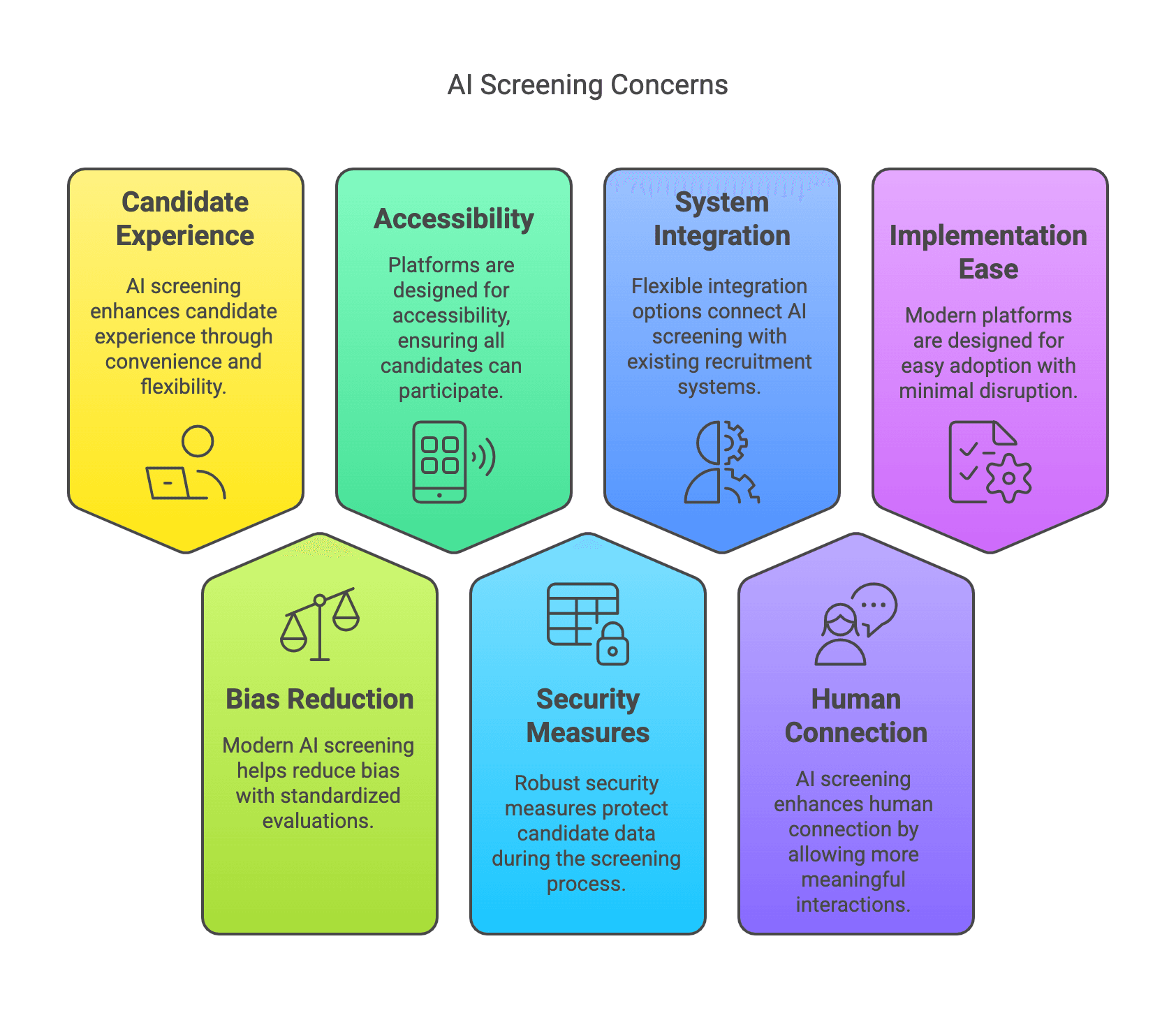
Concern #1: Impact on Candidate Experience
The Concern: Many organizations worry that AI screening might create an impersonal experience that alienates top candidates.
The Reality: When implemented thoughtfully, AI screening actually enhances the candidate experience through:
- Convenience and flexibility: Candidates interview on their own schedule
- Reduced stress: Time to prepare and present their best selves
- Multiple response attempts: Opportunity to refine and improve answers
- Faster process: Quicker feedback and decisions
- Consistent evaluation: Fair assessment for all candidates
"Our candidates consistently rate our AI screening process higher than traditional phone screenings," explains Frank Kjerstein, CEO of Reblade. "The flexibility to complete interviews at their convenience and the ability to retry responses have been particularly well-received."
How Hirevire Addresses This:
- No login required for candidates
- Unlimited response attempts
- Mobile-friendly interface
- Custom branded experience
- Clear, concise instructions
Concern #2: Bias in AI Assessment
The Concern: There's legitimate concern that AI might perpetuate or even amplify existing biases in the hiring process.
The Reality: Modern AI screening platforms actually help reduce bias through:
- Standardized questions: All candidates answer identical questions
- Consistent evaluation: Same criteria applied to all applicants
- Structured assessment: Reducing influence of subjective impressions
- Multiple reviewer input: Diverse perspectives in evaluation
- Focus on relevant criteria: Emphasis on job-specific qualifications
"We've seen significant improvements in diversity since implementing AI screening," notes Jennifer Martinez, Director of People Operations at Midwest Manufacturing Solutions. "By focusing evaluations on standardized criteria rather than initial impressions, we've created a more equitable process."
How Hirevire Addresses This:
- Structured question templates
- Standardized evaluation criteria
- Team-based review capabilities
- Consistent assessment frameworks
- Focus on job-relevant responses
Concern #3: Technical Barriers for Candidates
The Concern: Organizations worry that technical requirements might create barriers for candidates without advanced technology or skills.
The Reality: Modern platforms are designed for accessibility:
- Browser-based interfaces: No software installation required
- Mobile compatibility: Interview from any smartphone or tablet
- Minimal bandwidth requirements: Optimized for various connection speeds
- Simple, intuitive interfaces: No technical expertise needed
- Practice opportunities: Familiarization before recorded responses
Curran Van Waarde, Founder of CelebStar.com, shares his experience: "We were concerned about technical barriers, but found that Hirevire's platform was remarkably accessible. We've had candidates successfully complete interviews from a wide range of devices and locations."
How Hirevire Addresses This:
- Works on any device with a browser
- No app downloads required
- No login creation necessary
- Simple, intuitive interface
- Low bandwidth optimization
Concern #4: Security and Privacy
The Concern: Organizations have legitimate concerns about the security and privacy implications of collecting and storing video interview data.
The Reality: Reputable AI screening platforms implement robust security measures:
- Data encryption: Both in transit and at rest
- Compliance frameworks: GDPR, CCPA, and other privacy regulations
- Access controls: Restricted permissions based on roles
- Data retention policies: Appropriate storage limitation
- Transparent policies: Clear information for candidates
"Security was a primary consideration in our platform selection," explains Yusuf Mansur Özer from Grape Law Firm. "Hirevire's approach to data protection gave us confidence that we were maintaining appropriate privacy standards."
How Hirevire Addresses This:
- Comprehensive security architecture
- Regular security audits
- Clear data usage policies
- Appropriate access controls
- Compliance with privacy regulations
Concern #5: Integration with Existing Systems
The Concern: Organizations worry about how AI screening will connect with their existing recruitment infrastructure.
The Reality: Modern platforms offer flexible integration options:
- ATS compatibility: Direct connections to major applicant tracking systems
- API access: Custom integration capabilities
- Middleware support: Integration platforms like Zapier and Make
- Webhook functionality: Event-triggered workflows
- Import/export capabilities: Data portability between systems
Kyle David, President and CEO of KDG, emphasizes this benefit: "Through Zapier, we were able to connect Hirevire to our existing systems without any custom development. All around one of the best things we've bought on AppSumo in years!"
How Hirevire Addresses This:
- Zapier integration (5000+ apps)
- Make/Integrately integration (2000+ apps)
- Webhook functionality
- Custom domain support
- API access
Concern #6: Loss of Human Connection
The Concern: Many organizations fear losing the human element in the screening process.
The Reality: AI screening enhances rather than replaces human connection:
- More focused human interaction: Time saved on administration allows for meaningful conversations
- Personalized introduction videos: Human touch at the beginning of the process
- Customized communication: Tailored messaging throughout the candidate journey
- Better-prepared live interviews: More informed discussions based on screening insights
- Improved final selection: More time for cultural fit and team integration
"We actually have more meaningful human interactions now," notes Lucas Pate, CEO at Element 99 Web Services. "By eliminating routine screening calls, our team can focus their human engagement on deeper conversations with promising candidates."
How Hirevire Addresses This:
- Custom intro/outro videos
- Personalized communication templates
- Team collaboration features
- Emphasis on augmenting rather than replacing human judgment
Concern #7: Implementation Complexity
The Concern: Organizations worry that implementing AI screening will be disruptive and resource-intensive.
The Reality: Modern platforms are designed for easy adoption:
- Intuitive interfaces: Minimal training required
- Rapid setup: Implementation in days, not months
- Guided onboarding: Step-by-step implementation support
- Phased adoption: Start small and scale gradually
- Templates and best practices: Pre-built resources to accelerate adoption
"Implementation was remarkably straightforward," shares Rob Hampton, Founder of Coda Music Technologies. "We were fully operational within two weeks of deciding to move forward, with minimal disruption to our ongoing recruitment efforts."
How Hirevire Addresses This:
- Intuitive user interface
- Comprehensive onboarding resources
- Template library for common roles
- Responsive support team
- Phased implementation guidance
By proactively addressing these common concerns, organizations can move forward confidently with AI screening implementation, knowing that solutions exist for potential challenges. The thoughtful design of platforms like Hirevire ensures that the transition enhances rather than compromises the recruitment experience for both candidates and hiring teams.
Future of AI in Recruitment: What's Next?
As AI interview screening becomes a standard part of efficient recruitment processes, forward-thinking organizations are already looking toward the next wave of innovations. Understanding these emerging trends helps companies prepare for the future recruitment landscape and maintain a competitive edge in talent acquisition.
Emerging Trends in AI Recruitment
Several key developments are shaping the next generation of recruitment technology:
1. Advanced Natural Language Processing
The evolution of NLP is creating more sophisticated candidate assessment capabilities:
- Deeper semantic understanding: Moving beyond keywords to comprehend context and meaning
- Sentiment analysis refinement: More accurate assessment of enthusiasm and engagement
- Cultural nuance recognition: Better understanding of communication across diverse backgrounds
- Personality insights: Identifying traits and tendencies from communication patterns
- Improved multilingual capabilities: More accurate translation and assessment across languages
"The advances in language processing will transform how we evaluate communication skills," predicts Sarah Chen, HR Manager at GrowthTech Solutions. "We'll gain much deeper insights into how candidates think and express themselves."
2. Predictive Analytics Evolution
AI recruitment is moving from descriptive to predictive capabilities:
- Success prediction: More accurate forecasting of candidate performance
- Team compatibility analysis: Assessing fit within specific team dynamics
- Retention modeling: Identifying candidates likely to remain long-term
- Skills evolution mapping: Predicting candidate development potential
- Role-success pattern recognition: Understanding subtle factors in high performers
3. Immersive Assessment Technologies
Virtual and augmented reality are creating new assessment possibilities:
- Simulation-based evaluation: Assessing skills in virtual work scenarios
- Interactive assessments: Dynamic problem-solving in realistic environments
- Virtual workplace tours: Immersive candidate introduction to company culture
- Spatial skills assessment: Evaluation of capabilities not captured in traditional interviews
- Remote collaboration simulation: Testing teamwork in virtual environments
4. Enhanced Candidate Experience
The candidate journey continues to evolve with new engagement approaches:
- Hyper-personalization: Tailored experience based on candidate profile and preferences
- Conversational interfaces: More natural interaction with screening platforms
- Real-time feedback: Immediate insights during the application process
- Gamified elements: Engaging assessment experiences that reduce stress
- Transparent AI: Clearer communication about how technology is used in decisions
Key Takeaways
Let's summarize the five ways AI interview screening transforms the recruitment timeline:
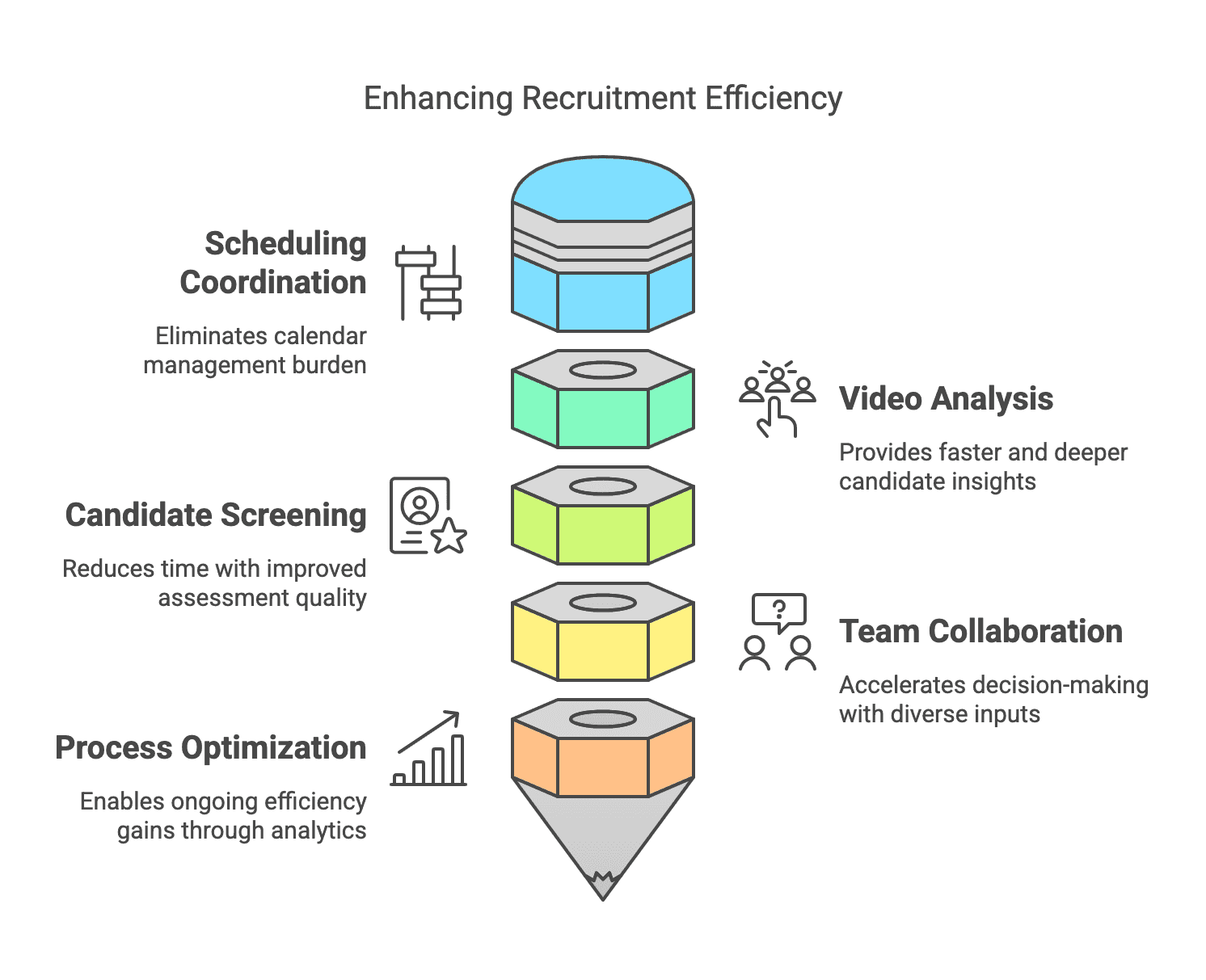
- Elimination of scheduling coordination: Asynchronous interviews remove the administrative burden of calendar coordination, saving 96% of time previously spent on scheduling.
- AI-powered video analysis and assessment: Sophisticated evaluation of candidate responses enables 85% faster review while providing deeper insights into capabilities and fit.
- Automated initial candidate screening: Structured, consistent evaluation creates 75% reduction in initial screening time with improved assessment quality.
- Enhanced team collaboration: Streamlined sharing and feedback collection accelerates decision-making by 65% while incorporating more diverse perspectives.
- Data-driven insights and process optimization: Comprehensive analytics enable continuous improvement, creating 25-35% ongoing efficiency gains beyond initial implementation.
The compounding effect of these improvements consistently delivers the 50% reduction in overall time-to-hire that organizations seek.
The Path Forward
For organizations ready to transform their recruitment process, the implementation path is clear:
- Assessment: Document your current process and establish baseline metrics
- Selection: Evaluate platforms with your specific needs in mind
- Implementation: Begin with a focused pilot to validate results
- Expansion: Extend to all appropriate roles after initial success
- Optimization: Leverage analytics for continuous improvement
The phased approach minimizes risk while accelerating time-to-value, typically delivering measurable results within the first month of implementation.
Final Thoughts
The recruitment landscape has fundamentally changed. Organizations still relying on traditional, manual screening processes face an increasingly untenable competitive disadvantage in the talent marketplace.
By implementing AI interview screening, your organization can join the growing ranks of forward-thinking companies achieving the dual benefits of dramatically reduced time-to-hire and improved candidate quality.
The question is no longer whether to adopt AI interview screening, but how quickly you can implement it to gain these advantages for your organization.
Frequently Asked Questions
As organizations explore AI interview screening solutions, several common questions arise. Here are straightforward answers to the most frequently asked questions about implementing this technology in your recruitment process.
What is AI interview screening?
AI interview screening is a technology that uses artificial intelligence to automate and enhance the candidate evaluation process. It typically includes capabilities such as:
- Asynchronous video interviews
- Automated candidate assessment
- Standardized evaluation frameworks
- Team collaboration tools
- Analytics and reporting features
Modern platforms like Hirevire combine these capabilities in an intuitive interface that dramatically reduces time-to-hire while improving candidate quality.
How does AI reduce bias in the hiring process?
AI screening helps reduce bias through several mechanisms:
- Standardized questions: All candidates respond to identical questions
- Consistent evaluation: Same criteria applied to everyone
- Structured assessment: Reducing reliance on subjective impressions
- Multiple reviewer capability: Incorporating diverse perspectives
- Focus on relevant criteria: Emphasis on job-specific qualifications
Research indicates that AI screening can effectively reduce bias by up to 40% when implemented properly, creating a more equitable recruitment process.
Can AI interview screening work for all types of roles?
While AI screening is applicable to most positions, its effectiveness varies by role type:
- High-Volume Roles: Extremely effective for roles with standardized requirements
- Technical Positions: Very effective when combined with skill assessment
- Management Roles: Effective for initial screening, especially communication skills
- Creative Positions: Effective when using multi-format responses (video, portfolio, etc.)
- Executive Positions: Supplemental tool alongside more high-touch processes
"We've successfully applied AI screening across almost all departments," notes Jennifer Martinez from Midwest Manufacturing. "We simply adjust the question design and evaluation criteria based on role requirements."
How long does it take to implement AI interview screening?
Implementation timelines vary by organization size and complexity:
- Small organizations (10-50 employees): 1-2 weeks typically
- Mid-sized companies (51-200 employees): 2-3 weeks for full implementation
- Larger enterprises (201+ employees): 3-6 weeks for comprehensive rollout
Most organizations can implement a successful pilot within the first week, allowing for validation of results before full-scale deployment.
How does Hirevire's AI screening compare to other solutions?
Hirevire differentiates itself from competitors in several key ways:
Feature
Hirevire
Typical Competitors
Starting price
$39/month
$70-149/month
Candidate login
Not required
Often required
Response limits
300-12,000 interviews/year by plan
Typically capped
Language support
90+ languages
Limited options
Implementation
Hours/days
Weeks/months
Integration
7000+ apps via Zapier/Make
Limited options
"We evaluated several platforms before choosing Hirevire," explains Lucas Pate, CEO at Element 99 Web Services. "The combination of affordability, features, and ease of implementation made it the clear choice."
Will candidates find AI screening impersonal?
Contrary to common concerns, well-implemented AI screening often improves the candidate experience:
- 76% of candidates prefer the flexibility of asynchronous interviews
- 82% appreciate the opportunity to present their best selves
- 68% report less stress compared to live screening calls
- 91% value the faster response and decision times
The key is thoughtful implementation with clear communication about the process and purpose.
What technical requirements do candidates need?
Modern AI screening platforms like Hirevire have minimal technical requirements:
- Device: Any smartphone, tablet, or computer with a camera
- Browser: Any modern web browser
- Connection: Basic internet connection (1 Mbps+)
- Skills: Basic digital literacy only
No special software installations or technical expertise is required, making the process accessible to virtually all candidates.
How secure is candidate data in AI screening platforms?
Reputable platforms implement comprehensive security measures:
- Encryption: Both in transit and at rest
- Access controls: Role-based permissions
- Compliance: GDPR, CCPA, and other privacy regulations
- Data retention: Appropriate limitations and policies
- Transparency: Clear information for candidates
When selecting a platform, verify their security certifications and data handling practices.
Can AI screening integrate with our existing ATS?
Most modern AI screening platforms offer multiple integration options:
- Direct integration with popular ATS platforms
- API connections for custom integration
- Middleware platforms like Zapier and Make
- Webhook functionality for event-driven workflows
- Manual export/import capabilities
Hirevire specifically offers integration with 7000+ applications through Zapier and Make, ensuring compatibility with virtually any existing recruitment tech stack.
What ROI can we expect from implementing AI screening?
While results vary by organization, typical ROI includes:
- 50-60% reduction in time-to-hire
- 60-70% decrease in direct recruitment costs
- 15-25% improvement in quality of hire
- 30-40% increase in recruiter productivity
- 3000-4000% first-year ROI on platform investment
These returns typically begin materializing within the first month of implementation, with full benefits realized within 2-3 months.
How will AI screening affect our recruitment team?
Rather than replacing recruiters, AI screening transforms their role:
- Less time on administrative tasks
- More focus on high-value candidate interactions
- Enhanced ability to identify quality candidates
- Greater capacity to support hiring managers
- More strategic contribution to talent acquisition
"Our recruiters have become much more strategic partners," shares Rob Hampton, Founder of Coda Music Technologies. "Instead of drowning in scheduling and basic screening, they're now focused on candidate experience and finding the perfect match."
By understanding these common questions and their answers, organizations can move forward confidently with AI interview screening implementation, knowing what to expect and how to maximize their results.