Paradox.ai Review 2026: Pricing, Reviews & Alternatives
Last updated: 7 October 2026. Review scores, pricing figures and ownership details were checked against G2, Capterra and Workday's SEC filing on 7 October 2026. Alternative tool screenshots captured 25 August 2026.
Paradox.ai is a legitimate, well reviewed hiring platform built for enterprises that hire hourly workers at volume. It holds 4.5 out of 5 from 94 reviews on G2, starts at $1,000 a month on its Capterra listing, and publishes no price list. Paradox is the company behind Olivia, the AI assistant that texts candidates about jobs at McDonald's, Chipotle and General Motors, and Workday has owned it since 1 October 2025 after paying about $1.1 billion.
Two kinds of people search for Paradox.ai, and this page answers both. If you got a text from Olivia and want to know whether it is real before you hand over your phone number, skip to Is Paradox.ai legit. If you are evaluating it as a buyer, the pricing, review scores, and alternatives sections below have the numbers.
Key takeaways
| Tool | Best for | Key strength |
|---|---|---|
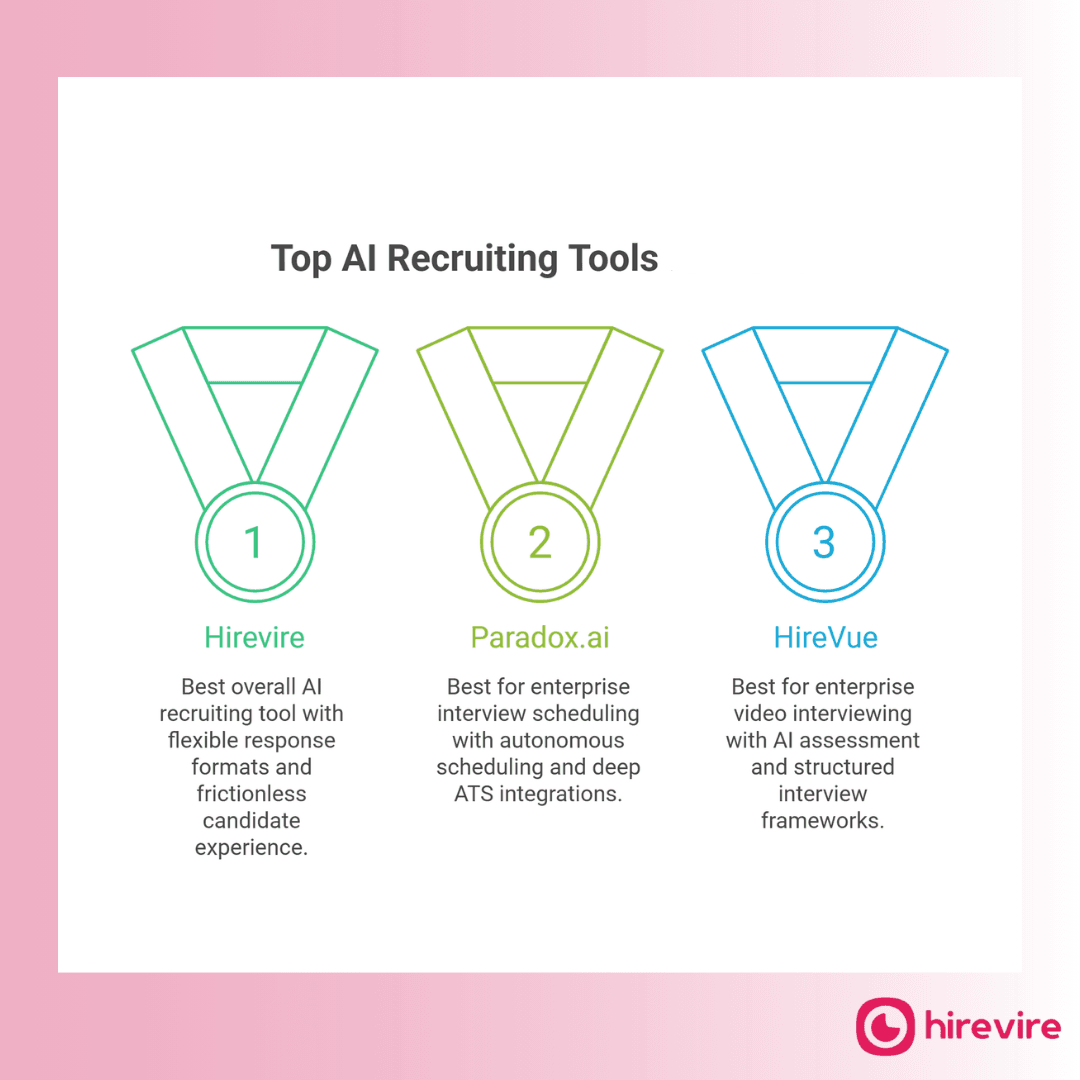
| Paradox.ai (Olivia) | Enterprises hiring 10,000+ hourly workers a year | Autonomous SMS scheduling at a scale nothing else matches |
| Hirevire | Teams of 1 to 50 hiring for skilled and professional roles | Published pricing from $39/month, candidates answer without an account |
| HireVue | Enterprises standardising structured video interviews | Assessment science and compliance documentation |
| Willo | SMBs wanting plain async video with no sales call | Free tier, browser based, no candidate download |
The short version: Paradox.ai is legitimate, well reviewed by the enterprises that can afford it, and priced from about $1,000 per month on its Capterra listing, with no published price list. The larger annual figures quoted around the web have no traceable source (see the Paradox AI pricing breakdown). If you hire in the hundreds rather than the tens of thousands, the cost and the implementation timeline are the two things that will rule it out.
Is Paradox.ai legit?
Yes. Paradox is a real company, founded in 2016, and since 1 October 2025 it has been a wholly owned part of Workday, the payroll and HR software company used by about half the Fortune 500. Workday paid about $1.1 billion for it, $1.0 billion of that in cash.
Three things you can verify yourself in under a minute:
- The acquisition is announced on Workday's own investor newsroom and was reported by HR Dive and Staffing Industry Analysts in August 2025.
- Paradox publishes named customer results on its site, including 7-Eleven at 40,000 hours saved per week and Compass Group hiring 120,000 workers a year with a 20 person team.
- It has 59 verified business reviews on G2 and 8 on Capterra, both under the company's real name.
Paradox says Olivia schedules around 32 million interviews a year, which is close to one in ten of all job interviews booked in the United States. If you applied for an hourly job at a large chain in the last year, you have probably already talked to it.
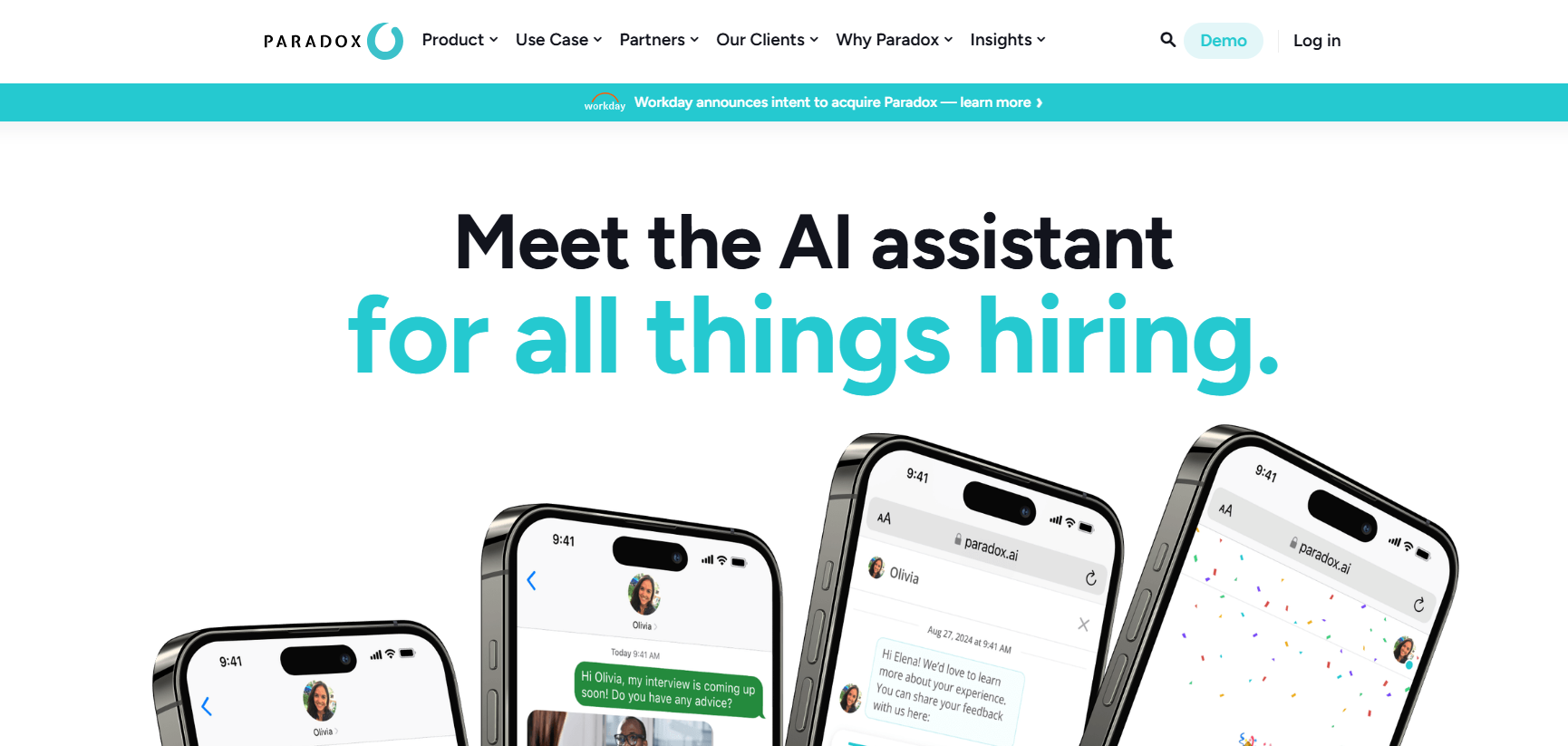
Paradox's own site carried the Workday acquisition banner. Note the paradox.ai address bar in the message mockups, which is what a genuine Olivia link looks like.
Which employers use Olivia?
The full list of 30 employers, and the commonly searched names Paradox has not confirmed, is in Which companies use Paradox AI.
If you received a text, it most likely came from a large employer hiring for hourly or frontline roles. Paradox names these customers publicly on its own site and in its press materials:
- Retail, grocery and restaurants: McDonald's, Chipotle, Wendy's, Outback Steakhouse, Lowe's, 7-Eleven, Ace Hardware, Tractor Supply, Compass Group, Aramark
- Healthcare: Houston Methodist, Essentia Health, CVS Health
- Manufacturing and corporate: General Motors, Nestlé, Unilever, Procter & Gamble, Intel
Staffing and merchandising agencies also run Olivia on behalf of the brands they hire for, which is why the employer named in your text may not be the company you would actually work at. If your employer is not on this list, search their name alongside "Olivia" or check their official careers page, since Paradox does not publish a full customer list.
Is Paradox.ai legit for jobs, or is the text I got a scam?
The platform is legitimate, but the text you received might not be, and those are separate questions. Scammers copy recruiting messages precisely because tools like Olivia have made automated hiring texts normal, so a real looking SMS about a job is no longer evidence of anything on its own.
Check the message against these four things before you reply:
- Real Olivia links sit on the employer's own careers domain or on a
paradox.aisubdomain. If the link goes to a shortened URL or a lookalike domain with an extra hyphen, stop. - Olivia asks about availability, work eligibility, and shift preferences. It does not ask for your bank details, your national insurance or social security number, or a payment for training or equipment.
- You should be able to find the same job on the company's official careers page. Go there directly by typing the company name into a search engine, not by following the link in the text.
- A real employer will not push you to move the conversation to Telegram, WhatsApp, or a personal Gmail address.
If any of those fail, treat it as a phishing attempt regardless of how polished the chat feels. Reporting it to the company whose name is being used is worth the two minutes.
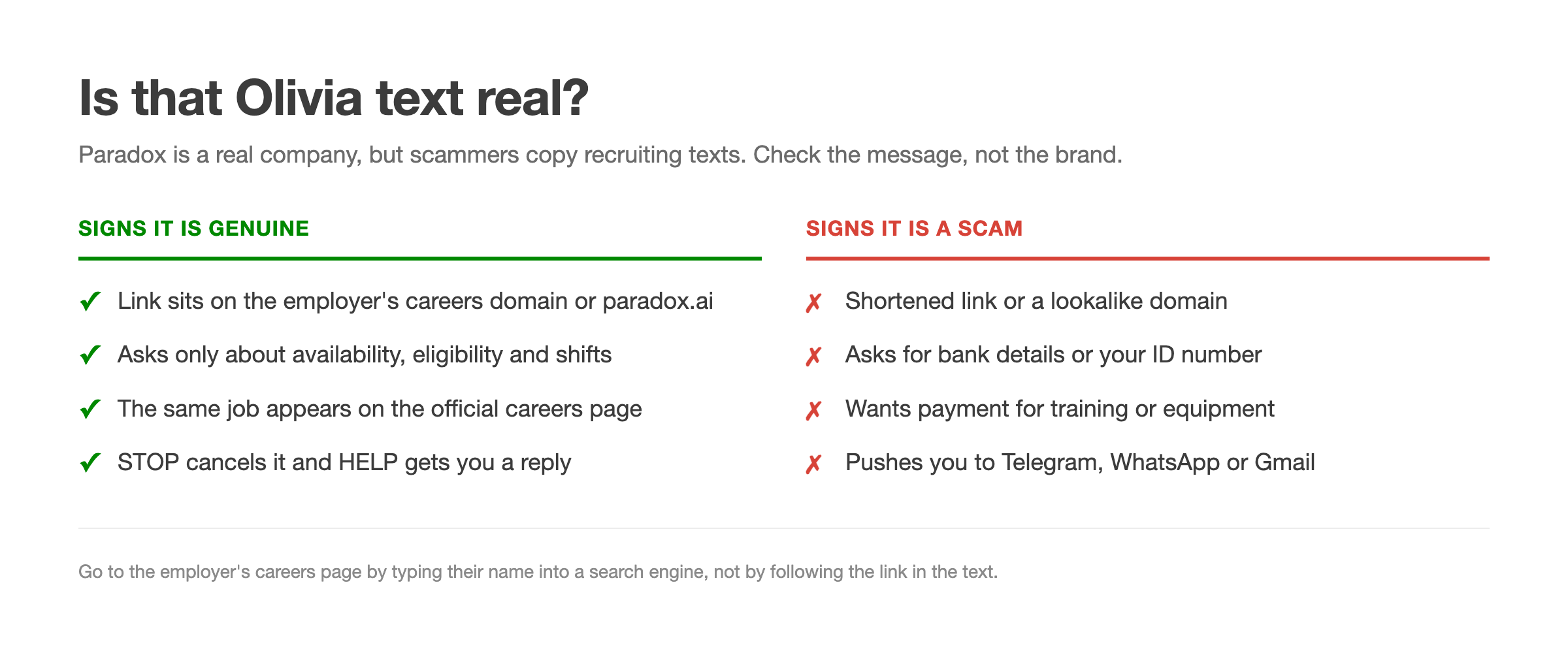
Check the message rather than the brand name. A real Paradox text still tells you nothing about who sent it.
What is [email protected]?
It is the help address Paradox includes in the SMS opt-in notice employers use when they invite candidates to apply or interview by text. If you can see it in a message, that message went through Paradox's platform rather than someone's personal phone.
The notice follows the same pattern across employers: a keyword and shortcode to opt in (Outback Steakhouse uses HIREME to 30437), then HELP for assistance or the [email protected] address, a note that message and data rates apply and frequency varies, and STOP to cancel.
Two things worth knowing:
- Paradox's own terms of use point candidates at [email protected], so you may see either address depending on whether you are reading the SMS notice or the terms.
- Compliant opt-out wording is a reasonable signal, because scam texts rarely bother with it, but it is not proof on its own. Anyone can copy the wording. The four checks above still apply.
How do I stop Olivia texts from Paradox?
Reply STOP to the number that messaged you. That cancels messages from that shortcode, and you should get a single confirmation message back. If you want help rather than a cancellation, reply HELP to the same number or email [email protected].
Stopping one employer's shortcode does not opt you out of every employer running Paradox, since each uses its own number. If messages keep arriving after you have sent STOP, that is a strong sign the sender is not actually using Paradox's system, and worth treating as a scam.
Is Olivia a real person?
No. Olivia is the name Paradox gives its AI assistant, and it is disclosed as an assistant rather than presented as a human recruiter. It handles the scheduling and screening steps, then hands you to a person for the actual interview. Under Workday the product is now also sold as the Candidate Experience Agent, so you may see either name.
What is Paradox.ai?
Paradox.ai is recruiting software that replaces application forms and scheduling emails with a text conversation. Instead of filling in a form, a candidate answers a handful of questions over SMS, WhatsApp, or a chat widget on the careers site, and the assistant books the interview against a recruiter's live calendar.
It was built for what the industry calls high volume hourly hiring: restaurants, retail, warehouses, care homes, and call centres, where the same role is filled hundreds of times a year and speed matters more than depth of assessment. Tractor Supply reported a 58% drop in time to apply after deploying it, and Flynn Group says about 90% of its hiring process now runs without a recruiter touching it.
Who owns Paradox.ai?
Workday. The agreement was signed on 21 August 2025 and closed on 1 October 2025 for about $1.1 billion, $1.0 billion of it in cash. Paradox continues to sell to companies that do not use Workday, and it still integrates with iCIMS, SAP SuccessFactors, and Oracle HCM, but the roadmap now sits inside Workday's talent acquisition suite.
For buyers this matters in one practical way. Being owned by an enterprise vendor tends to push pricing and contract terms further towards enterprise norms, not away from them, so the odds of Paradox launching a self serve tier for small teams are lower now than they were in 2024.
What does Paradox.ai actually do?
The product is organised into named modules rather than one flat feature list:
- Conversational Apply and Conversational Career Sites, which handle the application itself
- Conversational Scheduling, the autonomous interview booking that most customers buy it for
- Applicant screening, which validates knockout criteria over chat or text
- Video interviewing, both recorded and live
- Conversational Events for hiring days, and Conversational CRM for talent pools
- Offer letters, onboarding paperwork, and post hire document collection
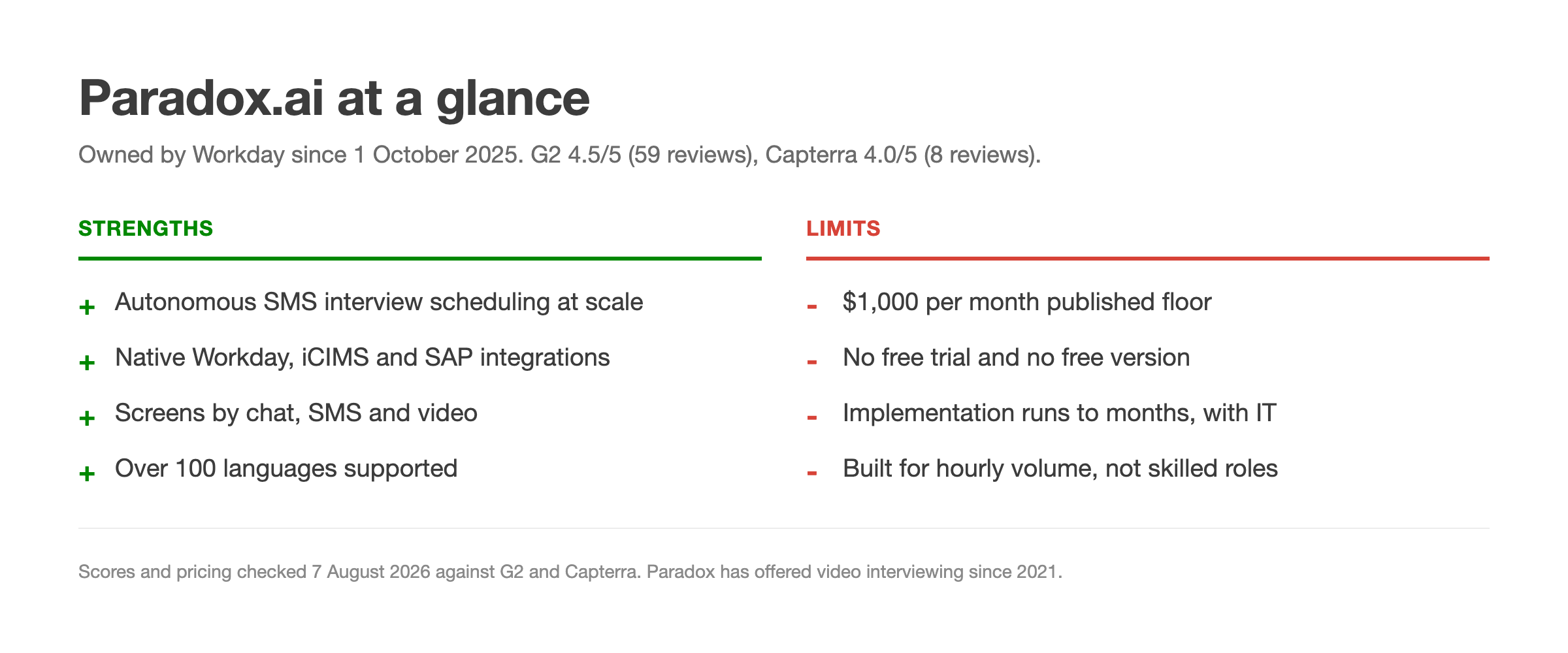
It supports over 100 languages and exposes more than 1,000 trackable metrics in its analytics.
One correction worth stating plainly, because several competitor comparisons online get it wrong: Paradox does support video interviews. It launched video in 2021 and still sells it. Reviews claiming the platform is text only are out of date.
Paradox.ai reviews: what G2 and Capterra actually say
Paradox holds 4.5 out of 5 from 94 reviews on G2 and 4.0 out of 5 from 8 reviews on Capterra, both checked on 7 October 2026. On Capterra the sub scores are ease of use 3.9, value for money 4.0, and customer service 4.1.
Those two numbers disagree for a reason worth understanding. G2's sample is larger and skews towards the enterprise talent acquisition leaders who chose the platform and ran the implementation. Capterra's smaller sample rates value for money at 4.0, which is the lowest of its three sub scores and lines up with the most common complaint in both sets: the platform works, and it costs a great deal.
What reviewers consistently praise:
- Scheduling automation that removes the back and forth entirely for high volume roles
- SMS reminders that measurably cut interview no shows
- Knockout screening that filters unqualified applicants before a recruiter sees them, the same job auto-disqualification rules do in async tools
What reviewers consistently raise as problems:
- Implementation timelines measured in months, with real IT involvement
- Configuration complexity once you move past the default workflows
- No published price, so budgeting requires a sales cycle first
Community discussion on forums and Reddit is thinner and mostly candidate side rather than buyer side, dominated by people asking the legitimacy question this page answers above. There is no aggregate community rating to cite, so treat G2 and Capterra as the two scores that exist.
Paradox.ai pricing in 2026
Paradox does not publish a price list. The one public figure is its Capterra listing, which shows a starting price of $1,000 per month ($12,000 a year), with no free trial and no free version. Everything above that entry point is negotiated.
Annual ranges of $30,000 to $95,000 and setup fees of $15,000 to $35,000 appear on many pricing pages, including earlier versions of this one. A check on 7 October 2026 found no contract, filing or Paradox document behind them, so treat them as unverified estimates. Every circulating figure, its source, and a three year cost comparison are in Paradox AI pricing 2026.
Paradox.ai pricing alternative: what the difference costs you
If Paradox's $1,000 per month floor is above your budget, here is the comparison with the numbers already worked out. Hirevire publishes its prices and bills annually or monthly with no implementation fee.
| Paradox.ai | Hirevire | |
|---|---|---|
| Entry price | $1,000/month ($12,000/year) | $39/month billed yearly ($468/year) |
| Mid tier | Not published | $99/month billed yearly ($1,188/year) |
| Top published tier | Not published | $199/month billed yearly ($2,388/year) |
| Setup fee | Not published | $0 |
| Free trial | None | 7 days, no card required |
Worked out against Paradox's published floor of $12,000 a year:
- Hirevire Essentials at $468 a year costs $11,532 less, a 96% reduction
- Hirevire Professional at $1,188 a year costs $10,812 less, a 90% reduction
- Hirevire Agency at $2,388 a year costs $9,612 less, an 80% reduction
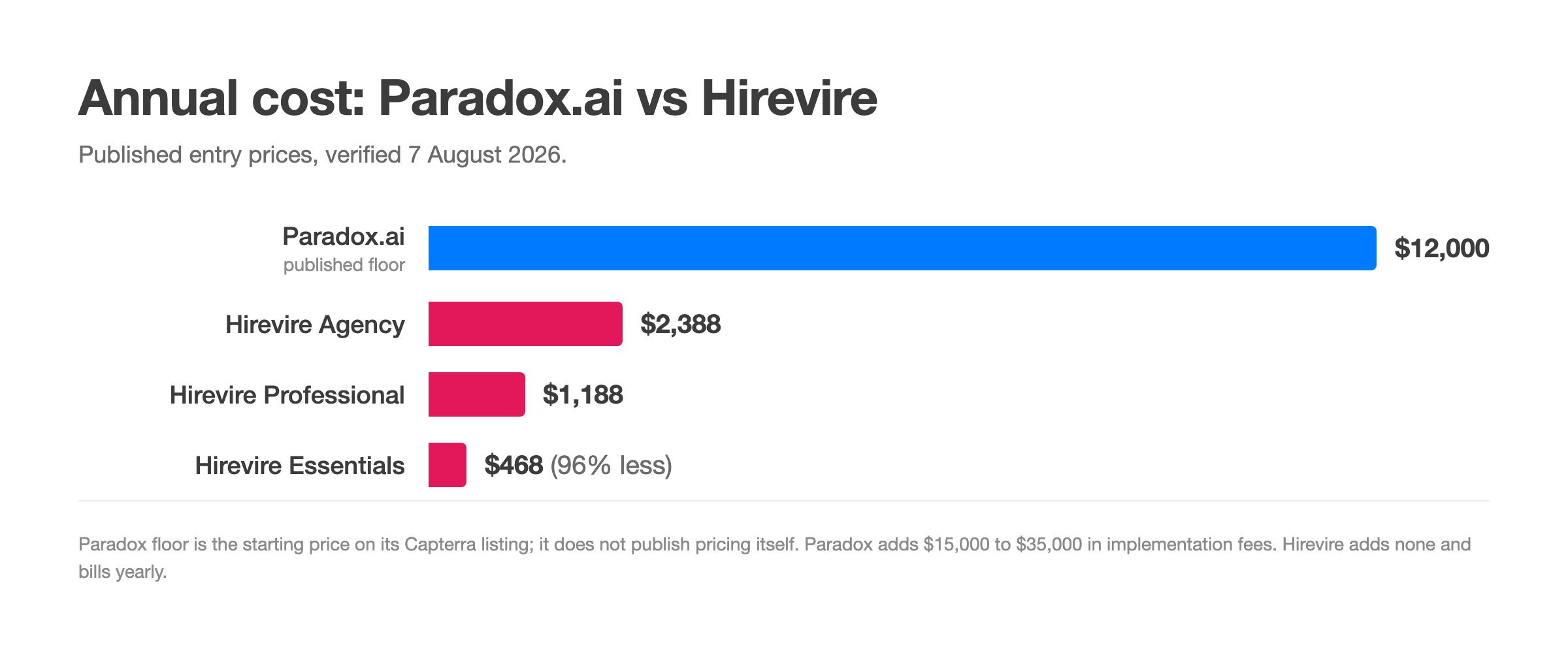
The honest caveat: these are not equivalent products at equivalent scale. Paradox's floor buys autonomous scheduling across hundreds of recruiter calendars and a Workday grade integration. If that is what you need, the money buys something real. The comparison matters when you are hiring for 5 or 20 roles and would be paying enterprise infrastructure prices for a fraction of the use.
Paradox scheduling tool: how the automation works
Conversational Scheduling is the module most Paradox customers name as the reason they bought it. The assistant reads recruiter and hiring manager availability from connected calendars, offers the candidate open slots over text, books the meeting, and handles reschedules without anyone from the talent team intervening.
The parts that make it work at scale:
- Live calendar sync with Google Calendar, Outlook, and enterprise calendar systems
- Automatic timezone detection, which matters for multi site and multi country hiring
- Interviewer pools, so any qualified interviewer can take the slot rather than one named person
- Candidate self service rescheduling over the same SMS thread
- Automated reminders ahead of the interview, which is where the no show reduction comes from
The trade off is configuration. Scheduling rules, interviewer pools, buffer times, and escalation paths all have to be defined before go live, and that setup work is a meaningful share of the implementation cost. Teams booking a few interviews a week rarely recover that investment.
The step by step walkthrough, including how it works with Workday and SAP SuccessFactors, is in Paradox interview scheduling.
Paradox.ai for university and graduate recruiting
Paradox handles campus and graduate hiring through Conversational Events, its hiring event module, rather than through a dedicated graduate product. For a university milk round the pattern is: the assistant collects student details at the careers fair or from a QR code, screens for graduation year and work eligibility, then books interview slots against the recruiting team's calendar for that campus.
It fits graduate recruiting reasonably well for the same reason it fits hourly hiring. Both involve many applicants for near identical roles, both are seasonal and time boxed, and both attract candidates who answer a text far faster than an email.
A quick disambiguation, because the search results mix these up: Paradox Interactive is the Swedish video game publisher behind Crusader Kings and Cities: Skylines. It is a different company with no connection to Paradox.ai. If you are researching a game studio's graduate scheme, this is the wrong page.
Paradox.ai competitors and alternatives
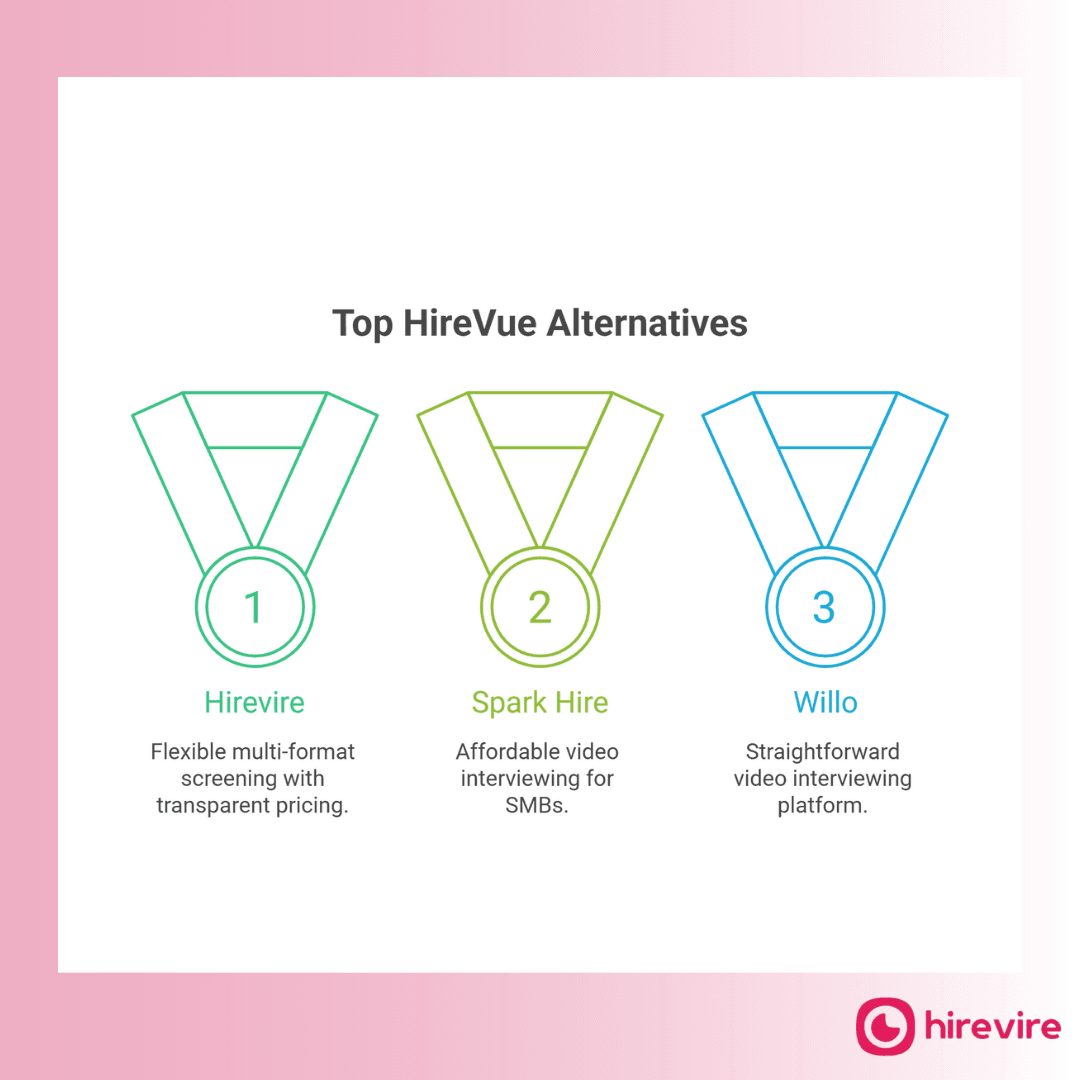
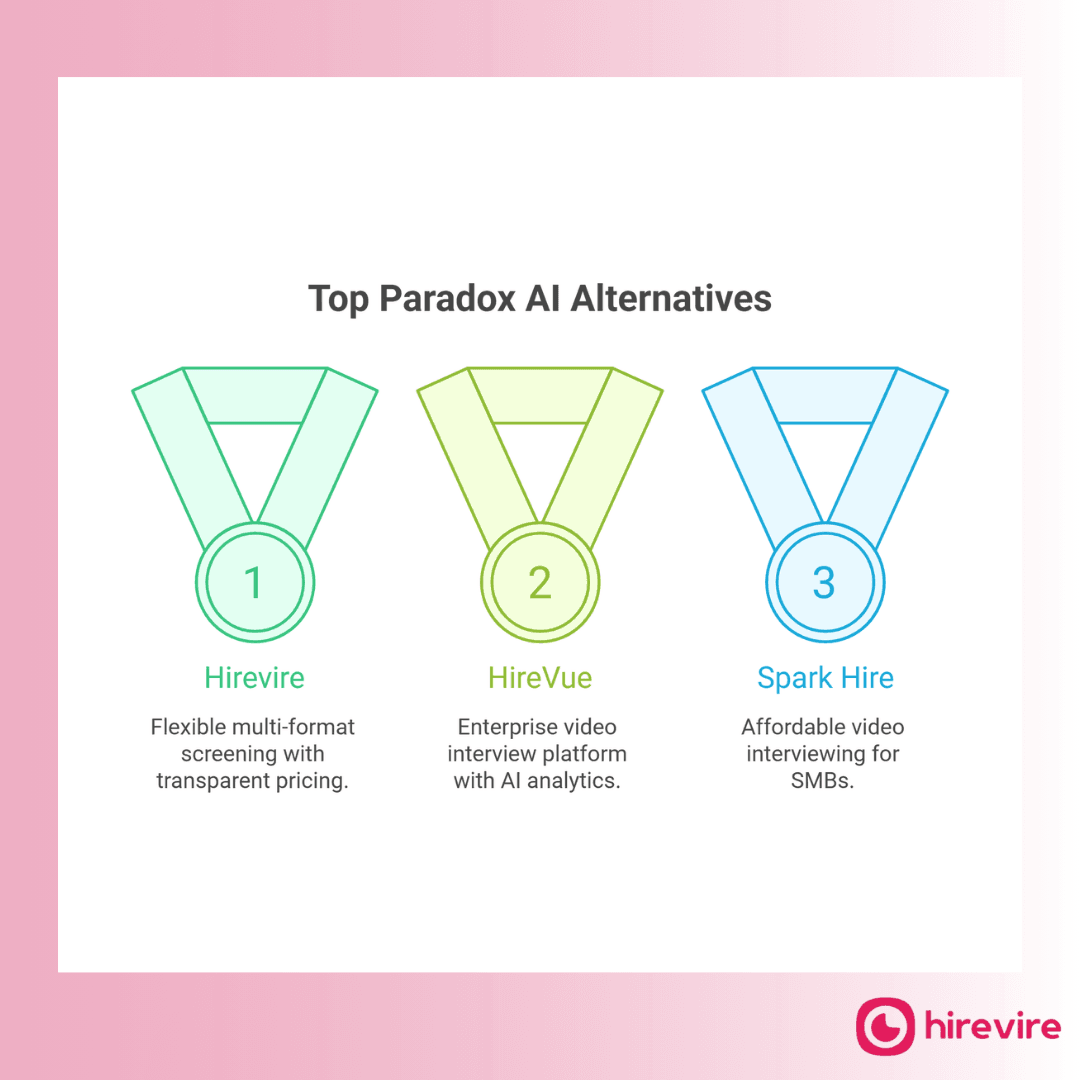
The right alternative depends on which job you want Paradox to do. For text-based hiring of hourly workers at volume, the closest replacements are Humanly, Sense and Talkpush. For recorded screening with a published price, Hirevire, Classet and Workable are the only three of twelve tools that list one. The full comparison is in 12 Paradox AI alternatives, ranked by published price, and Paradox vs HireVue covers that pairing on its own.
| Alternative | Starting price | Best for |
|---|---|---|
| Hirevire | $39/month billed yearly | Small teams and agencies that want recorded screening |
| Classet | $249/month billed annually | Hourly and trades operators |
| Workable | $299/month | Small and mid-size companies that want an ATS |
| Humanly | Quote only | Hourly and frontline hiring at volume |
| HireVue | Quote only | Enterprise assessments and campus hiring |
Hirevire, the lowest published price on the list
Hirevire is async video screening software. You write the questions, send candidates a link, and review their recorded answers when it suits you. Candidates answer in the browser with no account and no password, which is the single biggest difference in completion rate against tools that gate responses behind a login.
https://www.youtube.com/watch?v=vCSRJIQTExg
A walkthrough of setting up a screening interview and reviewing candidate responses, which is the workflow this section describes.
Where it differs from Paradox in practice:
- Candidates can answer by video, audio, text, or file upload on the same question set, which suits portfolio and code sample roles that a chat interview cannot assess
- AI scorecards and transcripts are included on every plan, including the $39 tier
- Setup takes minutes rather than months, with no IT involvement or integration project
- Transcription covers 90+ languages
- 7,000+ apps connect through Zapier, Make and Pabbly Connect, and webhooks connect it to anything else, your calendar tool and ATS included
- Hiring managers rate and comment on the same candidate without a seat, through shared review links and team collaboration
Paradox fits best where hiring runs by text message for frontline workers, across large interviewer pools, with a native Workday connection. Hirevire covers the screening step with SMS invites and connects onward through webhooks, Zapier and Make, so a candidate who passes can be booked in your calendar tool and updated in your ATS.
Who Paradox.ai is right for
Paradox is a strong choice if most of these describe you:
- You hire thousands of hourly or frontline workers a year across multiple locations
- Interview scheduling, not candidate assessment, is your actual bottleneck
- Your candidates respond to text messages and rarely open email
- You run Workday, iCIMS, SAP SuccessFactors, or Oracle HCM
- You have a recruiting operations function and IT capacity for a multi month implementation
- Your budget for hiring software starts in five figures a year
Look elsewhere if:
- You hire for tens of roles a year rather than thousands
- You need to see a price before you book a sales call
- Roles you fill require portfolios, code samples, or written work as part of screening
- You need to be live this month
- Nobody on your team can own a configuration project
For that second list, Hirevire covers the same screening job at $39 to $199 a month with setup measured in minutes. Start a 7 day free trial, no card required.
Related comparisons
- 12 Paradox AI alternatives, ranked by published price
- Paradox vs HireVue, chat scheduling against video assessment
- Paradox AI pricing in 2026, what the money buys
- HireVue review, pricing and alternatives, the other enterprise platform Paradox is most often shortlisted against
- HireEZ reviews, pricing and alternatives, for sourcing rather than scheduling
- Fetcher AI reviews, pricing and alternatives, outbound recruiting automation
- Best AI recruiting tools for 2026, the full category comparison
- Screening infrastructure, if you want screening embedded in your own product rather than a hosted tool
Frequently asked questions
What is Paradox.ai?
Paradox.ai is conversational recruiting software built around Olivia, an AI assistant that screens candidates and books interviews over SMS, WhatsApp, and web chat. It is designed for high volume hourly hiring and integrates with Workday, iCIMS, SAP SuccessFactors, and Oracle HCM. Workday acquired the company in a deal that closed on 1 October 2025.
Is Paradox.ai legit?
Yes. Paradox was founded in 2016 and has been owned by Workday since 1 October 2025, following an acquisition worth about $1.1 billion. It has 94 reviews on G2 rated 4.5 out of 5 and serves around 200 enterprise customers including McDonald's, Chipotle, and General Motors. Scam texts that imitate recruiting messages do exist, so verify any job link against the employer's official careers page before replying.
What is [email protected]?
It is the help address Paradox includes in the SMS opt-in notice employers use when inviting candidates to apply or interview by text. Seeing it means the message went through Paradox's platform rather than an individual's phone. Paradox's terms of use point candidates at [email protected] instead, so either address can appear. Compliant opt-out wording is a reasonable signal but not proof, since anyone can copy it.
How do I stop Olivia or Paradox text messages?
Reply STOP to the number that messaged you, and you should receive a single confirmation message. Reply HELP to the same number, or email [email protected], if you want assistance rather than a cancellation. Stopping one employer's shortcode does not opt you out of other employers using Paradox, because each runs its own number. Messages continuing after STOP suggest the sender is not really using Paradox.
Is the Olivia text message I received real?
Possibly, but verify it rather than assuming. Genuine Olivia links point at the employer's careers domain or a paradox.ai subdomain, and the assistant only asks about availability and eligibility. Any request for bank details, identity numbers, or payment for equipment is a scam, as is pressure to move the conversation to Telegram or WhatsApp. Search for the job on the company's official careers site instead of clicking the link.
How much does Paradox.ai cost in 2026?
Paradox does not publish a full price list. Its Capterra listing shows a starting price of $1,000 per month. Larger annual figures quoted online have no traceable source. There is no free trial or free version.
Is Paradox.ai free?
No. There is no free plan and no free trial. The lowest published entry point is $1,000 per month via its Capterra listing. For a screening tool with a published price and a free trial, Hirevire starts at $39 per month billed yearly with a 7 day trial and no card required.
Who owns Paradox.ai?
Workday. The agreement was signed on 21 August 2025 and closed on 1 October 2025 for about $1.1 billion, $1.0 billion of it in cash. Paradox still sells to and integrates with companies that do not run Workday, but its roadmap now sits within Workday's talent acquisition suite.
What are the best Paradox.ai alternatives?
For teams that need a published price and fast setup, Hirevire starts at $39 per month and supports video, audio, text, and file responses. HireVue suits enterprises focused on structured assessment, Spark Hire covers SMB video interviewing from $149 per month, Willo offers a free async video tier, and Workable is the option if you need a full applicant tracking system rather than a screening tool.
Does Paradox.ai support video interviews?
Yes. Paradox launched video interviewing in 2021 and offers both recorded and live formats alongside its chat and SMS screening. Comparisons describing Paradox as text only are out of date.
Does Paradox.ai integrate with Workday?
Yes, and the integration is closer than it was, since Workday now owns the company. Paradox for Workday delivers candidate communication over SMS directly from Workday. Native integrations with iCIMS, SAP SuccessFactors, and Oracle HCM remain in place.
Is Paradox Interactive the same company as Paradox.ai?
No. Paradox Interactive is a Swedish video game publisher known for Crusader Kings and Cities: Skylines. Paradox.ai is a recruiting software company owned by Workday. They share a name and nothing else.
How long does Paradox.ai take to implement?
Reviewers commonly describe implementations running from several weeks to several months, depending on ATS complexity and how many workflows need configuring. Scheduling rules, interviewer pools, and screening criteria all have to be defined before go live, which is why G2 reviewers report an average of 2 months to implement.
Verdict: is Paradox.ai worth it in 2026?
| Criterion | Our rating | Note |
|---|---|---|
| Scheduling automation | 5/5 | The best autonomous scheduling sold today |
| Candidate experience | 4/5 | Fast and mobile first, though chat suits hourly roles better than skilled ones |
| Feature breadth | 4/5 | Apply, screen, schedule, video, events, onboarding |
| Ease of implementation | 2/5 | Months, not weeks, with real IT involvement |
| Pricing transparency | 2/5 | One published figure, everything above it negotiated |
| Overall | 4/5 | Excellent at enterprise scale, hard to justify below it |
For the company it was built for, yes. If you are hiring 10,000 frontline workers a year across 300 locations and your recruiters spend their days rescheduling interviews, Paradox removes that work almost entirely, and the Workday acquisition makes it a safer long term bet rather than a riskier one. The review scores back this up: 4.5 on G2 across 94 reviews is a strong number for enterprise software.
The limits are about fit rather than quality. The $1,000 per month floor is the only published figure, implementation takes months, and the value for money sub score of 4.0 on Capterra is the softest number in either review set. None of that is damning. It just describes software priced and built for enterprises.
If you are hiring at a smaller scale and mainly need to screen candidates properly before booking anyone's time, Hirevire does that job for $39 to $199 a month, with AI scorecards and transcripts on every plan and candidates answering in the browser without creating an account. Setup takes minutes.
Try Hirevire free for 7 days. No credit card required.