The Risks of Over Automation in Your Hiring Process (and What to Keep Human)
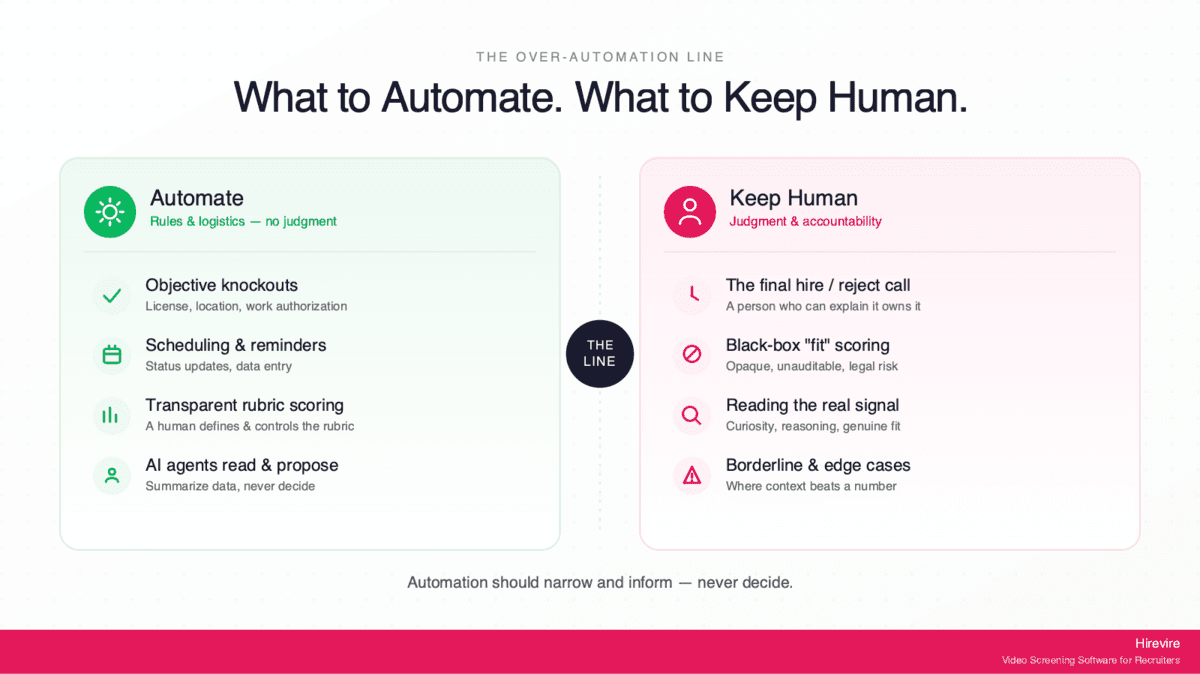
Over-automating hiring backfires when software starts making evaluative decisions it should not, screening out qualified people with opaque scoring and creating legal exposure under AI hiring laws. The fix is a clear line: automate objective knockouts and logistics, use transparent rubric-based scoring a human controls, and keep final decisions human. Hirevire's Auto-Disqualification filters only the must-haves you set, and its AI Scorecards score candidates against rubrics you define, never a black box.
The most common mistake in recruiting automation is not automating too little. It is automating the wrong things, then trusting the output. A tool that filters applicants by whether they hold a required license is doing useful, defensible work. A tool that assigns a candidate a "culture fit" score of 62 out of 100 from a video, with no explanation you can inspect, is doing something else entirely, and it is doing it on your legal liability.
This guide draws a line most automation pitches skip past. It covers where recruiting automation genuinely earns its place, the four costs that pile up when you push past that line, how to tell transparent scoring from opaque scoring (and why the difference is a compliance issue, not a preference), and a 5-minute audit you can run on your own funnel this week.
Quick Takeaways
| Hiring task | Automate or keep human | Why |
|---|---|---|
| Filtering on objective must-haves (license, location, work authorization) | Automate | Pass/fail criteria you set; no judgment involved |
| Scheduling, reminders, status updates, data entry | Automate | Pure logistics; humans add no value, only delay |
| Scoring open-ended answers against a defined rubric | Automate the scoring, human owns the rubric and reviews | Consistent and fast, but only defensible if the rubric is yours and visible |
| Ranking "culture fit" or personality from video with a hidden model | Keep human | Opaque, hard to validate, high disparate-impact risk |
| Final hire/reject decision | Keep human | A person must own the call and be able to explain it |
| Reading and summarizing candidate data for you (AI agents) | Automate reading, human decides | Agents should propose, not decide |
Why "Automate Everything" Is the Wrong Goal
The pitch for hiring automation almost always frames the human as the bottleneck. Recruiters are slow, inconsistent, and expensive, so the logic goes, and software is fast, consistent, and cheap. Push as much of the funnel onto the machine as possible and you win on every axis.
That logic holds right up until the machine starts making judgments instead of executing rules. There is a real and underappreciated difference between automating a rule and automating a decision.
A rule is something you can write down completely before any candidate applies. "Must hold a valid CDL." "Must be authorized to work in the US." "Must have at least three years in a clinical setting." These are pass/fail. A machine applying them is doing exactly what a human would do, only faster and without getting tired on the four-hundredth application. Automating rules is almost pure upside.
A decision is different. "Is this person a strong communicator?" "Will they fit our team?" "How good is this answer, really?" These require judgment, context, and the ability to weigh tradeoffs that you cannot fully specify in advance. When you hand a decision like that to a system whose reasoning you cannot see, you have not removed the judgment. You have hidden it inside software and stopped being able to inspect it.
The goal was never "maximum automation." The goal is a hiring process that is fast where speed is free and careful where care matters. Treating automation as the objective rather than the tool is how teams end up rejecting good candidates at scale and not finding out for months.
There is also a quieter cost. According to LinkedIn's Future of Recruiting research, recruiters spend a large share of their time on administrative work. That is exactly the work automation should absorb, freeing recruiters to spend judgment where judgment counts. Over-automation inverts this. It automates the judgment and leaves the human doing cleanup when the system gets it wrong.
The Four Costs of Over-Automating Hiring
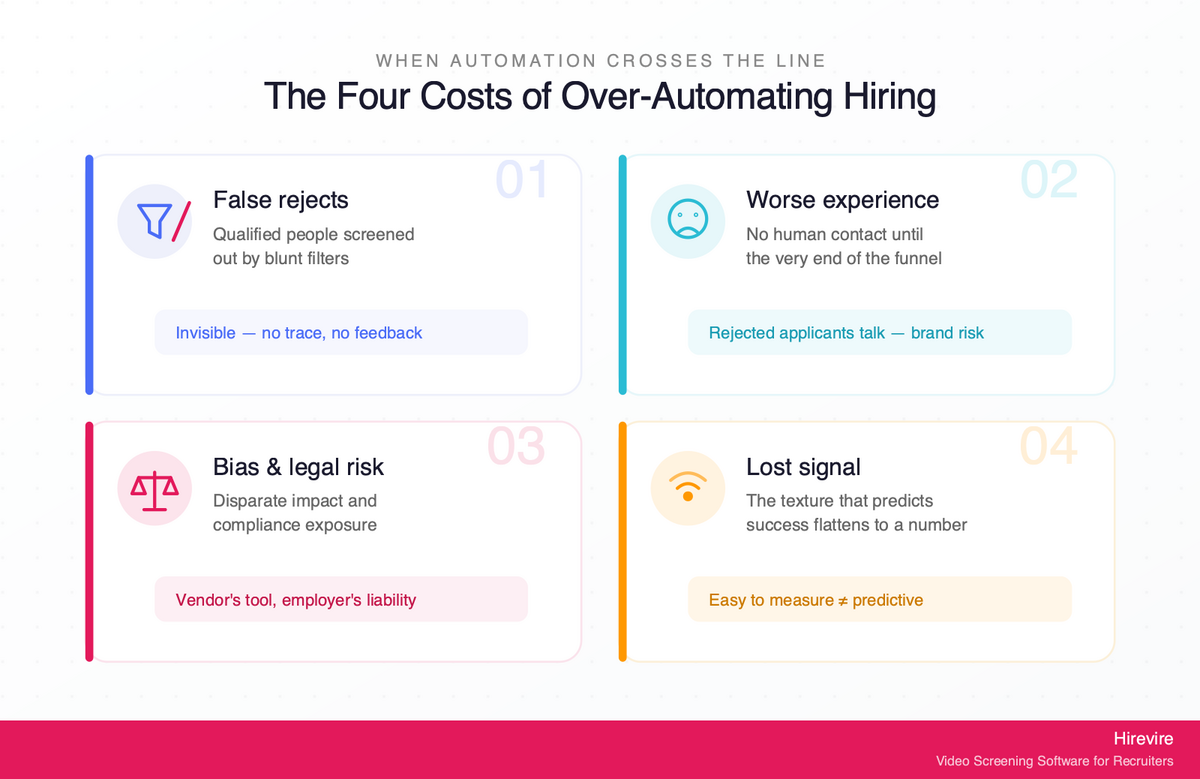
When automation crosses from rules into decisions, the damage is not theoretical. It shows up in four specific ways, and they compound.
Cost 1: Qualified Candidates Get Falsely Rejected
The most direct cost of over-automation is the false negative, a genuinely qualified person screened out by a rule that was too blunt or a model that scored them poorly for the wrong reason.
Keyword-matching resume filters are the classic offender. A candidate who wrote "managed a P&L" gets filtered out of a search for "budget responsibility," even though those describe the same experience. An applicant with a two-year gap for caregiving gets down-ranked by a model that learned, from historical data, that gaps correlate with weaker hires. The candidate never knows. The recruiter never knows. The role just takes longer to fill, and the team quietly concludes "there's no talent out there."
False rejects are expensive precisely because they are invisible. A bad hire announces itself within months. A good candidate you auto-rejected leaves no trace at all. You cannot manage what you never see, which is why over-automated funnels can underperform for a long time before anyone notices the leak.
Cost 2: Candidate Experience Degrades
Every additional automated gate is another place a real person can fall through for a machine reason. Candidates feel it. A funnel that never lets an applicant reach a human until the very end communicates, accurately, that the company sees hiring as a volume problem to be processed rather than people to be evaluated.
This matters beyond goodwill. Candidates who have a poor application experience tell others, decline to reapply, and in some cases stop buying from the company. The same talent market that makes automation tempting (too many applicants to handle manually) also makes reputation fragile (every rejected applicant is a potential reviewer). Automating the experience into something cold and unaccountable trades short-term throughput for long-term applicant flow.
Cost 3: Bias and Legal Exposure
This is the cost that turns a process problem into a compliance problem. When an automated system scores or ranks candidates and that scoring correlates with a protected characteristic, the result can be unlawful disparate impact, regardless of whether anyone intended to discriminate.
The EEOC's technical assistance on AI in employment selection is explicit that Title VII applies to software, algorithms, and AI used in selection procedures. Crucially, the guidance makes clear that relying on a vendor's tool does not move the liability off the employer. If the tool screens people out on a protected basis, the employer using it can be on the hook.
Regulators have started writing this into law. New York City's Local Law 144 requires employers using an automated employment decision tool to commission an independent annual bias audit and publish the results before using the tool to screen candidates. Other jurisdictions are following. An opaque scoring model you cannot explain is not just an ethics risk; it is increasingly a tool you may not be legally permitted to use without proof it does not discriminate, proof you cannot generate if you cannot see inside it.
Cost 4: You Lose the Signal You Were Hiring For
The last cost is subtle but real. Aggressive automation tends to flatten candidates into whatever the system can measure, and the things that are easy to measure are rarely the things that predict success.
A model optimizing for keyword density rewards resume-gaming over substance. A "culture fit" score trained on past hires rewards similarity to people you already employ, which is the opposite of what most teams say they want. The texture that an experienced recruiter picks up in a five-minute conversation (genuine curiosity, the way someone reasons through an ambiguous problem, whether their enthusiasm is real) is exactly the signal that disappears when you automate evaluation down to a number. You end up with a process that is efficient at selecting for the wrong things.
The Human-Judgment Line: A Framework for What to Automate
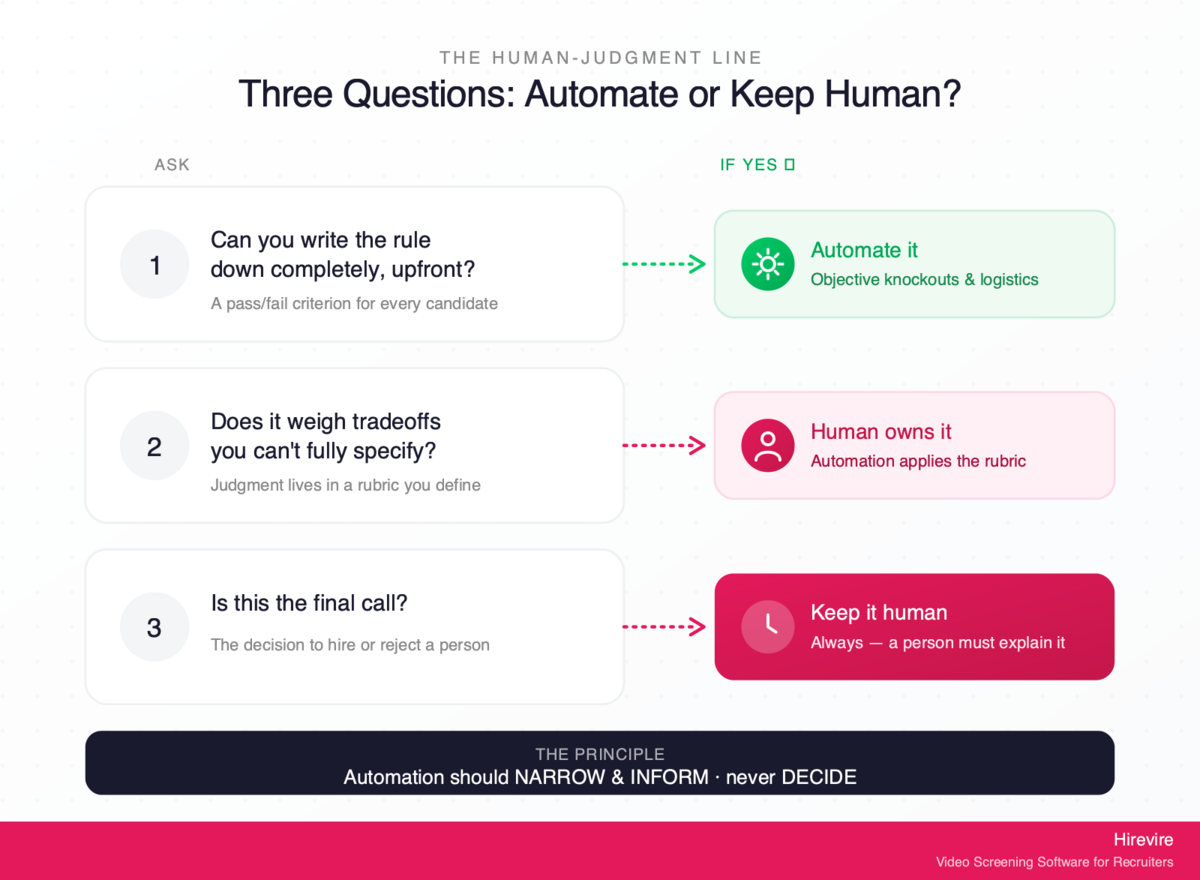
Drawing the line is simpler than the marketing makes it sound. Run every step of your process through three questions.
Question 1: Can I write the rule down completely, in advance, for every candidate?
If yes, automate it. License checks, location requirements, minimum years of experience, work authorization, required certifications. These are objective knockouts. There is no judgment to preserve, so automating them only removes drudgery. This is what Hirevire's Auto-Disqualification is built for: you define the must-have criteria, and applicants who do not meet them are filtered before they ever record a response, saving review time without anyone guessing.
Question 2: Does this step require weighing tradeoffs I cannot fully specify ahead of time?
If yes, a human has to own it, but automation can still assist. Scoring an open-ended answer is the clearest example. You cannot reduce "how good is this answer" to a rule, but you can define a rubric (what a strong answer contains, what a weak one lacks) and have a tool apply it consistently. The judgment lives in the rubric, which you wrote and can see. The automation handles the tedious part: applying it identically to every candidate without fatigue.
Question 3: Is this the final call?
If yes, keep it human, always. The decision to hire or reject a person should be made by a person who can explain it. Automation can rank, summarize, flag, and recommend right up to that point. It should not pull the trigger.
A useful way to hold the line: automation should narrow and inform, never decide. It is allowed to take a thousand applicants down to a reviewable shortlist and hand you everything you need to evaluate them well. The moment it starts making the evaluative call itself, you have crossed the line, and you should be able to say exactly where.
Transparent vs. Opaque Scoring (and Why It's a Compliance Issue)
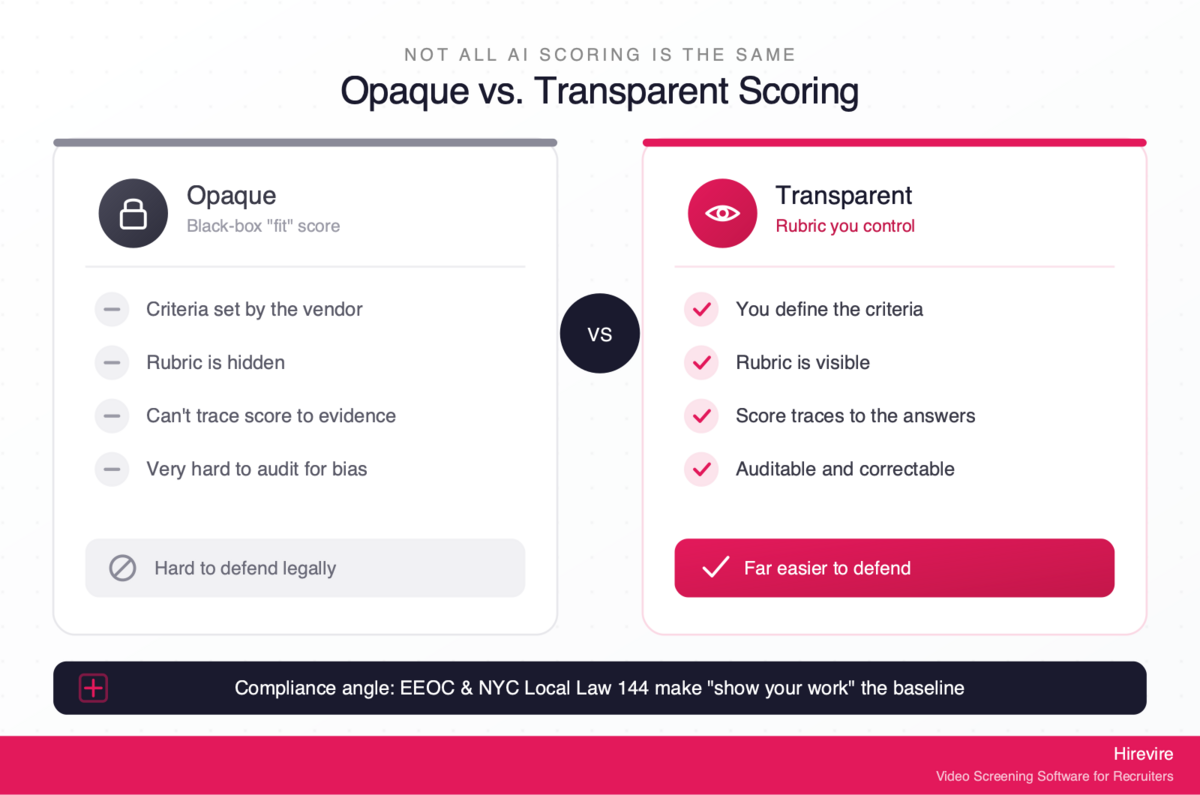
Not all automated scoring is the same, and the difference is not academic. It determines whether you can defend a decision when a regulator, a rejected candidate's lawyer, or your own leadership asks how it was made.
Opaque scoring produces a number or a ranking without an inspectable basis. The model weighs inputs you cannot see, against criteria you did not set, and outputs a "fit score" or a percentile. When someone asks why candidate A scored 71 and candidate B scored 48, the honest answer is "the model decided." You cannot audit it, you cannot correct it, and you cannot prove it does not discriminate.
Transparent scoring produces a score you can trace back to criteria a human defined. The rubric is visible. Each candidate's score connects to specific evidence in their answers. When someone asks why candidate A outscored candidate B, you can point to the rubric and the responses and show the reasoning. This is the difference between a defensible process and a liability.
Here is the comparison that matters:
| Property | Opaque scoring | Transparent rubric scoring |
|---|---|---|
| Who defines the criteria | The vendor's model | You, the hiring team |
| Can you see the rubric | No | Yes |
| Can you trace a score to evidence | No | Yes, to specific answers |
| Can you audit it for bias | Very difficult | Yes |
| Defensible under EEOC guidance | Hard to demonstrate | Far easier to demonstrate |
| What happens when it is wrong | You may never know | You can see and correct it |
This is exactly the design behind Hirevire's AI Scorecards. The hiring team defines the evaluation criteria, sets the weights, and uses clear 1-to-5 scoring levels. The AI then applies that human-created rubric consistently to every candidate, with feedback tied to the actual responses. The scoring is automated; the judgment, the rubric, stays yours and stays visible. That visibility is not a nice-to-have. Under the EEOC's guidance and laws like NYC's Local Law 144, being able to show how a tool reaches its scores is moving from best practice toward baseline requirement.
To be clear, the problem is not AI scoring as a category. The problem is the pattern of opaque, black-box scoring that no one in the company can explain. A transparent rubric a human controls solves for speed and consistency without inheriting the legal and ethical exposure of a hidden model.
Even AI Agents Need a Human in the Loop
The newest frontier in hiring automation is the AI agent, a system that can read across your hiring data, summarize it, and take actions. This is genuinely useful, and it is also where the "narrow and inform, never decide" principle gets its hardest test.
Done right, an agent reads and proposes. It can pull together a candidate's responses, transcripts, and scorecard, summarize the pipeline, and surface who is worth your attention next. What it should not do is quietly reject candidates or finalize a hire on its own.
Hirevire's MCP integration is built on exactly this model. It lets AI agents like Claude read and summarize your hiring data, candidate lists, interview transcripts, while the human keeps decision-making authority. Even where agents have write access to update statuses, they operate within your existing account permissions, and you can revoke that access. The agent is a research assistant that prepares the decision for you. It is not the decision-maker. That boundary is the whole point: the more capable automation gets, the more deliberately you have to preserve the human's role at the moment of judgment. MCP for recruiting shows that split across a 500-applicant screening run.
How to Automate Screening Without Removing the Human
The right way to use automation in screening is to let it do the volume work and hand a well-prepared shortlist to a person, with the reasoning attached. Hirevire was built around that division of labor, and it is worth walking through what a balanced setup actually looks like.
The funnel starts with objective knockouts. Auto-Disqualification filters on the must-haves you define (certifications, location, authorization, minimum experience), so applicants who genuinely cannot do the job never consume review time, and no human had to make a judgment call to remove them.
Candidates who clear that bar record asynchronous video, audio, or text responses to the questions you set, on their own schedule, with no login required. This is automation of logistics, the scheduling and collection that used to eat days, and it improves candidate experience rather than degrading it because applicants answer when it suits them.
Then transparent rubric scoring does the consistency work. AI Scorecards apply the rubric you wrote to every candidate, producing scores tied to evidence in the answers. This is the step that replaces fatigued, inconsistent manual review, but because the rubric is yours and the reasoning is visible, you are reviewing the AI's work, not deferring to it.
Finally, a human decides. Shared review links let your team watch responses, read the scorecard, add ratings and comments, and shortlist together. The tool has narrowed a thousand applicants to a handful and explained its reasoning. The actual hiring call belongs to the people who will work with the person.
Across thousands of recruiters, that balance is what shows up in the reviews. Hirevire holds 5/5 stars on Capterra (26 reviews) and 4.6/5 on G2 (30 reviews).
"It cuts down my hiring process by at least 75% and made it sooo much easier to see/feel who the candidates were before having to hop on a call with them."
— ElevateClients, AppSumo
"It's a time saver and is still very personalized for our candidates. 100% recommend it."
— Damien V., G2
Notice what those recruiters are describing: automation that gave them more contact with the human signal (seeing and hearing candidates earlier), not less. That is the test of automation done right. It should bring you closer to the people you are evaluating, not wall you off from them.
Ready to automate the busywork without handing over the judgment? Try Hirevire free and keep the final call where it belongs.
A 5-Minute Over-Automation Audit
You do not need a consultant to find out whether your process has crossed the line. Walk through these checks on your current funnel.
1. Find every step where software produces a score or ranking. For each one, ask: can I see the criteria, and can I explain a given score to a rejected candidate? If the answer is no, you have opaque scoring in your pipeline. Flag it.
2. Identify your false-reject blind spot. Pull a sample of recently auto-rejected applicants and have an experienced recruiter review them cold. If more than a handful look like people you should have talked to, your automation is rejecting on the wrong basis.
3. Trace the final decision. Is there a named human who owns each hire/reject call and can explain it? Or does the system effectively decide by ranking people below a cutoff no one reviews? If it is the latter, the machine is deciding.
4. Check your compliance footing. For any automated tool that scores or ranks candidates, can you produce evidence it does not create disparate impact? If you operate anywhere with AEDT rules like NYC's Local Law 144, have you run the required bias audit?
5. Measure the human contact point. At what stage does a candidate first reach a real person? If that point keeps moving later, your experience is degrading even if your throughput looks good.
Any "no" or "I'm not sure" is a place to pull a decision back across the line.
Frequently Asked Questions
What are the biggest risks of over-automating the hiring process?
The four main risks of recruiting automation overreliance are: falsely rejecting qualified candidates through blunt filters or opaque models, degrading candidate experience by removing human contact, creating bias and legal exposure when automated scoring produces disparate impact, and losing the predictive signal that gets flattened when evaluation is reduced to a number. The first risk is the most dangerous because false rejects are invisible, a bad hire surfaces quickly, but a good candidate you auto-rejected leaves no trace.
When should you not automate a hiring decision?
You should not automate any step that requires weighing tradeoffs you cannot fully specify in advance, and you should never automate the final hire or reject call. A simple test: if you can write the rule down completely before any candidate applies (a license requirement, a location requirement), automate it. If the step needs judgment that depends on context, a human must own it, though automation can still assist by applying a rubric you defined. The final decision should always be made by a person who can explain it.
Is using AI in hiring legal?
Using AI in hiring is legal, but it is regulated, and the employer carries the liability. The EEOC's technical assistance confirms that Title VII applies to AI and algorithmic tools used in selection, and that relying on a vendor's tool does not shift responsibility off the employer. Some jurisdictions go further: New York City's Local Law 144 requires an independent annual bias audit before an automated employment decision tool can be used to screen candidates. The practical takeaway is that transparent, auditable scoring is far easier to defend than an opaque model whose reasoning you cannot show.
What is automation bias in hiring?
Automation bias is the tendency to over-trust a system's output simply because it came from software, accepting a score or ranking without questioning how it was produced. In hiring it is especially dangerous because it leads teams to defer to opaque models they cannot inspect, treating a "fit score" as objective truth when it may encode the very biases it was supposed to remove. The defense is transparent scoring you can trace to a human-defined rubric, plus a standing rule that automation informs decisions rather than making them.
What is the difference between transparent and opaque AI scoring?
Opaque scoring outputs a number or ranking with no inspectable basis, the criteria are set by the vendor's model, you cannot trace a score to evidence, and you cannot audit it for bias. Transparent rubric scoring produces a score tied to criteria a human defined, with each result traceable to specific candidate responses, so you can explain and audit it. The difference is a compliance issue: under current EEOC guidance and laws like NYC's Local Law 144, being able to show how a tool reaches its scores is moving from best practice toward requirement. Hirevire's AI Scorecards use the transparent model, you define the rubric and weights, the AI applies them consistently.
Can AI agents make hiring decisions?
AI agents should read and propose, not decide. A well-designed agent can summarize candidate data, pull together responses and transcripts, and surface who deserves attention, work that genuinely speeds up hiring. What it should not do is reject candidates or finalize a hire on its own. Hirevire's MCP integration follows this model: agents like Claude can read and summarize your hiring data while the human keeps decision-making authority, and any write access operates within permissions you control and can revoke.
How do I automate screening without hurting candidate experience?
Automate logistics and objective knockouts, not human contact. Use automated filtering for must-have criteria so unqualified applicants are removed without consuming review time, let candidates submit asynchronous video, audio, or text responses on their own schedule (which candidates generally prefer to rigid scheduling), and use transparent scoring to prepare a shortlist. Then bring a human in to review the actual responses and make the call. The goal is to use automation to reach the human signal earlier, seeing and hearing candidates sooner, rather than walling applicants off behind machine gates.
What hiring tasks are safe to fully automate?
Tasks safe to fully automate are the ones with no judgment in them: filtering on objective must-haves (work authorization, required licenses, location, minimum experience), and pure logistics like scheduling, reminders, status updates, and data entry into your ATS. These are rules you can write down completely in advance, so a machine applying them only removes drudgery. Anything that involves evaluating the quality of an answer or a person should keep a human in the loop, with automation assisting rather than deciding.
How can I tell if my hiring process is over-automated?
Run a quick audit. Find every step where software produces a score or ranking and check whether you can explain each result; if not, you have opaque scoring. Review a sample of auto-rejected candidates cold to see how many you should have spoken to. Confirm a named human owns each final decision rather than a silent cutoff. Verify you can produce evidence that any scoring tool does not create disparate impact, including any bias audit your jurisdiction requires. And measure how late in the funnel a candidate first reaches a real person. Any uncertainty is a place to pull a decision back to human control.
The Bottom Line
Recruiting automation is not the enemy, and neither is AI. The failure mode is overreliance, handing evaluative decisions to software that cannot explain itself, and then trusting the output because it arrived as a confident-looking number.
The line is learnable and it holds up under pressure. Automate the rules you can write down in full. Automate logistics ruthlessly. Use transparent, rubric-based scoring that a human defines and can audit. Keep the final decision, and the accountability for it, with a person. Even your most capable AI agents should read and propose, never decide.
Key Takeaways
- Over-automation's real cost is false rejects, qualified people screened out invisibly, which can drag down a funnel for months before anyone notices.
- Opaque scoring is a compliance liability, not just an ethics concern; EEOC guidance and laws like NYC's Local Law 144 increasingly demand auditable, explainable tools.
- Transparent rubric scoring gives you speed and consistency without the legal exposure, because the judgment stays in a rubric you control and can show.
- Automation should narrow and inform, never decide. The moment software makes the evaluative call, you have crossed the line.
For teams that want automation that keeps them in control, Hirevire pairs Auto-Disqualification for objective knockouts with transparent AI Scorecards you define, and a human-in-the-loop MCP model for AI agents, so you automate the busywork and keep the judgment.
Your Next Steps
- Run the 5-minute over-automation audit on your current funnel and flag every opaque scoring step.
- Replace any black-box scoring with a transparent rubric a human owns and can explain.
- Try Hirevire free to automate screening without handing over the final call.
Ready to automate your hiring the right way?
Written by the Hirevire team, drawing on work with thousands of recruiters who use asynchronous screening daily.