Retail Seasonal Hiring: Retail Employers Guide to Screen the Holiday Applicant Flood in Days, Not Weeks
Retailers handle seasonal and holiday hiring by replacing phone screens with async video pre-screening. Seasonal applicants record answers on their own phone with no login, and hiring teams batch-review responses with auto-disqualification rules so they can move fast inside a compressed window. Hirevire is mobile-first, supports bulk SMS and email invites, and charges fixed pricing with no per-interview fees starting at $39/month.
The seasonal hiring problem is one of timing. A store posts roles in October, hundreds of applications land within days, and the entire pool has to be screened, interviewed, offered, and onboarded before the first big shopping weekend. The applicants are largely mobile-first and short on patience, and a single recruiter cannot phone-screen 400 people in two weeks.
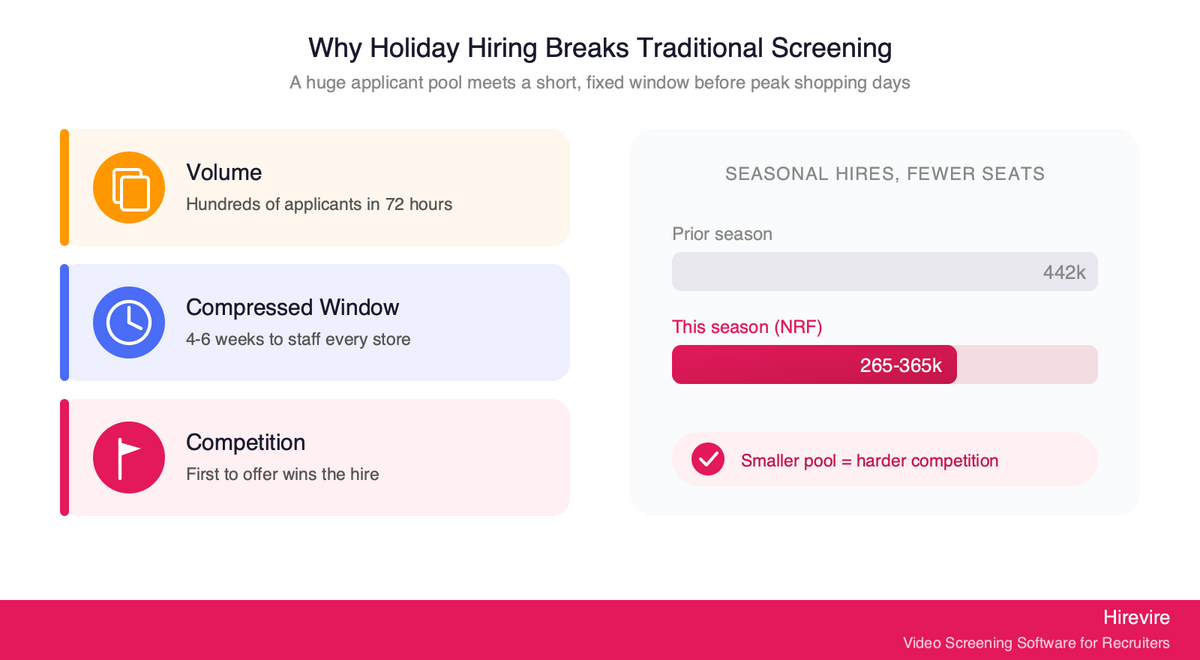
For 2025, the National Retail Federation expects retailers to hire between 265,000 and 365,000 seasonal workers, down from 442,000 in 2024. Fewer seasonal seats means each store is competing harder for the same labor pool, and the team that responds first usually wins the hire. Speed is the whole game.
Quick Summary: Seasonal retail hiring works best when screening is asynchronous and mobile-first. Send bulk invites, let candidates record short video or audio answers from their phone with no account to create, auto-disqualify anyone who misses your must-have criteria, and batch-review the rest on your own schedule. Hirevire provides this workflow with mobile-first recording, SMS and email invites, bulk operations, and auto-disqualification on fixed monthly pricing.
Key Takeaways
| Question | Short answer |
|---|---|
| What is the core problem in seasonal retail hiring? | A huge applicant volume must be screened inside a short, fixed window before peak shopping days. |
| What is the fastest screening method? | Async video or audio pre-screening, where candidates record on their phone and teams batch-review. |
| Why does mobile-first matter so much? | Most seasonal retail applicants apply from a phone, and long or login-gated forms cause heavy drop-off. |
| How do you cut review time? | Auto-disqualification on objective must-haves (age, availability, work authorization) before anyone records. |
| How do you avoid leftover cost? | Use fixed monthly pricing with no per-interview fees, then pause or downgrade after the season. |
| How do you keep good seasonal hires? | Tag top performers during screening and fast-track them into permanent roles after the holidays. |
The Seasonal Crunch: Why Holiday Hiring Breaks Traditional Screening
Seasonal retail hiring is not regular hiring sped up. It is a different problem with its own constraints, and the methods that work for filling one salaried role over six weeks fall apart under holiday pressure.
The defining feature is the compressed window. Most retailers post seasonal roles in late September and October and need bodies trained and on the floor before Black Friday. That leaves roughly four to six weeks to handle the entire funnel for every store, often across dozens of locations at once. A corporate hourly recruiter who supports 30 stores cannot personally call every applicant, and store managers screening on top of running their floor have even less time.
The volume is the second pressure. A single store posting can pull in hundreds of applicants in the first 72 hours, especially for entry-level cashier, stockroom, and sales associate roles. Multiply that across a region and the recruiting team is staring at thousands of resumes that all look roughly the same: limited work history, similar availability, comparable experience. Resume sorting barely separates the pool.
The third pressure is competition for the same workers. With the NRF projecting 265,000 to 365,000 seasonal hires for 2025, the lowest level in about 15 years, retailers are fighting over a smaller pool. A strong seasonal candidate is often applying to three or four stores in the same shopping center on the same day. Whoever screens and makes an offer first gets the hire. A store still playing phone tag a week later has already lost them.
Why Phone Screens Collapse Under Volume
The traditional first step in retail hiring is a quick phone screen. It works fine at low volume. At seasonal volume it becomes the bottleneck that sinks the whole timeline.
Each phone screen requires scheduling and often two or three attempts to connect, because hourly applicants are working other jobs or screening unknown numbers. A recruiter who needs 15 minutes per successful call, plus failed attempts and voicemail tag, completes only a handful per hour. Screening 400 applicants this way is not possible in the window available.
Worse, phone screens run in series. One recruiter can only be on one call at a time, so the funnel moves at the speed of a single person's calendar. Applicants who would have been great hires sit in a queue, get an offer from a competitor, and disappear before anyone reaches them.
The Cost of a Slow, Leaky Funnel
Slow screening does not just delay hires, it loses applicants outright. Long or clunky application steps drive heavy abandonment. CareerBuilder found that 60% of job seekers quit in the middle of filling out online applications because of their length or complexity. Every extra friction point, a phone tag loop, a login wall, a 40-field form, peels candidates off the top of an already time-limited funnel.
That matters more in a tight labor market. Replacing lost applicant flow with new ad spend late in the season is expensive and slow, and the BLS Job Openings and Labor Turnover data shows just how much churn the broader labor market carries even in normal months. The fix is not more applicants. It is screening the ones you already have faster, before they take another offer.
Why Seasonal Applicants Demand No-Login Mobile Screening
The seasonal retail labor pool skews young, mobile-first, and impatient with process. Many are students, gig workers, and first-time or returning hourly workers who do everything on their phone and will not jump through hoops to apply for a temporary job.
Most hourly and frontline candidates apply directly from their phones, a pattern documented across recruiting research including Indeed Hiring Lab. When the next step after applying is "download an app," "create an account," or "log in to a portal," a large share of those mobile applicants drop out. They are not invested enough in a seasonal role to fight a clunky flow, and they have other applications open in adjacent tabs.
This is why a no-login mobile experience is the single most important decision in seasonal screening. If a candidate can tap a link in a text message, see the questions, and record answers on the same phone they applied from, completion rates stay high. If they have to create credentials first, completion craters.
What Mobile-First Actually Requires
"Mobile-friendly" and "mobile-first" are not the same thing. A desktop screening tool with a shrunk-down layout still asks candidates to do things that are awkward on a phone. True mobile-first screening means:
No account creation. The candidate opens a link and starts. Hirevire's no-login mobile screening lets applicants record on any device without signing up, which removes the biggest single drop-off point.
Native phone recording. Candidates use the camera and microphone they already know how to use, with unlimited retakes so nerves or a flubbed first answer do not cost them the application.
Short, focused asks. Three to five questions that take a few minutes total, not a 30-minute assessment. Seasonal candidates will give you a few minutes; they will not give you half an hour.
SMS as the primary channel. Many seasonal applicants check texts far more reliably than email. Reaching them where they already are lifts response rates sharply.
The Drop-Off Math
Drop-off compounds. If a large share abandon a complex application, more abandon a login wall, and more still abandon a long assessment, a funnel that started with 400 applicants can deliver only a few dozen completed screens. A frictionless mobile flow protects the top of the funnel, and every drop-off point removed is candidates kept in play, which in a compressed season means more hires made before competitors reach the same people.
Async Pre-Screening for Seasonal Retail: Bulk Invite to Auto-Disqualify to Fast Offer
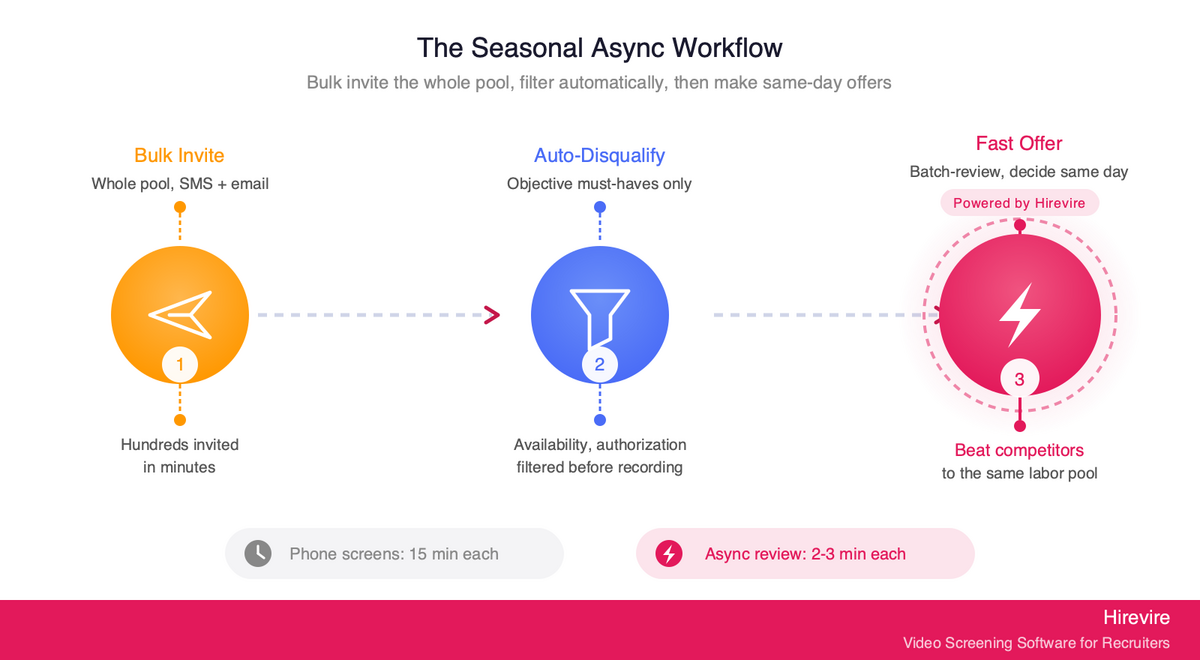
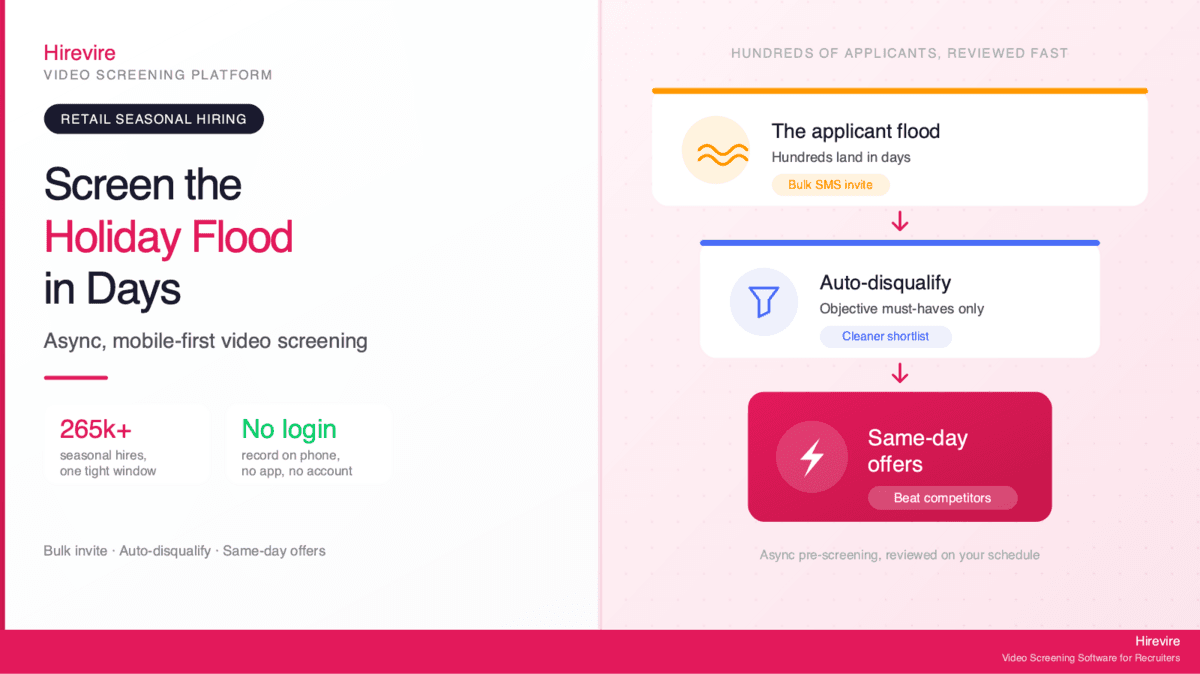
Asynchronous pre-screening is the method that makes seasonal hiring possible at volume. Instead of scheduling live conversations, the team sends every applicant the same set of questions, candidates record their answers whenever it suits them, and reviewers watch responses in batches on their own schedule. Nobody has to be available at the same time, which removes the scheduling bottleneck entirely.
The seasonal workflow has three moves: bulk invite, auto-disqualify, and fast offer.
Step 1: Bulk Invite the Entire Applicant Pool
Rather than picking a handful of resumes to phone-screen, invite everyone who clears your basic resume filter to record a short screening. Because recording is asynchronous and costs the recruiter no live time, there is no penalty for screening broadly. Wider screening means fewer good candidates missed because their resume looked average.
Hirevire's bulk operations let a recruiter send invites to a large applicant list at once over both SMS and email. A single recruiter can put hundreds of candidates into the screening stage in minutes, something that would take days of individual phone outreach.
Step 2: Auto-Disqualify on Objective Must-Haves
Not every applicant should reach the recording stage. Seasonal retail roles carry hard requirements: minimum age for certain departments, weekend and peak-week availability, work authorization, and sometimes the ability to lift a stated weight or stand for full shifts. These are objective knockouts, not judgment calls.
Hirevire's auto-disqualification lets the recruiter set those must-have criteria up front. Applicants who fail them are filtered to a separate tab before they record, which saves both review time and response credits. The recruiter never spends a minute watching a video from someone who cannot work the hours the role requires. Used correctly, auto-disqualification removes the obviously-unqualified portion of the pool automatically, leaving a cleaner set of real candidates to review.
A note on fairness: keep auto-disqualification to objective, job-related criteria. Automated screening tools fall under employment law. EEOC technical assistance on AI in employment selection makes clear that a tool screening candidates out on a protected basis can create unlawful disparate impact even when an employer relied on a vendor's product. Screen on availability and authorization, not on anything tied to a protected characteristic.
Step 3: Batch-Review and Make Fast Offers
With unqualified applicants filtered out and the rest having recorded short answers, reviewers watch responses in batches. A 90-second video tells a store manager more about a candidate's communication, energy, and customer-facing presence than a resume ever could, and it takes far less time than a scheduled call. Reviewers can rate, comment, and shortlist as they go.
Hirevire's shared review links let a corporate recruiter pass an entire stage of applications to a store manager for rating, with no login required for the reviewer. The manager who will actually work alongside the hire gets a say, collaboration happens without a meeting, and offers go out the same day responses come in. In a market where candidates are weighing multiple offers, same-day movement is what closes the hire.
The Async Advantage in One View
| Step | Traditional phone-screen flow | Async pre-screen flow |
|---|---|---|
| Reaching candidates | One-by-one calls, phone tag | Bulk SMS and email invite to the whole pool |
| Filtering unqualified | Manual, mid-call | Auto-disqualification before recording |
| Screening time per candidate | 15+ min live, scheduled | 2-3 min reviewed on your schedule |
| Throughput | Serial, one recruiter at a time | Parallel, whole pool at once |
| Time to offer | Days to weeks | Same day or next day |
Spinning a Pipeline Up and Down Without Leftover Cost
Seasonal hiring has a beginning and an end. The tool that screens 800 holiday applicants in October should not bill like an enterprise platform in February when hiring is quiet. Cost structure is part of the seasonal strategy.
The trap with many video and assessment platforms is per-interview or per-candidate pricing. A tool that charges per screen looks cheap in a quiet month and becomes punishing during the surge, exactly when you need it most. Screening 800 candidates at a few dollars each turns into a variable bill right when volume peaks, which penalizes the broad screening that makes seasonal hiring work.
Fixed pricing with no per-interview fees flips this: cost is known in advance, screening 800 candidates costs the same as screening 80 within plan limits, and there is no per-candidate anxiety discouraging the team from inviting the whole pool. Hirevire uses this model, so the surge does not generate a surprise invoice.
Pricing for the Season
| Plan | Yearly price | Monthly price | Interviews included | Best for |
|---|---|---|---|---|
| Essentials | $39/month (billed yearly) | $49/month | 1 active job, 1 user, 300 interviews/year | A single store or one role |
| Professional | $99/month (billed yearly) | $149/month | 5 active jobs, 5 users, 1,200 interviews/year, AI Match and Scorecards | A region or multi-role season |
| Agency | $199/month (billed yearly) | $249/month | 20 active jobs, 15 users, 12,000 interviews/year, white-label | High-volume, many locations |
What is genuinely unlimited on every plan: questions per interview, re-recording attempts for candidates, and the AI features. What scales by plan is active jobs, user seats, and the annual interview allocation. For most single-store seasonal needs, Essentials covers a full holiday hiring cycle; multi-location operators size up to Professional or Agency for the season and can adjust afterward.
The strategic point is matching the plan to the season and not paying enterprise-implementation costs for a temporary surge. A store does not need a $15,000-per-year platform to hire 20 holiday associates. It needs to screen fast, pay a predictable amount, and not carry heavy cost into the off-season.
Seasonal Screening Questions: A Ready-to-Use Template
Good seasonal screening questions are short, role-relevant, and designed to surface the things a resume hides: availability honesty, customer-facing presence, and reliability under pressure. Keep the set to three to five questions so candidates actually finish. Mix formats: use multiple-choice or single-choice for hard facts and short video or audio for the human signal.
Knockout Questions (best as multiple-choice, feed auto-disqualification)
These confirm the objective must-haves and can drive auto-disqualification so unqualified applicants never reach the recording stage.
- Are you available to work weekends and the week of [peak date], including evenings? (Yes / No)
- What is your earliest start date? (This week / Next week / Later)
- Are you legally authorized to work in [country]? (Yes / No)
- Can you commit to shifts of [X] hours and the physical requirements of the role, such as standing for a full shift or lifting up to [X] lbs? (Yes / No)
Video or Audio Questions (the human signal, 60-90 seconds each)
These reveal communication, energy, and customer instincts that no resume shows.
- Tell us about a time you helped a customer or coworker who was frustrated or in a hurry. What did you do? (Customer-facing temperament under pressure, the core seasonal skill.)
- The holidays get busy and loud. What helps you stay positive and reliable during a hectic shift? (Resilience and reliability during peak.)
- Why do you want this seasonal role, and would you be interested in staying on after the holidays if it went well? (Motivation, and an early flag for permanent-conversion candidates.)
Role-Specific Adaptations
| Role | Add this focus | Example question |
|---|---|---|
| Cashier / front-end | Accuracy and friendliness at speed | "Describe handling a long checkout line while keeping customers happy." |
| Stockroom / fulfillment | Reliability and physical readiness | "Tell us about a physically demanding job and how you kept pace." |
| Sales associate | Product enthusiasm and upsell instinct | "Sell us on a product you personally love in 60 seconds." |
| Seasonal lead / keyholder | Light leadership and judgment | "Describe a time you took initiative without being asked." |
A practical rule: every question should either screen out a clear mismatch or reveal something a resume cannot. If a question does neither, cut it. Shorter screens finish at higher rates, and in a season measured in days, completion rate is everything.
Async Video vs. Group Interviews vs. SMS Screening
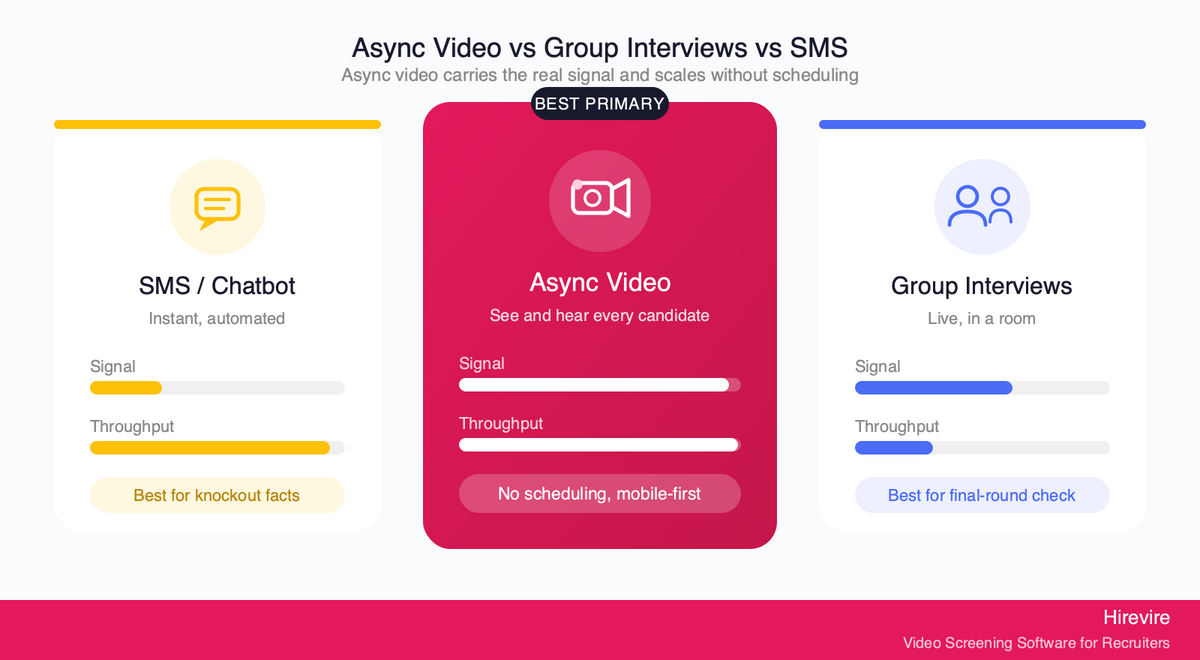
Retailers reach for three common methods to handle seasonal volume: async video pre-screening, group interviews, and SMS or chatbot screening. Each has a place. The differences come down to depth of signal, candidate experience, and how well they hold up under a compressed timeline.
| Factor | Async video pre-screening | Group interviews | SMS / chatbot screening |
|---|---|---|---|
| Signal depth | High: see and hear communication, energy, customer presence | Medium: see candidates but split attention across the group | Low: text answers only, no human read |
| Throughput | Very high: whole pool screened in parallel | Low: limited by room size and scheduling | Very high: instant, automated |
| Candidate experience | Strong: record on own time, no login, retakes allowed | Mixed: some shine, quiet candidates get lost | Fast but impersonal |
| Scheduling burden | None: fully asynchronous | Heavy: coordinate many people into one slot | None |
| Fairness / consistency | High: same questions, same review criteria for all | Lower: group dynamics favor the loudest | Medium: consistent but shallow |
| Best use | Primary screen for most seasonal roles | Final-round culture and energy check | Quick knockout questions only |
The strongest seasonal process usually combines them rather than picking one. Use SMS to deliver the invite and capture knockout facts, use async video as the primary screen that carries the real signal, and reserve group interviews for a fast final-round culture check on the shortlist if the role and store culture call for it. Hirevire covers the first two directly: SMS and email invites for reach, and mobile-first async video and audio for the screen itself, all in one place.
The method to avoid as a primary screen is the serial live phone call. It has lower signal than video, worse throughput than async, and the heaviest scheduling burden of all. It is the default that breaks under seasonal volume.
Converting Strong Seasonal Hires Into Permanent Staff
The best seasonal hires are the cheapest permanent hires you will ever make. They are already trained, already vetted on the floor during your busiest weeks, and already known to your managers. Treating the holiday season as a months-long working interview is one of the highest-return moves in retail recruiting, and async screening sets it up from day one.
It starts at the screening stage. When a candidate signals interest in staying on, or a manager flags strong potential during review, tag them. Hirevire's shared review links let managers rate and comment as they review, so the "permanent potential" signal is captured early rather than reconstructed from memory in January.
Through the season, watch the on-floor signals screening cannot show: attendance, reliability under peak pressure, how they handle a difficult customer. The seasonal period generates exactly the performance data ordinary hiring lacks, which is why conversions tend to outperform fresh hires.
Have the conversion conversation before the season ends, not after. Strong seasonal workers get other offers, and the same speed advantage that wins the initial hire wins the conversion. A store that has tagged its top performers can make permanent offers in the final weeks, while one relying on memory is scrambling after the holidays when the best people have moved on. The original screening records, ratings, and reviewer comments also give a documented, consistent basis for that permanent decision, and approaches like Hirevire's AI scorecards apply a human-defined rubric consistently rather than leaving conversion to gut feel.
What Retailers Say About Async Screening
Hirevire holds strong ratings across review platforms: G2: 4.7/5 stars (25+ reviews), Capterra: 5/5 stars (20+ reviews), and AppSumo: 4.9/5 (70+ reviews). The recurring theme in reviews from high-volume hirers is time saved and an easy candidate experience, both of which are exactly what a seasonal surge demands.
"It cuts down my hiring process by at least 75% and made it sooo much easier to see/feel who the candidates were before having to hop on a call with them."
— ElevateClients, AppSumo
"Hirevire is a game-changer in streamlining the hiring process. Its automated screening software saves lots of time and provides a good view of candidates. It's user-friendly, efficient, and perfect for high-volume hiring or short-staffed HR teams."
— Mohammad Awais, AppSumo
Implementation Guide: Standing Up a Seasonal Pipeline in a Week
A seasonal screening pipeline can be live in days. The setup is light by design, because the whole point is moving fast.
Days 1-2: Define must-haves and build the screen. List the objective knockouts for each role (availability, age, authorization, physical requirements) and draft three to five questions using the template above. Build the screening in Hirevire, map knockout questions to auto-disqualification rules, confirm the mobile flow needs no login, and add your store branding.
Days 3-4: Invite the pool and start reviewing. Pull your applicant list and send bulk SMS and email invites, leading with SMS for hourly applicants. Batch-review responses as they arrive and share stages with store managers through shared review links so the people who will work with the hire help decide.
Day 5 onward: Make same-day offers. As shortlisted candidates clear review, extend offers immediately. The compressed window rewards speed, so send offers as candidates clear rather than batching them for a weekly meeting.
Common Pitfalls to Avoid
- Too many questions. Long screens crater completion; three to five is the ceiling.
- Login walls. Any account-creation step before recording loses mobile applicants.
- Email-only outreach. Hourly candidates check texts more than email, so skipping SMS costs response rate.
- Subjective auto-disqualification. Keep knockouts objective and job-related; both EEOC guidance and NYC Local Law 144 underline that automated screening carries legal obligations.
- Slow offers. A great screen means nothing if the offer comes a week late. Move same-day.
Advanced Seasonal Strategies
A few refinements widen the gap between you and the store competing for the same workers:
- Pull invites forward. Some hiring shifts into October for early buying events. Screening earlier reaches strong candidates before the rush, when the pool is least picked over.
- Build a warm bench. Keep the records of strong candidates you cannot place immediately. When a no-show or early quit creates a mid-season gap, you already have vetted people to call.
- Segment by store need. Use separate jobs per store or region so review stays organized and managers only see their own applicants.
- Track completion and time-to-offer. These two metrics predict a fully staffed season. If completion drops, shorten the screen; if time-to-offer creeps up, the review or approval step is the bottleneck.
Frequently Asked Questions
How fast can a retailer screen hundreds of seasonal applicants?
With async video pre-screening, a recruiter can invite hundreds of applicants in minutes and review completed responses in batches at 2-3 minutes each, rather than 15-plus minutes per scheduled phone call. A pool of several hundred can move from invite to offer-ready within days. Hirevire's bulk operations and no-login mobile recording are built for exactly this volume.
What is async video pre-screening?
Asynchronous video pre-screening lets candidates record answers to set questions on their own device at their own time, while reviewers watch the responses later. Nobody schedules a live call, which removes the scheduling bottleneck that makes phone screens too slow for seasonal volume.
Why is mobile-first screening important for seasonal hiring?
Most seasonal retail applicants apply from their phones, and long forms or login walls cause heavy abandonment. CareerBuilder found 60% of job seekers quit applications because of length or complexity. A no-login mobile flow keeps far more candidates in the funnel, which in a tight market directly means more hires. Hirevire's no-login mobile screening is designed to remove that drop-off.
How does auto-disqualification work without being unfair?
Auto-disqualification filters out applicants who fail objective, job-related must-haves such as availability, work authorization, or physical requirements, before they record. Hirevire's auto-disqualification handles these objective knockouts only. Fairness depends on keeping criteria job-related and never tied to protected characteristics, in line with EEOC guidance on AI in selection.
Should I use SMS or email to invite seasonal candidates?
Both, but lead with SMS. Hourly and seasonal applicants tend to check texts more reliably and faster than email. Hirevire supports bulk SMS and email invites, so you can reach candidates on the channel they actually watch.
How many screening questions should a seasonal screen have?
Three to five. Completion rate falls as length rises, and seasonal candidates are applying to several stores at once. Use multiple-choice for knockout facts and short 60-90 second video or audio prompts for the human signal like customer-facing temperament.
Does video screening cost more per candidate during a surge?
It depends on the pricing model. Per-interview pricing gets expensive exactly when volume peaks. Hirevire uses fixed monthly or yearly pricing with no per-interview fees, so screening 800 candidates costs the same as screening 80 within plan limits, which keeps a seasonal surge from generating a surprise bill.
How do I avoid paying for the tool in the off-season?
Match the plan to the season. A single store can run a full holiday cycle on Hirevire's Essentials plan at $39/month billed yearly, and multi-location operators can size up to Professional or Agency for the season. Fixed pricing means no per-candidate costs lingering after hiring slows.
Can group interviews replace video pre-screening for seasonal hiring?
Group interviews work well as a fast final-round culture and energy check, but they are weak as a primary screen because room size and scheduling cap throughput and quieter candidates get overlooked. Async video pre-screening is the stronger primary screen; reserve group interviews for the shortlist.
How do I turn seasonal hires into permanent employees?
Tag candidates who show permanent potential during screening, track on-floor performance through the season (attendance, reliability, customer handling), and make conversion offers before the season ends, while strong workers are still available. The screening records and reviewer ratings from the seasonal hire become a documented basis for a fair permanent decision.
Is async video screening legally compliant?
Async screening itself is a tool; compliance depends on how it is used. Keep any automated knockouts objective and job-related, and be aware of regulations like New York City's Local Law 144, which requires bias audits for automated employment decision tools, and EEOC guidance on disparate impact. Using video to capture human-reviewed responses, with objective filters and a human making the final call, keeps the process defensible.
Conclusion: Win the Season by Screening Faster
Seasonal retail hiring is won or lost on speed inside a fixed window. With the NRF projecting a smaller seasonal labor pool in 2025, the store that screens and offers first beats the store next door to the same workers. Phone screens cannot move fast enough; async, mobile-first pre-screening can.
Key Takeaways
- The seasonal crunch is a volume-versus-time problem: hundreds of applicants must be screened in weeks, and serial phone screens cannot keep up.
- Seasonal applicants are mobile-first and impatient, so a no-login mobile flow protects the top of the funnel from heavy drop-off.
- The winning workflow is bulk invite, auto-disqualify on objective must-haves, then batch-review and make same-day offers.
- Fixed monthly pricing with no per-interview fees lets you screen broadly during the surge without a surprise bill, then scale down after.
- Strong seasonal hires are your cheapest permanent hires; tag and track them early and convert before the season ends.
The Bottom Line
Holiday hiring does not have to mean a frantic month of phone tag and short-staffed stores. Replace serial phone screens with asynchronous, mobile-first video pre-screening, filter the pool automatically on objective criteria, and move offers out the same day candidates clear. For retailers that want to beat competitors to the same seasonal labor pool, Hirevire provides mobile-first screening, bulk SMS and email invites, and auto-disqualification on fixed pricing starting at $39/month.
Your Next Steps
- Draft three to five screening questions per seasonal role and define your objective knockouts.
- Build the screen with a no-login mobile flow and auto-disqualification rules.
- Try Hirevire's free trial and put your entire applicant pool into screening before the rush starts.
Ready to screen the holiday flood in days, not weeks?
Last updated: June 2026. All statistics and pricing verified as of June 13, 2026. Refresh the NRF seasonal-hiring figure to the current-year forecast at each republish.