How Air Secretary Screens Medical Secretary Candidates for English and Communication Skills Before Any Live Interview
Hiring for medical secretary roles is not the same as hiring for general administrative work. The role sits at the intersection of healthcare operations and patient-facing communication, and it requires a very specific combination of skills: organisational capability, professional conduct, and - above all - clear, articulate English communication.
For Dr. Barton Jennings, CEO of Air Secretary, this last requirement is the hardest to assess at scale. Air Secretary trains people to work as medical secretaries and employs a high volume of staff to fill those roles. At that volume, the problem is not identifying whether candidates have the right communication skills - it's doing so efficiently, before investing time in live interviews with people who are clearly unsuitable.
"In video you can see their English and communication skills and I can eliminate the people who are not suitable before interviewing them in person." —Dr. Barton Jennings, CEO, Air Secretary
Hirevire's async video screening platform gave Air Secretary the tool to do exactly that: assess communication quality from a recorded video response, before any live interview time is committed. This is the story of how the workflow changed and what it means for healthcare and medical hiring more broadly.
The healthcare talent market continues to face persistent shortages across support roles. According to the Association of Healthcare Recruiters International, administrative support positions in healthcare settings have some of the highest turnover rates of any healthcare adjacent role, driven in part by poor fit hires made under time pressure. Improving early-stage screening quality - not just speed - is the core value proposition for tools like Hirevire in this sector.
Why Communication Skills Can't Be Assessed From a CV Alone
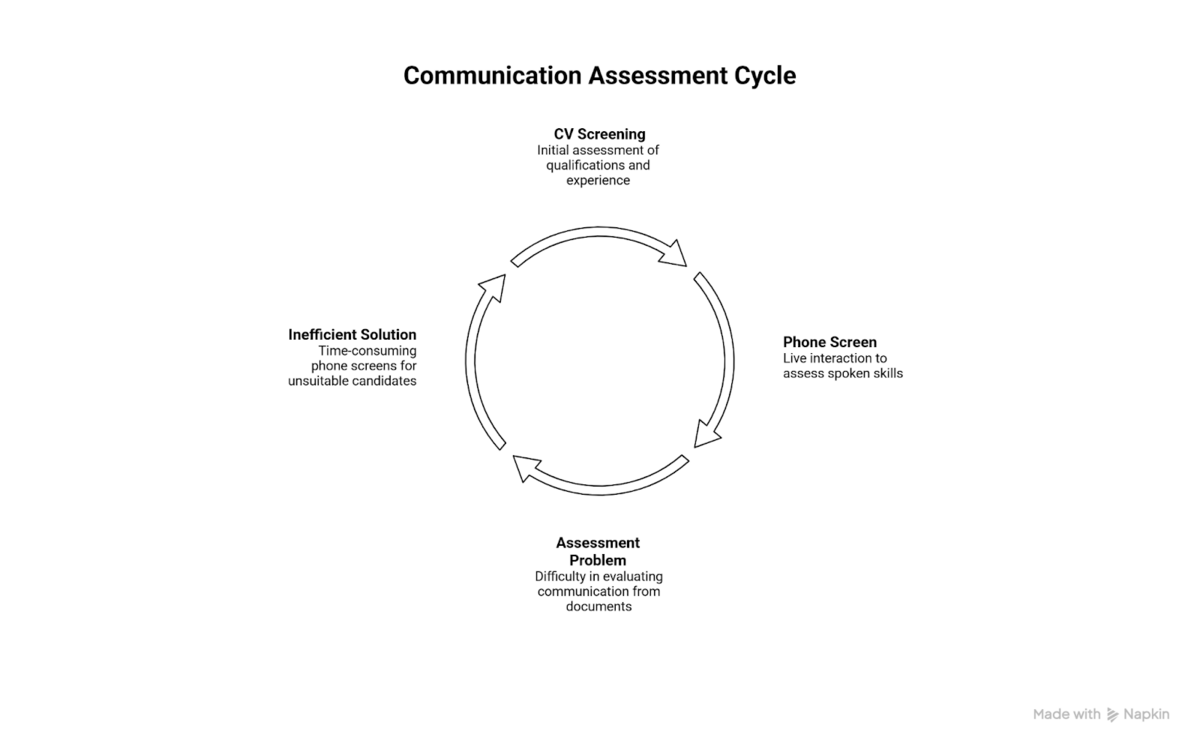
A CV for a medical secretary candidate will list qualifications, work history, and software proficiency. It will not tell you whether the candidate can handle a phone call from a distressed patient with clarity and patience. It will not show you how they present themselves when speaking under mild pressure. It will not reveal whether their written English competence translates to spoken fluency.
Medical secretaries interact with patients, clinicians, and insurance or administrative bodies every day. The nature of those interactions requires a baseline of professional communication that is higher than most administrative roles. A caller who can't understand their medical secretary, or who finds the interaction confusing or unprofessional, has a genuinely worse healthcare experience. In medical training environments like Air Secretary, the stakes are even higher: graduates who don't communicate well enough reflect on the training business's quality guarantee.
This creates a genuine assessment problem at the CV screening stage. A recruiter cannot determine English fluency or professional communication style from a document. Even a well-written cover letter - which many candidates have help preparing - is not a reliable proxy for spoken communication ability.
The traditional solution was the phone screen: call every candidate who looked passable on paper, listen to how they talk, make a judgment, and move on. The problem with that solution at scale is the same one every recruiter who does high-volume hiring knows well. Most of the people you call are not going to be suitable. And the time you spend finding that out on a live call is time you cannot use for anything else.
The Challenge: High-Volume Hiring Where Every Wrong Hire Costs Time and Money
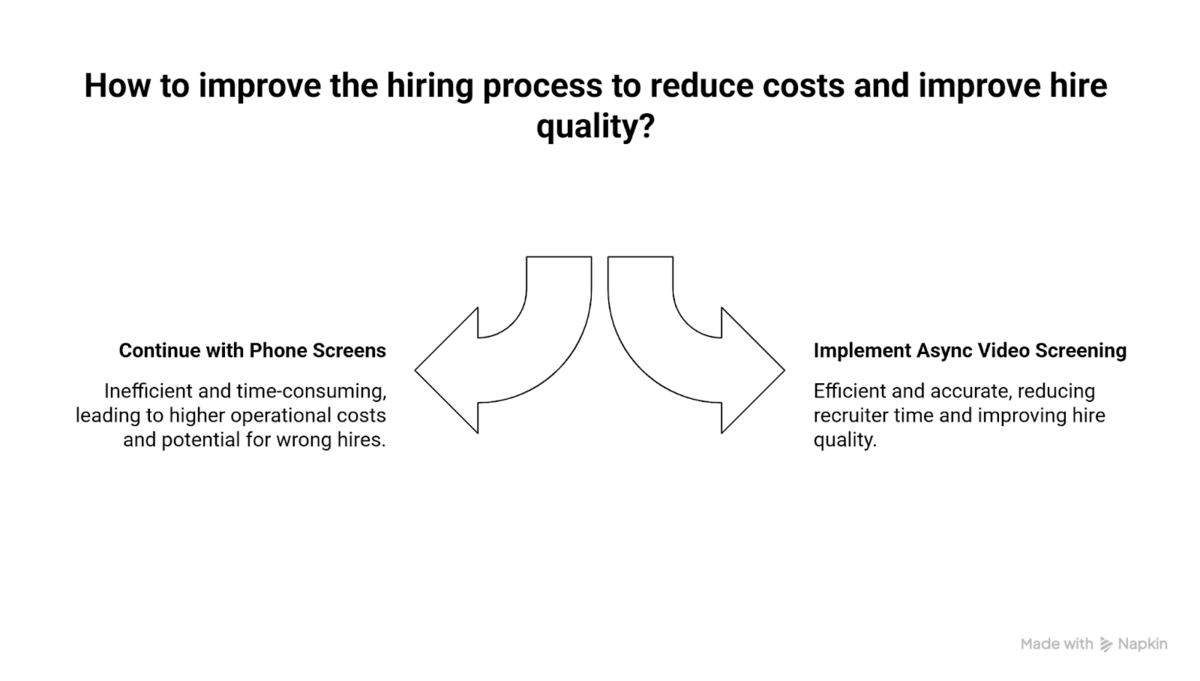
Air Secretary's business model requires a consistent pipeline of new hires. Medical secretary training businesses operate at volume - they recruit, train, and place staff on an ongoing basis, not in occasional bursts. That volume means the early-stage screening problem compounds quickly.
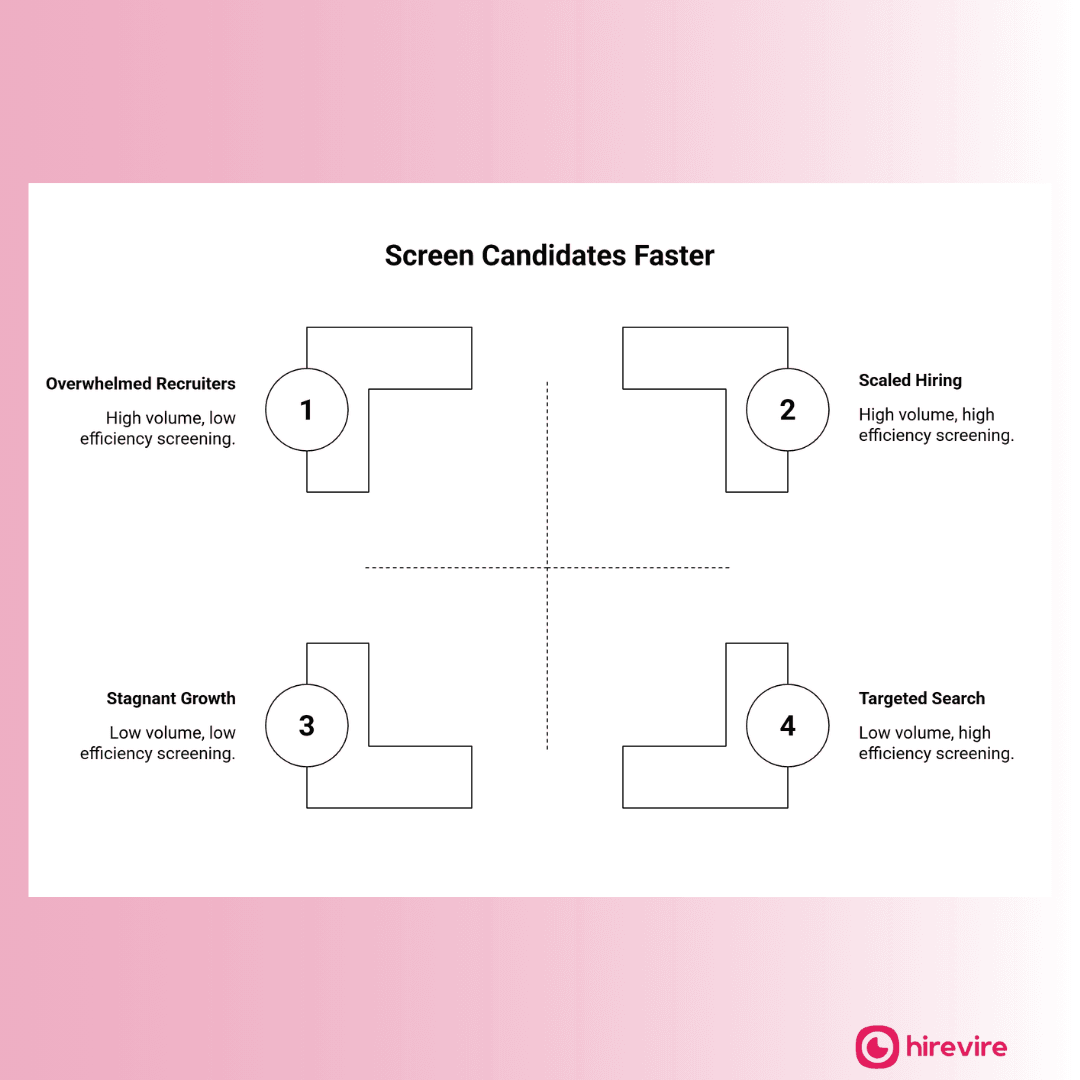
At the scale Air Secretary operates, even modest inefficiencies in the screening process create significant operational drag. If screening 100 candidates per month takes 75 hours of recruiter time through phone screens, and async video can reduce that to 15-20 hours, the monthly savings translate directly into capacity for other work - or the ability to screen more candidates in the same time.
The wrong hire cost in medical roles is also higher than in general administrative work. Training a candidate who lacks the communication skills for the role is wasted investment. Placing a trained secretary with a healthcare client who later decides the person's communication quality is inadequate damages the business relationship. The pressure to make better screening decisions earlier in the funnel is not just an efficiency argument - it's a quality argument.
For the best healthcare recruiting softwares, the key question is whether the tool helps identify fit more accurately earlier, not just whether it speeds up the process. In the case of communication-dependent roles, async video does both: it surfaces the candidates worth advancing more efficiently and more accurately than a CV review alone.
What the Old Screening Process Looked Like
Before Hirevire, Air Secretary's screening process worked the way most high-volume hiring processes do at small-to-medium businesses: application review followed by phone calls for candidates who passed initial CV screening.
The process had an inherent inefficiency built into it. The phone call was the only step that could assess communication quality, but it required both parties to be present at the same time. For Dr. Jennings, personally doing the hiring as CEO of the business, that meant a significant portion of his working week was committed to calls with candidates many of whom it was clear within the first few minutes were not suitable for the role.
There was also a consistency problem. Live interviews vary in quality depending on the interviewer's energy, focus, and how many interviews they've conducted that day. An interview held first thing in the morning with a fresh interviewer is not identical to one held at the end of a day of back-to-back calls. Async video removes that variability: every candidate is assessed on the same questions, and the reviewer can watch responses at a consistent level of attention rather than at whatever level the fifteenth call of the day allows.
For an employer hiring for roles where English fluency and communication professionalism are hard requirements, these inconsistencies in the screening process create real risk. Strong candidates can be passed over because the interviewer was tired and gave a shorter-than-usual interview. Weak candidates can advance because a charming phone presence covers underlying communication problems that would only appear under the normal demands of the role.
How Hirevire Changed the Evaluation Process
Hirevire inserted a structured video screening step between CV review and the first live interview. Candidates receive a link, record responses to pre-set questions, and the recordings are available for review when it suits Dr. Jennings.
The change in the screening workflow is structural rather than incremental. Instead of a live call where the assessment happens in real time and the interviewer has to make judgments while simultaneously managing the conversation, the async format allows the reviewer to:
- Watch the response knowing exactly what question was asked
- Replay sections to confirm initial impressions
- Compare multiple candidates side-by-side before making shortlisting decisions
- Share responses with other stakeholders without arranging separate interviews
For communication assessment specifically, the video format has a direct advantage over phone screens: it shows both verbal and non-verbal communication simultaneously. A candidate's professional demeanour, eye contact, composure under mild pressure, and presentation style are all visible in a video response in ways that a phone call doesn't capture.
The medical recruitment with AI interview tools space has developed specifically around this use case: roles where communication quality is a primary filter, and where the cost of misidentifying communication ability at the screening stage is high. Hirevire's platform addresses this directly.
Assessing English Fluency and Professionalism Before the First Live Interview
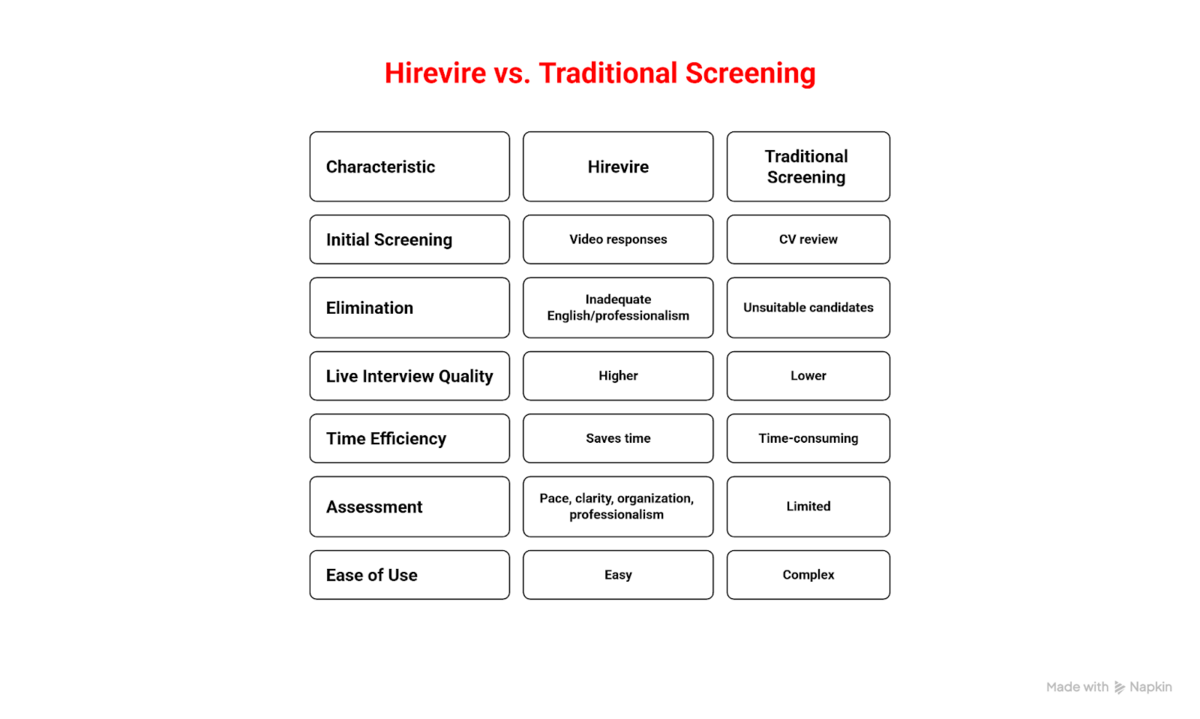
The specific value Air Secretary gets from Hirevire is the ability to assess English fluency and professional communication before committing to a live interview.
Dr Jennings' description of the tool's practical function is precise:
"I have a business employing people to train them to work as medical secretaries. So I am employing a lot of people. Hirevire is an amazing tool to get job applicants to record themselves answering some interview questions before I interview them in person. This saves me a lot of time in interviewing people who are not suitable for the role. In video, you can see their English and communication skills, and I can eliminate the people who are not suitable before interviewing them in person." —Dr. Barton Jennings, CEO, Air Secretary
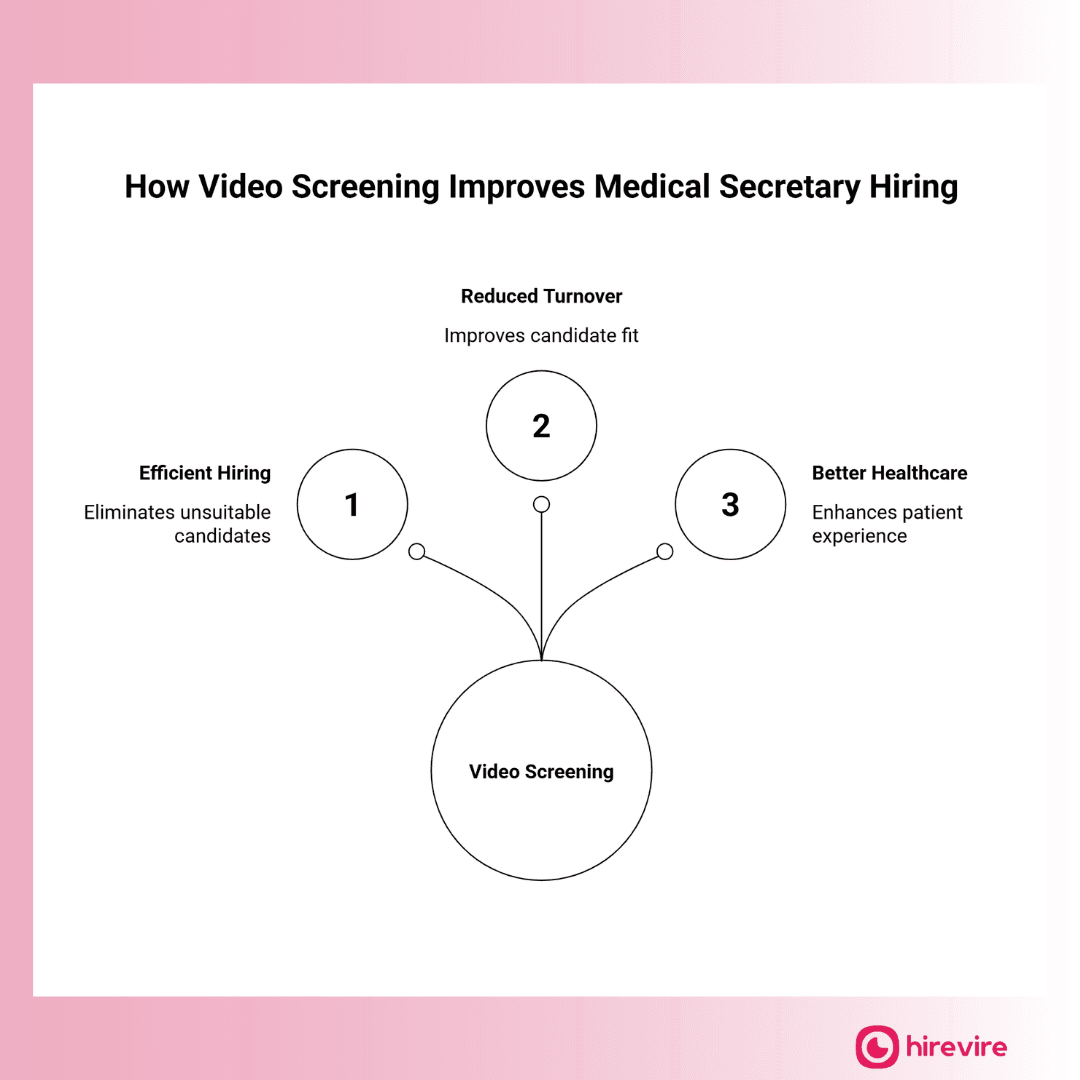
The elimination step is the key operational change. Before Hirevire, every candidate who passed a CV review became a scheduled phone call. With Hirevire, candidates who pass the CV review complete a video screen first. Those whose video responses demonstrate inadequate English fluency or communication professionalism are eliminated before a single minute of live interview time is spent on them.
For a CEO running a medical secretary training business and doing the hiring personally, this change has a direct impact on how time is allocated. The live interviews that remain after the Hirevire screen are with candidates who have already demonstrated they can communicate clearly on camera. The quality of the shortlist that makes it to a live interview is meaningfully higher than the one that resulted from CV review alone.
The assessment of English fluency in video responses covers elements that phone screens capture and adds elements they miss. In a video:
- Pace and clarity of speech are fully audible
- The ability to organise a response to a structured question is visible in real time
- Professionalism indicators - dress, setting, manner, direct eye contact with the camera - are observable
- The absence of preparation tells as much as its presence
None of these signals requires specialist assessment training. A reviewer who knows what good communication looks like - as any healthcare operator hiring for patient-facing roles does - can make reliable assessments from a 5-10 minute video review that would take a 30-minute phone screen to produce less reliably.
What Dr Barton Jennings Says About the Results
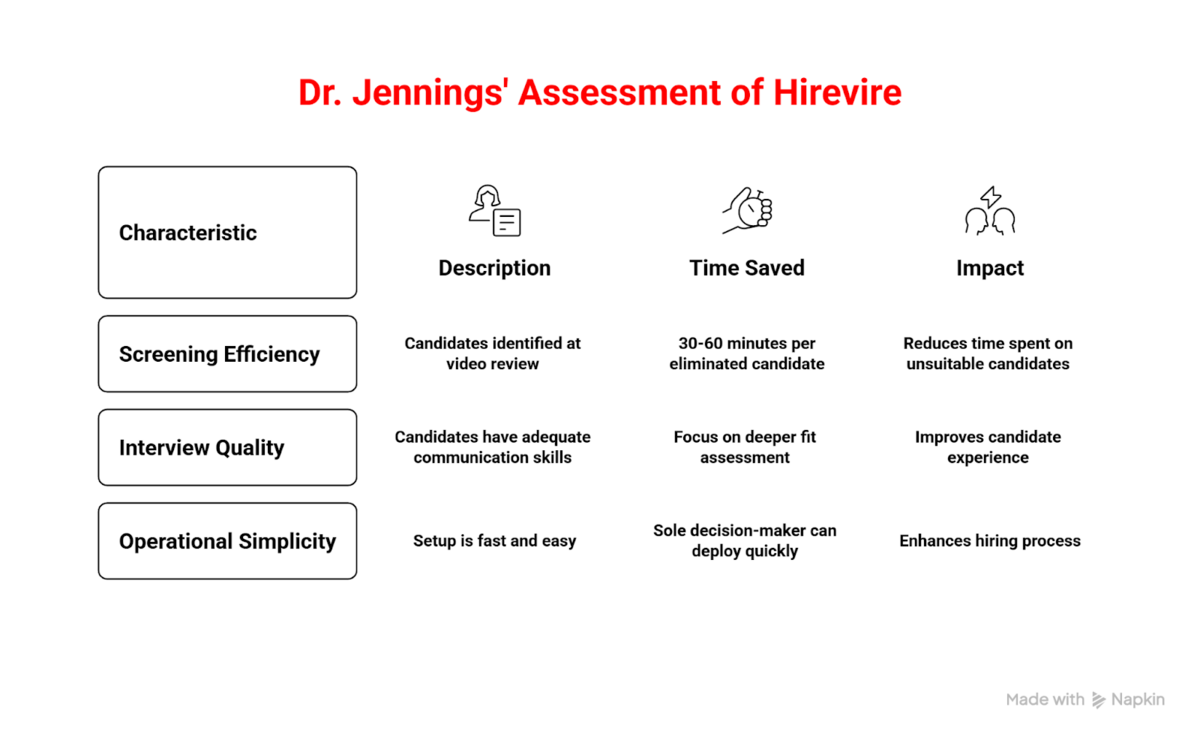
Dr. Jennings' assessment of Hirevire is direct and practical. The tool saves time by eliminating unsuitable candidates before live interview time is committed. For a high-volume medical hiring operation run by the CEO himself, that time saving is the core value.
The results break down as:
Screening efficiency: Candidates who would previously require a phone screen to identify as unsuitable are now identified at the video review stage. Each eliminated candidate represents 30-60 minutes of live interview time that was not spent.
Interview quality: The candidates who reach a live interview have already demonstrated adequate communication skills. Live interviews can focus on role-specific questions, deeper fit assessment, and practical knowledge rather than spending the first ten minutes determining whether the candidate can string a professional sentence together.
Operational simplicity: The setup is fast - Dr. Jennings describes it as "amazing" and the practical experience of a sole decision-maker getting a tool deployed and producing value quickly is meaningful evidence of actual usability.
How This Applies to Other Healthcare Support Roles
The Air Secretary use case is specific to medical secretary hiring, but the underlying screening logic applies across healthcare support roles where communication is a primary requirement.
Any role that involves direct patient interaction, coordination between clinical and administrative teams, or external communication with insurance, referral, or specialist contacts requires communication quality that can't be reliably assessed from a CV. Those roles include:
- Medical receptionists - First point of contact for patients; communication quality affects patient experience directly
- Healthcare coordinators - Manage complex scheduling and communication between multiple stakeholders
- Clinical administrative assistants - Support clinical staff with documentation and coordination
- Care group administrative staff - Similar requirements across residential and community care settings
Adam Godsall, Director of Operations at Hygea Care Group, independently reached a similar conclusion about Hirevire in a care group context:
"This is an amazing product, running alongside our ATS. It helps cut the fluff from applications. Easy to use, and easy to deploy. I love the ability to upload a video intro to the page too, nice touch. Maybe a fully featured ATS down the line, with job posting, with the inbuilt features already offered, would be a great business model. And I would defo adopt. Keep up the great work guys." —Adam Godsall, Director of Operations, Hygea Care Group
Godsall's observation that the tool "cuts the fluff from applications" captures the same functional outcome Dr. Jennings describes: the video screen surface the candidates worth reviewing further and removes the time waste of processing unsuitable candidates all the way to a live call. His comment about ATS integration running "alongside" existing systems reflects a key adoption consideration for larger healthcare operators - the tool needs to complement existing workflows rather than replace them entirely.
For any healthcare support hiring operation, the evaluation question is the same: what is the per-candidate cost of the current screening process, and what portion of that cost could be removed by eliminating unsuitable candidates one stage earlier? The case studies from Air Secretary and Hygea Care Group both suggest the answer is meaningful.
FAQs: Video Pre-Screening for Healthcare and Medical Hiring
How does video pre-screening improve candidate assessment for medical secretary roles?
Video responses allow reviewers to assess English fluency, professional presentation, and communication clarity - none of which are visible in a CV. For medical secretary roles where patient-facing communication is a hard requirement, video screening identifies unsuitable candidates before live interview time is committed.
What does Hirevire cost for healthcare hiring teams?
Hirevire offers three plans: Essentials at $49/month ($39/month billed annually), Professional at $149/month ($99/month billed annually), and Agency at $249/month ($199/month billed annually). For individual operators or small healthcare businesses doing their own hiring, the Essentials plan is typically sufficient.
Is async video screening suitable for high-volume healthcare recruiting?
Yes. For high-volume healthcare recruiting, async video screening reduces per-candidate assessment time from 45-60 minutes (phone screen) to 8-12 minutes (video review) while producing equivalent or better communication assessment. The asynchronous format also removes scheduling coordination overhead.
How do ai candidate assessment tools support fair evaluation in healthcare hiring?
Async video screening introduces a standardised assessment step that every candidate completes under the same conditions: the same questions, the same format, the same review criteria. This reduces the variability of live interview assessment and creates a more consistent baseline for comparison. It also produces a reviewable record, which supports fair assessment practices. See also: best healthcare recruiting software.
What types of questions work best for medical secretary video pre-screening?
Questions that require candidates to demonstrate communication under mild structure - role-play scenarios, describing how they'd handle a specific patient query, explaining their experience with medical terminology - reveal communication quality more reliably than general interview questions. The specific question design depends on the role, but any question that requires a candidate to speak clearly and professionally for 60-90 seconds will surface the communication quality being assessed.
How does Hirevire help firms reduce time-to-hire for critical roles?
By removing the scheduling overhead from early screening and enabling reviewers to assess multiple candidates asynchronously, Hirevire reduces the time from application to shortlist significantly. For critical roles where delay creates operational risk, the ability to complete initial screening within 24-48 hours rather than 5-10 days is a direct contribution to reducing time-to-hire.
Conclusion
Air Secretary's use of Hirevire for medical secretary candidate screening demonstrates a specific and replicable solution to a problem that affects every healthcare employer doing high-volume direct hiring.
The problem is: communication quality is a primary filter for the role, but CVs don't show it and phone screens are too time-intensive to apply at volume. The solution is: async video screening, applied between CV review and live interviews, which surfaces communication quality in 8-12 minutes per candidate rather than 45-60 minutes.
Dr Barton Jennings eliminated unsuitable candidates before they reached live interviews, improved the quality of the shortlists he was spending time on, and did it without adding administrative overhead to a process he was already running as the CEO of the business himself.
For healthcare operators, medical training businesses, and any employer where communication quality is the primary screening criterion, this is a workflow change worth making.
Start screening medical candidates more effectively with Hirevire