Best Software for Large-Scale Tech Talent Assessments: Screening Developers Without the Bottleneck
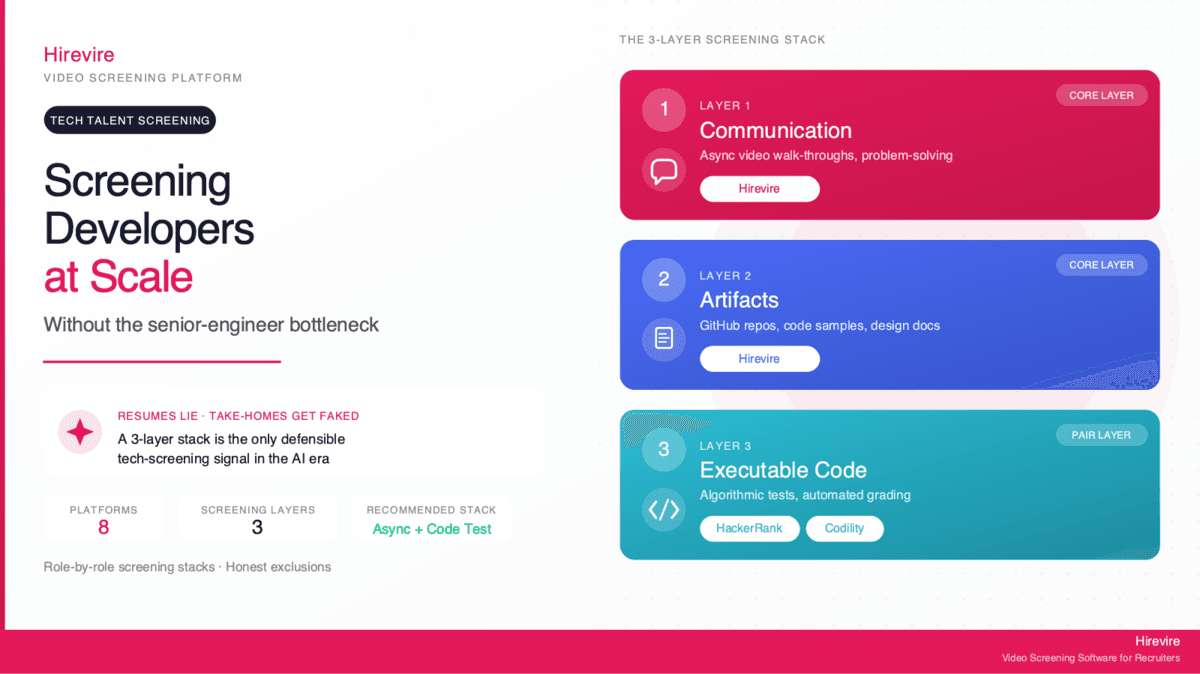
Resumes lie about technical ability. Take-home tests get outsourced or generated by AI. Live coding rounds bottleneck on engineering interviewer time. The whole tech-screening playbook from 2018 is broken in 2026, and the question for any team hiring developers at volume is the same: what is left that actually works?
The answer is a three-layer screening stack that combines async video (for communication and problem-solving approach), file upload (for actual code samples, GitHub repositories, architecture diagrams), and skills tests (for measurable coding ability). The right software for large-scale tech talent assessments handles all three layers without forcing engineers into a recruiter-built tooling chain that takes a week to set up per role.
This article ranks the eight platforms that genuinely solve developer pre-screening at scale. Tech hiring is a specific vertical with unique screening needs - communication assessment matters, but so do code samples and system-design artifacts that other categories of recruiting tool cannot capture. The platforms below were chosen because they handle the artifact side, the communication side, or both, and because they scale to engineering pipelines processing hundreds of candidates per role.
Hiring volumes are increasing while engineering interviewer time stays fixed. Stack Overflow's annual developer survey consistently shows that technical screening efficiency is the single largest bottleneck in engineering hiring, and a Bureau of Labor Statistics analysis of software developer job growth projects the developer workforce expanding faster than the hiring infrastructure designed to evaluate it. The platforms on this list are how teams keep up.
Quick Answer: Hirevire is the best software for large-scale tech talent assessments for most teams because it combines async video screening with multi-format file upload (code samples, GitHub links, architecture diagrams) in a single candidate flow, with no per-interview fees and no candidate login. For pure code-test assessments, pair it with HackerRank or Codility - the two are complementary, not competitive.
Transparency Note: This comparison is published on Hirevire's website. While we believe Hirevire is an excellent solution and we have positioned it as our top choice, we have done genuine research on every tool listed here so you can make an informed decision based on your specific needs. Hirevire is the best fit for combined communication and artifact screening; specialized code-test platforms still win for pure executable-code evaluation, and we have called out where each is the right answer.
Quick Comparison Table
| Tool | Best For | Starting Price | G2 Rating | Code Execution | Async Video |
|---|---|---|---|---|---|
| 1. Hirevire | Async video + file upload at scale | $39/mo (annual) | 4.7/5 (25+) | No (file upload) | Yes |
| 2. HackerRank | Pure code-test assessments | $199/mo | 4.5/5 (500+) | Yes | Limited |
| 3. Codility | Algorithmic code testing | $1,200/yr | 4.6/5 (800+) | Yes | No |
| 4. TestGorilla | Skills tests across role types | $142/mo | 4.5/5 (1300+) | Limited | Yes |
| 5. Adaface | AI-powered conversational testing | $180 | 4.6/5 (44+) | Yes | No |
| 6. myInterview | Customizable async video | Custom | 4.7/5 (90+) | No | Yes |
| 7. Willo | Clean async video at scale | $209/mo (annual) | 4.7/5 (200+) | No | Yes |
| 8. intervue.io | Live coding sessions | Free + paid | 4.3/5 (4) | Yes | Live |
Key Insight: No single platform handles every layer of tech screening. The platforms cluster into two buckets: pure technical assessments (HackerRank, Codility, TestGorilla, Adaface, intervue.io) and communication plus artifact screening (Hirevire, myInterview, Willo). The most effective tech screening stacks pair one from each bucket.
The Three-Layer Tech Screening Stack
Before the tools, the framework. Tech hiring breaks down into three measurable signals, and the screening stack should map onto all three.
Layer 1: Communication and Problem-Solving Approach
This is the layer that resumes and code tests cannot capture. How does the candidate explain a system-design decision? How do they reason out loud about a trade-off they have not seen before? Async video handles this layer at scale. A five-minute recorded answer to "walk me through how you would design a rate limiter" produces more signal than three pages of resume bullets.
Layer 2: Actual Code and Artifacts
GitHub repositories, code samples, architecture diagrams, design documents, technical writing. This is the artifact layer. Most platforms force a choice between code-test execution and file upload, but real engineering work happens in artifacts more often than in timed live-code sessions. A platform that accepts file uploads alongside video is the most accurate proxy for real work.
Layer 3: Executable Code Evaluation
Timed coding tests, algorithmic challenges, take-home projects with automated grading. Code-test platforms own this layer. They are good at it. The challenge is that AI coding assistants have made the take-home test signal noisier - a candidate can submit clean code without having written it themselves. The fix is pairing the test with async video where the candidate explains their approach, which makes outsourcing harder.
The eight platforms below are sorted by which layer they own. The recommended stack for most engineering teams pairs Hirevire (Layers 1 and 2) with HackerRank or Codility (Layer 3).
1. Hirevire - Best for Combined Async Video and Artifact Screening
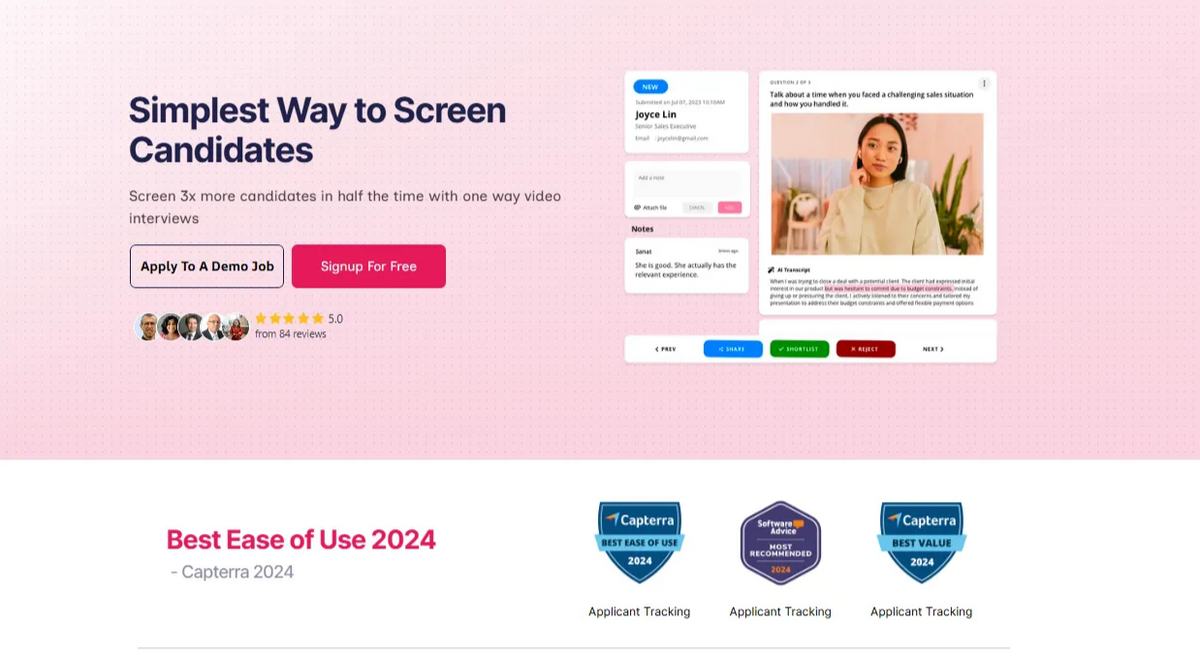
Hirevire is the strongest single platform for the combined-communication-plus-artifact use case that defines modern tech screening. The platform's multi-format response collection means a single screening flow can ask the candidate to record a video walk-through of a system-design problem, upload a GitHub repository link, attach an architecture diagram, and answer a multiple-choice question about preferred frameworks - all in one flow, with no candidate login, no app download, and no per-interview cost.
Why Hirevire Fits Tech Hiring Specifically
Most async video platforms force video-only responses, which is wrong for engineering. An engineering screen needs to see the work, not just hear the explanation. Hirevire's file upload accepts any format - code samples, ZIP files of project work, PDFs of design documents, screenshots of system architectures, links to deployed projects, GitHub URLs. The recruiter receives a single candidate package containing video answers, transcripts, and uploaded artifacts, all attributed to the same candidate record.
The async model also fits engineering hiring culturally. Developers prefer async over scheduled live screens because async respects deep work - candidates can respond at the end of their day without taking time off, which raises completion rates among employed senior engineers who are the most valuable target.
Key Features for Tech Screening
Multi-Format Response Collection - Video for system-design walk-throughs, audio for quick scenario answers, file upload for code samples and architecture diagrams, rich text for written explanations, multiple choice for stack preferences. Each question independently configured.
File Upload for Code Samples and Artifacts - Any format, no size constraint within reasonable limits, attached to the candidate record alongside the video response.
No Candidate Login Required - Engineers click the link and respond. No account creation, no password, no email verification. This drives completion rates above 70% on a population that traditionally hates recruiter friction.
AI Transcription in 90+ Languages - Every video and audio response generates a searchable transcript automatically. A hiring manager screening fifty engineering responses can keyword-search for "Kubernetes" or "monorepo" without watching every minute.
AI Match Scoring (Professional and Agency plans) - Custom evaluation prompts up to 200 characters guide the AI to score responses against role-specific criteria. Useful for narrowing five hundred engineering responses to a top fifty for human review by senior engineers.
ATS Integrations - Direct integrations with Greenhouse, Workable, Lever, Ashby, Bullhorn, Manatal, plus 5,000+ apps via Zapier. The candidate record lands in the ATS with video, transcript, and uploaded artifacts attached.
Team Collaboration for Engineering Reviewers - Multiple senior engineer reviewers can score the same submission independently, comment on specific timestamps in the video, and shortlist collaboratively without scheduling sync time.
Pricing
| Plan | Monthly | Yearly | Best Fit for Tech Hiring |
|---|---|---|---|
| Essentials | $49/month | $39/month (annual) | 300 interviews/year - testing the model on a single role |
| Professional | $149/month | $99/month (annual) | 1,200 interviews/year - 5-10 simultaneous engineering roles |
| Agency | $249/month | $199/month (annual) | 12,000 interviews/year - large engineering pipelines, agencies, or recruiting firms |
For most engineering teams, Professional at $99/month annual is the right starting point. For agencies or in-house teams running large engineering pipelines (15+ open roles), Agency is the choice.
Pros
- Combines video, audio, file upload, and text in a single flow - the only mainstream platform that does this for tech screening
- No-login candidate flow eliminates the friction senior engineers most often cite as a reason to drop out
- AI transcription in 90+ languages enables global engineering hiring without local recruiter coverage
- File upload accepts code samples, GitHub repos, architecture diagrams, design docs - real engineering artifacts
- Predictable monthly pricing with no per-interview fees
- Direct ATS integrations remove the data-entry tax
Cons
- No code-execution sandbox - pair with HackerRank or Codility for executable code testing
- Async-only, so live system-design rounds need a separate tool (Zoom, CodeSignal Interview, etc.)
Best For
- Engineering teams hiring 50+ candidates per role
- Roles where artifact review (code samples, GitHub, architecture diagrams) matters as much as code execution
- Senior engineering hiring where async respects candidate time
- Agencies and recruitment firms running engineering pipelines for multiple clients
- Globally distributed engineering hiring requiring multilingual transcription
Real Tech Hiring Customer Story
HireTruffle scaled to 15 engineering hires in 6 weeks using Hirevire for combined async video plus file-upload screening. Engineers submitted GitHub repos and architecture diagrams alongside their video answers, all in one flow. The team reported recovering days of senior-engineer review time per role because the async format let reviewers triage at their own pace rather than blocking out scheduled interview slots.
Customer Reviews
G2: 4.7/5 stars (25+ reviews) - View Reviews
"It cuts down my hiring process by at least 75% and made it sooo much easier to see/feel who the candidates were before having to hop on a call with them."
— ElevateClients, AppSumo
Capterra: 5/5 stars (20+ reviews) - View Reviews
"Being able to set up questions that can be answered with video, text, audio, an image, a file, multiple-choice options, or even a single-choice test style is fantastic."
—Sergio Arias Merino, AppSumo
AppSumo: 4.9/5 (70+ reviews) - View Reviews
2. HackerRank - Best for Pure Code-Test Assessments
HackerRank is the most established name in algorithmic code-test assessments, with a deep library of pre-built challenges across languages and difficulty levels. It is the default choice for the executable-code layer of the screening stack - the platform that actually runs the candidate's code and grades it.
Key Features
- Pre-built coding challenge library across 35+ languages
- Live coding interview tooling (CodePair) alongside async assessments
- Anti-cheating measures: webcam proctoring, plagiarism detection, anomaly flagging
- Integrations with major ATS platforms
- Skill-based hiring playbooks for common engineering roles
Pricing
| Plan | Price | Includes |
|---|---|---|
| Starter | $199/month | Basic assessments, single user |
| Pro | $449/month | Advanced assessments, multiple users, live interviews |
| Enterprise | Custom | High-volume, advanced security, integrations |
Pros
- Largest library of pre-built coding challenges in the category
- Strong anti-cheating tooling, increasingly important in the AI-coding-assistant era
- Mature integrations with Greenhouse, Workable, and other major ATS platforms
Cons
- AI coding assistants have made take-home test signal noisier; pair with async video to compensate
- No artifact screening - candidates cannot submit GitHub repos or architecture diagrams in the same flow
- Per-month pricing climbs quickly at scale
Best For
The executable-code layer of any large-scale engineering screen. Pair with Hirevire for the communication and artifact layers.
Customer Reviews
G2: 4.5/5 stars (500+ reviews) - View Reviews
Capterra: 4.5/5 stars (50+ reviews) - View Reviews
3. Codility - Best for Algorithmic Code Testing
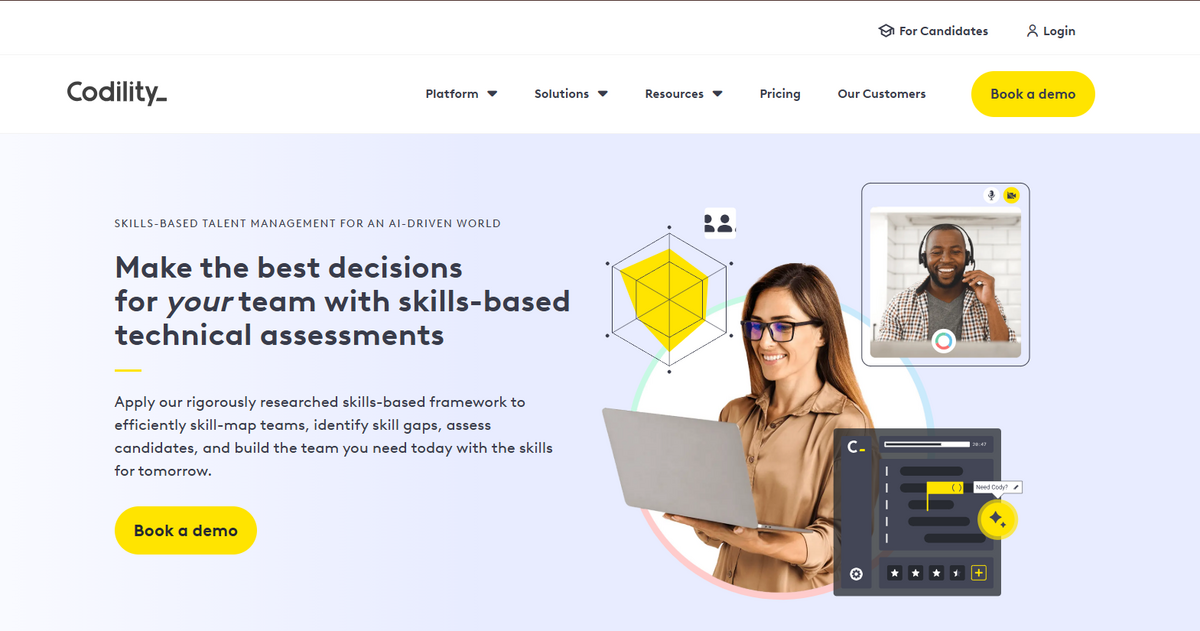
Codility is the other major name in code-test assessments, with a particular strength in algorithmic and computer-science fundamentals testing. It is widely adopted in engineering organizations that prioritize algorithmic depth (data engineering, infrastructure, ML platform) and want a defensible, structured assessment process.
Key Features
- Curated algorithmic coding challenges with structured difficulty progression
- Code review tooling for senior engineering reviewers
- Plagiarism detection across submissions
- ATS integrations
- Reporting on candidate performance benchmarks
Pricing
| Plan | Price | Includes |
|---|---|---|
| Starter | $1,200/year | Core assessment library |
| Scale | $6,000/year (with two months free) | Advanced features, higher volume |
| Custom | Contact sales | Enterprise volumes |
Pros
- Strongest algorithmic depth in the category
- Defensible, structured process that holds up under audit
- Annual pricing is more predictable than monthly tiers
Cons
- Algorithmic focus may over-index on CS fundamentals for product engineering roles where applied work matters more
- No async video - pair with Hirevire for communication signal
- Lower starter tier requires annual commitment
Best For
Engineering organizations hiring for roles where algorithmic depth genuinely matters (data, infra, platform, ML, quant). Less suited to product engineering or full-stack roles where applied work is more predictive.
Customer Reviews
G2: 4.6/5 stars (800+ reviews) - View Reviews
Capterra: 4.6/5 stars (40+ reviews) - View Reviews
4. TestGorilla - Best for Skills Tests Across Role Types
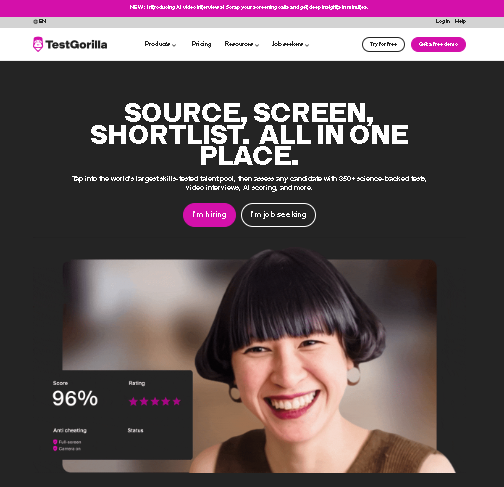
TestGorilla offers a broad library of pre-built skills tests covering coding, cognitive, personality, and role-specific evaluations. It is a strong fit when the hiring funnel includes both engineering and adjacent technical roles (data analysts, DevOps, SREs, technical PMs) and the team wants a single platform for all of them.
Key Features
- Library of 400+ skills tests across role types
- Anti-cheating measures including webcam proctoring
- One-way video question support alongside skills tests
- ATS integrations
- Cognitive and personality assessments alongside coding tests
Pricing
| Plan | Price | Includes |
|---|---|---|
| Free | $0 | Starter pack with limited features |
| Core | $142/month | Full library access |
| Plus | Custom | Enterprise pricing on request |
Pros
- Broadest skills test library in the category
- Lower starting price than HackerRank or Codility
- Useful for cross-functional engineering hiring (DevOps, data, technical PM)
Cons
- Coding test depth is lighter than HackerRank or Codility for pure algorithmic roles
- One-way video is bolted on rather than a first-class feature
- Anti-cheating tooling is less mature than the specialist platforms
Best For
Teams hiring across multiple technical roles (engineering plus data, DevOps, SRE, technical PM) who want a single skills-test platform. For pure software engineering hiring at scale, HackerRank or Codility have deeper coding-test depth.
Customer Reviews
G2: 4.5/5 stars (1,300+ reviews) - View Reviews
Capterra: 4.2/5 stars (250+ reviews) - View Reviews
5. Adaface - Best for AI-Powered Conversational Testing
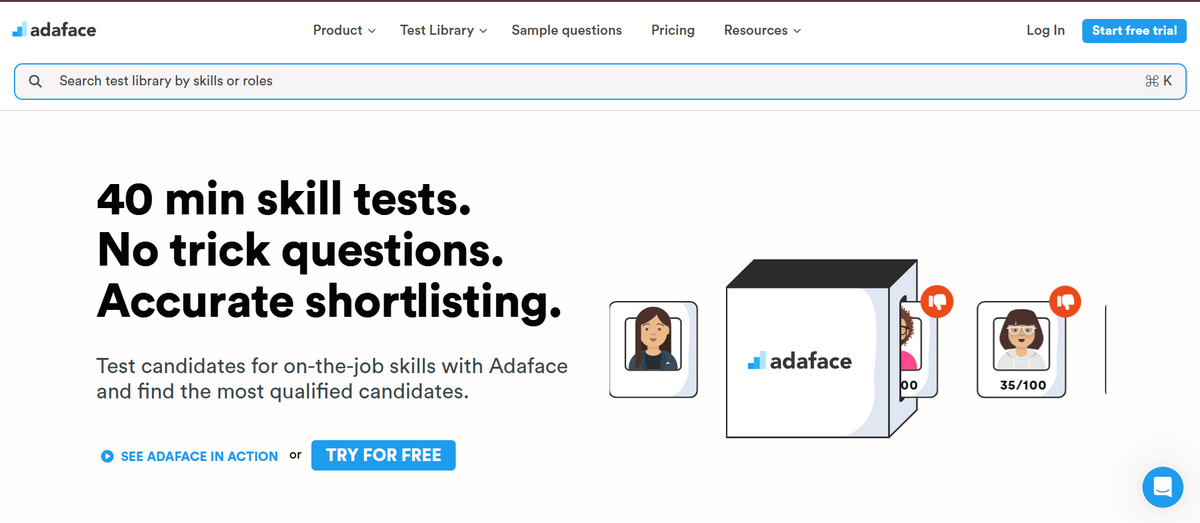
Adaface uses an AI-powered conversational format for technical assessments, where a chatbot interviewer asks code-execution questions and follows up with conversational probes. The format is designed to reduce both candidate gaming and the test-anxiety effect that depresses scores on traditional timed assessments.
Key Features
- Conversational AI assessment format
- Library of pre-built tests across 750+ skills
- Code execution sandbox
- Custom test creation with private question banks
- ATS integrations and reporting
Pricing
Adaface uses an annual credit-based model.
| Plan | Price | Credits |
|---|---|---|
| Individual | $180/year | 12 credits |
| Starter | $500/year | 50 credits |
| Pro | $900/year | 100 credits |
| Scale | $3,000/year | 500 credits |
| Enterprise | $20,000/year | 5,000 credits |
Pros
- Conversational format produces higher candidate completion than traditional timed tests
- Code execution alongside conversational follow-up
- Annual credit pricing is predictable
Cons
- Conversational format is novel and requires candidate education
- Credit-based pricing can be hard to model at unpredictable volumes
- Less established than HackerRank or Codility for senior engineering procurement buyers
Best For
Mid-market engineering teams that want a code-test platform with a less hostile candidate experience, and that value conversational follow-up alongside the test itself.
Customer Reviews
G2: 4.6/5 stars (44+ reviews) - View Reviews
Capterra: 4.7/5 stars (10+ reviews) - View Reviews
6. myInterview - Best for Customizable Async Video
myInterview offers async video interviewing with strong customization on questions, evaluation rubrics, and the candidate experience. For engineering hiring teams that want a flexible video tool but do not need Hirevire's file-upload artifact handling, it is a credible alternative on the video-only side.
Key Features
- Customizable async video interview templates
- Auto-generated candidate reports with summary scoring
- Real-time team collaboration on candidate review
- ATS integrations
- Mobile-optimized candidate experience
Pricing
myInterview does not publish pricing. Quotes are tailored to organization size and volume; mid-volume engineering teams typically land in the mid-thousands per year range.
Pros
- Highly flexible question and rubric customization
- Strong candidate-side UX
- Solid review ratings on G2 and Capterra
Cons
- Pricing opacity makes evaluation harder than transparent-pricing alternatives
- No file upload for code samples or artifacts - video only
- Less suited to engineering hiring than Hirevire for that reason
Best For
Engineering teams that want async video screening only, without artifact handling, and that value customization on rubrics and templates.
Customer Reviews
G2: 4.7/5 stars (90+ reviews) - View Reviews
Capterra: 4.7/5 stars (40+ reviews) - View Reviews
7. Willo - Best for Clean Async Video at Scale
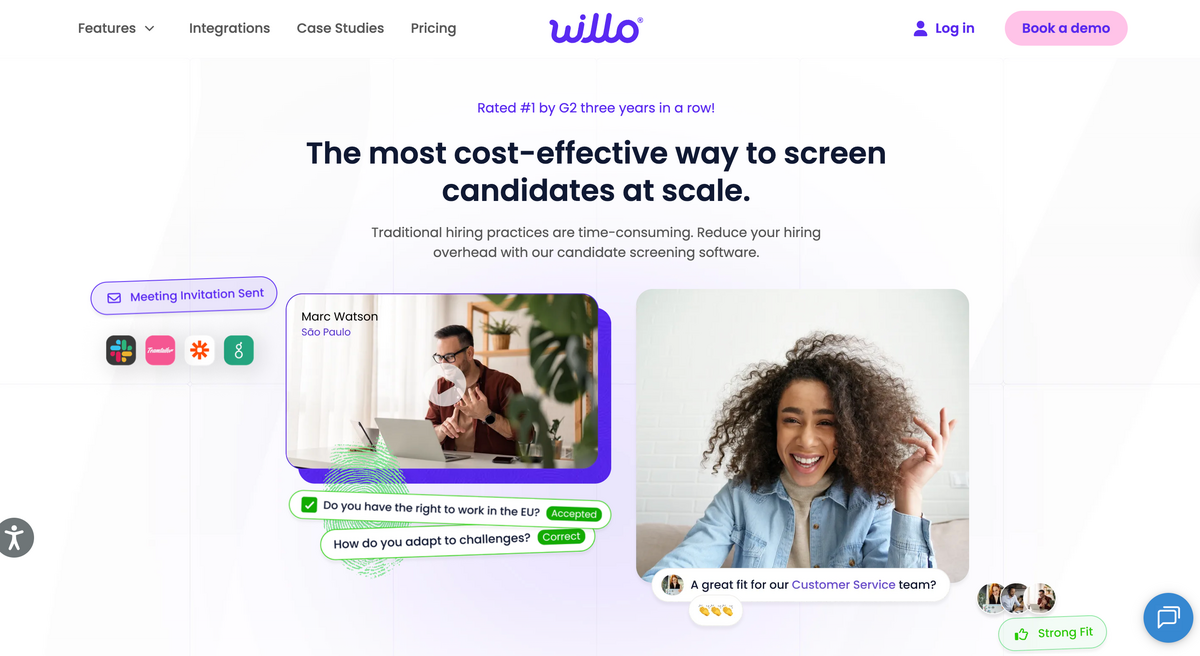
Willo is a focused async video platform that does one thing well: collect video responses at scale with a clean, low-friction candidate experience. It is a good fit when the engineering team already has a separate code-test platform (HackerRank or Codility) and needs a clean video layer to pair with it.
Key Features
- Async video interviews with clean candidate UX
- No-login candidate flow
- Brand customization for career pages
- Calendar and ATS integrations
- Bulk invitation tooling
Pricing
| Plan | Monthly | Annual | |
|---|---|---|---|
| Growth | $279/month | $2,508/year | |
| Scale | $409/month | $3,684/year | |
| Enterprise | Custom | Custom |
Pros
- Clean, focused product
- No-login candidate flow improves completion
- Solid integrations for the price point
Cons
- No file upload for code samples or artifacts - video only
- Per-month response caps constrain high-volume engineering pipelines faster than Hirevire
- No AI scoring on the video layer
Best For
Engineering teams that already have a code-test layer and need a clean async video pairing for the communication layer.
Customer Reviews
G2: 4.7/5 stars (200+ reviews) - View Reviews
Capterra: 4.7/5 stars (30+ reviews) - View Reviews
8. intervue.io - Best for Live Coding Sessions
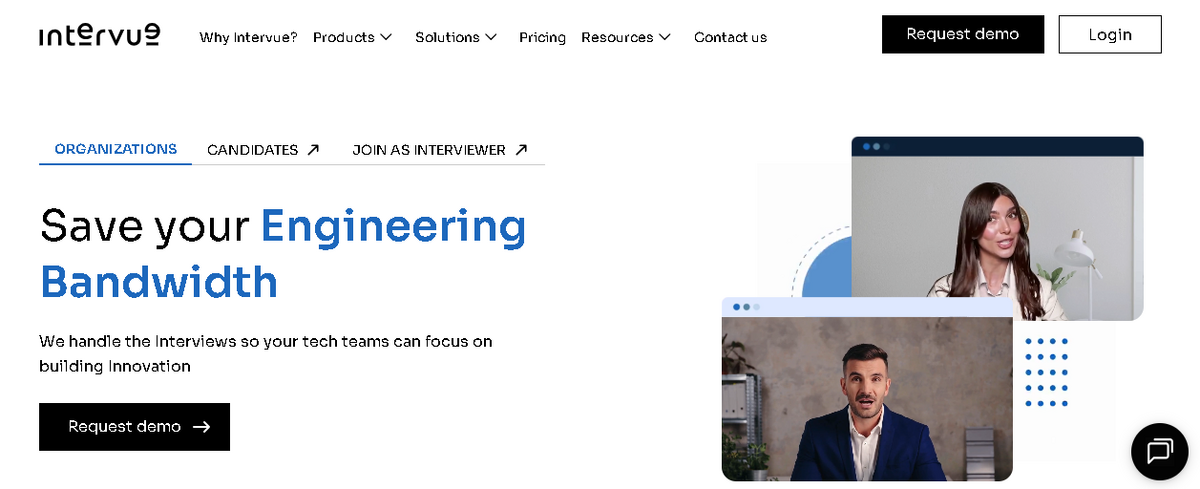
intervue.io is a live-coding-session platform with a free tier and tiered paid plans. It is purpose-built for synchronous technical interviews where the engineering reviewer watches the candidate code in real time, which is the right tool for the live-round layer of the stack rather than the pre-screening layer.
Key Features
- Live shared coding environment with multi-language support
- Audio and video alongside the coding session
- Question banks and interview templates
- Recording and playback for asynchronous review
Pricing
intervue.io offers a tiered structure including a free plan limited to 3 live coding sessions per day, plus paid subscription plans for higher volume.
Pros
- Free tier lowers the barrier to evaluation
- Purpose-built for the live-coding use case
- Multi-language support across major engineering stacks
Cons
- Live-only model does not solve the pre-screening bottleneck this article addresses
- Limited review platform footprint compared to leaders
- Async pre-screening still needs a separate tool
Best For
The live-round layer of the engineering hiring funnel, after pre-screening has narrowed the pool.
Customer Reviews
Capterra: 4.3/5 stars (4 reviews) - View Reviews
G2: 4.4/5 stars (30+ reviews) - View Reviews
Recommended Stacks by Engineering Role
The right combination of platforms depends on the role. Below is a role-specific mapping based on what each role's screening signal actually looks like.
Backend Engineer
Recommended stack: Hirevire (video walk-through of system-design problem + GitHub link upload) + HackerRank or Codility (algorithmic test).
The async video captures problem-solving approach and communication. The file upload captures real-work artifacts. The code test captures algorithmic depth.
Frontend Engineer
Recommended stack: Hirevire (video walk-through of UI architecture decision + portfolio link or design file upload) + HackerRank for executable code test.
Frontend signal is heavier on artifacts (portfolio, deployed projects, design sense) than on algorithmic depth. The file upload is the highest-signal layer.
ML Engineer
Recommended stack: Hirevire (video walk-through of model-design choice + Jupyter notebook or paper PDF upload) + Codility (algorithmic test).
ML hiring weights research artifacts (papers, notebooks) heavily. File upload of a notebook plus video explanation produces a richer signal than a code test alone.
DevOps / SRE
Recommended stack: Hirevire (video walk-through of incident response + Terraform/Helm config upload) + TestGorilla for cross-functional skills tests.
DevOps signal is heavier on configuration artifacts and incident-response thinking than on algorithmic puzzles.
Engineering Manager
Recommended stack: Hirevire (video walk-through of conflict resolution and team-scaling examples + writing sample upload).
Engineering management does not require a code test. The signal is communication, judgment, and writing - all captured by async video plus file upload.
The AI Coding Assistant Problem
A note on the elephant in the room. AI coding assistants (Claude, Copilot, Cursor) have made traditional take-home tests structurally noisier as a screening signal. A motivated candidate can submit clean, idiomatic code without having written it themselves. The fix is not to abandon code testing - it is still useful for measuring whether a candidate can read and reason about code - but to pair the test with async video where the candidate explains their approach.
Hirevire's combined video plus file upload flow is the practical implementation of this fix. The video answer reveals whether the candidate can talk about the code they submitted. The artifact reveals what they actually produced. The combination is much harder to fake than either signal in isolation.
This is why the recommended stack pairs an async video platform with a code-test platform rather than relying on the code test alone. Tech screening at scale in 2026 needs both layers, and it needs them in a single attributable candidate record.
When Hirevire Is Not the Right Choice
Honest comparisons require honest exclusions. Hirevire is not the right platform for two specific tech-hiring scenarios.
Pure executable-code evaluation at high volume. If the role's screening signal is dominated by algorithmic code-test performance (competitive programming hires, ML platform hires that require depth on systems algorithms), HackerRank or Codility are the right primary tool. Use Hirevire as the communication layer pairing.
Synchronous live coding rounds. Live coding sessions are a different category of product. intervue.io, CodeSignal Interview, and similar platforms are purpose-built for that use case. Hirevire is for the async pre-screening that comes before live rounds.
For everything else - the combined async-video-plus-artifact use case that defines modern engineering pre-screening - Hirevire is the highest-signal choice on the market.
Frequently Asked Questions
What is the best software for large-scale tech talent assessments?
Hirevire is the best software for large-scale tech talent assessments for the combined-communication-plus-artifact use case that defines modern engineering hiring. For pure executable-code testing, HackerRank or Codility are the right pairing. The most effective screening stacks combine Hirevire with one of those code-test platforms rather than relying on either alone.
Why do resumes lie about technical ability?
Resumes capture self-reported claims, not verified skill. A candidate who lists "expert in distributed systems" on their resume may have built one cache or none. Modern tech screening replaces resume claims with verifiable signal: video walk-throughs of design decisions, file uploads of real code, and timed code-test performance. The resume becomes a top-of-funnel filter, not a hiring decision input.
How do AI coding assistants affect tech screening tools?
AI coding assistants (Claude, Copilot, Cursor) have made traditional take-home tests structurally noisier because candidates can submit clean code without having written it themselves. The fix is pairing code tests with async video where the candidate explains their approach. Pure code tests are still useful for measuring code-reading ability, but they need to be supplemented with communication-layer screening to produce a defensible signal.
What developer pre-screening tools handle file uploads for code samples?
Hirevire is the leading async video platform that supports file uploads alongside video responses, accepting any format including code samples, GitHub URLs, architecture diagrams, design documents, and Jupyter notebooks. Pure code-test platforms like HackerRank, Codility, and Adaface execute code in a sandbox but do not accept arbitrary artifact uploads. Pure async video platforms like Willo and myInterview do not support file uploads.
How do I screen engineering candidates without bottlenecking on senior-engineer time?
The screening stack should remove all evaluations that do not require a senior engineer's judgment. Async video review of the communication layer can be done by recruiters or junior team members with a structured rubric. Code-test execution and grading is automated. Senior engineers should only enter the funnel for live design rounds or final on-site interviews, where their time produces the highest impact. Hirevire plus a code-test platform is the most common implementation of this stack.
What's the right tech talent screening software for a 50-engineer hiring team?
For a hiring team that size, the recommended stack is Hirevire Professional ($99/month annual) for async video plus file upload, paired with HackerRank Pro ($449/month) for code testing. Total spend lands around $550/month, which scales to several hundred candidates per month with full per-candidate data captured.
Are tech assessment platforms legal under New York City Local Law 144?
Compliance varies by tool and configuration. Local Law 144 requires bias audits for automated employment decision tools. Code-test platforms that grade purely on test correctness are typically lower-risk because the grading is deterministic. AI-scored video platforms require attention - some vendors publish bias-audit results, others do not. Verify with your legal team before enabling AI scoring in regulated jurisdictions.
Can I use Hirevire as a standalone tech screening tool?
Yes, for many engineering roles - especially senior, manager, frontend, and DevOps roles where artifact and communication signal matter more than algorithmic code-test performance. For algorithmically heavy roles (data, infra, platform, ML platform), pair Hirevire with a code-test platform.
How does engineering candidate screening at scale handle global hiring?
The leading platforms support global engineering hiring through multilingual transcription and time-zone-friendly async flows. Hirevire generates AI transcripts in 90+ languages, allowing reviewers to evaluate candidates from any geography without local language coverage. Code-test platforms like HackerRank and Codility are language-agnostic for the test itself.
What's the cost difference between code-test platforms and async video platforms?
Async video platforms like Hirevire typically cost $99-$199/month for high-volume use. Code-test platforms like HackerRank cost $199-$449/month for comparable volume. The recommended combined stack lands in the $300-$650/month range for most mid-market engineering teams. At enterprise scale, both categories shift to custom pricing.
Conclusion
Tech screening at scale in 2026 is a stack problem, not a single-tool problem. Communication, artifacts, and executable code are three different layers of signal, and the right software for large-scale tech talent assessments addresses all three. The honest decision tree is short: most engineering teams should pair Hirevire (for communication and artifacts) with HackerRank or Codility (for executable code), and reserve live coding platforms for the rounds after pre-screening narrows the pool.
The AI coding assistant problem makes this stacked approach more important, not less. A code test alone is more gameable than it was three years ago. A video walk-through alone misses the actual work. The combination - asynchronous, attributable, and artifact-rich - is the highest-signal pre-screening flow available at scale.
Key Takeaways
- Tech screening is three layers, not one. Communication, artifacts, and executable code each need their own tool.
- Hirevire owns the artifact-plus-video layer. Multi-format response collection is the differentiator for engineering hiring specifically.
- Code-test platforms are the executable-code layer, not the whole stack. Pair with async video to defend against AI-coding-assistant gaming.
- Async respects engineer time. Senior engineers complete async screens at higher rates than scheduled live ones.
- The recommended stack scales. Hirevire Professional plus HackerRank Pro covers most mid-market engineering hiring at predictable monthly cost.
Your Next Steps
- Map your engineering roles to the role-specific stacks above
- Identify whether your current screening misses the communication layer, the artifact layer, or both
- Try Hirevire's free trial to add the async video plus artifact layer to your stack
For most engineering teams, Hirevire is the highest-signal addition to the tech screening stack. The combination of async video, file upload, AI transcription, and predictable pricing makes it the strongest single tool for the communication-plus-artifact use case that defines modern developer hiring.
Last updated: April 2026. All pricing and ratings verified as of April 26, 2026.