BambooHR MCP: What Exists and What It Can't Do
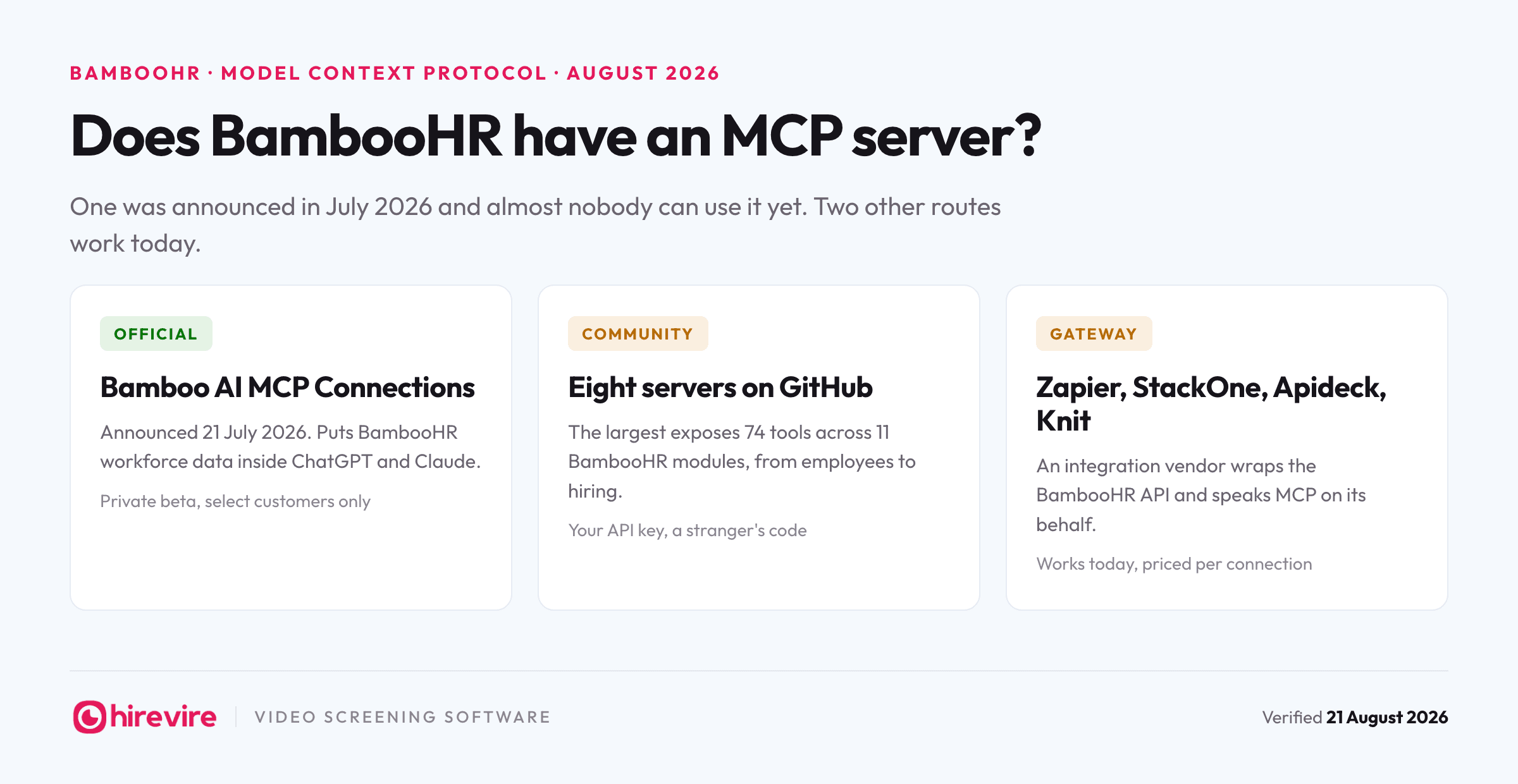
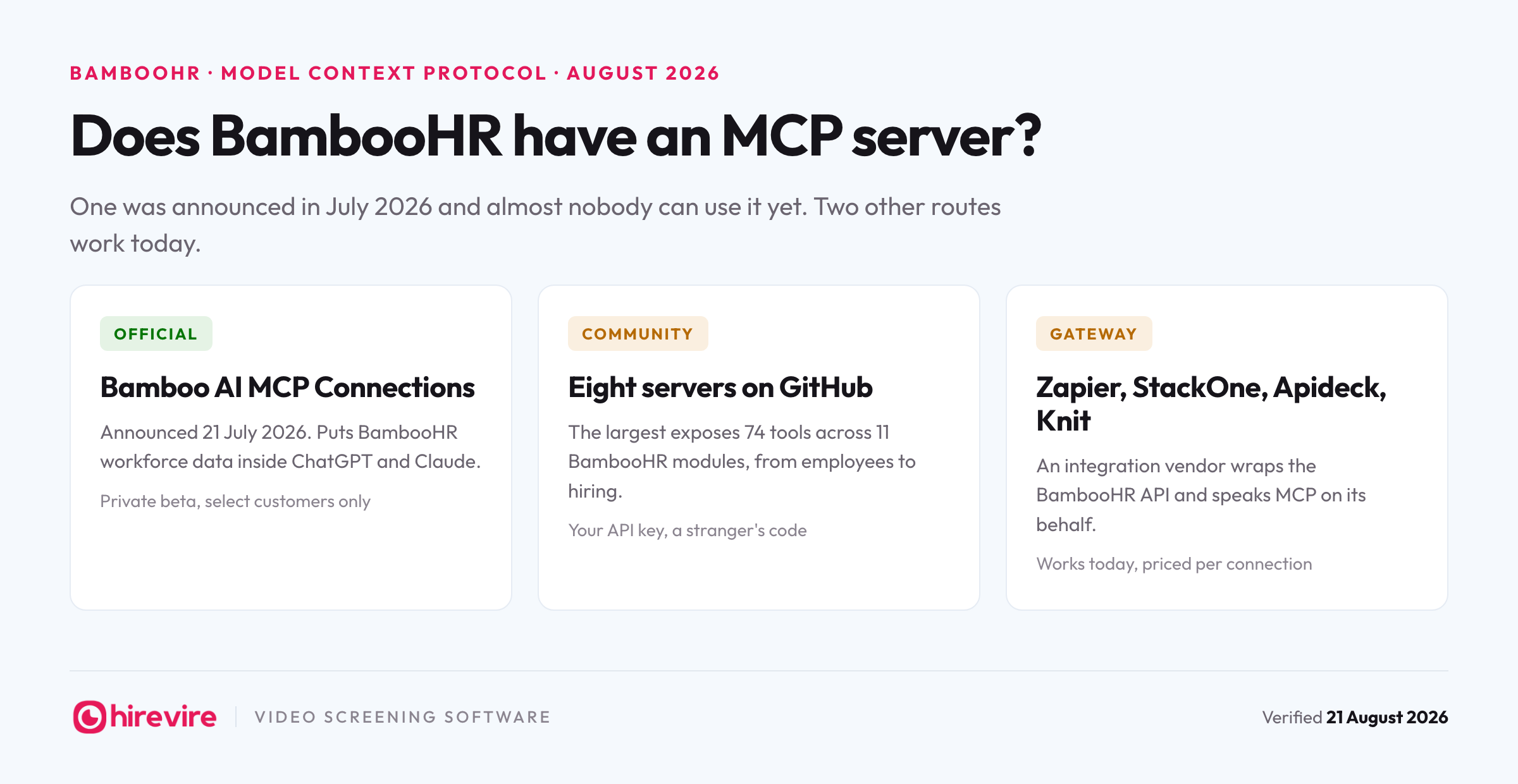
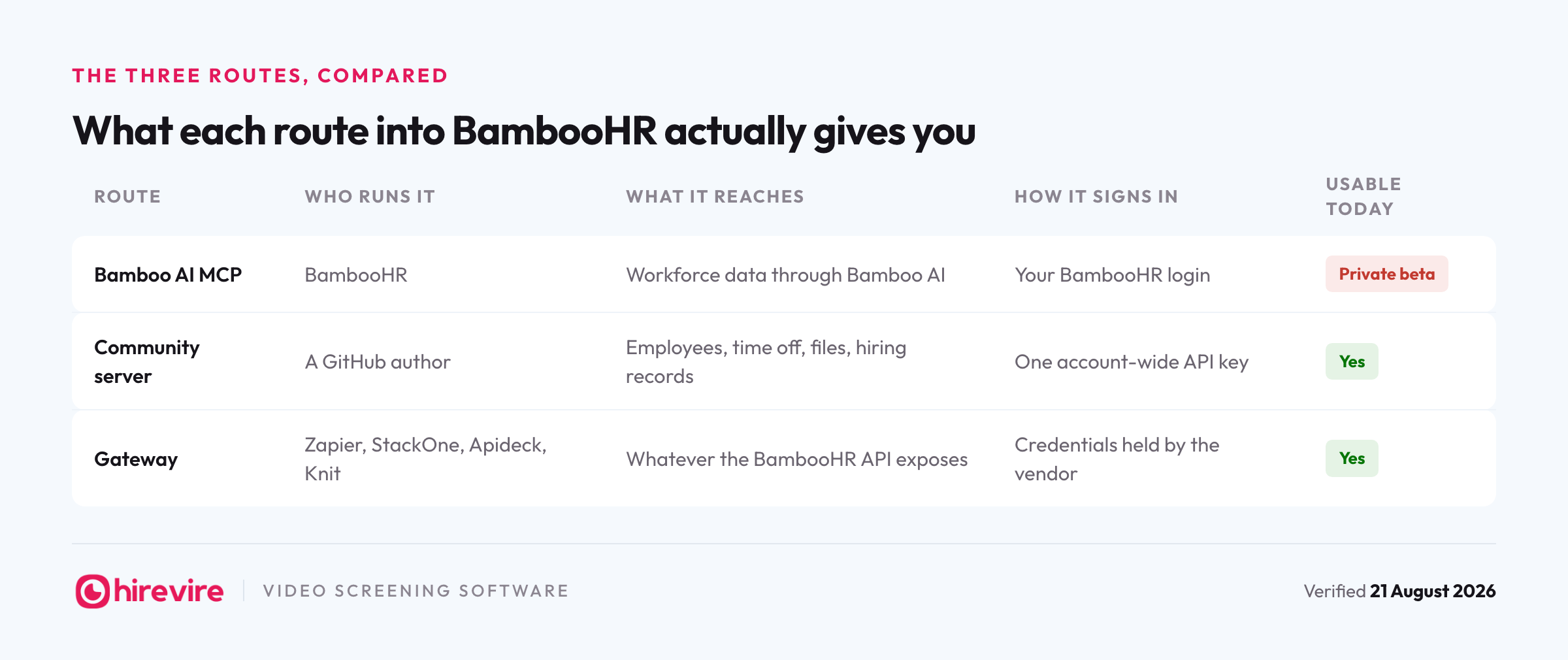
BambooHR announced an official MCP connection on 21 July 2026, and you almost certainly cannot use it. It ships as part of Bamboo AI and it is in private beta for selected customers, with no public server URL and no connection docs. What is available to everyone today is a set of community servers on GitHub and a handful of integration gateways.
Last verified: 21 August 2026. Every claim below was checked against BambooHR's own press releases and developer documentation, plus the GitHub repositories themselves, on that date.
The official answer
BambooHR launched Bamboo AI in July 2026, and MCP Connections were part of it. In BambooHR's own words, the feature brings the intelligence of Bamboo AI into ChatGPT, Claude and other workplace AI tools so customers can act on workforce data in the places they already work.
Read the availability line before you plan around it. Bamboo AI is in private beta with select customers. There is no published server URL, no tool list, and no pricing or plan detail. BambooHR's developer terms of service now reference MCP servers as part of BambooHR-provided developer tools, which is a real signal that the path is being formalised, but a terms document is not a connection you can make on Monday.
So the honest status is: announced, not available. If you are choosing tooling this quarter, treat it as a 2027 possibility.
What you can actually connect today
The community servers
BambooHR has more community MCP implementations than any other HR platform, with roughly eight competing servers published on GitHub. They are not equal.
The most complete is acalder-techpm/bamboohr-mcp, which exposes 74 tools covering 11 BambooHR modules: employees, time off, time tracking, hiring, benefits, training, goals, reports, webhooks, files and metadata. It also bundles 30 role-based skills, which are prewritten workflows for HR admins, managers, recruiters and payroll. Ask "who is out next week on the engineering team" and it calls the right tool with a date range and a department filter.
A tighter option is evrimalacan/mcp-bamboohr, a TypeScript server covering employee data, time off and company files, with a published test suite. Smaller surface area, easier to read before you run it.
Both work the same way in practice. You run the server yourself and you give it a BambooHR API key.
The gateway route
Zapier, StackOne, Apideck, Composio, Knit, Merge and Pipedream all expose BambooHR over MCP. A gateway runs the infrastructure, holds the credentials and translates one MCP connection into many HR APIs.
This is the right choice when one agent needs to read BambooHR, your ATS and your file storage in the same conversation. The trade is a third party sitting in the path of employee data, a per-connection price, and a tool list that mirrors BambooHR's API rather than the questions an HR manager actually asks.
Before you point a community server at employee records
Five checks, in the order that matters:
- Look at how it authenticates. A BambooHR API key is account-wide, not scoped to one person, so the server reaches every record the key reaches no matter what an individual's permissions say in BambooHR itself.
- Read the last commit date before the star count. A server that has not been touched in eight months will break the first time BambooHR changes an endpoint, and nobody is on call for it.
- Check whether it can run read-only. Several of these servers can create and update records, and if you only want an agent answering questions, it should not be able to write.
- Find out where the key gets stored. An environment variable on your own machine is fine. A config file that syncs somewhere is not.
- Ask procurement early. If your organisation needs a signed data processing agreement before a vendor touches employee records, a GitHub repository cannot sign one. This kills more community-server plans than any technical issue.
What none of these routes reach
Look at what the tool lists cover. Employees, time off, benefits, training, goals, reports. Even the 74-tool server's hiring module covers application records: the candidate's name, the source, the stage they sit in, the resume file attached.
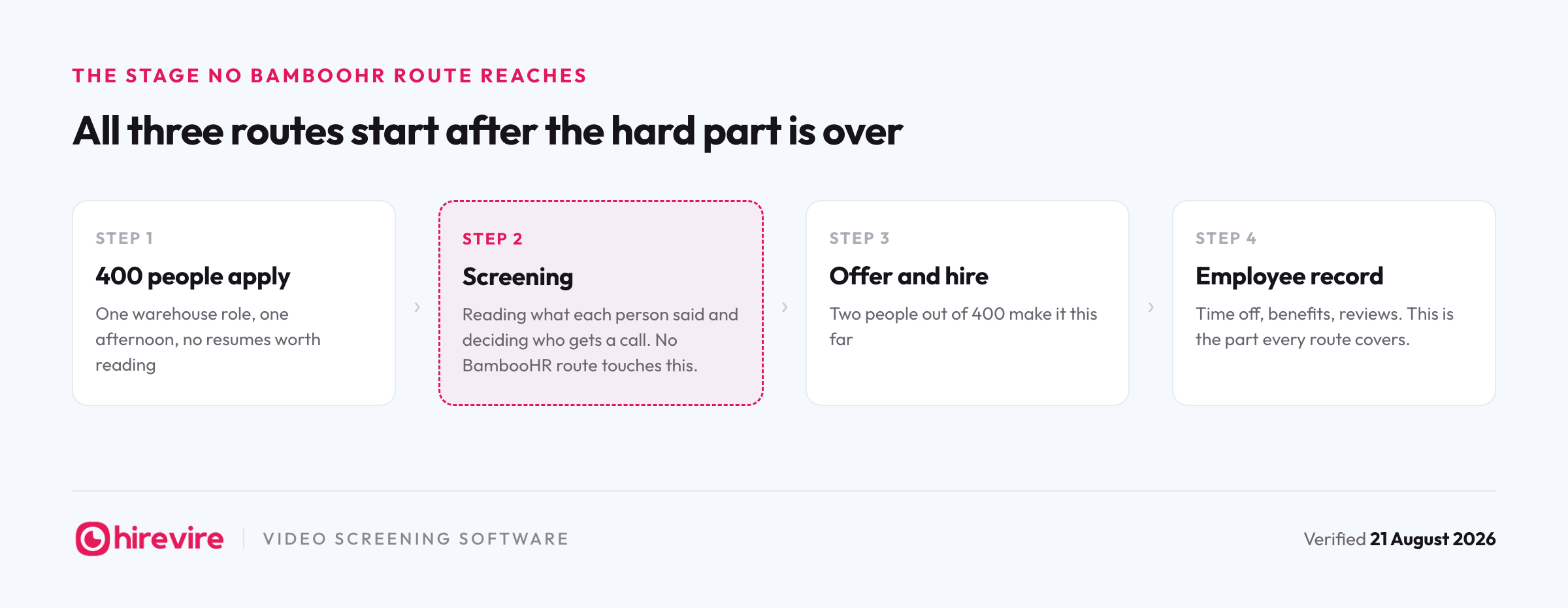
Every one of those describes a person who already exists as a record. The stage where a recruiter spends the actual day is missing.
Screening 400 applicants for a warehouse role means going through 400 sets of answers and deciding which forty are worth a phone call. A BambooHR MCP server, official or community or gateway, can tell your agent that 400 people applied and which stage each sits in. It cannot tell the agent what any of them said, because BambooHR never held that content. The recording, the answer and the score live in whatever tool did the screening.
Pairing BambooHR with a screening tool that has its own MCP
These two systems belong in the same agent. BambooHR holds the employee record, which is what exists after a hiring decision. Screening happens before that record exists, and a few screening tools now run their own MCP servers.
Hirevire is one of them. You copy the server URL from My Account, Integrations, paste it into Claude or ChatGPT, sign in, and choose read only or read and write. After that the agent can post a role, pull every application above a score, read what a specific candidate said, and move people to shortlisted. The permissions follow the person who signed in rather than a shared key, which is the difference that usually matters to a security review.
The arrangement is simple: your agent screens through the screening tool, you make the call, and BambooHR gets the person who was hired.
Frequently asked questions
Does BambooHR have an official MCP server?
Announced but not available. BambooHR introduced MCP Connections as part of Bamboo AI in July 2026, and it is in private beta for selected customers, with no public server URL or connection documentation as of August 2026.
Is a community BambooHR MCP server safe to use with employee data?
It depends on the server and on your policy. The specific risk is that these servers authenticate with an account-wide BambooHR API key rather than an individual login, so the server can read whatever that key can read regardless of the user's own permissions.
Can I connect BambooHR to Claude today?
Yes, through a community server you run yourself or through a gateway such as Zapier, StackOne, Apideck or Knit. Both work. Neither is supported by BambooHR.
Which community BambooHR server is the most complete?
acalder-techpm/bamboohr-mcp, with 74 tools across 11 BambooHR modules and 30 role-based workflow bundles. Larger surface area also means more code to read before you trust it with an API key.
What can a BambooHR MCP server not do?
Screen candidates. Every route covers records about people who already exist in your system. None of them holds what an applicant actually said during screening, because BambooHR never stored that content.
Is a gateway better than a community server?
For most teams, yes, because a gateway is a company that can sign an agreement and answer a support ticket. You pay for that per connection and you accept a third party in the path of your employee data.
The short version
BambooHR's own MCP exists as an announcement and a private beta. What works today is a community server with an account-wide API key, or a gateway with a bill and a contract. Both give an agent good access to employee records, time off and hiring stages.
What neither gives you is the screening stage, which is where the hours actually go. If that is the part of the week you wanted to hand to an agent, Hirevire's MCP server connects with one URL and a sign-in, and sits alongside BambooHR rather than replacing it. The full picture of which HR tools run servers is in our monthly MCP table.
Last verified: 21 August 2026.