Workday MCP: What HR Teams Can Connect Today
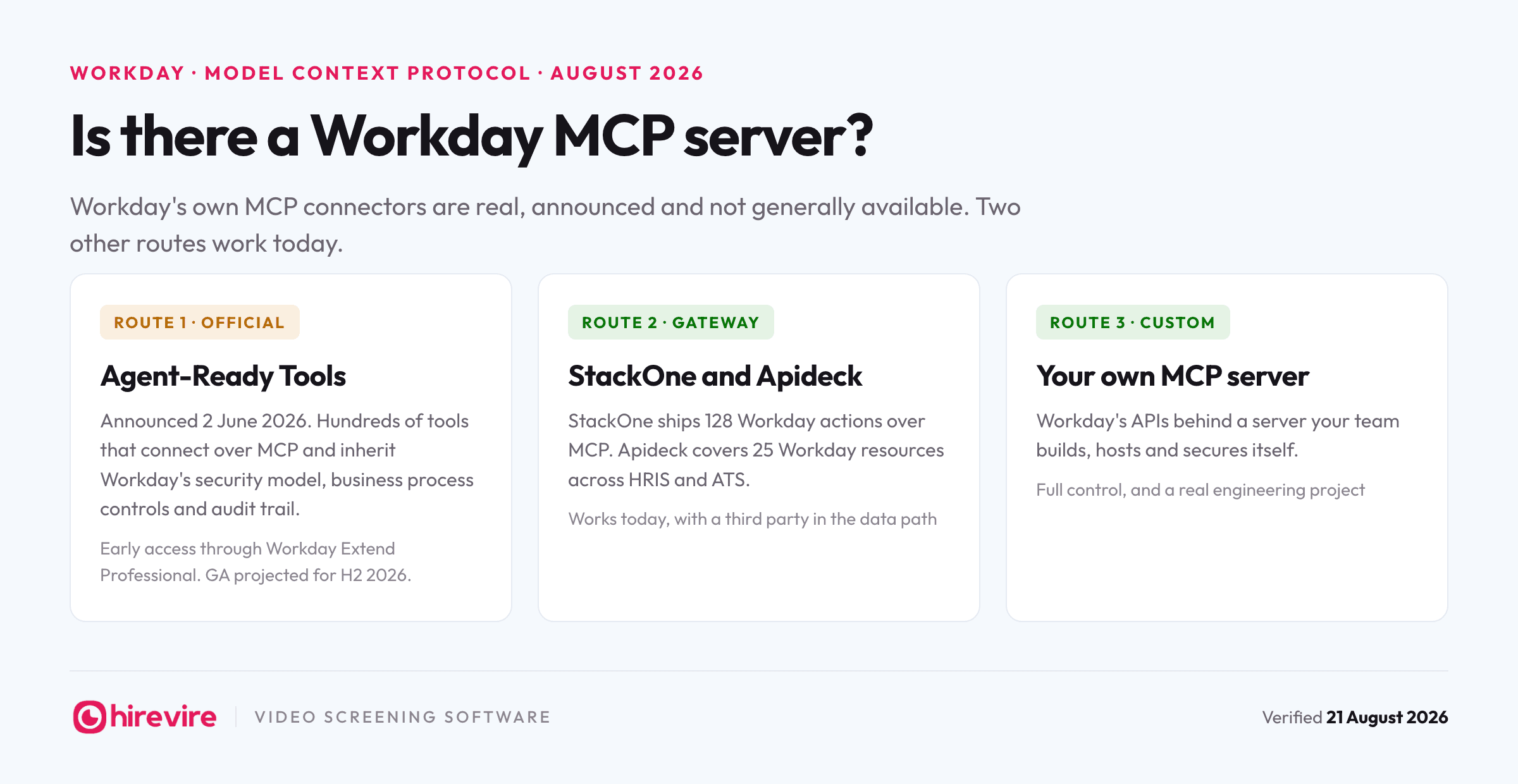
Workday has MCP connectors and most customers cannot use them yet. They are called Agent-Ready Tools, they were announced at Workday DevCon on 2 June 2026, and they are in early access through Workday Extend Professional with general availability projected for the second half of 2026. If you need an agent reading Workday data this quarter, the two routes that work are a gateway or an integration you build yourself.
Last verified: 21 August 2026. Checked against Workday's own newsroom and the gateway vendors' documentation on that date. Statuses in this category change fast, so the date matters as much as the answer.
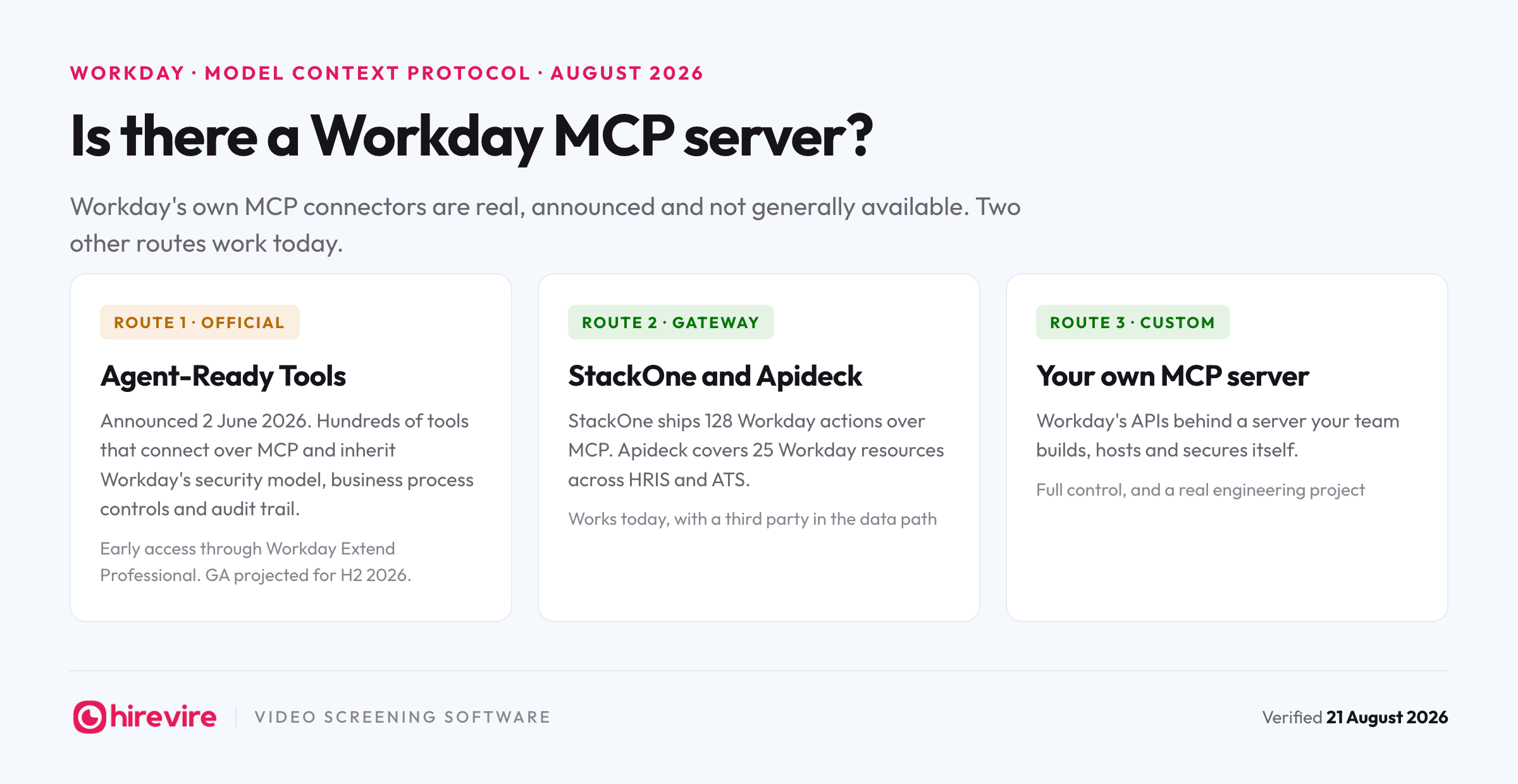
This confusion is not your fault. Workday talks about AI agents constantly, and the announcements blur three different things: what has shipped, what is in early access, and what a partner sells. Here is each route with its actual status.
Route 1: Workday's own Agent-Ready Tools
At DevCon in June 2026, Workday announced a developer stack for agents. Three pieces matter.
Agent-Ready Tools are enterprise connectors built for autonomous agents to read and act on HR and finance data. Workday's own description is the useful part: hundreds of tools that act across all of Workday connect through open standards like MCP, and agents automatically inherit Workday's security and delegation model, business process controls and audit trail. That inheritance is the real selling point. An agent does not get a side door around your approval chains.
Developer Agent lets developers build Workday apps and agents in natural language from tools like Claude Code, Cursor and Codex.
Agent Passport tests and continuously monitors agents against security standards including the OWASP LLM Top 10, NIST AI RMF and MITRE ATLAS.
Now the availability, which is where plans go wrong. Agent-Ready Tools and Developer Agent are in early access through Workday Extend Professional, and general availability is projected for the second half of 2026. Agent Passport reaches early access in the second half of 2026, with general availability projected before the end of the year. Projected is Workday's word, not a commitment.
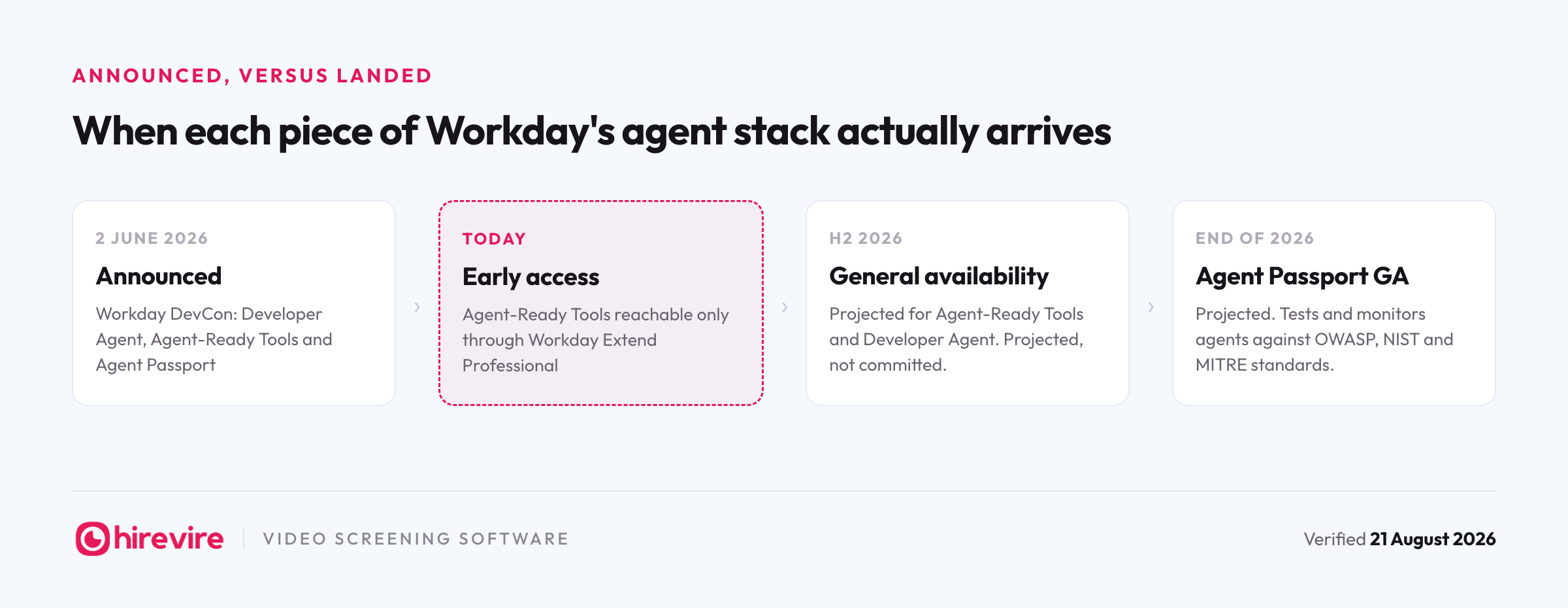
Two practical consequences. Extend Professional is a paid SKU, so this is not something a Workday customer switches on from a settings page. And an early access tool list can change between releases, which matters a great deal if you are scripting against it and much less if a recruiter is typing questions into a chat window.
Route 2: gateways
If you want an agent reading Workday today, this is the route that works.
StackOne runs a hosted Workday MCP server with 128 prebuilt actions, plus managed authentication and an execution runtime. Connect it to Claude, Cursor or any MCP client. Apideck takes a broader approach, exposing 25 Workday resources across HRIS, ATS and accounting through one server that also covers 200 or so other applications.
The honest limits are worth stating. You are putting a third party in the path of employee and finance data, which is a procurement conversation at most Workday-sized companies. You pay per connection. And the tool list mirrors Workday's API surface rather than the questions an HR manager asks, so an agent gets a lot of endpoints and not much shape.
For a team that wants one agent reading Workday alongside their ATS and file storage, a gateway is still the shortest path by a wide margin.
Route 3: build it yourself
Workday publishes APIs, and an enterprise team can wrap them in an MCP server it hosts and secures itself. This is the route large Workday customers pick when data cannot leave their control, when they need a tool list shaped around their own processes, or when they already have an integration team maintaining Workday connections.
It is a real project, not an afternoon. The upside is that when Agent-Ready Tools reach general availability you can swap the transport underneath and keep the tool design you already validated.
The part recruiting still misses
Read Workday's DevCon announcement closely and one thing is absent: recruiting. The announcement covers HR, finance and IT, and says nothing specific about Workday Recruiting workflows.
The reason that matters is structural. Requisitions, approvals, offers and the record of hire live comfortably in Workday and are the kind of structured object an agent handles well. The screening stage does not live there at all. When 400 people apply for 30 warehouse roles, Workday can tell an agent that 400 applications exist and which stage each sits in. It cannot tell the agent how any of those people described handling a difficult shift, because that content was never in Workday.
So even after Agent-Ready Tools reach general availability, the highest-volume, most repetitive stage of hiring stays outside the agent's reach unless something else supplies it.
The pattern teams use while they wait
Rather than waiting for a Workday route to cover screening, teams put an MCP-native screening layer in front of Workday and leave Workday doing what it does well.
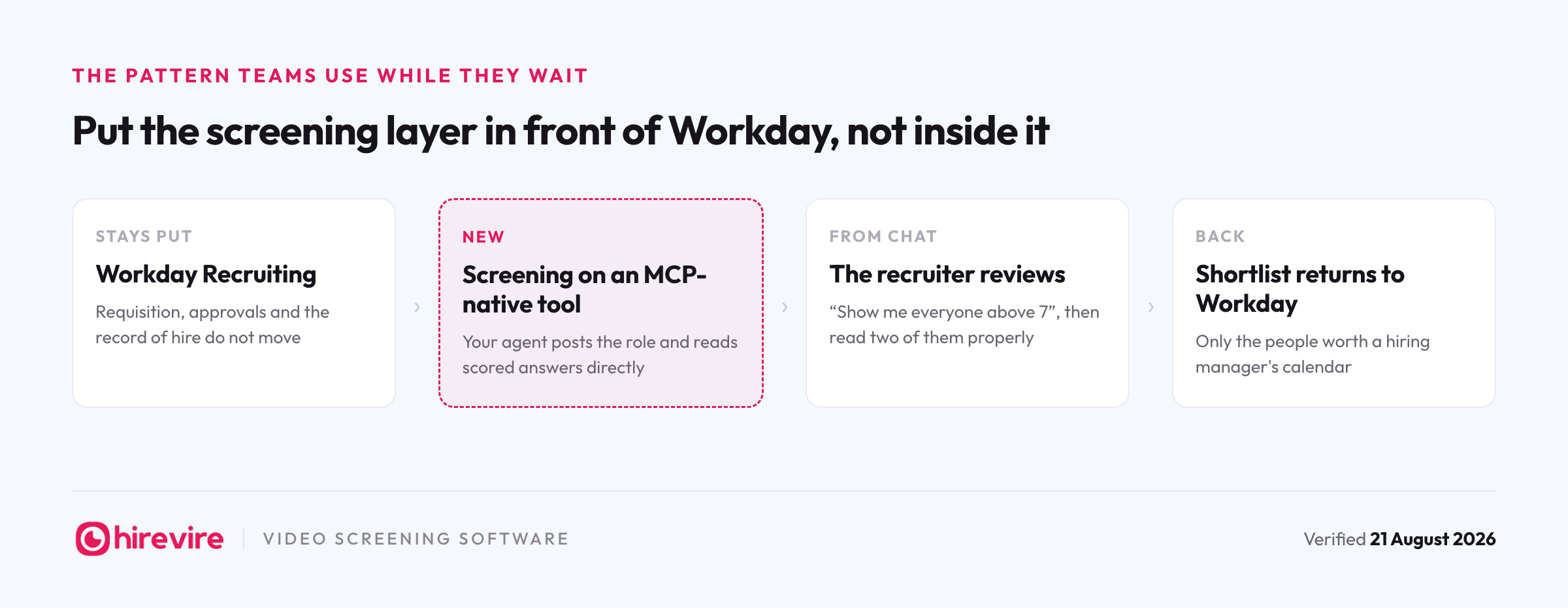
In practice that means Hirevire runs the screening round and exposes it over its own MCP server. A recruiter copies the server URL from My Account, Integrations, pastes it into Claude or ChatGPT, signs in, and picks read only or read and write. Then the agent can post the role, pull every application above a score, read what a specific person said, and move the top twenty to shortlisted. Sign-in is per user over OAuth, so the agent inherits that recruiter's permissions instead of a shared key.
Workday keeps the requisition, the approvals and the hire. The shortlist arrives with only the people worth a hiring manager's calendar. Our guide to adding screening automation to your ATS covers how results flow back for the major systems including Workday.
Frequently asked questions
Is there an official Workday MCP server?
Yes and no. Workday's Agent-Ready Tools connect over MCP, but they are in early access through Workday Extend Professional, with general availability projected for the second half of 2026. Most customers cannot use them today.
Can Claude read Workday data right now?
Yes, through a gateway. StackOne runs a hosted Workday MCP server with 128 actions and Apideck covers 25 Workday resources, both connectable to Claude today. Neither is run by Workday.
What is the safest route today?
If your security team will not accept a third party in the data path, build your own MCP server on Workday's APIs. If they will, a gateway is faster and cheaper. Waiting for Agent-Ready Tools is reasonable only if your timeline runs past general availability.
Do Agent-Ready Tools cover recruiting?
Workday's announcement covers HR, finance and IT without naming recruiting specifically. Requisitions and hires are structured Workday objects that an agent should handle well. Screening content was never stored in Workday, so no Workday route reaches it.
What does Agent-Ready Tools cost?
It is reached through Workday Extend Professional, a paid product, and Workday has not published separate pricing for the tools themselves. Talk to your account team before planning around it.
What is Agent Passport?
A Workday product that tests, verifies and continuously monitors AI agents against security standards including the OWASP LLM Top 10, NIST AI RMF and MITRE ATLAS. Early access in the second half of 2026, general availability projected before the end of 2026.
The short version
Workday's own MCP connectors are real, well designed and not generally available. A gateway from StackOne or Apideck works today at the cost of a third party in your data path. Building your own works today at the cost of an engineering project.
None of the three reaches screening, because Workday never held what candidates said. If that stage is the one eating your recruiters' week, Hirevire's MCP server connects in about five minutes and sits in front of Workday rather than replacing any of it. Our monthly MCP table tracks the status of 22 HR tools including this one.
Last verified: 21 August 2026.