Interview Scorecard Template + How to Score Candidates
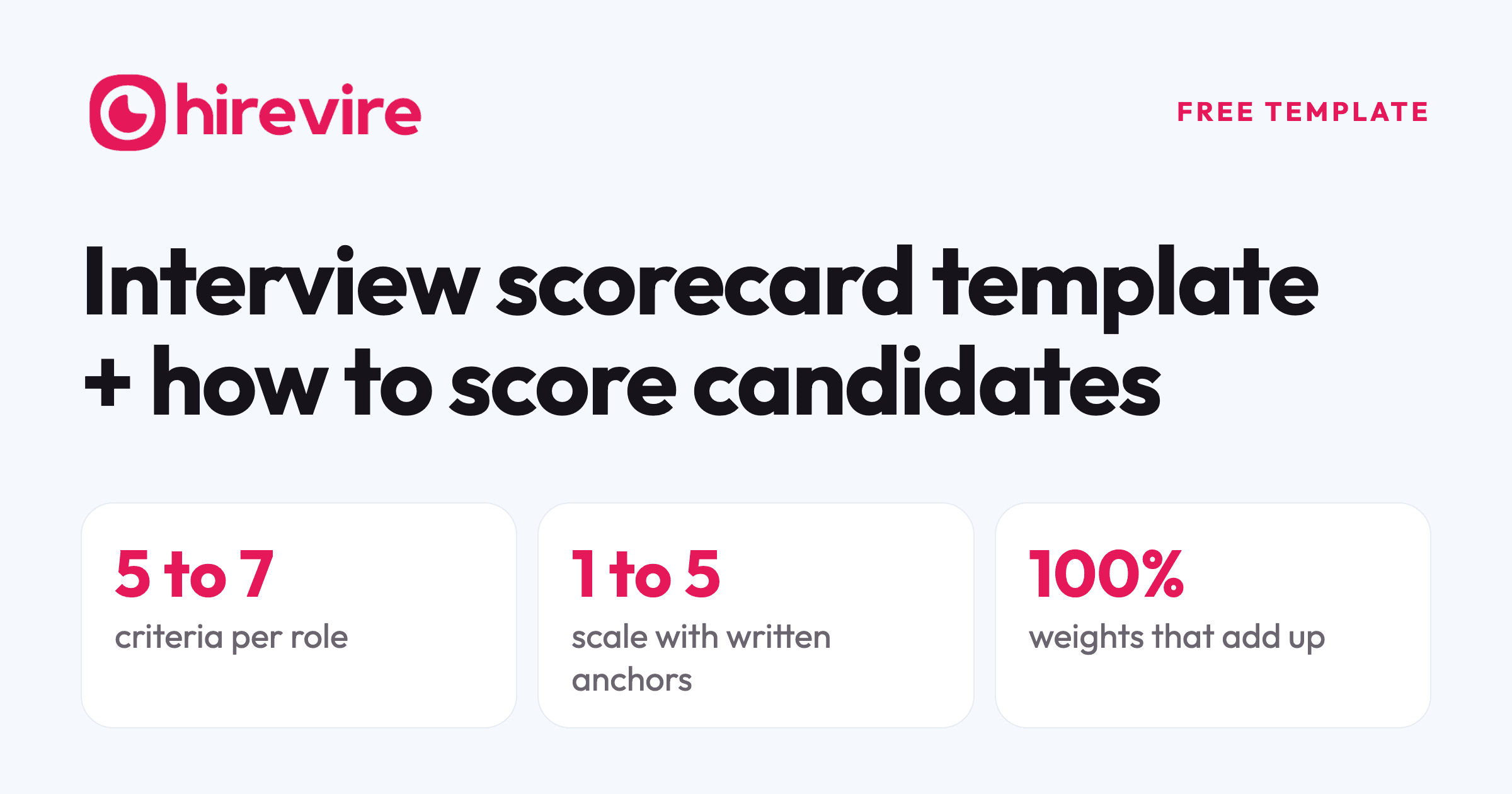
An interview scorecard template is a one-page sheet that lists five to seven skills the job needs, gives each skill a weight, and describes what a 1, a 3 and a 5 answer sound like. Every interviewer scores the same skills on the same 1 to 5 scale, writes one line of evidence, and only then compares notes. The free template below is built for a customer service role and takes about 20 minutes to adapt to any other job. To have the same rubric applied to every applicant's recorded answers, try Hirevire free for 7 days, no credit card needed.
What is an interview scorecard?
An interview scorecard is the form each interviewer fills in while or right after talking to a candidate. It holds the criteria for the role, a rating scale, a weight per criterion and space for evidence. The finished score lets a hiring team compare ten candidates on the same terms, even when three different people ran the interviews.
The scale is the part most teams get wrong. A bare "rate communication 1 to 5" invites gut feel, because one interviewer's 4 is another's 3. A scorecard works when each number has a written description, called an anchor, that any interviewer can match an answer against. The US Office of Personnel Management recommends exactly this for structured interviews: a rating scale with behavioral examples at each level.
A scorecard and a rubric are often used as the same word. Strictly, the rubric is the set of anchors for each criterion, and the scorecard is the sheet that carries the rubric, the weights and the final score.
Interview scorecard template (copy this)
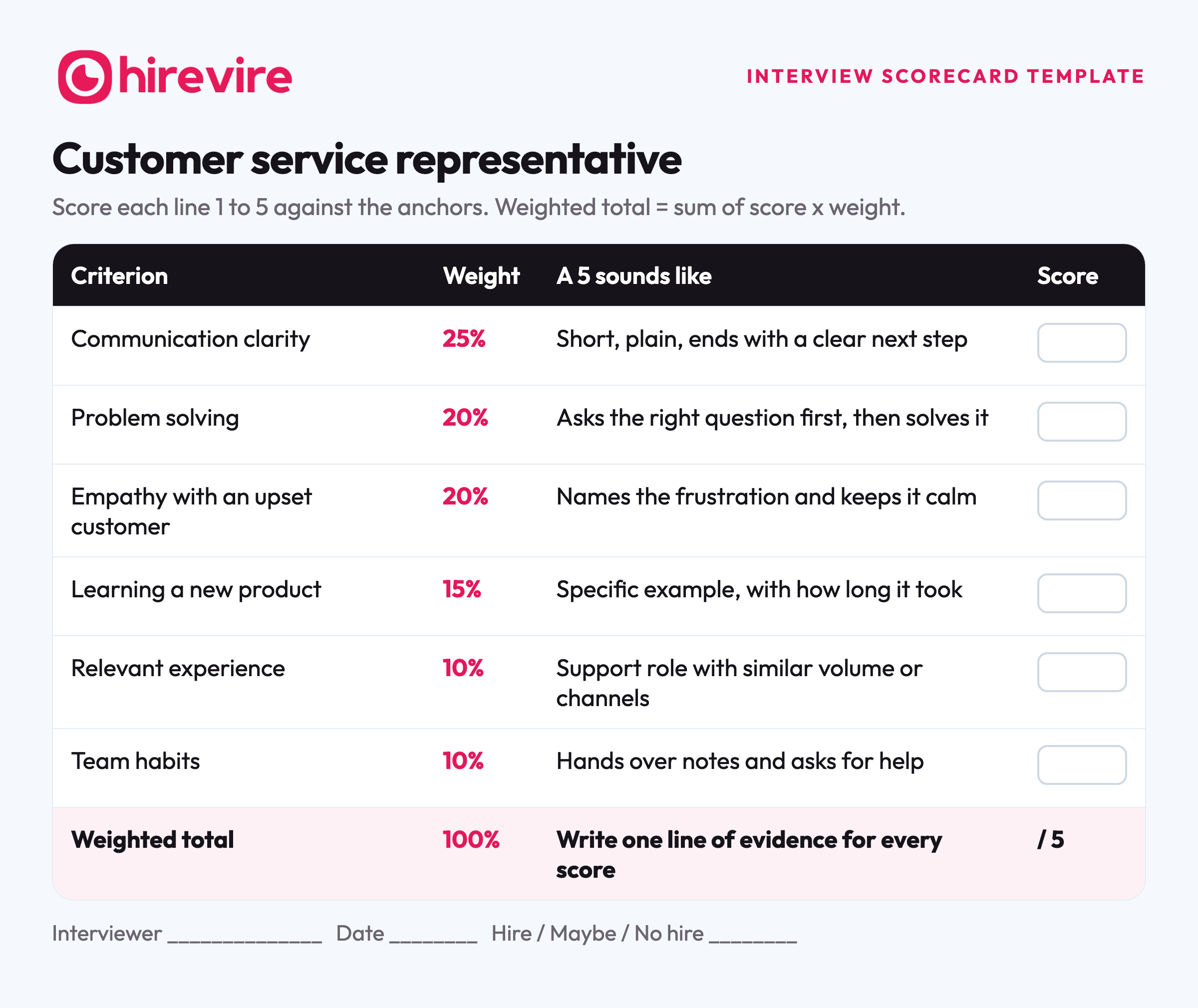
Copy the table into a spreadsheet or a doc. The weights add up to 100%. The example role is a customer service representative who handles phone and chat support.
| Criterion | Weight | What a 1 sounds like | What a 3 sounds like | What a 5 sounds like | Score (1 to 5) | Evidence |
|---|---|---|---|---|---|---|
| Communication clarity | 25% | Rambles, the customer would not know the next step | Clear, with some filler or jargon | Short, plain, ends with a clear next step | ||
| Problem solving | 20% | Guesses or escalates at once | Finds the fix with prompting | Asks the right question first, then solves it | ||
| Empathy with an upset customer | 20% | Defensive or scripted | Polite, acknowledges the problem | Names the customer's frustration and keeps it calm | ||
| Learning a new product | 15% | No example of learning a tool fast | One example, little detail | Specific example with how long it took | ||
| Relevant experience | 10% | No customer-facing work | Some customer-facing work | Support role with similar volume or channels | ||
| Team habits | 10% | Blames others in examples | Neutral examples | Shows handing over notes and asking for help | ||
| Weighted total | 100% | out of 5 |
Under the table, add three lines: the interviewer's name, the date, and a hire, maybe or no-hire call written before reading anyone else's scorecard.
Ready-made rubrics for other roles sit in the AI Scorecard and Rubric Library, for example the account executive scorecard, the registered nurse scorecard and the virtual assistant scorecard.
How do you build an interview scorecard for a new role?
Start from what the person must do in their first 90 days and work back to five to seven criteria. Fewer than five misses things; more than seven and interviewers stop reading the anchors.
- List the three or four tasks that fill most of the week. For a support role that is answering tickets, calming upset customers and learning product changes.
- Turn each task into a skill you can hear in an answer: clarity, problem solving, empathy, learning speed.
- Add one or two criteria for experience and how the person works with a team.
- Weight the criteria so the skills that decide success carry the most. A single criterion above 30% usually means the other criteria are padding.
- Write the anchors for 1, 3 and 5. Leave 2 and 4 as "between the two". Writing all five levels takes twice as long and interviewers rarely use the difference.
- Attach one or two interview questions to each criterion, so every candidate gets the same chance to show each skill. The screening questions guide has questions sorted by skill.
- Move hard requirements out of the scorecard. Work authorisation, shift availability or a required licence are yes or no checks, and they belong in knockout questions asked before the interview.
Show the draft to the hiring manager before the first interview. Changing the weights after you have seen candidates turns the scorecard into a way to justify a favourite.
How do you score a candidate on a 1 to 5 scale?
Score each criterion on its own, from the answer you heard, using the anchors. Write one line of evidence next to every score, a short quote or a fact from the answer. "Said she would refund first and investigate later" is evidence. "Seemed confident" is an impression.
A few habits keep the numbers honest:
- Score right after each answer while the detail is fresh. Waiting until the end blends answers into one overall feeling.
- Use the whole scale. If nobody ever gets a 1 or a 5, the anchors are too vague or the interviewer is hedging.
- Score what was said in this interview. A strong CV is already in "relevant experience" and should not lift every other line.
- When an answer sits between two anchors, give the lower number and say why in the evidence column. The team can raise it in the debrief.
How do you calculate a weighted interview score?
Multiply each score by its weight and add the results. The total stays on the same 1 to 5 scale, so a 3.8 reads the way a 4 does on any single line.
Here are two candidates for the customer service role, scored with the template above.
| Criterion | Weight | Candidate A | A weighted | Candidate B | B weighted |
|---|---|---|---|---|---|
| Communication clarity | 25% | 4 | 1.00 | 3 | 0.75 |
| Problem solving | 20% | 3 | 0.60 | 4 | 0.80 |
| Empathy with an upset customer | 20% | 5 | 1.00 | 3 | 0.60 |
| Learning a new product | 15% | 4 | 0.60 | 3 | 0.45 |
| Relevant experience | 10% | 2 | 0.20 | 5 | 0.50 |
| Team habits | 10% | 3 | 0.30 | 4 | 0.40 |
| Total | 100% | 3.70 | 3.50 |
Candidate B has five years in a call centre and would win on a CV screen. Candidate A scores higher because the role is weighted toward clarity and handling an upset customer, which is what the job needs every day. The weights did their job: they made the team say in advance what matters most.
In a spreadsheet, put the weights in column B as decimals and the scores in column C, then use =SUMPRODUCT(B2:B7,C2:C7) for the total.
How do you keep scores consistent across interviewers?
Give everyone the same questions in the same order, have each person score alone, and calibrate on a shared example before the first real interview.
Calibration takes 15 minutes. Pick one recorded answer, ask every interviewer to score it against the anchors without talking, then compare. Where scores differ by two points or more, the anchor needs rewording. A recorded answer helps here because everyone judges the exact same words. With live interviews, each person heard a slightly different conversation.
Two more rules from structured interviewing research, including the guidance Google published on its re:Work site:
- No one sees other scorecards until theirs is submitted. The first opinion in a debrief pulls every later one toward it.
- In the debrief, go through the criteria where scores differ one line at a time, starting with the biggest gap.
Structured interviews with fixed questions and anchored scales predict job performance better than unstructured ones. A 2022 re-analysis of selection research by Sackett and colleagues in the Journal of Applied Psychology put structured interviews at the top of the list of common hiring methods. Psychologist Scott Highhouse's 2008 review explains why managers still trust their gut over a scorecard, and why the scorecard usually wins.
Which criteria lead to biased scores?
Vague criteria leave room for bias, because interviewers fill the gap with their own taste. "Culture fit", "presence" and "polish" are the usual culprits. Replace each with the behaviour you mean: "asks for help when stuck", "explains a decision to a customer in two sentences".
Keep anything linked to a protected characteristic off the sheet, along with proxies such as accent, appearance, age cues or "energy". If a criterion cannot be described with a 1, 3 and 5 anchor that refers to what the candidate said or did, drop it. The EEOC's guidance on employment tests and selection procedures applies to interview scoring too: the method has to be job-related and consistent with business necessity, and every candidate should be scored the same way.
How do you score every applicant automatically?
Write the rubric once and let software apply it to each recorded answer. Hirevire's AI Scorecards take the factors, weights and 1 to 5 descriptions you write and score every application against them, with written feedback for each factor that explains which part of the answer earned the score.
Hirevire
Hirevire is one-way video screening software. You set up the questions and the scorecard, send one link, and candidates record their answers in the browser on a phone or laptop without creating an account. Each answer arrives with an AI transcript in 90+ languages and a 1 to 5 score per factor from your rubric.
How the template above maps to Hirevire:
- Each row of the template becomes a factor, with its weight and the 1, 3 and 5 descriptions.
- Auto-disqualification handles the yes or no requirements before anyone records, and disqualified responses do not count against your quota.
- Recruiters still rate each interview 1 to 5 themselves and leave notes, so the AI score sits next to the human one.
- Follow-up questions ask a candidate for more detail on a weak line without booking a call.
- Shared review links send the scored shortlist to a hiring manager or client who does not have a login.
- Zapier, Make and ATS integrations pass scores on to the tools you already use, and webhooks on the Agency plan connect anything else.
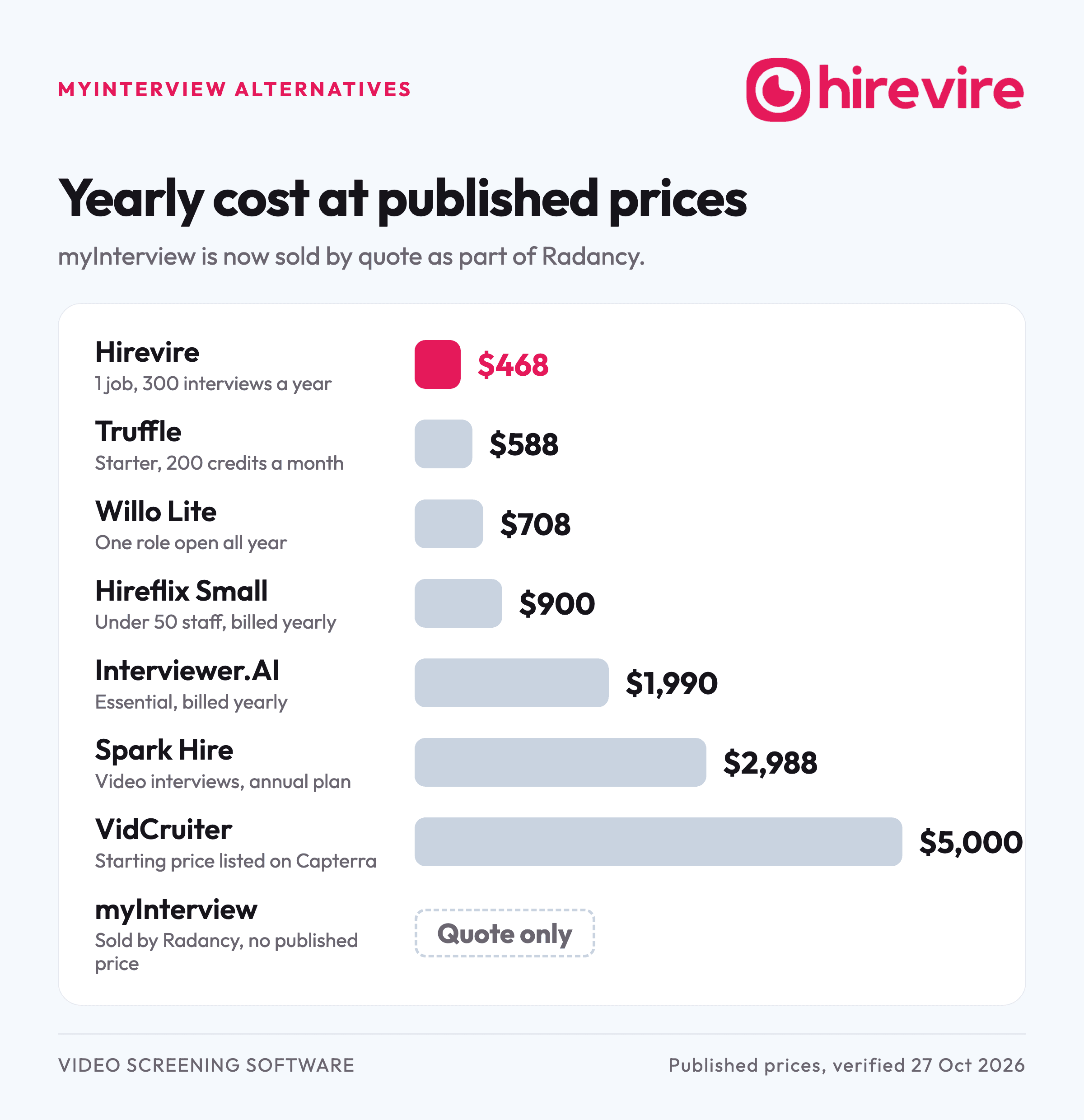
AI Scorecards and transcripts are on every plan. Essentials costs $39 a month billed yearly ($468 a year) for one active job and 300 interviews a year; Professional and Agency add more jobs, users and interviews. See pricing for the full table. To score your next role's applicants against the template above, try Hirevire free for 7 days, no credit card needed.
The score is advice for the reviewer. The rubric comes from your team, the reasoning is visible on every factor, and the person reviewing makes the call. For more on how AI scoring compares with manual scorecards, read the candidate interview scorecards guide.
See a scored screening from start to finish
The walkthrough below shows a one-way interview from the candidate's link to the transcript and the scored answers. To build the same flow with your own scorecard, try Hirevire free for 7 days, no credit card needed.
Frequently asked questions
What should be on an interview scorecard?
Five to seven job criteria, a weight for each, a 1 to 5 scale with written anchors for 1, 3 and 5, an evidence column, the interviewer's name and date, and a hire, maybe or no-hire call made before the debrief.
How many criteria should an interview scorecard have?
Five to seven. Fewer leaves out skills the role needs, and more than seven makes interviewers skim the anchors and score on overall impression.
What is the difference between an interview scorecard and a rubric?
The rubric is the set of descriptions that define each score level for a criterion. The scorecard is the full sheet: criteria, weights, the rubric, the scores and the evidence.
How do you calculate a weighted interview score?
Multiply each criterion's 1 to 5 score by its weight and add the results. With weights that total 100%, the final number stays on the 1 to 5 scale. In a spreadsheet, SUMPRODUCT of the weights and scores does it in one formula.
Should interviewers see each other's scores before the debrief?
No. Each interviewer submits a scorecard alone first. Seeing an earlier score pulls later ratings toward it and hides real disagreement about the candidate.
Can AI score interviews against your own scorecard?
Yes. Tools such as Hirevire's AI Scorecards apply the factors, weights and anchors you write to each recorded answer and explain every score in writing. The recruiter reviews the reasoning and makes the decision.
Is there a free interview scorecard template?
Yes. The template on this page is free to copy into a spreadsheet, and the Hirevire Rubric Library has ready-made rubrics for hundreds of roles.
Sources
- U.S. Office of Personnel Management, Structured Interviews
- Google re:Work, Use structured interviewing
- Sackett, Zhang, Berry and Lievens (2022), Revisiting meta-analytic estimates of validity in personnel selection, Journal of Applied Psychology
- Highhouse (2008), Stubborn reliance on intuition and subjectivity in employee selection, Industrial and Organizational Psychology
- U.S. EEOC, Employment Tests and Selection Procedures
- Hirevire AI Scorecards
- Hirevire pricing
- Hirevire AI Scorecard and Rubric Library