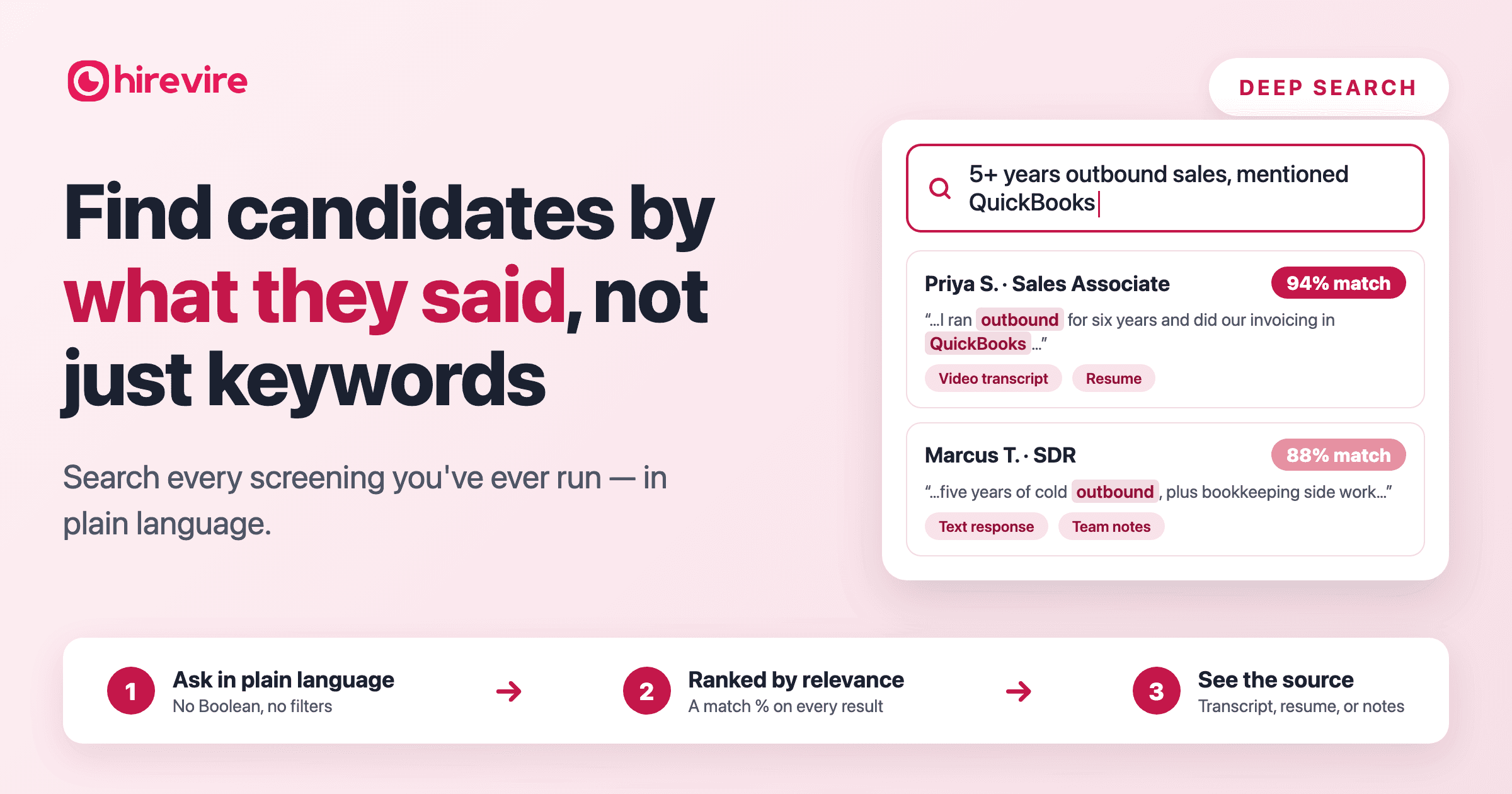
SMS Recruiting: Screen Hourly & Deskless Staff Faster
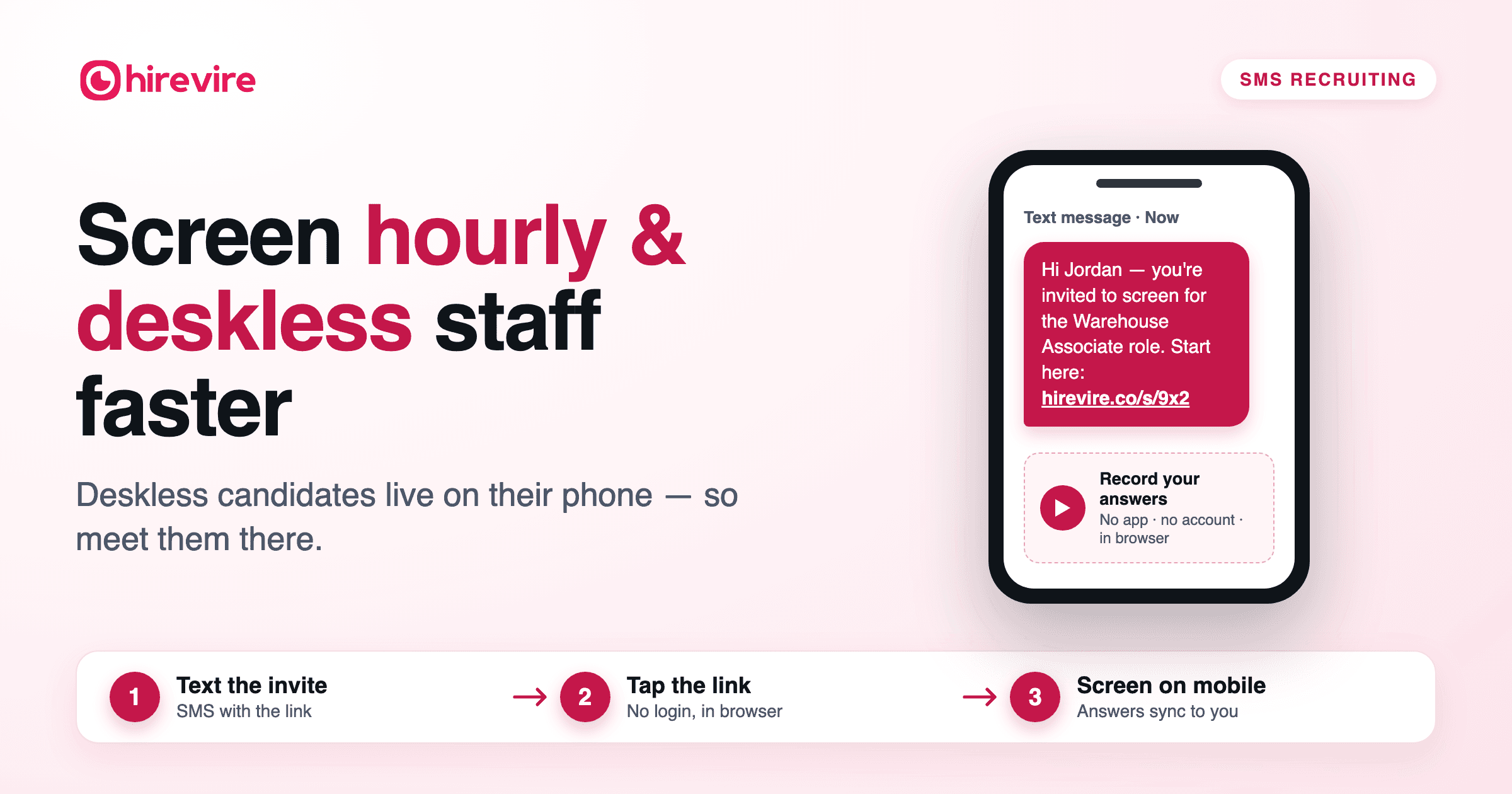
SMS recruiting means reaching candidates where they actually are — their phone — instead of an email inbox they rarely open. In Hirevire, that looks like an SMS invite template that texts each applicant their interview link, which opens a no-login mobile screening: they tap the link, record video, audio, or text answers in the browser, and hit submit — no app, no account, no password. Their responses land straight in your pipeline. For hourly and deskless roles, that single change — text instead of email, tap instead of log in — is the difference between a filled shift and a ghosted one.
If you hire warehouse pickers, retail associates, call-center agents, drivers, or care staff, you already know the pattern: you post a role, applications pour in, and then the funnel leaks. You email an assessment link and hear nothing. You call and get voicemail. The candidate who was keen on Monday has taken another job by Thursday. The bottleneck usually isn't sourcing — it's the gap between "applied" and "screened." SMS closes that gap because deskless workers read texts within minutes, not days.
This page is about using SMS as the delivery layer on top of fast, mobile-first screening — not about turning your recruiting into a bulk-marketing channel. Here's the honest version of what that does and doesn't include.
Key takeaways
| The email-first way | The problem | The SMS + no-login way |
|---|---|---|
| Email the screening link | Deskless candidates rarely check email; open rates crater | Text the link — read within minutes |
| Send a portal that needs an account | Sign-up friction kills mobile completion | Tap the link, record in-browser, no login |
| Desktop-oriented assessment | Candidates are on a phone, not a laptop | Mobile-first by default, finished in one sitting |
| Chase no-shows by phone | Voicemail, tag, repeat | Automated SMS reminders with the same link |
| SMS billed as a metered ATS add-on | Per-message costs stack up | Invite + reminder templates included in the plan |
Why deskless hiring breaks on email
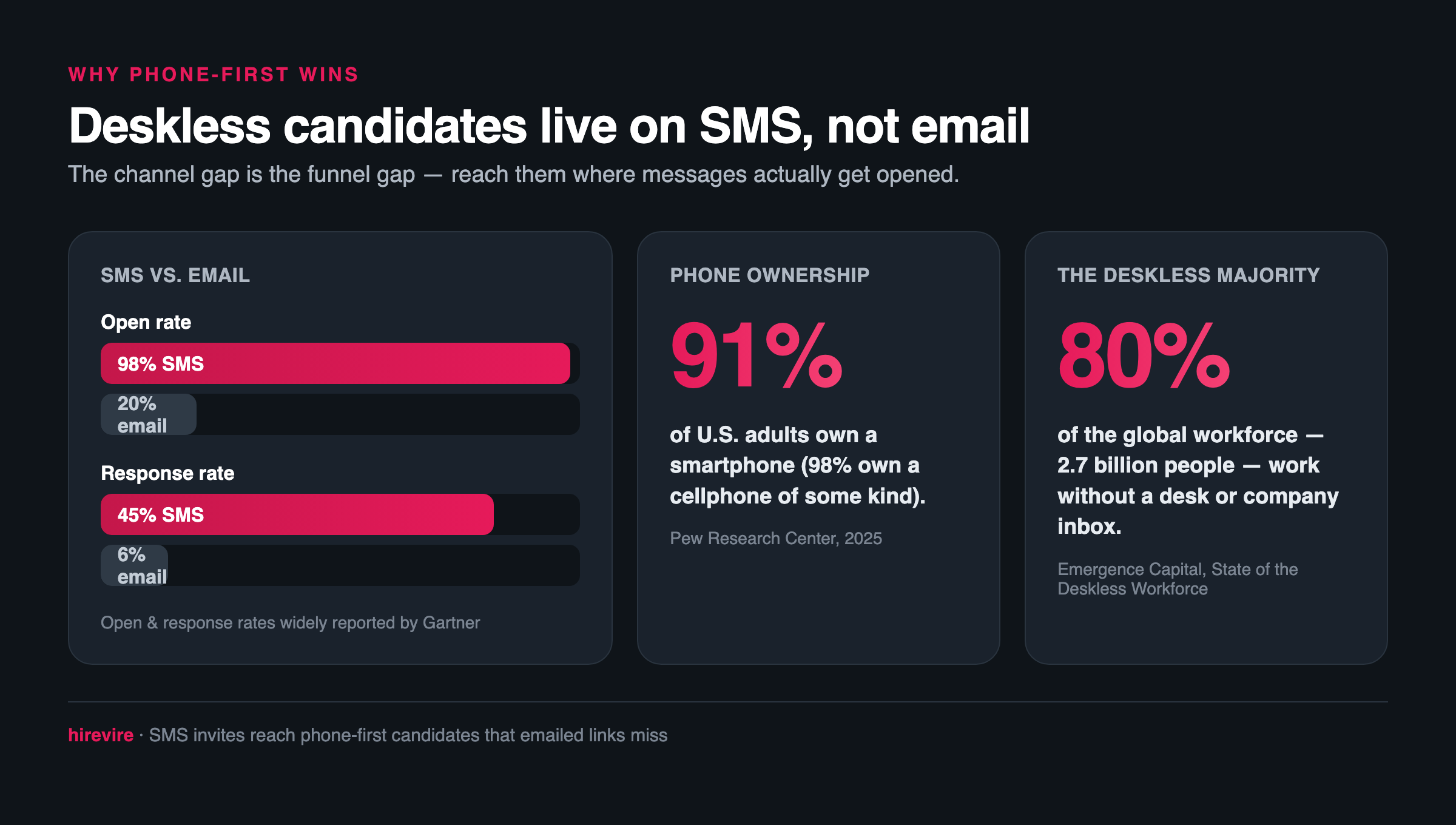
Around 80% of the global workforce — 2.7 billion people — is deskless, according to Emergence Capital's State of the Deskless Workforce report. They don't sit in front of a company inbox all day. Yet almost all of them carry a phone: Pew Research Center found that 91% of U.S. adults own a smartphone, and 98% own a cellphone of some kind. When you send an hourly candidate a screening email, you're routing your most time-sensitive message through the channel they check least. It sits unread next to promotions and receipts, and by the time they see it, the shift you were hiring for is already at risk.
The channel math is stark. SMS open rates are widely reported by Gartner at around 98%, versus roughly 20% for email — and SMS response rates near 45% against about 6% for email. For a funnel that lives or dies on how many invited candidates actually start, that gap is the whole game.
Then there's the login wall. Ask a candidate on a phone, standing in a break room, to create an account and set a password before they can even start, and a large share simply won't. Every extra step between "I'm interested" and "I've answered your questions" is a place to lose them. For high-volume roles where you need dozens of completed screens a week, that drop-off compounds fast.
Text messaging inverts both problems. It goes to the device that's already in their hand, and — paired with a link that opens without a login — it turns screening into something a candidate can finish before their break ends.
What SMS recruiting actually is
SMS recruiting (also called text recruiting) is using text messages to move candidates through hiring — most usefully, to deliver the screening invite and the reminders that follow. It's not one single product category; it's a delivery channel bolted onto whatever screening you already run. The value shows up entirely in the numbers that matter for hourly hiring: how many invited candidates actually start, and how fast.
There's an important distinction to draw, because the term gets stretched. On one end, "SMS recruiting" can mean bulk marketing — nurture campaigns, drip sequences, mass outreach to sourced leads. On the other, it means transactional recruiting texts: "Here's your interview link," "Reminder — your screening is still open." Hirevire is firmly in the second camp. It texts each candidate the invite and reminder tied to their own screening, then gets out of the way. If you're looking for a conversational SMS chatbot or a marketing-automation platform, that's a different tool. If you want the fastest possible path from applied to screened for phone-first candidates, that's exactly this.
The flow: text → tap → screen → ATS
Here's the end-to-end loop for a single candidate:
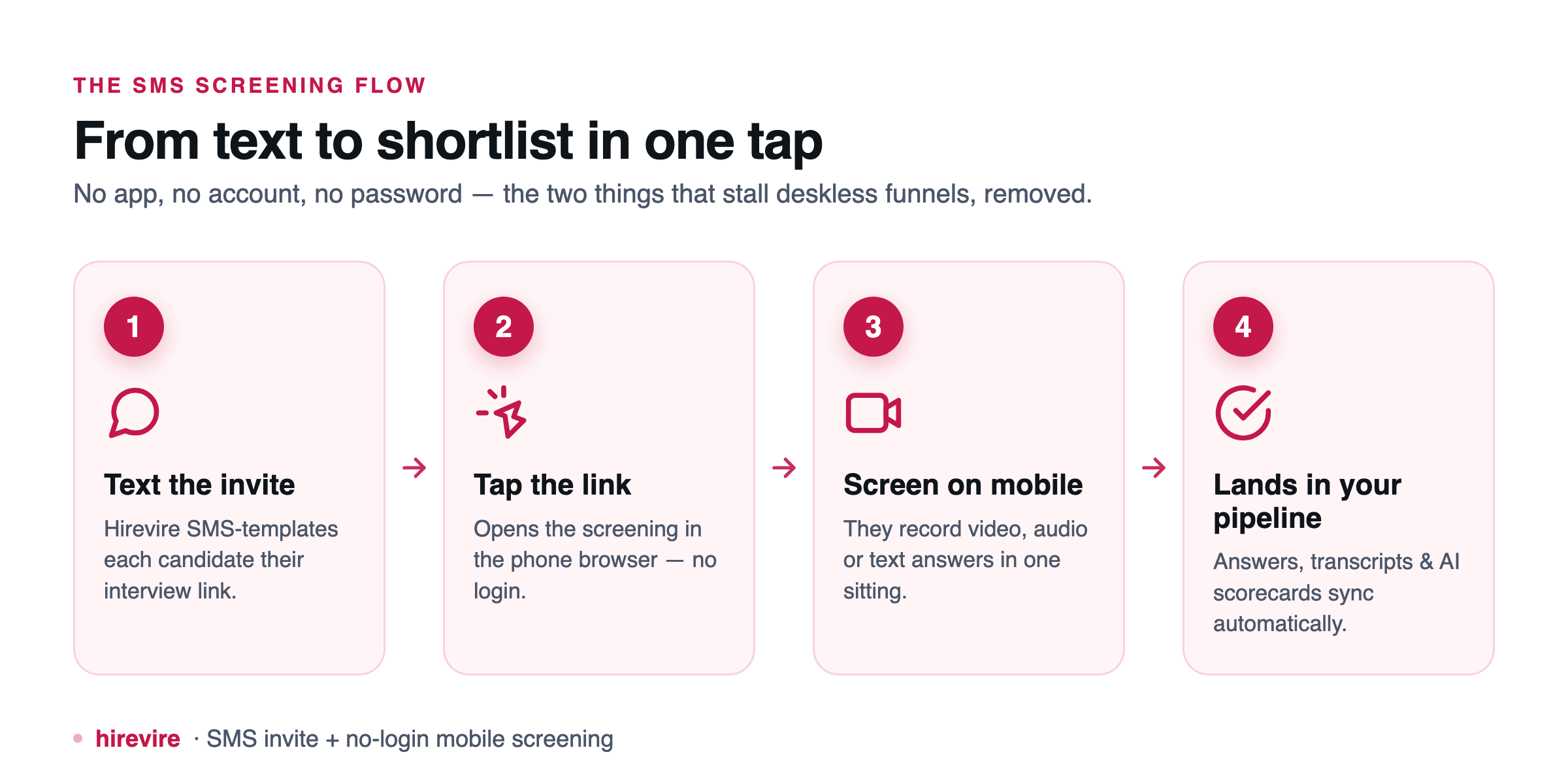
- Text the invite. Using an SMS template, Hirevire sends the candidate their unique interview link — personalized, with your role and company.
- Candidate taps the link. It opens no-login mobile screening right in the phone browser. No app to download, no account to create, no password to remember.
- They record answers. Video, audio, text, or file upload — whatever you asked for — recorded in-browser, most candidates finishing on their first sitting.
- Responses sync to your pipeline. Every answer, transcript, and AI scorecard lands on the candidate's card automatically, ready to review or share.
Because the link opens without a login, mobile completion stops being the weak point in your funnel. And because you can send the invites in bulk, one recruiter can put a screening question in front of a hundred applicants in the time it used to take to email a handful.
The point: SMS is the on-ramp; no-login mobile screening is the road. Together they remove the two things that stall deskless funnels — an unopened inbox and a sign-up wall.
Missed candidates get an automated SMS reminder carrying the same link, so the follow-up you'd normally do by hand — the calls, the voicemails, the "just checking in" — happens on its own.
Where it fits: retail, logistics, call centers
SMS-delivered screening earns its keep anywhere hiring is high-volume, hourly, and phone-first:
- Retail & seasonal. When holiday hiring means processing hundreds of applicants against a hard deadline, texting invites and screening on mobile lets a small team keep pace. See retail seasonal hiring.
- Warehouse & logistics. Peak-season surges are a screening problem, not a sourcing one. Bulk SMS invites plus async pre-screening with auto-disqualification filter volume without adding recruiter hours.
- Call center & BPO. These are voice roles, so the most predictive signal is how someone actually speaks. An SMS invite to a quick audio/video screen captures communication and tone up front, before you spend anyone's time on a live interview.
The common thread is mobile-first candidate behavior: these applicants live on their phones, so the process that meets them there wins the ones the email-and-portal process loses.
SMS and your ATS pricing
A fair question when you're comparing tools: how much does SMS add to the cost? On many applicant tracking systems, SMS is a metered add-on — you pay per message or per credit pack on top of your subscription, and the bill scales with your volume just as your hiring does.
Hirevire's approach is to include SMS invitation and reminder templates as part of the screening workflow rather than as a separate metered product. You're sending transactional recruiting texts — invites and reminders tied to a candidate's own screening — not running priced marketing blasts, so it stays part of getting candidates screened. Plans run Essentials at $39/month (1 job, 300 interviews/year), Professional at $99/month (5 jobs, 1,200 interviews/year), and Agency at $199/month (20 jobs, 12,000 interviews/year), billed annually. Candidates never pay or sign up to respond.
What Hirevire's SMS does — and doesn't — do
Being precise here saves you a mismatched-tool headache:
| Hirevire SMS does | Hirevire isn't |
|---|---|
| Text candidates their interview invite link | A bulk SMS marketing / nurture platform |
| Send automated reminders to non-responders | A two-way conversational SMS chatbot |
| Open a no-login mobile screen from that link | An SMS inbox for free-form candidate chat |
| Sync all responses to your pipeline + ATS | A sourcing tool that texts cold leads |
If your goal is faster, higher-completion screening for hourly and deskless roles, this is the right shape. If you specifically need drip marketing campaigns or a chatbot that holds back-and-forth text conversations, pair Hirevire with a dedicated SMS marketing tool — or choose one. The honest fit is transactional recruiting SMS wrapped around real screening.
That transactional shape also matters for compliance. Cold-texting people who never opted in carries real legal risk — in the U.S., the TCPA requires prior express written consent before sending recruiting texts, which is exactly what makes mass-texting sourced leads a liability. Hirevire's flow sidesteps that by design: you're texting candidates who applied to your role, using the number they gave you, about the screening they're expecting. That's an existing relationship, not a cold blast. (Rules vary by region, so always follow your local law and give candidates a clear way to opt out.)
Set it up in 4 steps
- Build your screening questions. Add the video, audio, or text prompts you want every applicant to answer, plus any knockout questions for auto-disqualification.
- Turn on the SMS invite template. Personalize the text candidates receive with their interview link.
- Bulk-invite your applicants. Send the SMS invite to everyone in the role at once; set reminders for non-responders.
- Review in your pipeline. Watch responses come in on each candidate's card — with transcripts and AI scorecards — and move your best into a shortlist stage to share or advance.
Frequently asked questions
What is SMS recruiting software? It's software that uses text messages to move candidates through hiring — most practically, to deliver the screening invite and reminders. In Hirevire, an SMS template texts each candidate their interview link, which opens a no-login mobile screen where they record answers that sync back to your pipeline. The point is reaching phone-first candidates on the channel they actually check.
Can SMS recruiting speed up hourly hiring? Yes — that's its strongest use case. Hourly and deskless candidates read texts within minutes but rarely check email, so an SMS invite gets opened when an emailed link gets ignored. Paired with a no-login mobile screen they can finish in one sitting, it compresses the slowest part of hourly hiring: the gap between "applied" and "screened."
Does Hirevire send the SMS, or do I text the link myself? Hirevire sends it. Using the SMS invitation and reminder templates, it texts each candidate their personalized interview link and can automatically follow up with non-responders — so you're not copy-pasting links into your phone.
How much does SMS add to ATS pricing? On many ATSs, SMS is a metered add-on billed per message or per credit pack on top of your plan. Hirevire includes SMS invite and reminder templates as part of the screening workflow across its plans (Essentials $39/mo, Professional $99/mo, Agency $199/mo, billed annually), rather than as a separate metered product.
Is text recruiting compliant with SMS rules? Regulations like the U.S. TCPA require prior express written consent before sending recruiting texts, which makes cold-texting sourced leads risky. Hirevire's model is transactional: you text candidates who applied to your job, using the number they provided, about the screening they're expecting — an existing relationship rather than cold outreach. Rules vary by region, so follow your local law and always give candidates a way to opt out.
Does Hirevire do two-way SMS conversations or SMS marketing? No. Hirevire focuses on transactional recruiting texts — invites and reminders tied to a candidate's screening — not bulk SMS marketing campaigns or a conversational chatbot. If you need drip marketing or free-form text chat, that's a separate category of tool.
Do candidates need an app or account to respond? No. They tap the link in the text and record their answers directly in the phone browser — no app to install, no account to create, no password. That no-login step is what makes mobile completion rates hold up for deskless roles.
Which roles is this best for? High-volume, hourly, phone-first hiring: retail and seasonal, warehouse and logistics, call center and BPO, drivers, and care staff — anywhere candidates live on their phones and speed to screen decides who you actually land.